Plants Wilting but the Soil Is Wet
Wilting means the leaves are losing water faster than the roots can deliver it. When the soil is already wet, the fault usually lies in the delivery system: roots short of oxygen, roots that have started to rot, roots that were cut or disturbed, or a disease that blocks the stem. Heat can do the same thing to a healthy plant for a few hours. Hold off on more water until you have checked what is happening at root depth.
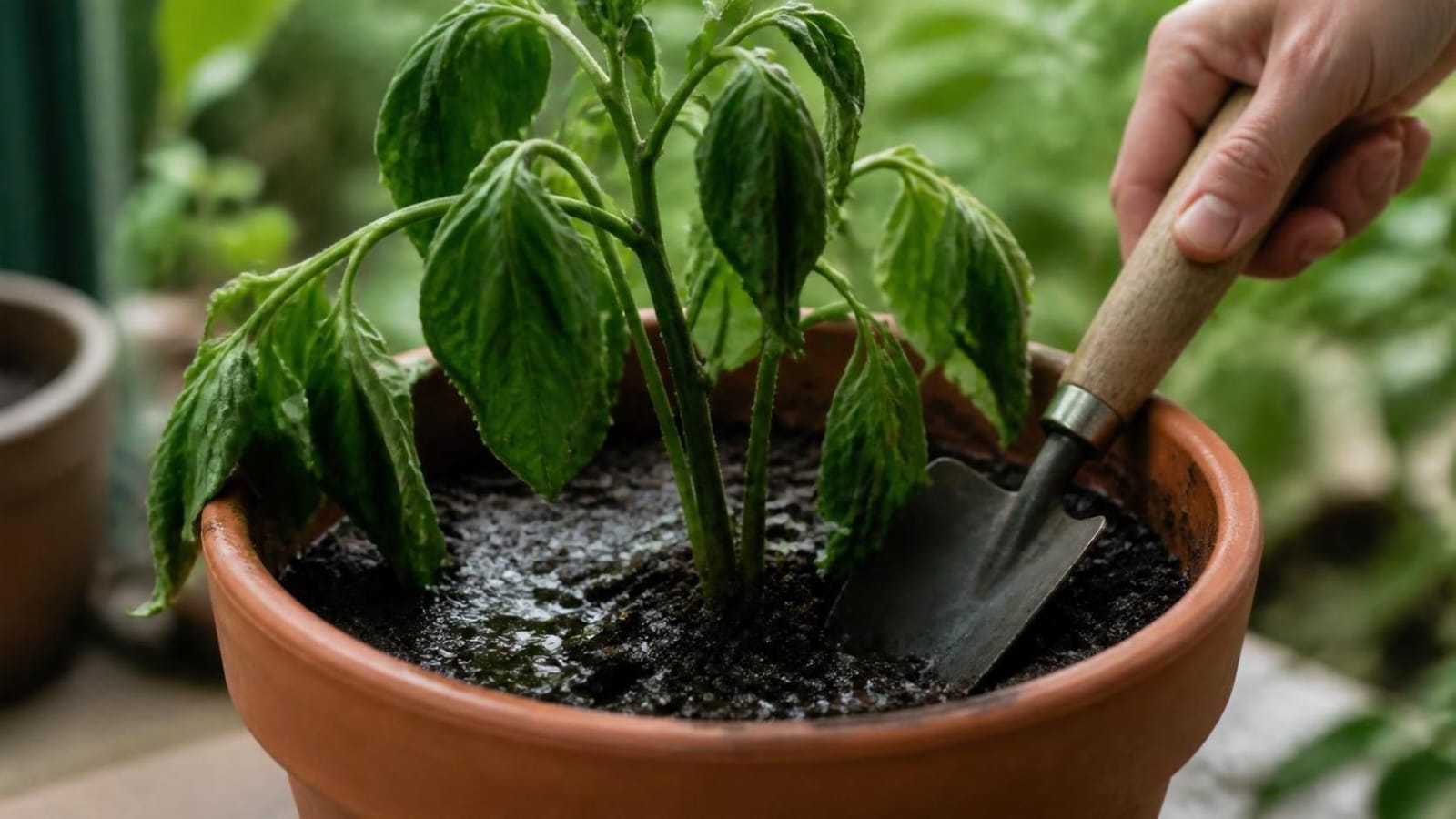
You pushed a finger into the soil and it came out damp, yet the plant is still drooping. Most of us reach for the watering can anyway, because a drooping plant looks thirsty. That reflex is the one move most likely to turn a fixable problem into a much harder one.
A wilted leaf is a report about the inside of the plant, not about the soil. Leaves stay firm because their cells are full of water under pressure, and the roots keep that supply topped up. Anything that interrupts the supply makes leaves go limp, whether the soil is bone dry or soaked. University of Florida extension educators make the same point: a wilted plant is short of water internally, which is not the same as the soil being short of water.
Three checks that narrow it down in five minutes
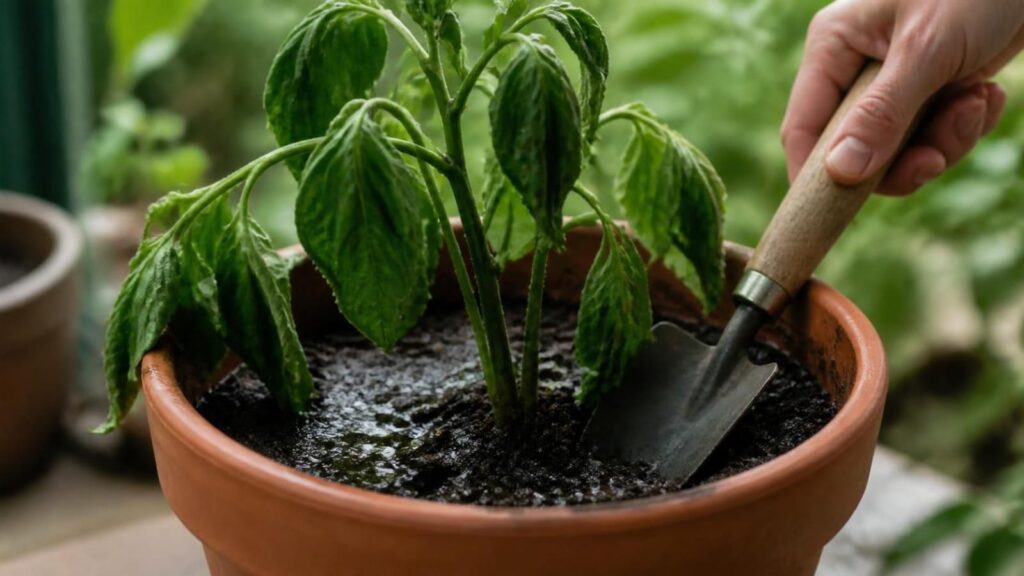
Before you treat anything, collect clues. These three checks rule out most of the possible causes for very little effort.
1. Check moisture where the roots actually are
Push a trowel handle or a finger several inches down beside the plant, not just under the surface. The surface can be soaked from your last watering while the root zone tells a different story. Squeeze a handful from root depth: if it holds together as a cool, wet ball, you can stop thinking of this as a thirst problem, which is the test the Florida extension team suggests.
In a pot, lift it. A container that still feels heavy several days after watering is holding water the roots are not using. The opposite surprise happens too: a pot that feels light, with a damp-looking top and water that ran straight out of the drainage holes, may have a dry root ball that shrank away from the pot wall. That plant needs a slow soak, not a drainage fix.
2. Note when the wilting happens
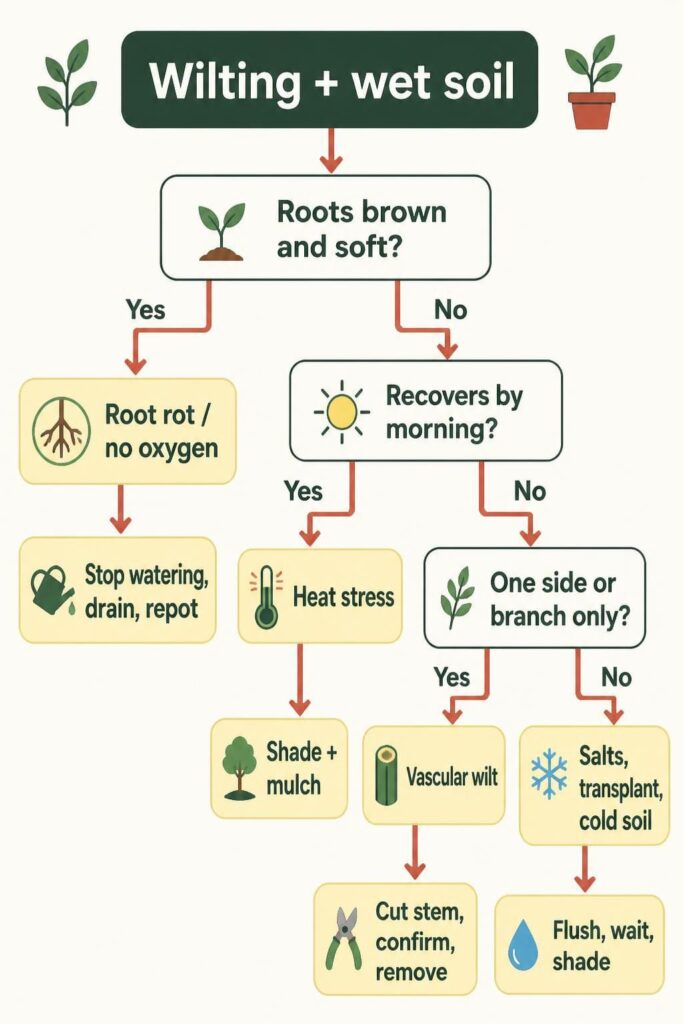
A plant that droops in the afternoon and is firm again by morning is mostly dealing with weather. Its leaves lose water to heat and wind faster than the roots can keep up. A plant that is still limp at sunrise has a supply problem that cooler air will not fix.
There is one catch. Early vascular disease can start as wilting in the hottest hours that recovers overnight. The University of Connecticut describes exactly that pattern for Verticillium wilt in tomatoes. So overnight recovery is reassuring only if the plant stays the same from week to week. If each recovery is a little weaker, keep reading.
3. Look at the pattern
One plant struggling in an otherwise healthy bed points to something about that plant: its roots, a stem disease, how it was planted. A whole low corner wilting after heavy rain points to drainage. Every plant in one pot is a pot problem. Wilting that affects one side of a plant or a single branch is a flag for blocked water-carrying tissue inside the stem, which is a different cause from rot.
Match what you see to the likely cause
Several causes look alike from a distance. This table separates them by the clues you can check yourself.
| What you see | Most likely cause | How to confirm | First move |
|---|---|---|---|
| Droopy plant, soil wet for days, lower leaves yellowing, sour smell from the pot | Oxygen-starved roots or early root rot | Slide the plant out. Brown, soft, smelly roots confirm it; pale, firm roots do not. | Stop watering, empty saucers, trim dead roots, repot into fresh, free-draining mix. |
| Limp in the afternoon, firm again by morning, soil still moist at root depth | Heat and wind load on the leaves | Look again early next morning, before the sun reaches the plant. | Shade and mulch. Do not add water to wet soil. |
| Wilting began soon after planting, dividing, repotting or digging nearby | Cut or disturbed roots | The timeline fits and the roots look intact. | Keep moisture steady rather than soggy, give afternoon shade, hold off fertilizer. |
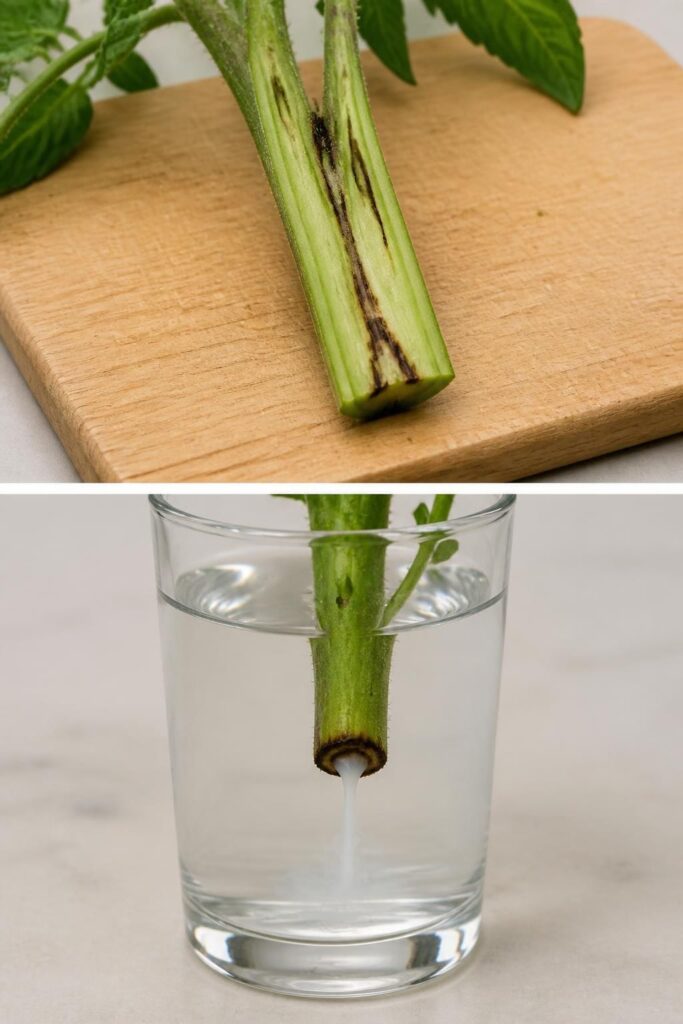
| One branch or one side yellows and wilts, and it worsens over weeks | Fusarium or Verticillium wilt (vascular disease) | Cut the lower stem lengthwise. Brown streaks in the inner tissue are the sign. | No cure. Confirm with local extension, remove the plant, rotate crops, choose resistant varieties. |
| Sudden wilting of a whole plant, often a tomato | Bacterial wilt | Suspend a cut stem in a glass of water. A milky stream from the cut end points to it. | Remove the plant and get the diagnosis confirmed before replanting the same crop there. |
| Crisp leaf tips, white crust on the soil or pot rim, container plant fed often | Fertilizer salt build-up | Look for crusty deposits on the surface or around the rim. | Flush the pot with plain water until it drains freely, then pause feeding. |
| Seedlings fall over at the soil line, stems thin and pinched | Damping off | Soil stays constantly damp and the stem is narrow at the base. | Ease watering, add airflow, restart with clean seed-starting mix if many are lost. |
Why wet soil can still leave a plant dry
Roots breathe. They take oxygen from the air spaces in the soil, and they need it to do the work of pulling water in. Saturated soil has water where the air should be. The Missouri Botanical Garden, passing on guidance from University of Missouri Extension, explains that when the oxygen in soil air falls below roughly 12 percent, roots start to suffocate, and that water uptake drops within about an hour of oxygen falling below the critical level.
That is the irony of this problem. A plant standing in wet soil can be as short of water as one in a desert, because the part that does the drinking has stopped working. Roots that are already weakened by lack of air are also easier targets for root-rot organisms, so the damage can speed up.
The same source adds a point that most wilting articles skip: the loss can show up late. Fine feeder roots die first, and a plant can hold its leaves through a wet, cool spell, then wilt or scorch weeks later when the first hot week arrives and the reduced root system cannot keep up. If a plant starts wilting in summer after a rainy spring, the cause may be months old.
Ask why the soil is still wet
Wet soil that will not dry is itself a clue. Common reasons are a pot without drainage holes, a saucer that is never emptied, a dense or very fine potting mix, compacted or heavy clay ground, a low spot where rainwater collects, and watering on a fixed schedule whatever the weather. In clay beds without mulch, a hard crust can also form on top. The Missouri Botanical Garden notes that breaking the crust when conditions allow, then mulching, keeps the surface softer and lets air move into the soil.
Look at the roots before you decide
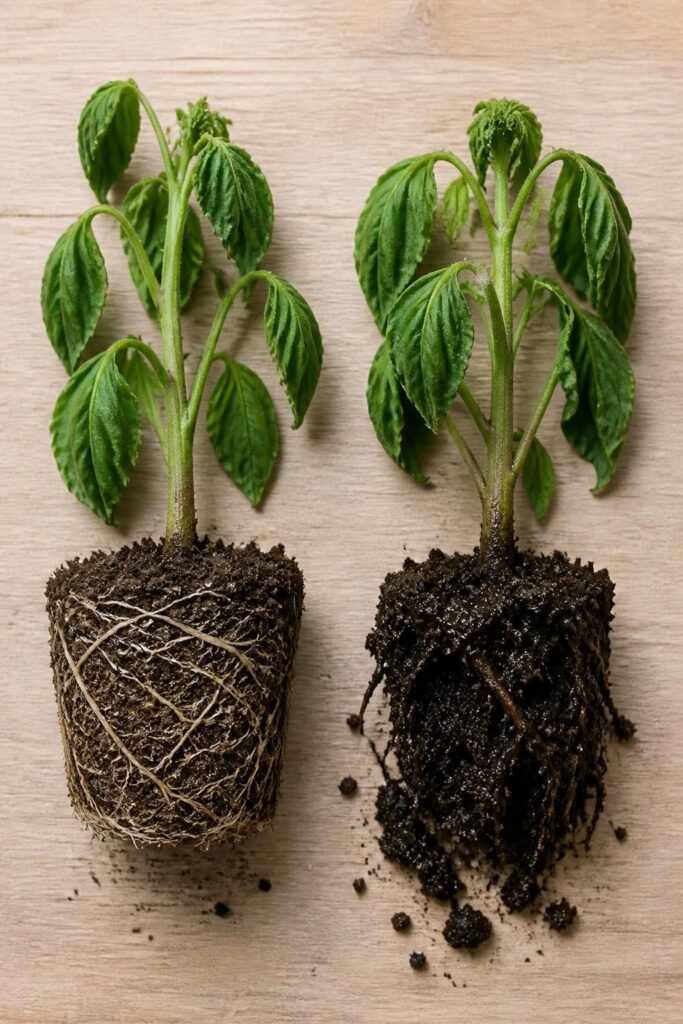
For a potted plant, support the base of the stem, tip the pot and slide the plant out. Healthy roots are pale and firm, and the root ball holds together. Dead roots are brown or black and soft, and often smell sour or musty. A root ball that is a solid tangle circling the pot is another kind of trouble: the Florida extension article lists circling and kinked roots among the reasons roots fail to take up water.
For a plant in the ground, scrape the soil back gently around the base of the stem and look at the top roots and the stem just above the soil line. A small plant can be lifted with a fork, checked and replanted straight away. For a large shrub or tree, a local arborist or extension office is the safer route.
When the roots look fine
Heat, wind and big leaves
Broad, thin leaves lose water quickly. Robert Pavlis of Garden Myths describes his ligularia wilting by midday even in shade and wet soil, then standing up again by early evening. If the soil is moist at root depth and the plant recovers, shade through the hottest hours and a layer of mulch do more good than extra water. Added water on top of already wet soil is how a heat problem becomes a root problem.
Roots that were cut or moved
A plant that was recently transplanted, divided, repotted or dug around has fewer roots feeding the same amount of leaf. The same Garden Myths article points out that people often respond by watering far too much. Its advice is to move plants in spring or fall, when evaporation from leaves is lower, and to shade a summer transplant for a week or two. Keep the soil evenly moist, not soggy, and give it time.
Fertilizer salts in containers
In pots, fertilizer salts can accumulate when plants are fed often and watered lightly. High salt levels make it harder for roots to take up water, so the plant wilts or scorches at the tips even though the mix is damp. A white crust on the surface or around the rim is the usual clue. Flushing with plain water until it runs freely from the drainage holes is the standard remedy, and feeding should wait until the plant has recovered.
Cold, wet ground
In early spring, roots in cold, saturated soil work slowly. A warm, sunny afternoon can then pull water out of the leaves faster than sluggish roots can replace it. Plants usually settle as the soil warms, but heavy cold ground is also where seedlings and young transplants are most at risk.
When only part of the plant wilts: vascular disease
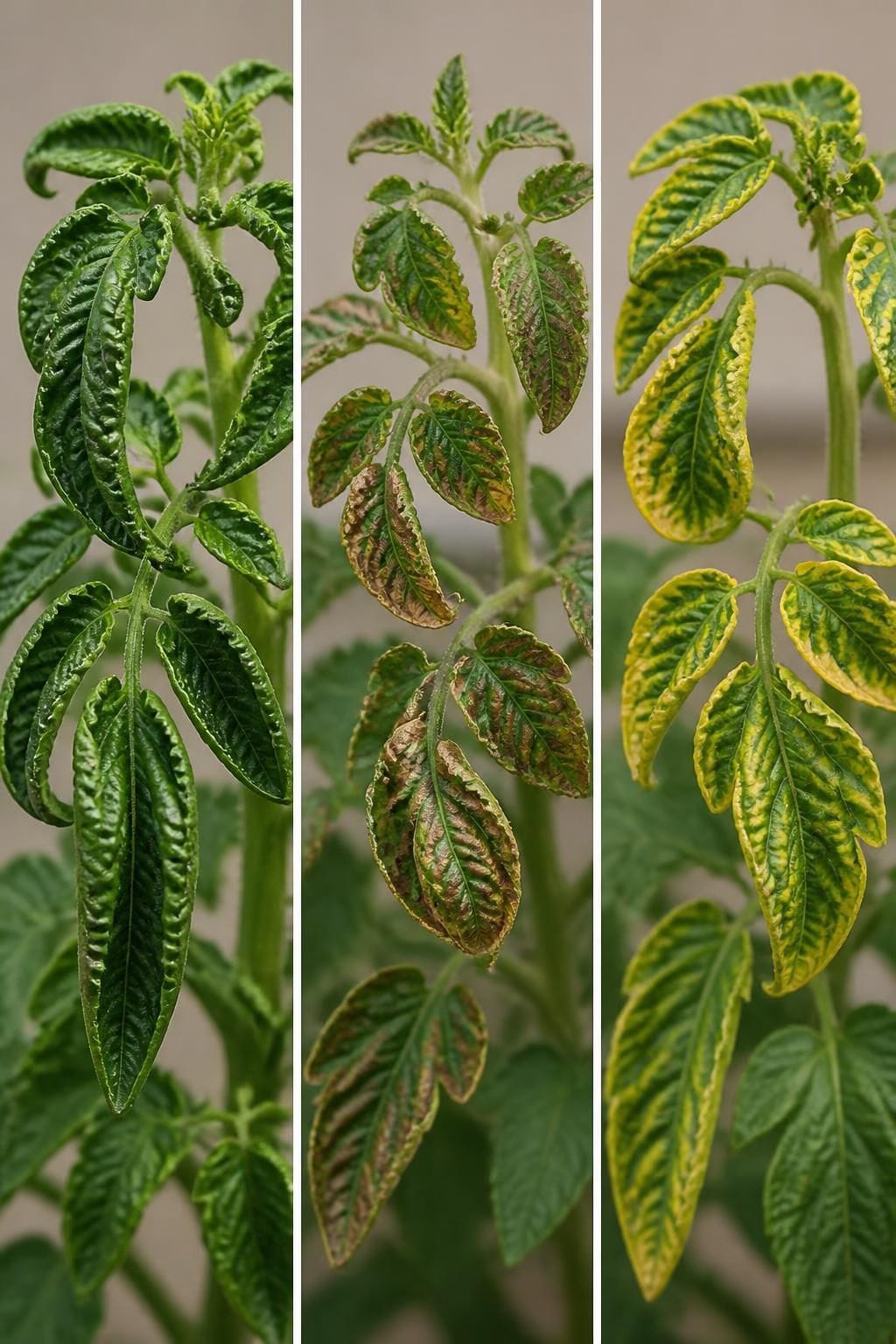
Some soil fungi and bacteria invade the water-carrying tissue of the stem and block it. Tomatoes are the best-documented case, and other crops have their own wilt diseases. The clues differ from rot. NC State Extension describes Fusarium wilt as starting with wilting or yellowing on one half of the plant, one branch or one side of a leaf, and says that cutting the stem near the base shows light brown streaks in the inner tissue. UC IPM calls this one-sided pattern a yellow flag and notes the dark vascular discoloration can extend far up the stem.
Verticillium wilt looks similar, and the UC IPM guidelines warn that telling the two apart may need a laboratory. The UConn fact sheet gives one useful difference: Fusarium discoloration tends to run higher up the stem, while in Verticillium wilt it does not travel as far. When in doubt, send a sample to your local extension office rather than guessing.
Bacterial wilt has a quick home test. The University of Arkansas Cooperative Extension Service describes cutting a stem and suspending it in a glass of water: in infected plants, a milky stream appears from the cut end within a few minutes.
These diseases cannot be fixed by watering, and soaking a plant with these symptoms only keeps wet soil around damaged roots. NC State notes that homeowners can manage Fusarium wilt by rotating crops every three to five years, that resistant varieties limit severe symptoms, and that there are no homeowner fungicides that manage it. UC IPM adds that feeding by root-knot nematodes can overcome a variety’s resistance.
What to do, in order
- Stop watering and drain the extras. Empty saucers and outer pots, and let the root zone drain and take in air.
- Check moisture at root depth and compare it with a healthy plant or a healthy part of the bed.
- Inspect the roots or the stem. Use the root check for a plant that droops all over and the stem cut for a plant that wilts on one side.
- Fix the cause you found. For rot, trim dead roots and repot into fresh, free-draining mix. In beds, correct low spots, loosen a crusted surface and mulch. For salts, flush. For disease, remove the plant and plan rotation.
- Shade and wait. Protect the plant from the hottest hours while roots rebuild, and hold off fertilizer.
- Change one thing at a time and give it a week or two before judging the result.
What not to do
- Do not water just because the leaves droop. Check at root depth first.
- Do not fertilize a stressed plant. It cannot use the extra feed, and in a pot the salts add to the problem.
- Do not spray or drench on a guess. The right treatment depends on a correct diagnosis, and the products allowed differ by country and region. Follow the product label and your local regulations.
- Do not move a struggling plant into a much bigger pot of the same dense mix. A large volume of wet mix around a small root system stays wet longer.
Can the plant recover?
It depends on how much of the root system is still alive. If the problem was caught early and the cause is corrected, new roots can form once the soil drains and air returns, and leaves usually firm up over days to a couple of weeks. If most of the roots are brown and soft, the odds are poor. Vascular wilt diseases do not reverse, and the plant should be removed.
Watch for new growth and for leaves that are firm in the morning. Be careful for the rest of the season: the Missouri Botanical Garden warns that plants which lost roots during a wet period are poorly prepared for summer heat, and that newly planted trees and shrubs are the most exposed. Its advice is to water such plants promptly in hot, dry spells, and to water thoroughly rather than often and lightly.
Keeping it from happening again
- Use containers with drainage holes and a mix that stays open between waterings, and never leave pots standing in water.
- Water by checking the root zone, not the calendar, and water deeply but less often.
- In beds, deal with the reason water lingers: compaction, heavy clay, low spots. Organic matter and mulch help keep the surface from crusting.
- After a long wet spell, keep an eye on plants through the next hot week, since wilting can arrive late.
- Where wilt diseases are known locally, rotate susceptible crops and choose resistant varieties.
- Give new transplants some afternoon shade while they re-root.
Quick answers
Should I water a wilting plant if the soil is already wet?
No. If the soil at root depth is wet, more water will not reach roots that cannot use it. Improve drainage and air first.
Why does my plant only wilt in the afternoon?
Usually heat and wind. Leaves lose water faster than roots supply it, then catch up in the cooler evening. If the plant gets slightly worse each week even though it recovers overnight, look for root damage or a vascular disease.
How can I tell root problems from real thirst?
Check the soil at root depth. A plant that is short of water usually perks up soon after the root zone is properly rewetted. One with failing roots does not respond, and its roots will look brown and soft when you inspect them.
How long does recovery take?
Mild cases can improve within days to a couple of weeks once drainage is fixed. Plants with extensive rot may take much longer and some do not recover.
Why is only one plant in my bed wilting?
A single plant among healthy neighbors suggests something specific to it, such as damaged roots or a stem disease. Cut the stem and check the roots before assuming a watering problem