Rough Black Swellings on Plum and Cherry Branches: How to Diagnose and Treat Black Knot
The rough, charcoal-colored, elongated swellings gripping your plum or cherry branches are caused by Apiosporina morbosa, a widespread fungal pathogen responsible for Black Knot disease. These swellings are abnormal woody tumors caused by fungal mycelium invading the tree’s inner vascular cambium. Left unmanaged, each knot expands annually, cutting off the branch’s supply of water and nutrients, causing dieback, and releasing thousands of airborne spores every wet spring. The primary cure is manual pruning: cutting infected branches at least 4 to 8 inches (10 to 20 cm) below the visible knot into completely healthy wood during late winter dormancy.
Walking past a plum or cherry tree in winter often reveals surprises that dense summer foliage hid for months. Among the most startling is the appearance of thick, wart-like, pitch-black growths wrapped tightly around twigs and scaffold limbs. Many growers mistake them for insect nests, hail damage, or unusual wood tumors. However, these distinct structures—resembling burnt coal or lumps of tar welded to the branch—are the hallmark of a slow-developing fungal infection that targets the genus Prunus.
Plums and prunes bear the brunt of this infection, suffering rapid branch dieback and reduced yield when knots encircle fruiting wood. Tart cherries show moderate susceptibility, while sweet cherries exhibit somewhat stronger resistance but can still become infected under high spore pressure. Understanding how this pathogen operates inside the vascular system makes the difference between saving a productive tree or unintentionally spreading the infection across an entire orchard.
The Two-Year Timeline of a Black Knot Infection
One reason black knot catches growers off guard is its prolonged incubation period. When you spot a mature, cracked, coal-black gall on a branch, the original infection did not occur weeks ago—it likely started more than a full year earlier.
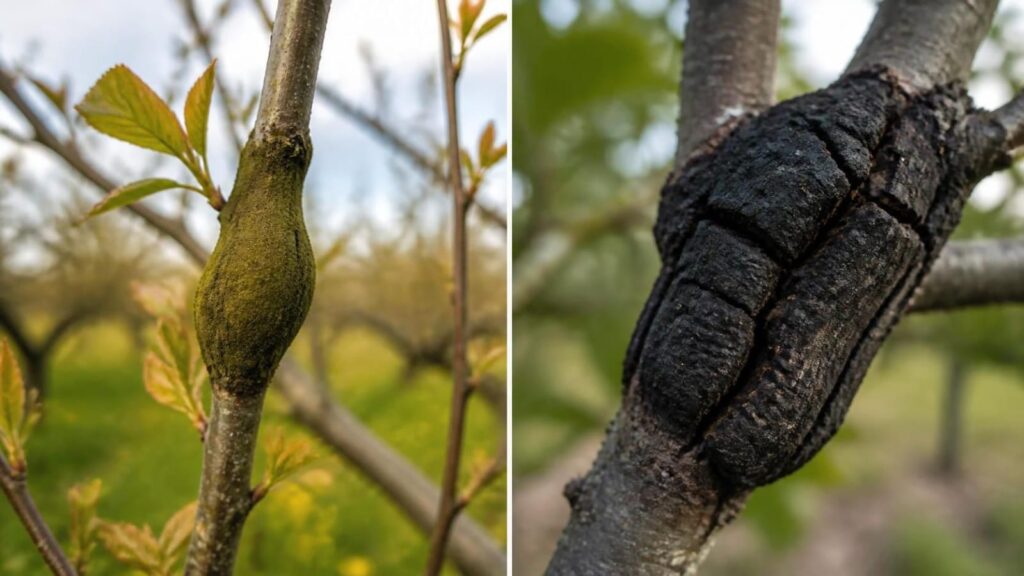
Year One: The Subtle Olive Swelling
The life cycle begins in early spring, precisely between bud break and late bloom. When temperatures hover between 55°F and 75°F (13°C and 24°C) during prolonged rainfall, mature knots discharge microscopic ascospores into the air. These spores land on succulent, current-season green shoots or wounded bark.
Once inside, the fungus secretes chemical growth regulators that force the plant’s cambium cells to divide abnormally fast, forming a gall. Throughout that first summer, however, virtually nothing looks abnormal. By late autumn or the following spring, the bark over the infected area stretches and produces a faint, olive-green swelling with a velvety texture. These young swellings are soft and easily overlooked unless twigs are inspected up close.
Year Two: The Charcoal Rupture
During the second growing season, the velvety green exterior darkens into deep charcoal and black. The bark splits wide open, exposing a porous, hard, brittle fungal mass (stroma). Knots can stretch anywhere from one inch to over a foot in length, gradually girdling the branch circumference.
In its second winter and subsequent spring, the black knot matures into an active spore-producing structure. Specialized fruiting bodies embedded within the rough surface erupt with spores during rains, renewing the cycle and sending new waves of disease into your tree’s tender spring growth.
Diagnostic Guide: Distinguishing Black Knot from Lookalikes
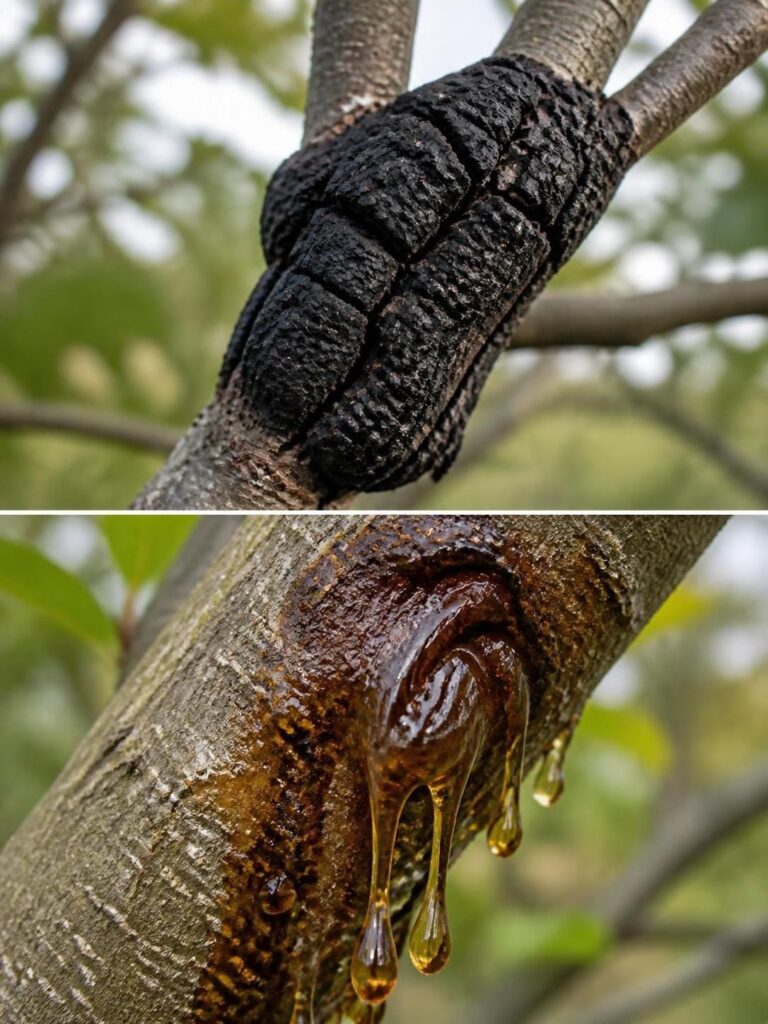
Not every swollen limb or dark spot on a stone fruit tree is black knot. Treating the wrong disease results in wasted effort and improper pruning cuts. As documented in diagnostic guides published by the University of Minnesota Extension, distinguishing between fungal stroma, bacterial cankers, and mechanical injury is essential before taking corrective action.
| Suspected Issue | Primary Visual Cue | Sap Exudation (Gummosis) | Wood Texture & Shape |
|---|---|---|---|
| Black Knot (Fungal) | Rough, charcoal-black bulging tumor | Rare, except occasionally at active margins | Hard, brittle, cracked surface wrapped along the twig |
| Bacterial Canker | Sunken, flattened oval lesions in bark | Heavy, amber or reddish-brown gummy oozing | Bark appears collapsed or water-soaked, never raised black galls |
| Wound Callus | Smooth, rounded swollen bark ridge | None | Normal wood color; firm, smooth, healing roll over an old cut |
| Borer Insect Damage | Localized swelling with tiny entrance holes | Copious gum mixed with sawdust-like frass | Wood beneath is tunneled; surface bark retains normal color |
The Pruning Protocol: How to Remove Knots Correctly
Growers frequently make the mistake of spraying fungicides directly onto hard black swellings in hopes of dissolving them. No chemical spray can penetrate or dissolve established fungal stroma. Physical excision during the dormant season is the absolute foundation of control.
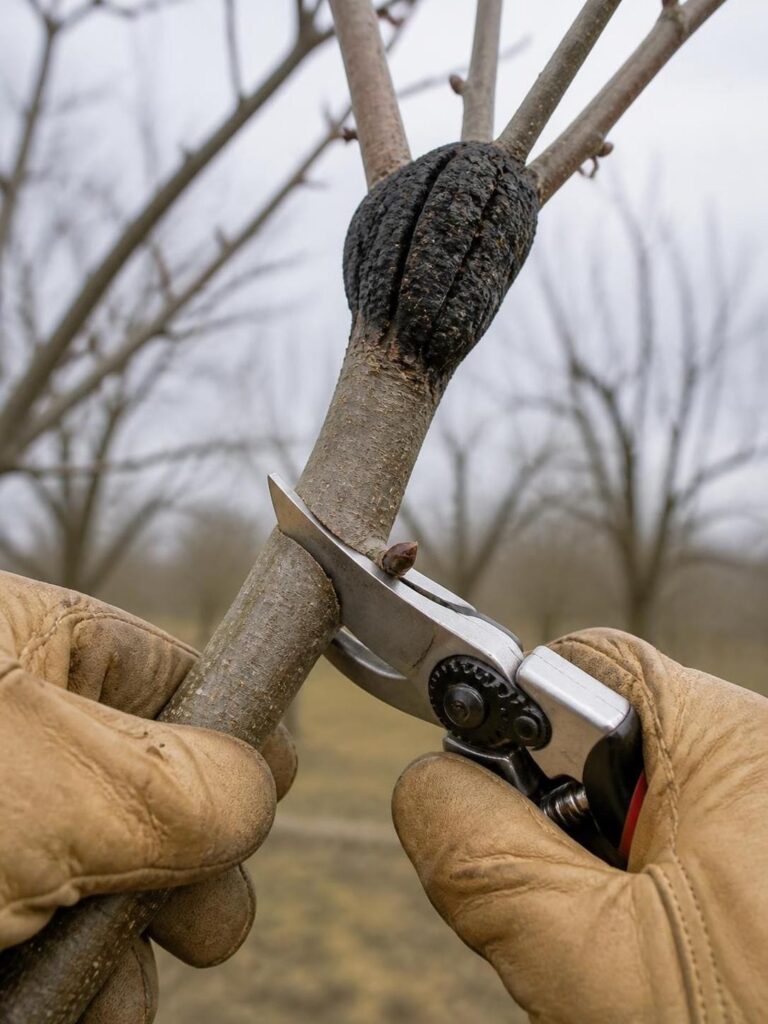
- Wait for complete dormancy: Schedule your pruning between mid-winter and very early spring, prior to bud swell. Without foliage, knots are fully visible, fungal spores are inactive, and the dormant tree experiences minimal sap pressure.
- Measure the 4 to 8-inch safety margin: Fungal hyphae grow invisibly through the inner sapwood several inches beyond the visible gall. Cutting directly beside the black mass leaves living mycelium inside the remaining branch. Always locate healthy wood at least 4 to 8 inches (10 to 20 cm) downstream toward the trunk and cut back to an outward-facing lateral branch or branch collar.
- Inspect the exposed cut surface: Examine the heartwood and cambium ring of the fresh pruning wound. The wood should appear creamy white or pale green. If you observe brown, yellowish, or discolored vascular staining, the fungus extends further down. Make another cut several inches lower until only pristine wood remains.
- Disinfect pruning tools between cuts: Dip or wipe shears with a 70% isopropyl alcohol solution or a freshly mixed 10% household bleach solution. Dry and lightly oil steel blades afterward to prevent corrosion.
Managing Knots on Scaffolds and the Central Trunk
Pruning lateral branches is straightforward, but when black knot establishes itself directly on a major scaffold limb or the main trunk, removing the limb could compromise the entire architecture of the tree.
In these critical situations, field guidance from Penn State Extension highlights that surgical gouging can be attempted as a last-resort salvage measure, though growers should be aware that its success rate is relatively low. Using a sharp, curved wood-carving chisel, carefully shave away the diseased knot down to sound, uninfected sapwood. Remove all infected fungal tissue along with at least one-half inch of surrounding healthy green bark and cambium on all sides.
Do not apply wound dressings, pruning tar, or sealers over the excised area. Modern arboricultural research confirms that artificial coatings seal in natural wood moisture, creating an ideal microclimate for heart-rot fungi while retarding the tree’s natural compartmentalization process. If a trunk knot encircles more than half of the trunk’s circumference, the tree’s structural stability and water transport are permanently compromised, making tree removal and replanting the most practical long-term choice.
Orchard Sanitation and the 500-Foot Reservoir
Pruning achieves little if diseased debris remains in the orchard. Detached black knots left lying on the orchard floor can continue discharging infectious spores into passing air currents for up to four months after being cut.
Immediately place all pruned infected wood into bags, burn them where local outdoor burning ordinances permit, or bury them under at least one foot of compacted soil. Never place black knot cuttings into home compost piles, as residential compost heaps rarely achieve the sustained internal heat required to kill fungal stroma.
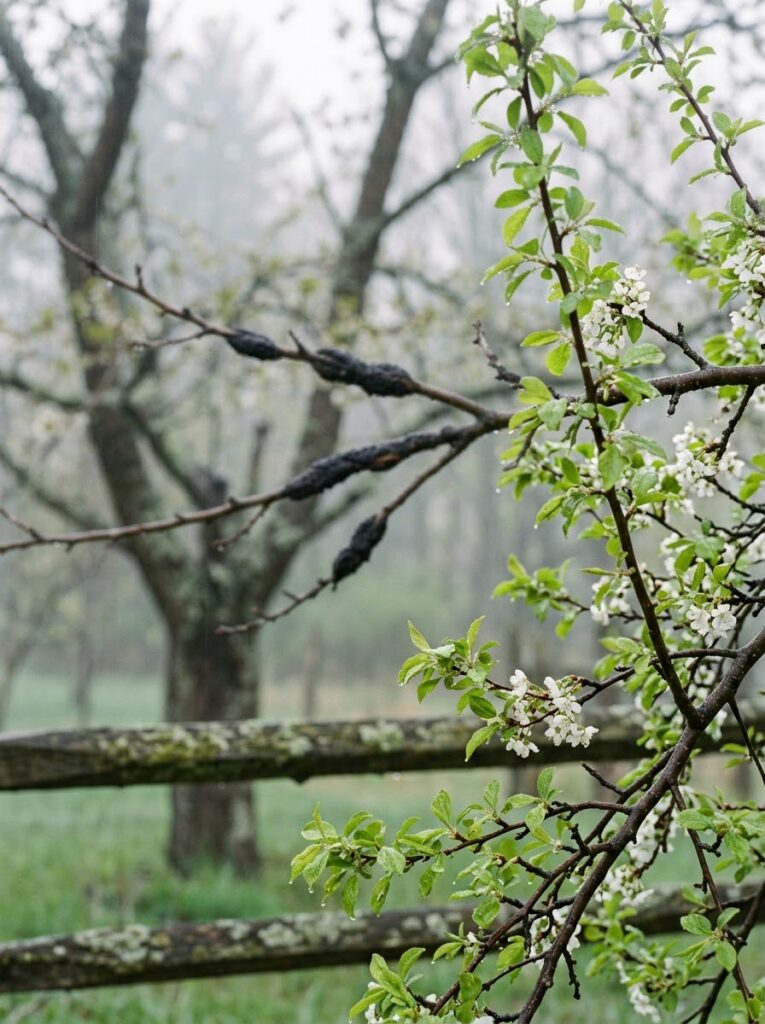
Furthermore, survey your perimeter and neighboring hedgerows. Wild black cherry (Prunus serotina) and wild chokecherry (Prunus virginiana) serve as massive reservoirs for Apiosporina morbosa. Even if your garden trees are thoroughly sanitized, an infected wild cherry growing within 500 feet (150 meters) will release airborne spores that reinfect your orchard each spring. Removing wild host brush within this perimeter significantly reduces seasonal disease pressure.
Preventive Sprays and Seasonal Timing
Fungicides act strictly as protective shields over vulnerable green tissue; they cannot eliminate an active internal infection. In sites with severe historical disease pressure, combining dormant pruning with a targeted chemical schedule provides added security.
A dual-timed preventive program focuses on two key biological vulnerabilities:
- Autumn leaf-fall application: When approximately 50% of the leaves have naturally dropped in autumn, apply a copper-based dormant fungicide. This protects freshly exposed leaf scars—a major pathway through which late spores can enter receptive twigs.
- Spring bud break coverage: Protect expanding young shoots by applying an approved protective fungicide (such as fixed copper, chlorothalonil, or captan) starting at bud swell or green tip. Reapply through bloom and petal fall prior to forecast rain events.
Always verify that the specific active ingredient is registered for stone fruits in your state or country. Stone fruit spray recommendations detailed by NC State Extension note that dilution ratios, safety precautions, and mandatory pre-harvest intervals (PHI) differ by formulation. Strictly follow the manufacturer’s product label and consult your regional agricultural office for locally approved management schedules.
Mistakes to Avoid When Managing Black Knot
- Do not prune during warm, wet spring weather; fresh cuts made during spore dispersal provide direct points of entry for new infections.
- Do not leave pruned branches on the ground; disconnected black knots continue discharging active spores for months.
- Do not rely on chemical sprays as a substitute for pruning; no spray can dissolve or cure hard fungal stroma.
- Do not coat pruning cuts with wound dressings or pruning paint, which trap moisture and promote internal heartwood decay.
Frequently Asked Questions About Black Knot
Can black knot be cured by spraying fungicides on existing swellings?
No. Once the rough, hard black gall has erupted through the bark, the fungal mycelium is already deeply established inside the branch’s vascular structure. Topical sprays cannot penetrate dense woody stroma or cure internal infection. Fungicides serve solely as preventative barriers to shield tender spring shoots from incoming spores.
Will black knot eventually kill my plum or cherry tree?
Yes, if left unchecked over multiple growing seasons. While a single small knot will merely cause the twig beyond it to die, the fungus multiplies each spring. Successive infections girdle main scaffold limbs, starve the canopy of water, and leave the tree structurally weakened and vulnerable to wood-boring insects and secondary decay fungi.
Are some plum varieties naturally resistant to black knot?
Yes. Plum varieties differ markedly in genetic susceptibility. European varieties such as ‘Damson’, ‘Stanley’, and ‘Bluefre’ are highly susceptible, whereas ‘Early Italian’ and ‘Au-Cherry’ show greater resilience. Among Japanese plums, ‘Shiro’, ‘Santa Rosa’, and ‘Methley’ demonstrate useful field tolerance when grown alongside good sanitation practices.
Can you save a tree if the black knot is located on the main trunk?
If the knot covers less than one-third of the trunk circumference, surgical excision down to sound wood may preserve the tree for a few seasons, though success is variable. However, if the gall encircles more than half of the trunk, the vascular system is permanently disrupted, and replacing the tree with a resistant cultivar is the most realistic path forward.