Tomato Flowers Dropping Before Fruit Forms: What Is Going On and What to Do
A tomato plant covered in yellow flowers feels like a promise. Then a few days later the blooms are shriveled, brown, and lying on the soil, and not one of them has turned into a tomato.
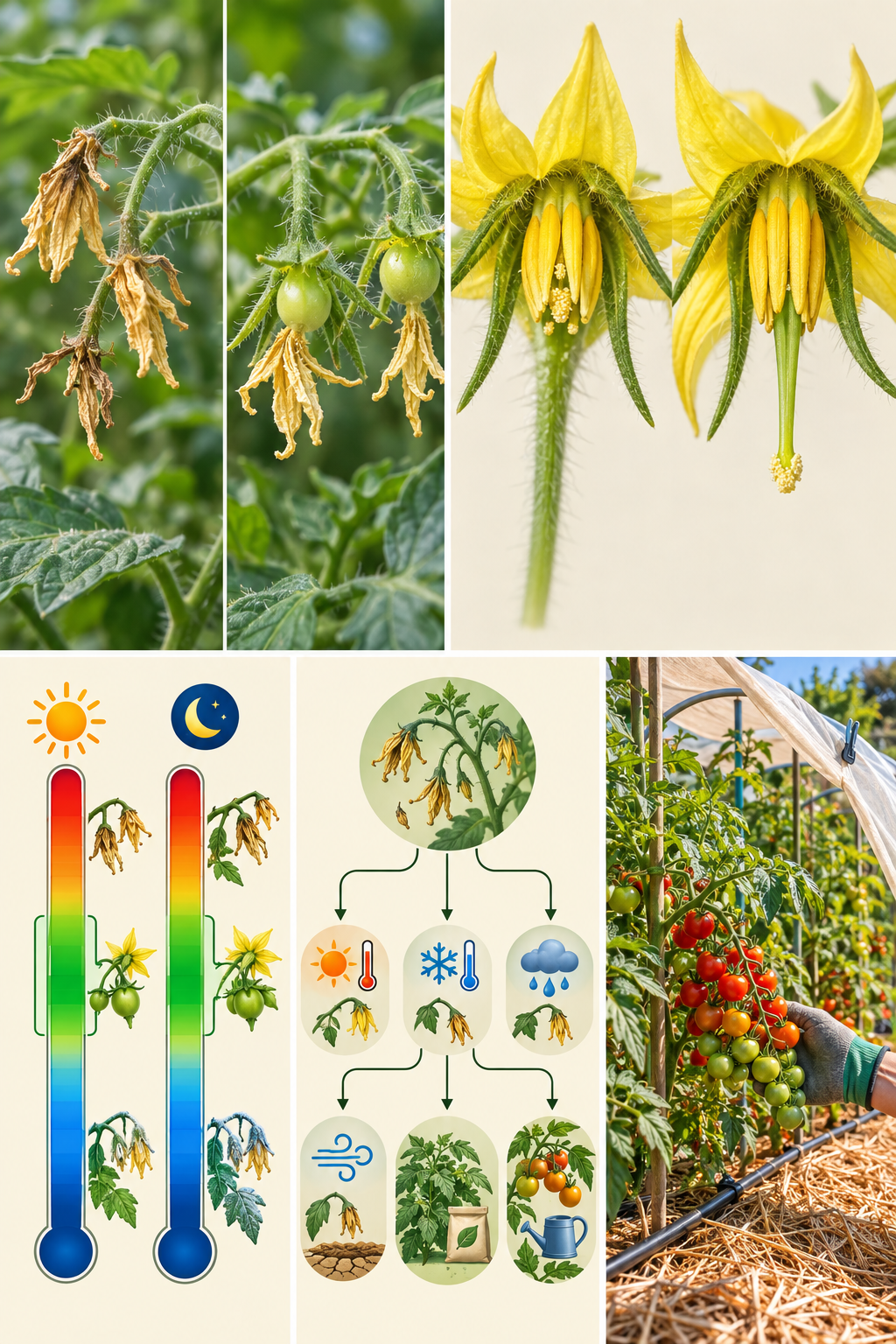
In most gardens the cause is temperature. Hot days, hot nights, or cold nights stop the flower from being fertilized, so the plant lets it go. Uneven watering, too much nitrogen, too little sun, and weak pollination come next. It is rarely a disease, and the plant usually starts setting fruit again once the weather settles.
The tricky part is that several of these causes look identical on the plant. This guide helps you tell them apart, so you act on the right one instead of fertilizing, spraying, or pruning your way into a second problem.
First, make sure it really is blossom drop
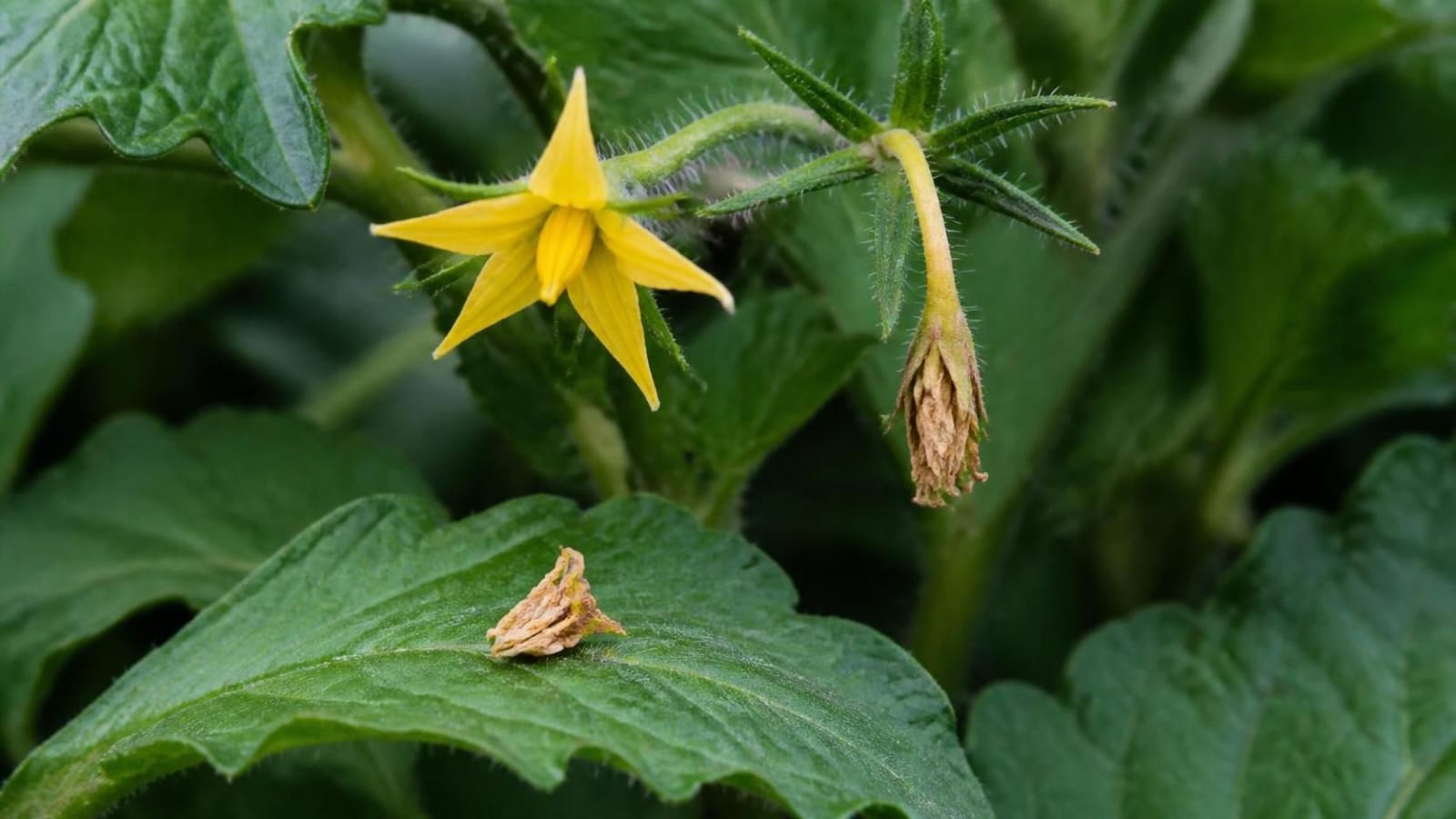
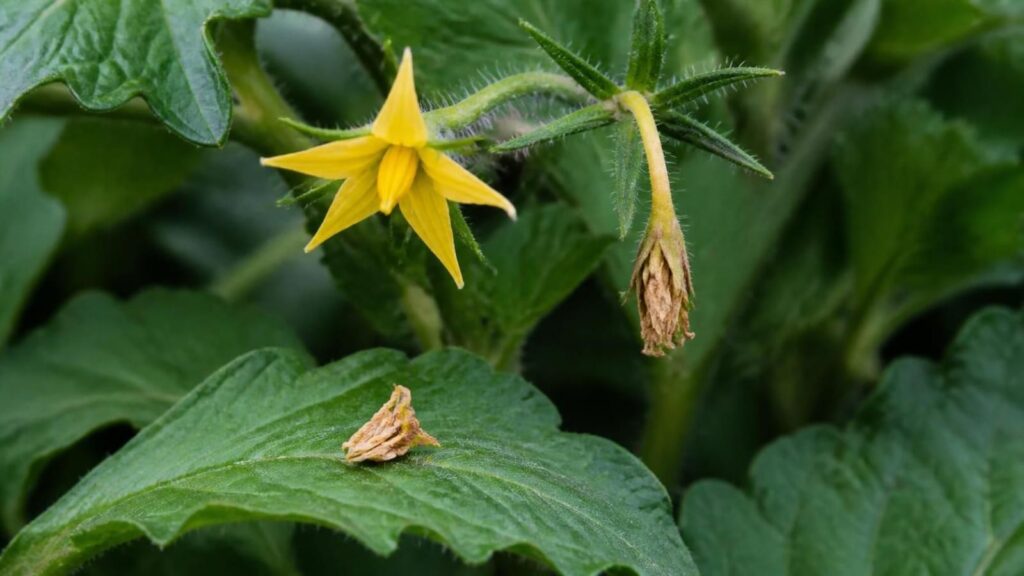
Blossom drop has a recognizable pattern. The flower opens, then dries, turns brown, and falls without leaving a small green fruit behind. Often the little stalk that holds each flower (the pedicel) turns yellow and shrivels first. The plant itself can look strong and green the whole time, which is why it is so confusing.
Two other problems get mixed up with it. A plant that is huge and leafy but has almost no flowers is a different case, usually tied to feeding, and we cover it below. And blossom end rot is a fruit problem: a tan to black sunken patch on the bottom of a tomato that already exists. If you are seeing that, flowers are not your issue.
Why today’s dropped flowers may trace back to last week’s weather
Most gardeners look at the weather this week and find nothing unusual. That can be misleading. According to Penn State Extension, when high temperatures occur 7 to 15 days before flowering, aborted and dropped flowers are the likely result. The damage happens while the flower is still developing, and you only see it once the bloom fails to set.
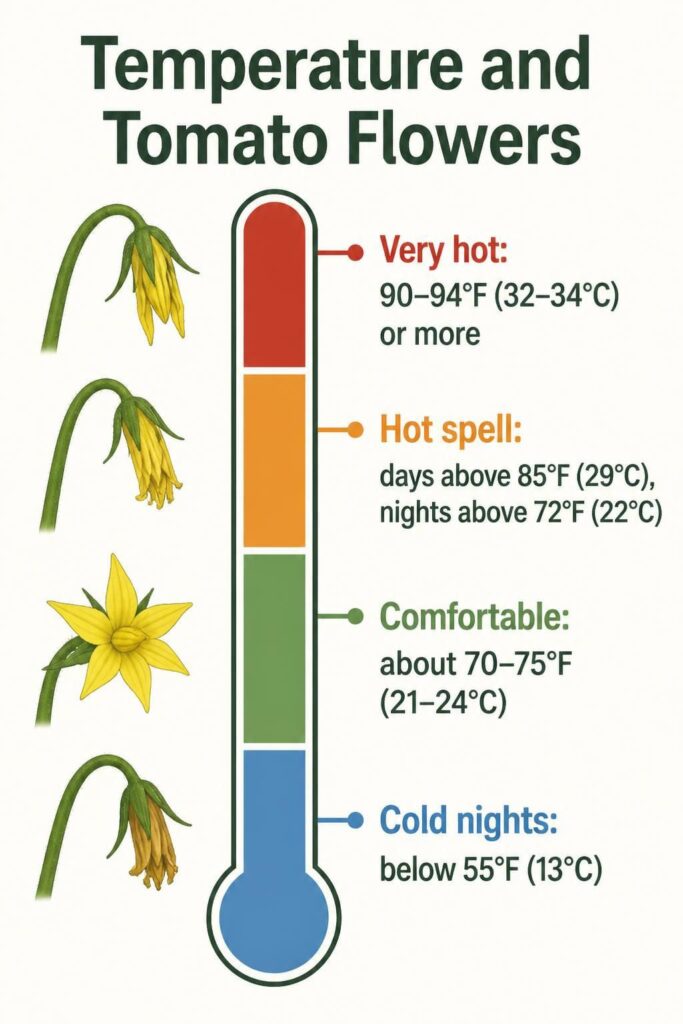
So when you are diagnosing, look back two weeks, not two days. Pay particular attention to the nights. Alabama Cooperative Extension notes that for some varieties, night temperatures above 72°F (22°C) can be enough to hurt flowering even when daytime highs stay below 85°F (29°C).
| Condition | Approximate range | What tends to happen to the flowers |
|---|---|---|
| Cold nights | Below about 55°F (13°C) | Fruit set is inhibited. Common in early spring and after cool snaps. |
| Comfortable | Roughly 70–75°F (21–24°C) for the plant overall | Flowers set normally when water, feeding, and pests are also in order. |
| Hot spell | Days above about 85°F (29°C) with nights above about 72°F (22°C) | Flowers often abort. The longer it lasts, the longer the problem lasts. |
| Very hot | Around 90°F (32°C) slows set, and 94°F (34°C) or nights above 75°F (24°C) can stop it | Pollen binds together, pollination drops, and many pollinators stop working. |
Sources give slightly different numbers. Oklahoma State University Extension, for example, puts the trouble zone at nights below about 60°F (16°C) or above 70°F (21°C), and days consistently above about 92°F (33°C). Treat the table as a zone, not a precise line. Variety matters too: Alabama Extension reports that heirloom varieties tend to be more sensitive than modern hybrids.
Short spells are not a cause for alarm. Alabama Extension says exposures of a week or less should not cause much of a problem. It is the long stretches that empty the plant of fruit.
Work through the clues
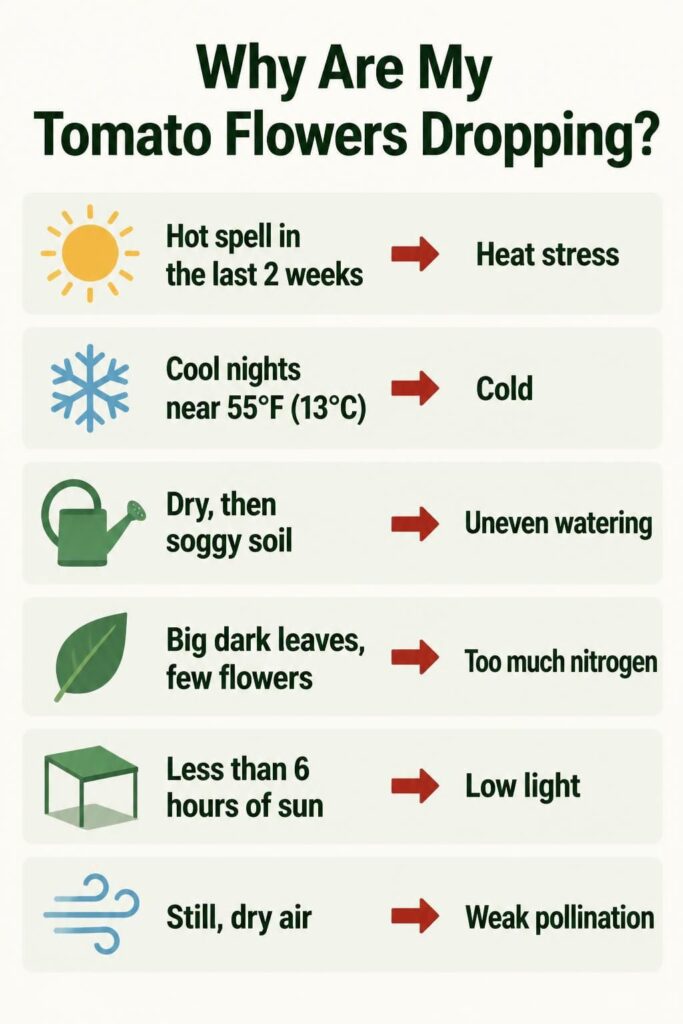
Start with the weather, because it is the most likely culprit. If the past two weeks were within the comfortable range, move down this list. Each cause has its own clue, a way to confirm it, and a sensible response.
Heat: the plant is healthy, but flowers fail after a hot stretch
The clue is timing. Flowers drop after a run of hot days or warm nights, the leaves look fine, and there are no spots, insects, or wilting. To confirm, check your overnight lows for the past two weeks, not just the daytime highs.
There is little you can do to change the weather, and Penn State notes that heat stress is tough to address in the field. What helps is reducing extra stress: keep the plants well watered, give them good air circulation, and consider shade cloth over the plants during a heat wave. Then give the plant time. Alabama Extension says plants will flower and set fruit again once temperatures become more favorable.
Cold nights: early flowers fall after a cool snap
The clue is the season. This happens in spring, on the first clusters, after nights that dipped near or below 55°F (13°C). Confirm it by checking recent lows. If you planted early, the plants may simply be ahead of the weather. Waiting is usually the answer, and protecting young plants on cold nights helps. Planting after the danger of frost has passed helps you avoid it.
Uneven watering: drops follow a dry spell or a soggy week
If the soil swings between bone dry and waterlogged, the plant will shed flowers to protect itself. University of Arizona Cooperative Extension describes alternating between too wet and too dry as the worst case, and recommends evenly moist soil. Alabama Extension suggests tomatoes need about 1 to 1.5 inches (25 to 38 mm) of water a week, which you should adjust for your soil and weather. Mulch slows moisture loss and steadies soil temperature.
Too much nitrogen: lush, deep green, and few flowers
The clue is the shape of the plant: big, dark leaves, thick stems, and very little to show for it. Nitrogen pushes leafy growth at the expense of flowers and fruit. The confirmation is your own feeding history, ideally backed by a soil test.
There is an important detail most guides skip. According to Arizona Extension, heavy nitrogen holds back fruit for 3 to 4 weeks after it is applied, until the plant has used it up. That means the fix is patience, not more feeding. Alabama Extension adds that too much fertilizer of any kind can raise salt levels around the plants, which can also cause blossom drop. Follow the label on whatever product you use.
Too little light
Tomatoes need at least six hours of full sun a day. Oklahoma State Extension notes that shaded plants produce only a few blossoms. If your yard is too shady, a container on a sunny patio can solve it. Arizona Extension adds that too much light can also be an issue, though it is more of a problem in greenhouses.
Weak pollination
Tomato flowers contain both male and female parts, so they pollinate themselves, but the pollen still has to move. Wind and buzzing insects usually do that. In still air, under cover, or in very dry conditions it may not.
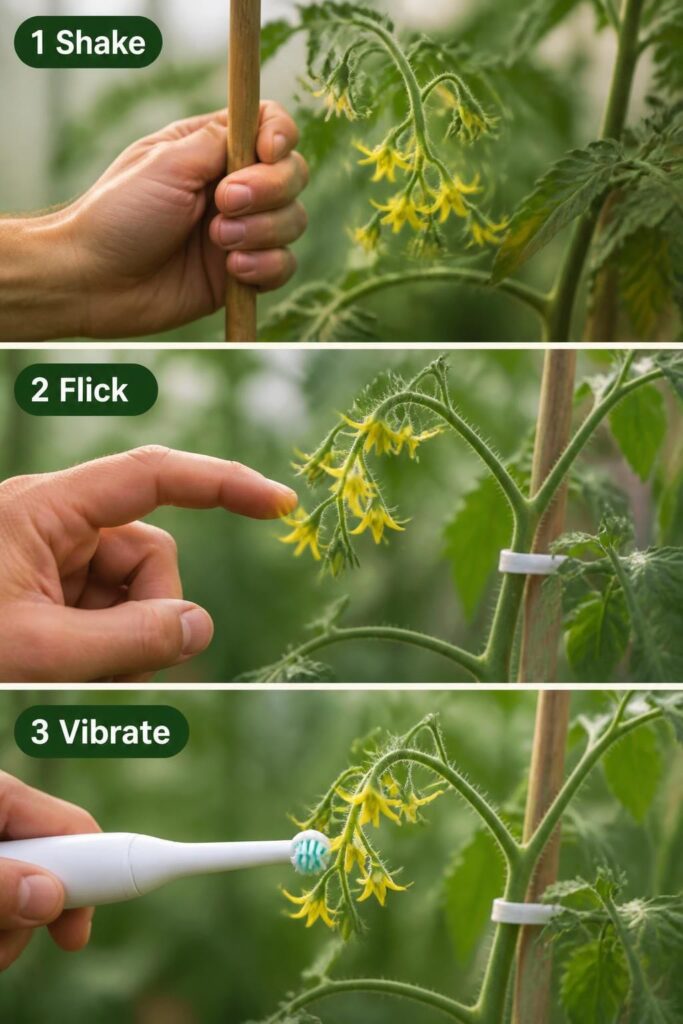
Arizona Extension suggests a few simple helps: give plants a good shake, flick the flowers with a finger, or touch the flower clusters with a vibrating electric toothbrush for a few seconds, ideally before it gets too hot. It also notes that humidity can limit set: above 70% is rarely a problem there, but below 40% can be. A realistic expectation matters here, because shaking only helps when the pollen is healthy. If a heat wave has already altered the flowers, shaking is unlikely to rescue them.
Other stresses: pests, disease, heavy pruning, or a heavy fruit load
Arizona Extension lists diseases, insect infestations, too much pruning, and excessive fruit set among the causes. Scout the plants regularly, deal with any pest or disease you actually find, and avoid stripping a plant of leaves during hot weather. Alabama Extension recommends checking plants daily for pests, since a stressed plant drops flowers more easily.
What about blossom-set sprays?
Garden centers sell hormone-type sprays that promise to hold flowers on the plant. They have a narrower use than the labels often suggest. Oklahoma State Extension says these sprays can reduce spring bloom drop caused by low night temperatures, but they have little effect on tomato set during high temperatures.
Arizona Extension adds that the sprays start fruit development without actually fertilizing the flower, so the fruit can develop with no seeds or only small ones. If you decide to try one for a cold-night problem, follow the product label and check which products are approved in your region. Do not expect it to fix a heat wave.
What not to do
- Do not add extra fertilizer to force flowers. Heavy nitrogen can hold back fruit for weeks.
- Do not spray a blossom-set product during a heat wave and expect fruit. It is aimed at cold-night drop.
- Do not prune the plant hard in hot weather. Too much pruning is listed among the causes of blossom drop.
- Do not flood the bed after a dry spell to make up for it. Even moisture is the goal.
- Do not pull the plant out. Blossom drop is usually temporary.
Will the plant recover, and how soon?
In most cases, yes. Because heat damage shows up a week or two after the weather event, recovery also lags. The first sign is not the old flowers coming back. It is new flowers that open after conditions settle and actually turn into small green fruit. If flowers keep failing after a long stretch of ideal weather, go back through the list above and look at water, feeding, light, and pests.
Preventing it next season
The most durable fix is choosing varieties that cope with heat. Alabama Extension says heat-set varieties were bred to tolerate high day and night temperatures, and names ‘Solar Fire’, ‘Bella Rosa’, ‘Phoenix’, ‘Red Bounty’, and ‘Tribute’ as ones that have performed well there. Look for words like heat-set or heat-tolerant in seed descriptions. If you love an heirloom that struggles in summer heat, plant it soon after the last frost so it flowers before the hottest weather.
- Get a soil test before planting so you know how much fertilizer you actually need.
- Mulch to keep soil moisture and temperature steady, and water evenly.
- Choose a spot with at least six hours of sun, with enough spacing for air to move between plants.
- For mid to late season, use heat-tolerant varieties, and keep shade cloth ready for heat waves.
Frequently asked questions
Is tomato blossom drop caused by a disease?
Usually not. Alabama Extension describes it as a weather-related condition rather than a nutritional disorder, disease, or insect problem. Other stresses can contribute, which is why it is worth checking the plant for pests and disease.
How many hot days does it take?
There is no exact count, since variety and nights matter. Alabama Extension says short exposures of a week or less should not cause much of a problem, while longer ones make the effect worse and longer lasting.
Do heirlooms drop more flowers than hybrids?
They tend to be more sensitive to heat. Alabama Extension reports that heirloom and heritage varieties are generally more affected than modern varieties, and that heat-set types were bred specifically to cope.