
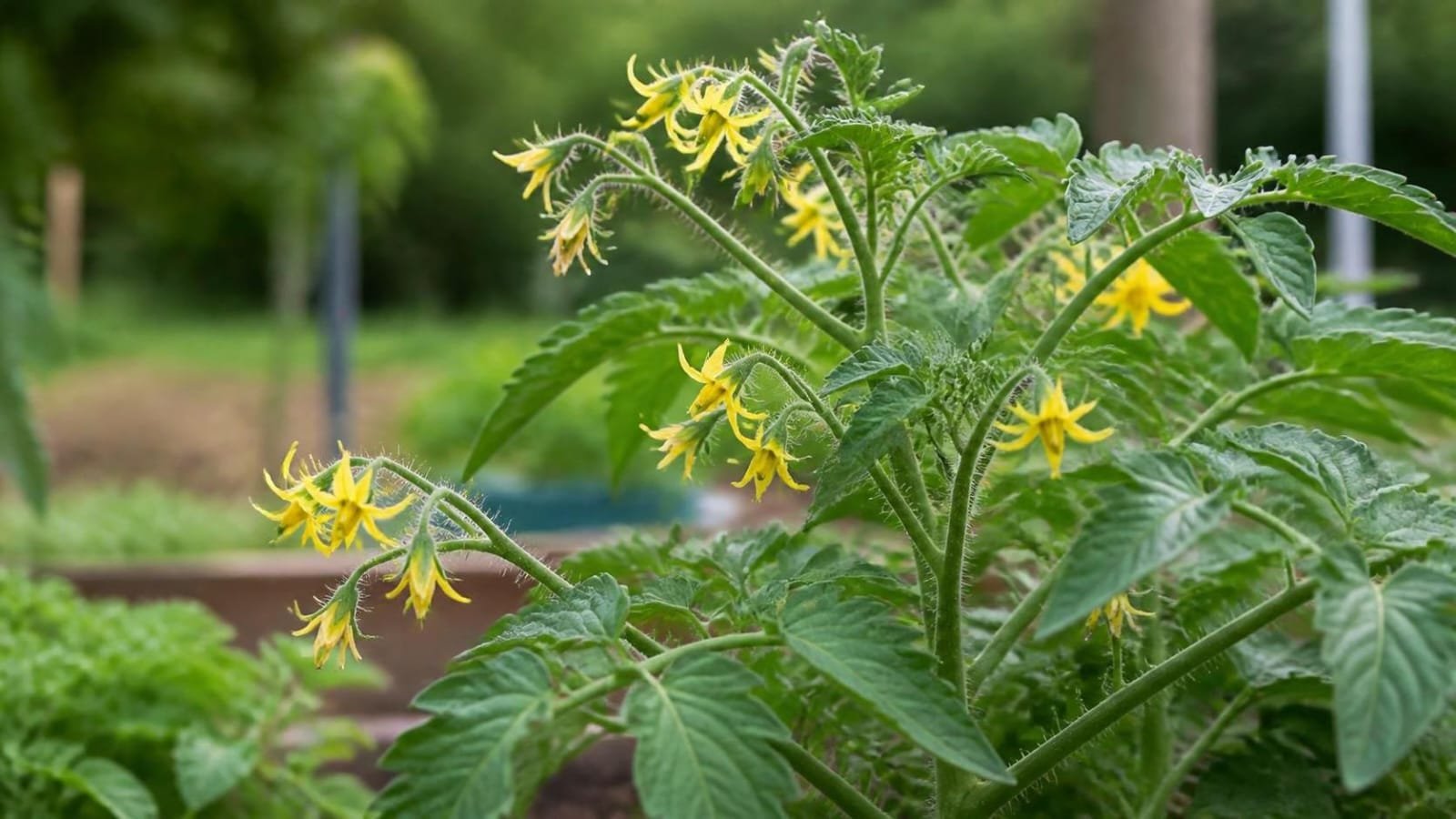
A tomato plant covered in yellow flowers looks like a promise. When those flowers wither and drop a week later, with no green fruit behind them, it feels like the plant has let you down. Usually it hasn’t. Flowers that fall without fruit are typically a sign that pollination failed during a particular stretch of weather or growing conditions, and the plant itself is often fine.
The short answer: unfavorable weather is the primary reason for blossom drop, with high daytime temperatures and low nighttime temperatures interfering with pollination. Humidity, still air, water stress and too much nitrogen come next. Most of these problems ease once conditions change, and new flowers can set fruit normally.
The rest of this article helps you work out which cause you’re dealing with, because the fixes differ, and some popular fixes make certain causes worse.
First, look closely at what the flower is doing
“Flowers but no fruit” can describe several different situations. Take a few minutes at the plant before changing anything.
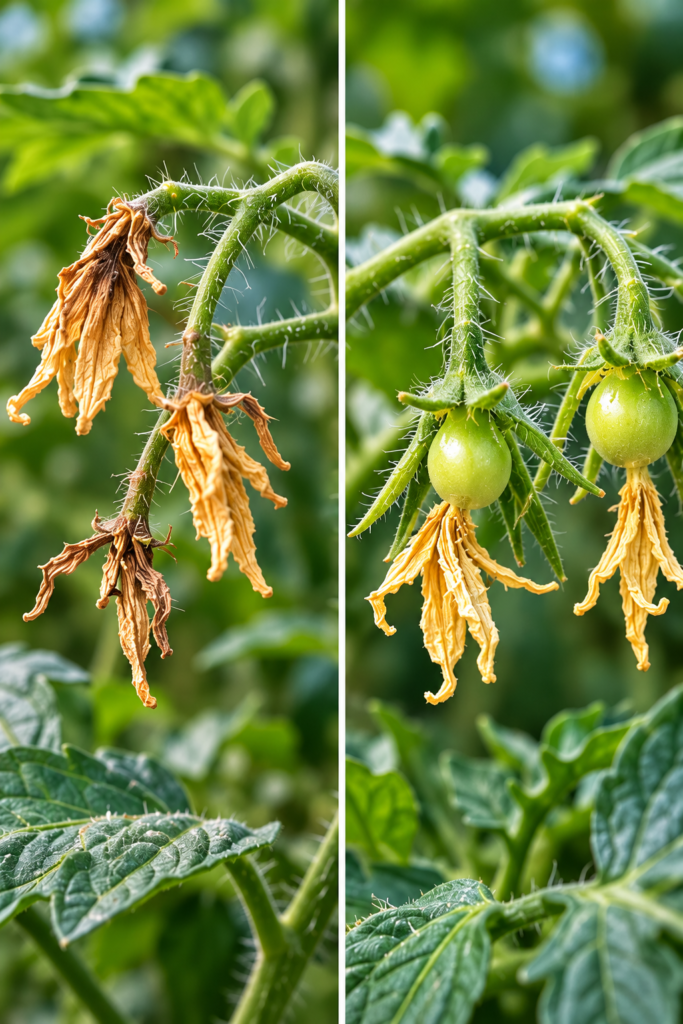
The flower withers and drops, with no swelling at the base. This is classic blossom drop. If a flower is not properly pollinated, it dies and drops off. Most of this article is about this situation.
The flower fades but the base swells, then the tiny fruit turns yellow and falls. Fertilization may have happened, and the plant then abandoned the fruit. Stress and overloading are the usual suspects. One extension source lists excessive fruit set among the causes of blossom drop.
The plant is big, green and leafy but has few flowers at all. That’s a different problem. It points to too much nitrogen, too little light, or a plant that hasn’t matured yet. Rather than a pollination failure, it’s a plant putting its energy into leaves.
Flowers open, hang on a few days, then dry up. This is still pollination trouble in most cases, and it’s the pattern the sections below focus on.
How a tomato flower actually gets pollinated
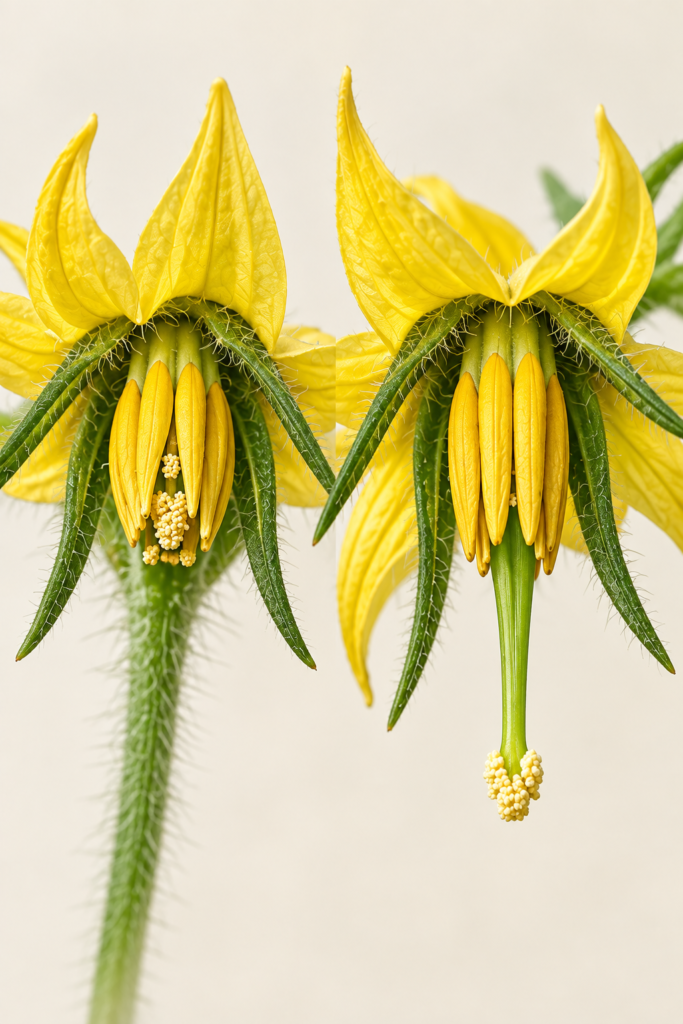
Knowing this makes every later section easier to follow. Tomato flowers are “complete”, meaning each one carries both male and female parts, so you don’t need a second plant or insects to get fruit. The flowers hang in downward clusters and are pollinated by movement and vibration, such as wind shaking them.
Pollen has to be released from the anthers, land on the sticky tip of the pistil (the stigma), and then grow a tiny tube down to the ovary. Every step depends on conditions. Pollen that’s too dry won’t stick, pollen that’s too humid clumps and won’t release, and pollen that’s stressed by heat or cold won’t grow properly.
Flower structure matters too. When the style is short, the stigma is surrounded by the anthers, which makes pollen transfer easy. In some varieties the style and stigma extend beyond the anthers, making transfer harder. If one variety in your garden sets fruit well and another drops flowers under identical conditions, this can be part of the reason.
Temperature: the most common cause
Extension sources agree on the basic picture, though exact thresholds differ slightly between them. That’s worth knowing, because the numbers you’ll see online range widely.
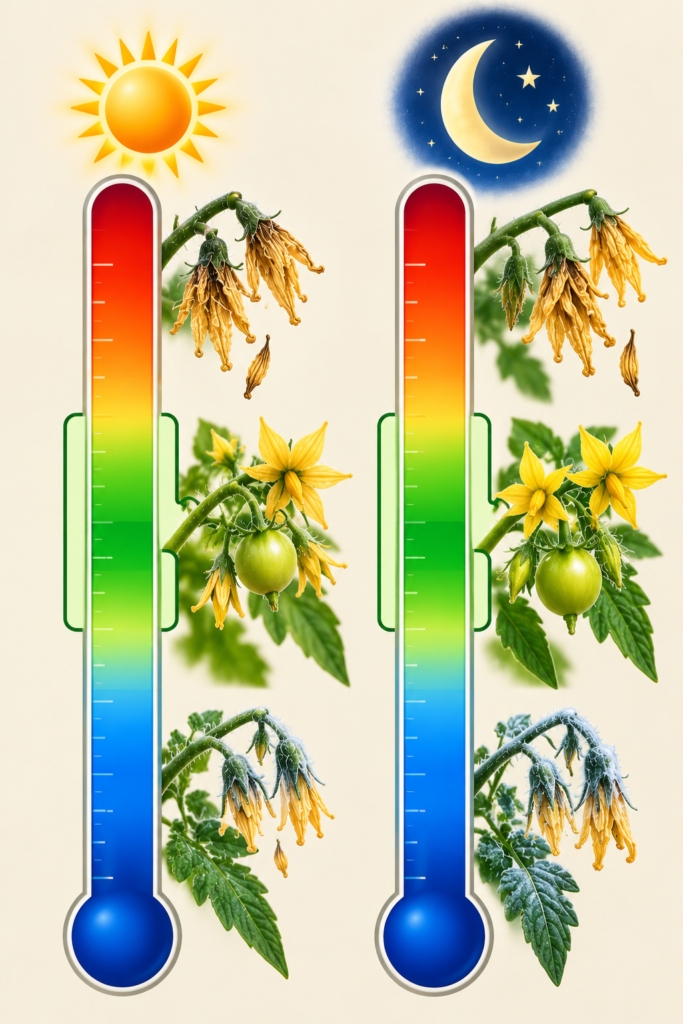
The comfortable range for tomatoes is a daytime temperature of roughly 70 to 85°F (21 to 29°C). Above about 85°F in the day, or above about 70°F at night, pollen becomes tacky and non-viable. Nights below about 55°F also promote blossom drop, since cold affects pollen viability and pollen tube growth. Other extension sources set the hot-night limit a little higher, around 75°F (24°C), so treat these as ranges rather than hard lines.
Nights matter more than most gardeners expect. One extension article suggests night temperatures may play a bigger role than daytime temperatures, because ideal fruit set happens within a narrow range of night temperatures, around 60 to 70°F, and nights above 75°F interfere with pollen tube growth. A plant that seems fine in a hot afternoon can still fail overnight.
Extreme heat can abort flowers outright. A Nevada extension publication notes that temperatures over 104°F for four hours or more cause flowers to abort, and that no chemical growth regulator helps under these conditions. A separate source gives a similar warning for around 103°F over several hours on consecutive days.
Cold is the spring problem. Early-season plants set out too soon can flower during cool nights and drop their first clusters. Cool conditions can also contribute to tomato catfacing in developing fruit. Once nights warm up, fruit set usually resumes.
Cherry types are more forgiving. Cherry tomatoes set fruit over a wider temperature range than most large-fruited varieties. If large slicers keep failing in your climate, a cherry or another small-fruited type is a reasonable insurance plant.
To check whether temperature is your cause, look at what the weather did roughly a week before the flowers dropped, since that’s when the flowers were opening. If it included several hot nights or a cold snap, that’s a strong clue.
Humidity, wind and still air
Tomato pollen is picky about moisture in the air. According to a University of Missouri bulletin, the ideal relative humidity for tomato pollination is 40 to 70 percent. Below that, pollen dries and struggles to stick to the stigma, and above that, it does not shed properly from the stamen. Another source says prolonged humidity over 80 percent hinders fruit set, because pollen either fails to shed freely or binds together.
That gives you two very different scenarios:
- Dry, windy, desert-type conditions: flowers dry out and pollen doesn’t stick. Strong winds can dry flowers out further, and dry soil adds stress.
- Muggy, wet or enclosed conditions: think greenhouses, polytunnels, or a rainy stretch. Pollen clumps and doesn’t release.
Still air is a third issue. In a greenhouse or a sheltered courtyard, there may be no natural shaking at all, which is why growers in these places often have to provide movement themselves.
Water, feeding, light and plant load
These are less common causes than weather, but they are real, and they often work together with heat.
Water stress. An extension source lists dry soil among the stresses that can add to blossom drop. Inconsistent watering, meaning long dry spells followed by heavy watering, is a common pattern. In heat, water stress makes everything worse. Overwatering can harm roots too, and stressed roots don’t support a flowering plant well.
Too much nitrogen. Several sources point to excessive nitrogen as a cause of leafy growth at the expense of flowering and fruiting. If your plant looks lush and dark green with few flowers, or you’ve been feeding it a leafy-growth fertilizer, this may be worth looking into. Follow the label of any fertilizer you use, and if you’re unsure what your soil needs, a soil test is more reliable than guessing.
Not enough light. Tomatoes generally need full sun, and many guides recommend six to eight hours of direct sun. Dark, cloudy weather can also slow pollen development, according to an Alaska extension publication. Heavy shade from neighboring plants or your own dense foliage can contribute.
Pruning and fruit load. One extension source lists too much pruning and excessive fruit set among causes of blossom drop. A plant that has stripped foliage has less energy to support flowers, and a plant already carrying a heavy crop may not set more.
Pests and disease. A plant fighting other stress, such as pests or disease, can drop flowers too. If you see damaged leaves, insects, or spots, sort that out first.
Match what you see to the likely cause
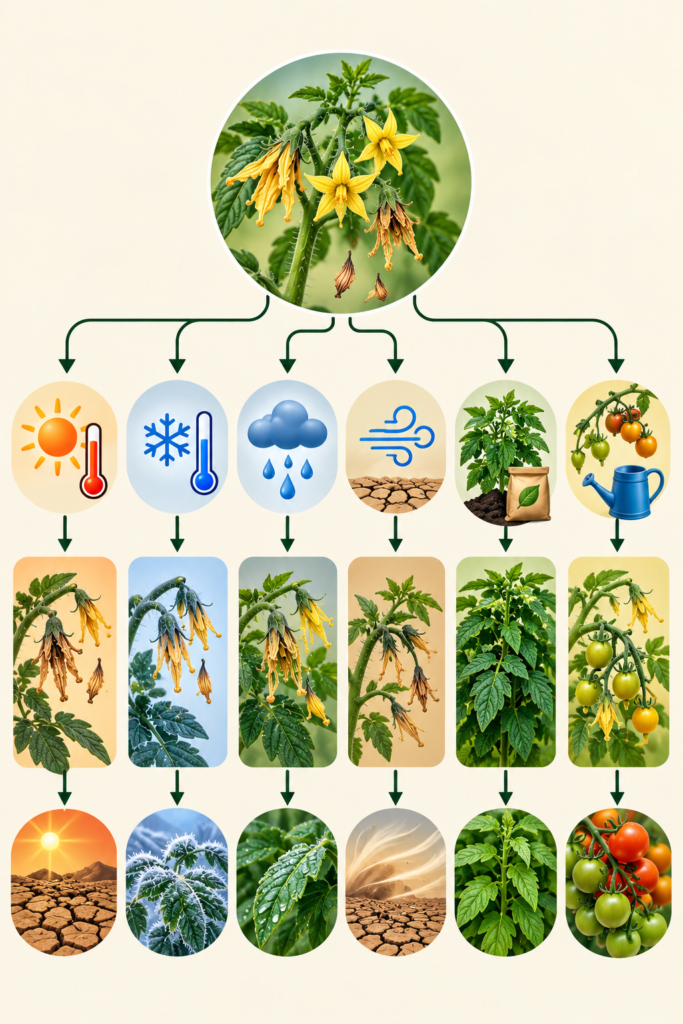
| What you observe | Likely cause | How to confirm | What to do |
|---|---|---|---|
| Flowers drop after a heat wave or hot nights | Heat stress on pollen | Check night and afternoon temperatures for the week before | Shade, steady watering, wait for cooler weather |
| Flowers drop after a cold snap or chilly nights | Cold stress | Check night lows for the week before | Protect plants on cold nights, wait for warmth |
| Flowers dry up in a humid or enclosed space | Pollen not releasing | Check humidity and airflow | Improve ventilation, help pollen move |
| Flowers dry up in dry, windy conditions | Pollen not sticking | Feel for dry air, check wind exposure | Wind protection, more consistent watering |
| Plant is lush and green with few flowers | Excess nitrogen or low light | Review feeding, light hours | Pause high-nitrogen feeding, improve light |
| Small fruit forms, then yellows and drops | Stress or overload | Check watering, fruit load, foliage | Even watering, avoid heavy pruning |
What to do about it
Help the pollen move. This is the safest step for most gardeners. In greenhouses with no wind, plants are mechanically shaken. Outdoors, you can give the plant a good shake, or flick the flowers with a finger. Bumblebees also help, since their vibrations work well to loosen pollen. Do it around mid-day, when pollen is typically shed. One source notes most pollen is shed between about 10 a.m. and 4 p.m.
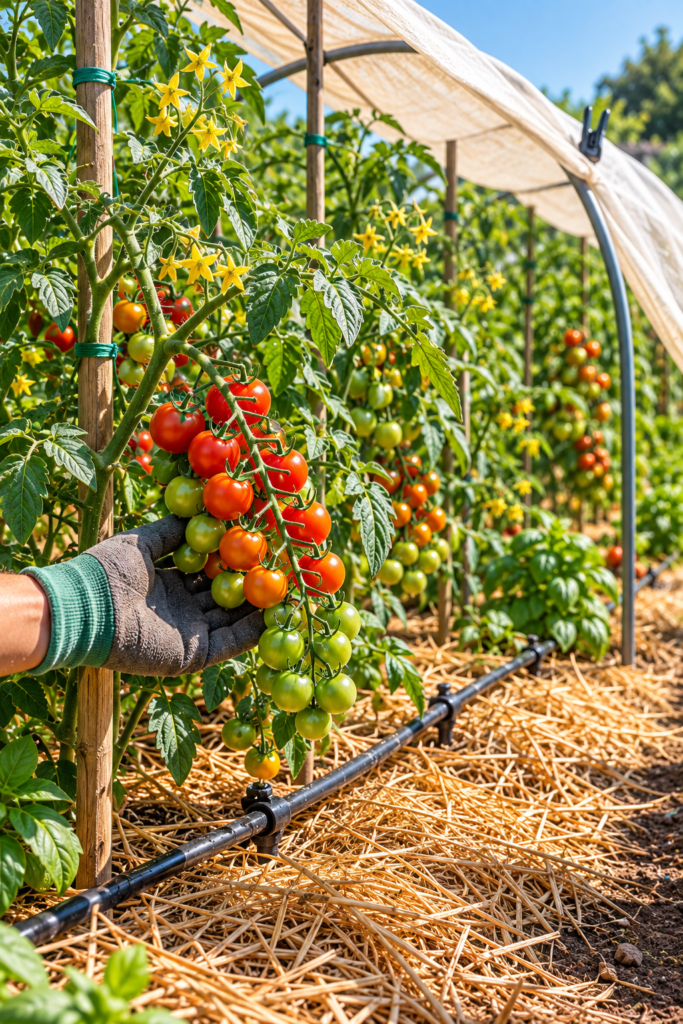
Shade during heat. Small-scale outdoor growers can consider floating row cover or similar material to shade their plants, according to the University of Missouri bulletin. This is a practical way to take the edge off afternoon heat.
Keep water steady. Deep, regular watering during dry weather helps, and mulch helps keep soil moisture more even. Avoid the feast-or-famine pattern.
Be careful with misting and hosing. In genuinely dry desert air, a Nevada extension publication suggests directing a strong jet of water at blossoms during the heat of the day, because evaporation cools the air, raises humidity and jars pollen loose. But the same publication says it stops working when days exceed 100°F and nights stay above 75°F. In humid regions, wetting the foliage can push humidity past the point where pollen releases and encourages fungal disease, so skip it there.
Consider hormone sprays only as a limited tool. Blossom-set sprays exist, but they’re not perfect. An Arizona extension publication explains that the sprays start fruit development without fertilizing the flower, so fruit forms with no seeds or very small ones. Oklahoma State advises that these sprays can reduce blossom drop from low spring night temperatures, but have little effect in high temperatures. If you decide to use one, follow the product label and check that it’s approved where you live.
Hold off on nitrogen if the plant is leafy. Switch to a more balanced approach based on a soil test or product label, rather than piling on high-nitrogen feed when nothing is setting.
What not to do
- Don’t pull the plant out. In hot regions, plants that stop setting fruit in summer often start again when temperatures cool. The Nevada publication notes that tomatoes will produce again in the fall, and recommends continuing to water and fertilize through the pause.
- Don’t add more fertilizer as a rescue. More nitrogen produces more leaves, not more fruit.
- Don’t over-prune to “redirect energy”. Foliage supports the plant through stress.
- Don’t mist blindly. As explained above, it only helps in dry air.
- Don’t rely on a spray to fix hot nights. No spray solves sterile pollen.
Will the plant recover, and how long will it take?
In most cases, yes. The flowers that already dropped are gone, but new flowers that open under better conditions can set normally. One gardening source puts it simply: once conditions stabilize, new flowers usually begin setting fruit without replacing the plant.
Timing varies with your weather, variety and how long the stress lasts, so any promise of “fruit in X days” would be a guess. A reasonable approach is to watch new flower clusters. If flowers that open after conditions improve are swelling at the base, you’re back on track. Fruit itself then needs several more weeks to develop and ripen.
Preventing it next season
- Time your planting. Aim so plants flower when temperatures are moderate, not during the hottest stretch or the last cold nights.
- Choose varieties suited to your climate. Cherry and other small-fruited types tolerate a wider range. Some tomato varieties are sold specifically as heat-tolerant, so check the seed description for your region.
- Site the bed well. Full sun, but with some airflow, and afternoon shade cloth available if summers are extreme.
- Mulch and water evenly. Drip irrigation or a soaker hose keeps moisture steady.
- Feed with restraint. Base decisions on a soil test where possible.
- In greenhouses or tunnels, manage humidity and ventilation, and plan on helping pollination when the air is still.
Quick questions
Do tomatoes need bees? Not strictly. Tomatoes are self-fertile, but they rely on wind or vibration to move pollen. Bumblebees are helpful because of the vibrations they create.
Can I hand-pollinate tomatoes? Yes. Gently shaking or flicking the flower clusters at midday is the standard method, and it’s often enough.
Is it blossom end rot? No. Blossom end rot affects developing fruit, causing dark sunken patches at the base. This article is about flowers that never turn into fruit.
Should I worry about the first flowers dropping? Not automatically. Early flowers often drop in cool spring weather, and later flowers usually do better.
Sources
- Understanding Tomato Fruit Set – Missouri Produce Growers Bulletin, University of Missouri
- Common Tomato Disorders Under Desert Conditions – University of Nevada
- Pollination & Fruit Development in Tomatoes – Cooperative Extension Service, University of Alaska Fairbanks
3 thoughts on “Tomatoes Flowering but Not Setting Fruit: Causes & Fixes”