
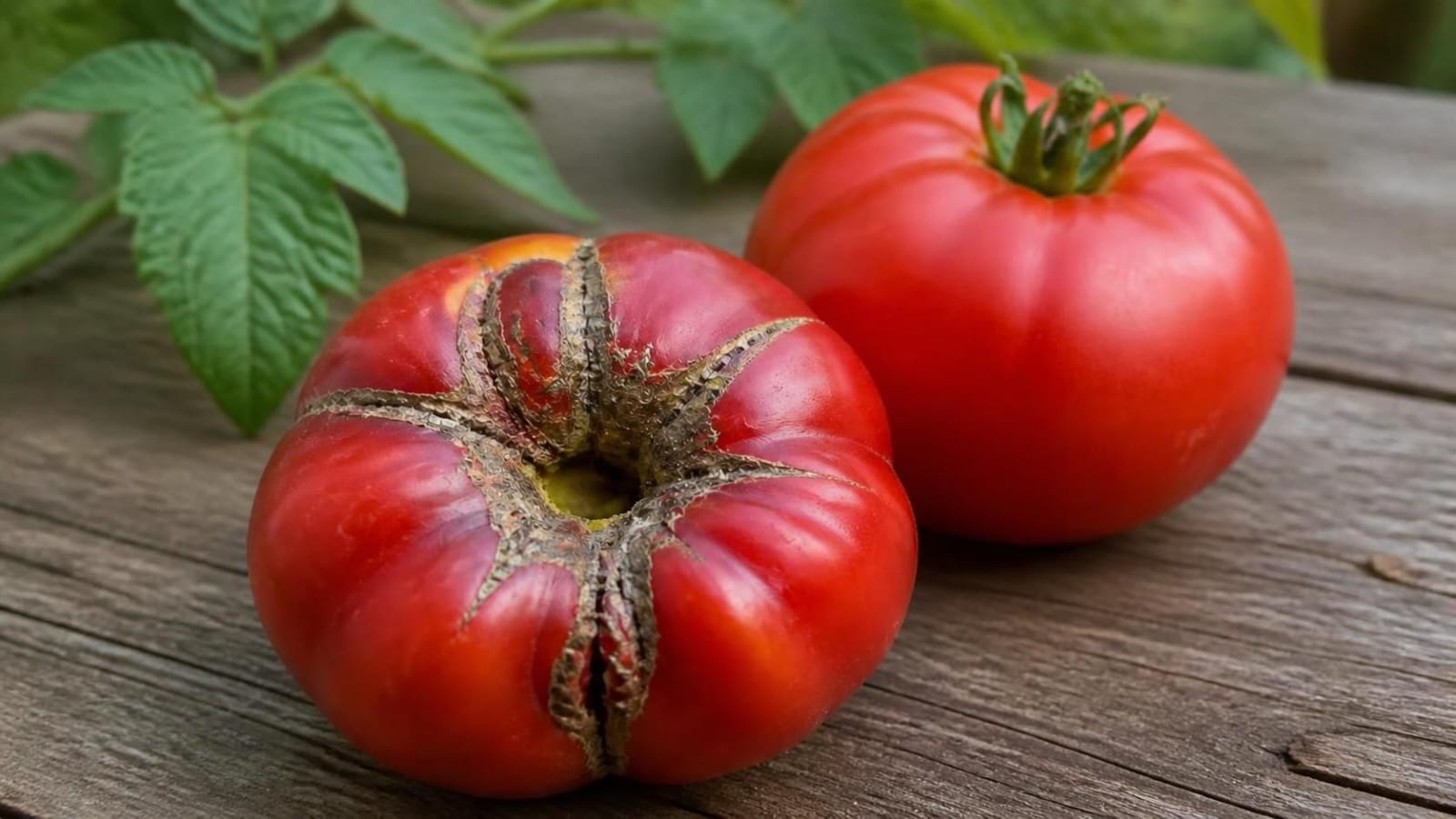
From the top, the tomato looks fine. Turn it over and the blossom end is puckered, scarred and folded in on itself, sometimes so deeply that the seed cavity shows through. If this happened on your first fruits of the season, or after a run of cold nights, you are almost certainly looking at catfacing.
Severe catfacing after cool weather is a flower problem that only becomes visible in the fruit. Cold nights around flowering, roughly in the low-to-mid 50s °F (about 11–13 °C), disturb how the flower’s female parts form, and the fruit then grows around the damage. Fruit that is already deformed will not recover, but later flowers usually set normally once the weather warms, and the fruit is generally safe to eat once the scars are cut away.
The cause is not completely understood, and sources disagree on some details, so this guide separates what is well supported from what is still theory. It also helps you rule out look-alike problems, because catfacing is often confused with blossom-end rot, zippering and cracking.
What severe catfacing looks like
UMass Extension counts a tomato as catfaced when the blossom scar is enlarged or perforated, and it points out that the fruit does not have to be badly distorted to qualify. Mild cases may show nothing more than a scar on the bottom. Severe cases are the ones that stop gardeners in their tracks.
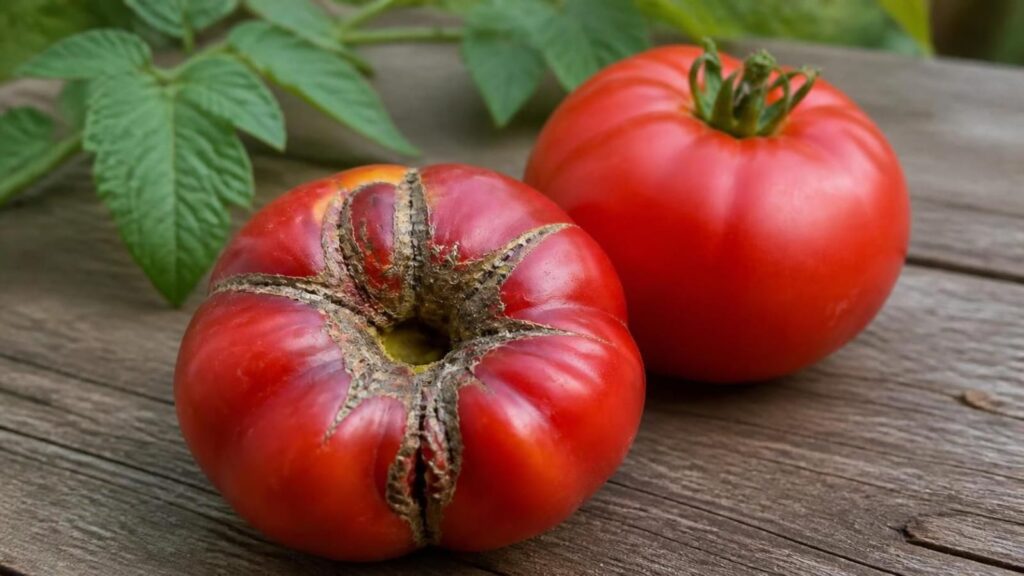
Mississippi State University Extension describes the typical severe picture: a malformed fruit with brown scars at the blossom end that sometimes run up the sides, and a puckered bottom with deep crevices. In the worst form, the bottom of the fruit seems turned inside out, so the seed cavity is visible from outside.
Catfacing is a physiological disorder, not an infection. As eOrganic explains, non-pathogenic disorders like this are the plant’s response to adverse conditions, so it will not spread from one plant to the next.
Rule out the look-alikes first
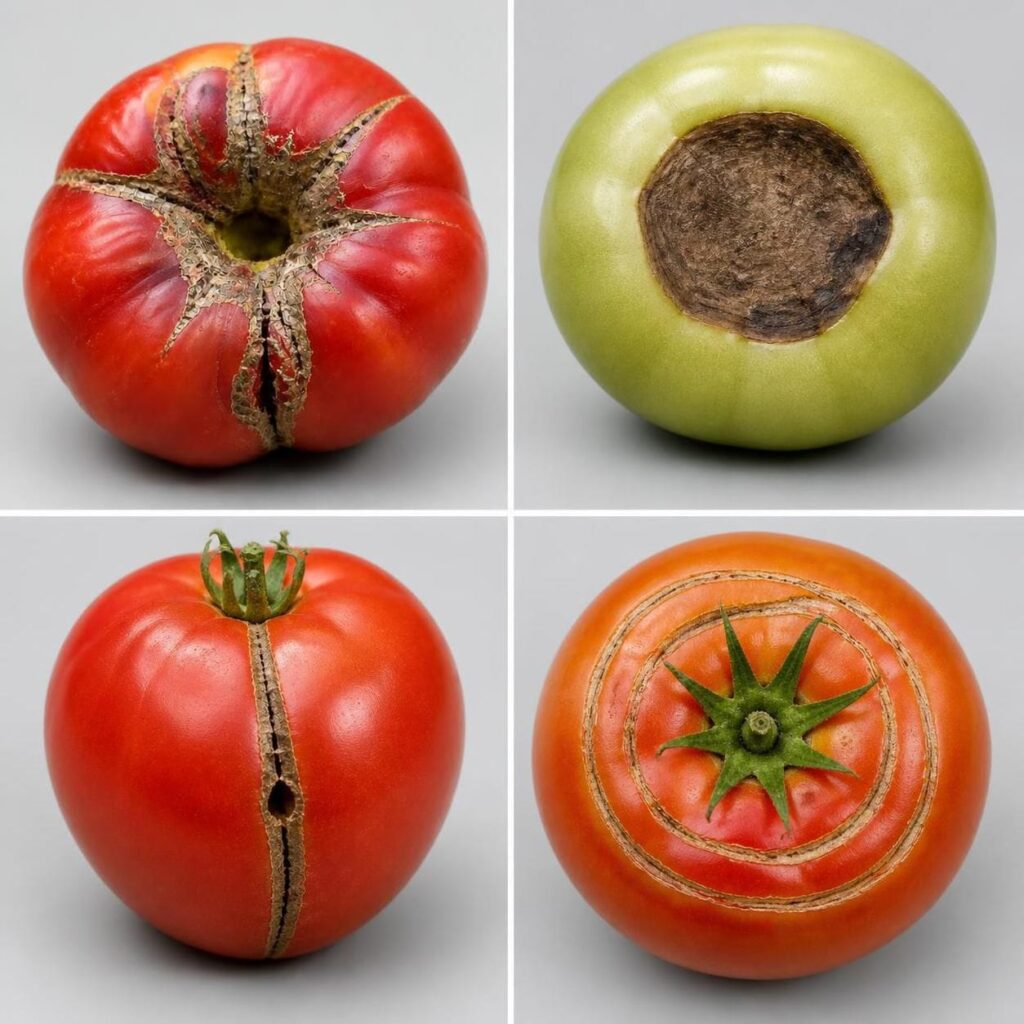
Several problems affect the bottom or skin of a tomato, and the wrong diagnosis sends you towards the wrong fix. Steadier watering, for example, helps with blossom-end rot and cracking, but does nothing for catfacing.
| Disorder | Where it shows | Key clue |
|---|---|---|
| Catfacing | Blossom end, sometimes running up the sides | Puckering and deep crevices with an enlarged or perforated scar; fruit often misshapen |
| Blossom-end rot | Bottom of the fruit, occasionally the side or inside | Dry, leathery, dark brown or black patch without puckering; linked to calcium supply and uneven watering |
| Zippering | Side of the fruit, often stem end to blossom end | A brown line like a zipper, sometimes with a hole; linked to an anther staying attached to the young fruit |
| Cracking | Around the stem end, or radiating from it | Splits or rings of scar tissue; a sign of uneven moisture in the plant |
| Ridged shoulders | Upper part of the fruit | Bumpy ridges that, like catfacing, are linked to low temperatures |
Mississippi State’s guidance draws the line between catfacing and blossom-end rot clearly: rot shows up as dark brown areas on the bottom of the fruit but without the puckering or crevices. It also notes that low temperatures cause ridged fruit as well as catfacing, so more than one of these can appear on the same plant. Name each fruit separately rather than the whole plant.
Why cool weather does this to a tomato
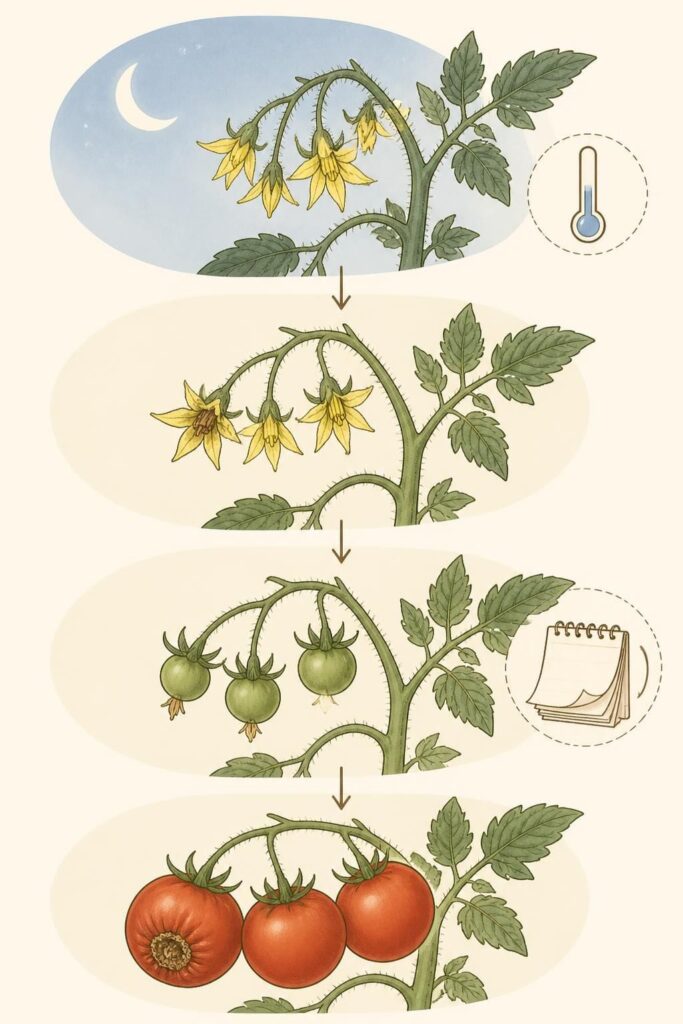
A tomato takes its shape from the flower it grew out of. According to eOrganic, in catfacing the female part of the flower develops abnormally because of low temperatures during flowering. The fruit then grows around that damaged tissue, which is why the deformity sits at the blossom end.
University of Maryland Extension says tomato flowers do not develop or pollinate properly when temperatures fall below 52–54 °F (about 11–12 °C). It stresses that it is the night temperature that counts: daytime highs in the 80s °F (roughly 27–32 °C) do not protect the flowers if nights stay at or below 54 °F.
Other sources set the line slightly differently. eOrganic describes extended spells of cool days (60–65 °F, about 16–18 °C) combined with cool nights (50–60 °F, about 10–16 °C). Mississippi State says fruit develops its best shape when temperatures stay above the mid-60s °F, about 18 °C. Because variety, humidity and the length of the cold spell all play a part, treat these numbers as a warning zone rather than a switch.
UMass adds that big swings between day and night temperatures have also been linked to the disorder, and it is candid that very little research has been done on the subject. That candour is worth keeping in mind whenever someone gives you a single, certain cause.
Why the damage appears weeks after the cold snap
Flowers that were chilled while they formed can still produce fruit that looks healthy for a while, so the cause and the symptom are separated by time. The Maryland report describes a cold spell in May whose effects showed up 20 to 30 days later. In some fields the first fruit set looked good, while the second, third and occasionally fourth sets were affected.
Mississippi State describes the more common home-garden pattern, in which only the earliest fruit set is hit and later-harvested fruit is generally fine. The two accounts fit together: what matters is which flower clusters were opening when the cold nights arrived.
This is also why covering plants after you spot ugly fruit rarely helps that fruit. Its shape was settled when the flower formed. What you can still protect are the flowers that have not opened yet.
Read your own plants for other clues
Cool weather is the main suspect, but it is not the only one. These clues help you decide whether it explains everything you are seeing.
- Large round fruit is scarred, but cherry, grape or plum types are fine. That points to cold plus variety. Maryland reports that the rounder and larger the fruit, the greater the chance of catfacing, and Mississippi State says large beefsteak types and many older heirlooms are commonly misshapen. To confirm, compare varieties growing side by side in the same conditions.
- Damage is worst along one edge of the garden and fades as you move away. Maryland lists exposure to the herbicide 2,4-D as another possible cause, with exactly that kind of pattern. If you suspect drift, map which plants are affected and ask your local extension office. Do not try to spray a remedy.
- Tiny insects are present in the open flowers. UMass notes that thrips damaging the side of the pistil can cause catfacing. Look closely inside several blossoms. If you do find them, use products labelled for tomatoes in your region, and follow the label and local regulations.
- Plants are pruned hard, or very lush from heavy feeding. UMass says that under some conditions pruning and high nitrogen can increase catfacing. Maryland suggests heavy pruning may lower the plant’s auxins, and one gardening writer describes this as a theory rather than something proven, which is fair.
- Plants went out very early, or into an unheated tunnel. UMass advises against low greenhouse temperatures for tomatoes and transplants, and against planting into high tunnels too early if you cannot heat them.
What to do about it now
Maryland’s assessment is blunt: there is little that can be done to control catfacing once it has happened, apart from choosing varieties that are not prone to it. That does not mean you are helpless. You can limit further damage and make good decisions about the fruit you already have.
- Decide which fruit is worth keeping. Maryland notes that removing catfaced fruit can be beneficial, because it is unmarketable but keeps drawing nutrients from the plant. At home, remove the severe ones you will not eat and let the milder ones ripen.
- Protect the flowers that are still to open. Mississippi State recommends plastic or spun-bonded row covers to raise temperatures on cool days and nights, and eOrganic adds high tunnels or other protection that warms the air during flowering. Small plants can also be wrapped in teepee-style covers, though a gardener-writer at Garden Betty points out that these only work while plants are young and small.
- Vent covers when it warms up. Mississippi State warns that pollen is sterilised at or around 93 °F (about 34 °C), so a sealed cover on a sunny afternoon can cause a different problem.
- Ease off the stressors you control. Prune less aggressively and avoid excessive nitrogen, as UMass advises. Base feeding on a soil test and follow the product label.
- Skip the sprays. There is no pathogen to treat, so a fungicide will not help. Only if you have confirmed thrips does pest control make sense, and then only with a product approved for tomatoes where you live.

Can you eat a catfaced tomato?
Generally yes. Mississippi State says catfacing does not affect edibility, and that the scars can be cut off and the rest of the tomato eaten.
There is one caution. UMass notes that a rough blossom scar can give black mold rot an entry point under certain conditions. Garden Betty adds that stretched skin can split and crust over, and that any wound can invite bacteria. Use your own judgement: cut away soft spots and eat the rest if the fruit still feels firm, and compost anything that is already moldy. The worst-looking fruit is best eaten first, so a hidden soft spot does not have time to spread.
Preventing it next season
Prevention is mostly about timing and variety, because both reduce the chance that your flowers open during a cold spell.
- Plant a little later. Mississippi State says planting when temperatures are higher avoids some of these problems.
- Watch the forecast. If nights are heading towards the low 50s °F (around 11–12 °C) while plants are in flower, have covers ready before the cold arrives, not after.
- Choose less prone varieties. UMass says heirlooms tend to be more prone than non-heirlooms, and Maryland reports that older cultivars appear more susceptible. Plum, cherry and grape types are affected far less than large round tomatoes.
- Try varieties bred for cool conditions. Garden Betty names Oregon Spring, San Francisco Fog, Siberia, Glacier and Northern Lights as examples. Mississippi State also mentions that some varieties are sold as “cold set” or “hot set”, so check local variety recommendations from your extension service.
- Mind the autumn. Cool nights can also catch the last flowers of the season. Garden Betty suggests early-maturing varieties that ripen before temperatures drop.
Quick answers
Will my plant keep producing catfaced fruit?
Usually not. Fruit set after the weather warms is generally normal. If cool spells keep returning, though, each new batch of flowers can be affected, which is what the Maryland report describes across several fruit sets.
Can I fix a catfaced tomato that is still growing?
No. The deformity starts in the flower, so the shape of a fruit is already set by the time you notice it. Let it ripen if you want to use it, or remove it so the plant puts energy into healthier fruit.
Can catfacing happen in a greenhouse?
Yes. UMass describes it as a disorder of both field and greenhouse tomatoes, and advises avoiding low greenhouse temperatures for fruiting plants and for transplants.
Is catfacing the same as a tomato disease?
No. It is a physiological disorder caused by growing conditions, so it does not spread between plants. The only infection risk comes afterwards, when a rough or split scar lets rot organisms in.