A drain is only a path. It can move water that reaches it, and only as far as something is willing to accept it. When a garden stays soggy even though there is a pipe, a gravel trench or a soakaway already in the ground, one of those two conditions is usually missing.
Garden soil that stays waterlogged despite drainage almost always comes down to one of five things: the drain has no working outlet, water never reaches the drain, a compacted or clay layer is holding water above it, groundwater or a leak is feeding the area from below, or more water is arriving than the ground can ever absorb. A simple test pit will show you which one it is.
That is why this guide starts with diagnosis rather than a list of fixes. Compost will not help a blocked outlet, and a new pipe will not help a soil layer that water cannot cross. Work out where the water is getting stuck, and the right repair becomes much clearer.
First, make sure it really is waterlogging
Waterlogging is easy to mistake for other problems. The Royal Horticultural Society notes that its symptoms are hard to tell apart from other disorders: yellowing or decay between the veins, soft areas at the base or centre of leaves, and sometimes wilting. The wilting is not a contradiction. Roots starved of oxygen cannot take up water or nutrients, so a plant standing in a puddle can look exactly like a plant dying of thirst.
The most reliable clue is underground. Lift a struggling plant, or expose a few roots, and look at them. The RHS describes blue-black roots, sometimes with a sour, rotting smell, as a typical sign. Healthy roots are usually pale and firm.
Duration and season matter too. A short-lived flash flood after a downpour seldom harms most plants; it is prolonged saturation that does the damage. In cold winter soil, roots and soil microorganisms respire very little, so waterlogging is much less harmful than it is in warm weather, when roots need plenty of oxygen.
Dig a test pit before you change anything
A hole in the ground tells you more than any amount of staring at puddles. Reliable sources describe slightly different versions of the same test, and it is worth knowing all three.
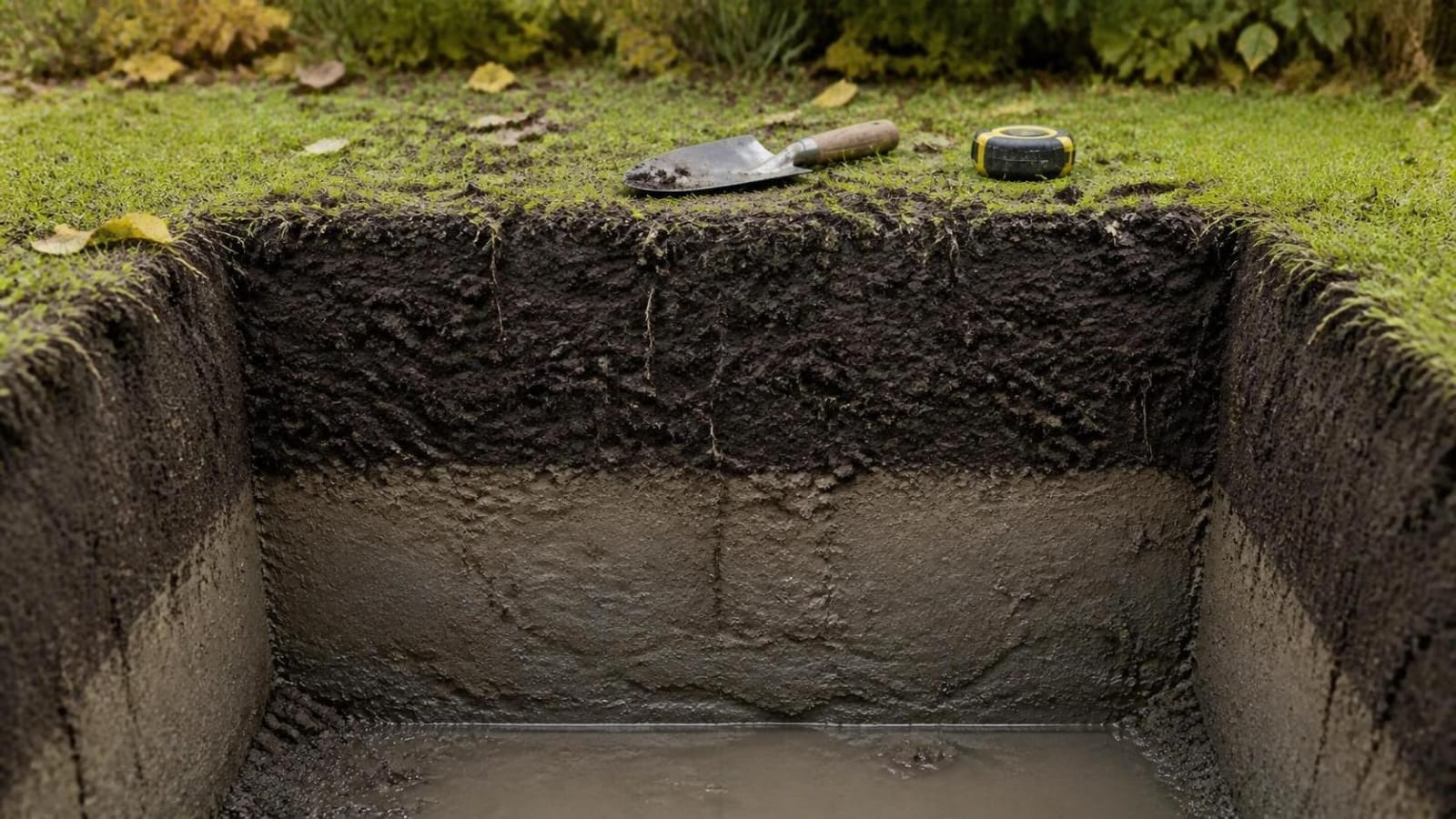
- The RHS suggests a straight-sided pit about 60 cm (2 ft) deep, covered to keep rain out and left overnight. If water collects, you have a high water table. If it stays dry, fill it with water, cover it again and check after 24 hours; water that is still there means poor drainage.
- Colorado State University Extension uses a 12-inch hole filled with water. If it has not drained in 30 minutes, the soil has a drainage problem, and if it still holds water after 24 hours, waterlogging may affect plant growth.
- A landscaping firm, MacColl & Stokes, describes a hole roughly 30 cm wide and 60 cm deep, filled and checked after four hours. It adds that a hole which drains and then refills from below points to a high water table.
These thresholds are rules of thumb rather than laboratory standards. Use them to compare one part of your garden with another, ideally after a spell of wet weather and again in a dry one.
Then look at the pit walls. The RHS advises checking whether roots go down deep or stop abruptly, whether there is a hard layer, and whether darker topsoil is sitting on a thick band of impervious clay or rock. Those details often explain more than the water test itself.
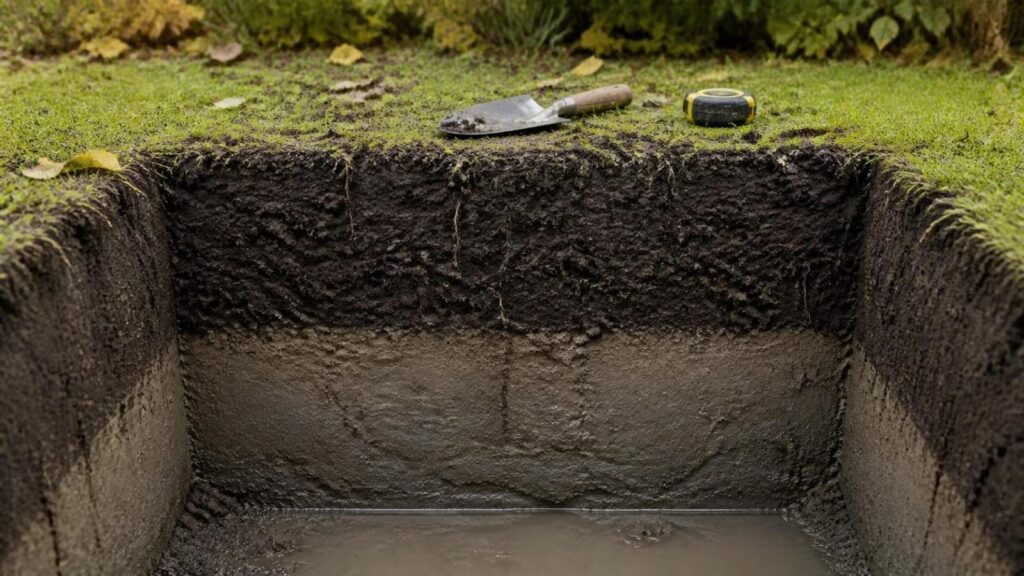
Here is how to read what you find.
| What you see | Likely cause | Where to look next |
|---|---|---|
| Water seeps into the empty pit from the sides or base | High water table or a spring | Check for leaking pipes, then consider raising the planting level or drainage with a proper outlet |
| Pit stays dry, but water you add drains very slowly | Dense soil or a compacted layer | Look for a hard layer on the pit walls; plan to break it up or work around it |
| Topsoil sits sharply on thick clay or rock | A barrier water cannot cross | Deep digging only helps if the layer is thin; otherwise raised beds |
| Water drains quickly from the pit, yet the surface stays wet | Surface runoff, poor levels or over-watering | Check downpipes, paving falls, low spots and irrigation |
| Drain trench stays full and nothing leaves the outlet | Blocked or missing outlet | Trace the pipe to its discharge point |
Why drainage that looks right can still fail
There is rarely a single reason, and many gardens have more than one. These are the failures that come up most often.
The pipe has nowhere to go
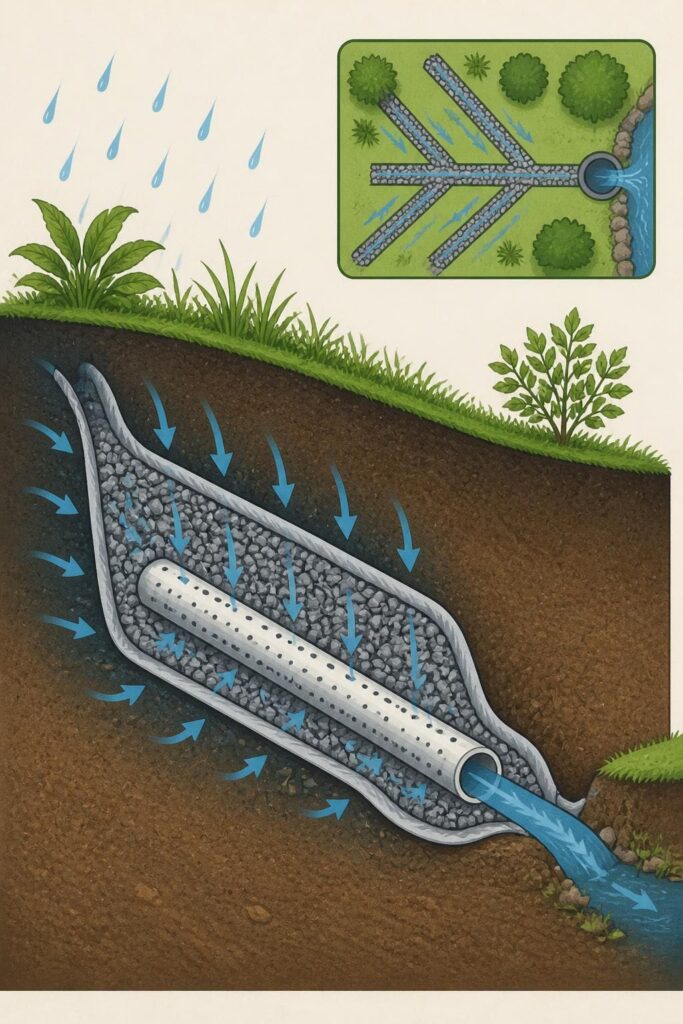
This is the most common reason for a drain that does nothing. Colorado State’s guidance describes a French drain as a rock-filled trench, usually with a pipe in the bottom, that must slope towards an outlet. Without a real outlet, the trench simply fills with water like the soil around it.
The RHS lists ditches, streams and soakaways as suitable destinations, and warns that local byelaws usually prohibit sending garden drainage water into sewers or storm drains. Pushing it onto a neighbour’s land is not an answer either. In heavy clay, a soakaway may also fill and empty slowly, so it may need to be larger, or a different approach may suit the site better.
A quick check: after heavy rain, go and look at the outlet. If water is running, the system works and the problem lies elsewhere. If it is dry while the garden is wet, water is not reaching the pipe. If it is full and not emptying, the problem is downstream.
Water cannot reach the pipe
A pipe is only as good as the soil’s ability to deliver water to it. Colorado State’s guidance is direct about this: drain tiles work only to the extent that the soil lets water flow towards them, and the water inside must then be able to run downhill to an outlet. In dense clay, water creeps towards a pipe so slowly that one line may dry a narrow strip and leave the rest of the bed soggy.
For small-scale piped drainage, the RHS suggests perforated pipes laid 40 to 60 cm deep and 3 to 6 m apart, with a fall of 1 in 40 towards the outlet, usually in a herringbone pattern where feeder lines meet a main line at 45 degrees. Treat those figures as a starting point. Large systems are skilled work and best left to a landscape or drainage contractor.
Silt, wrong levels or a missing filter
Drains also fail quietly. A trench without a membrane lets silt wash into the gravel and gradually seal it, and dirty stone does the same. The landscaping firm mentioned above stresses correct falls, clean stone and a membrane that keeps silt out. If a pipe has too little fall, water sits instead of leaving; the RHS notes that laying pipes with enough fall is a common difficulty and that pumps with float switches are sometimes used where gravity cannot do the job. Colorado State adds that the rock in a French drain should meet the surface grade so soil does not cover it. In older systems, silt and sometimes roots are the usual suspects when a drain that once worked slows down.
A layer in the soil is trapping the water
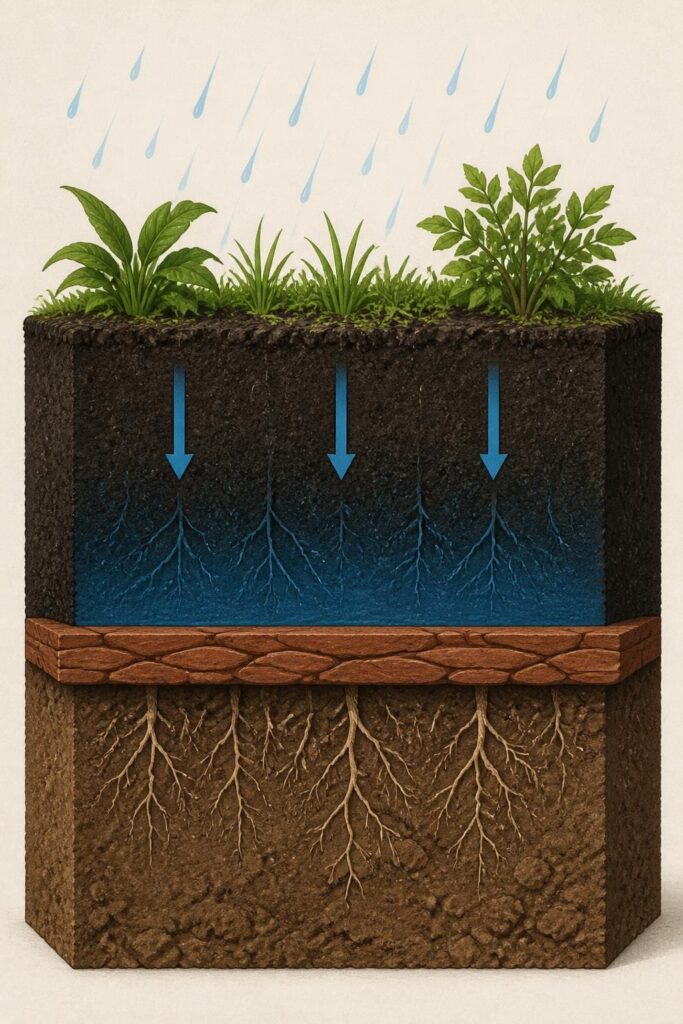
This is the cause that most “apparent drainage” cases hide. Colorado State describes soils where the upper layers take in water easily, only for it to stop when it meets a less permeable layer below. Soil scientists call the resulting saturated zone a perched water table. From the surface everything looks normal, but underneath there is a shelf holding water up in the root zone.
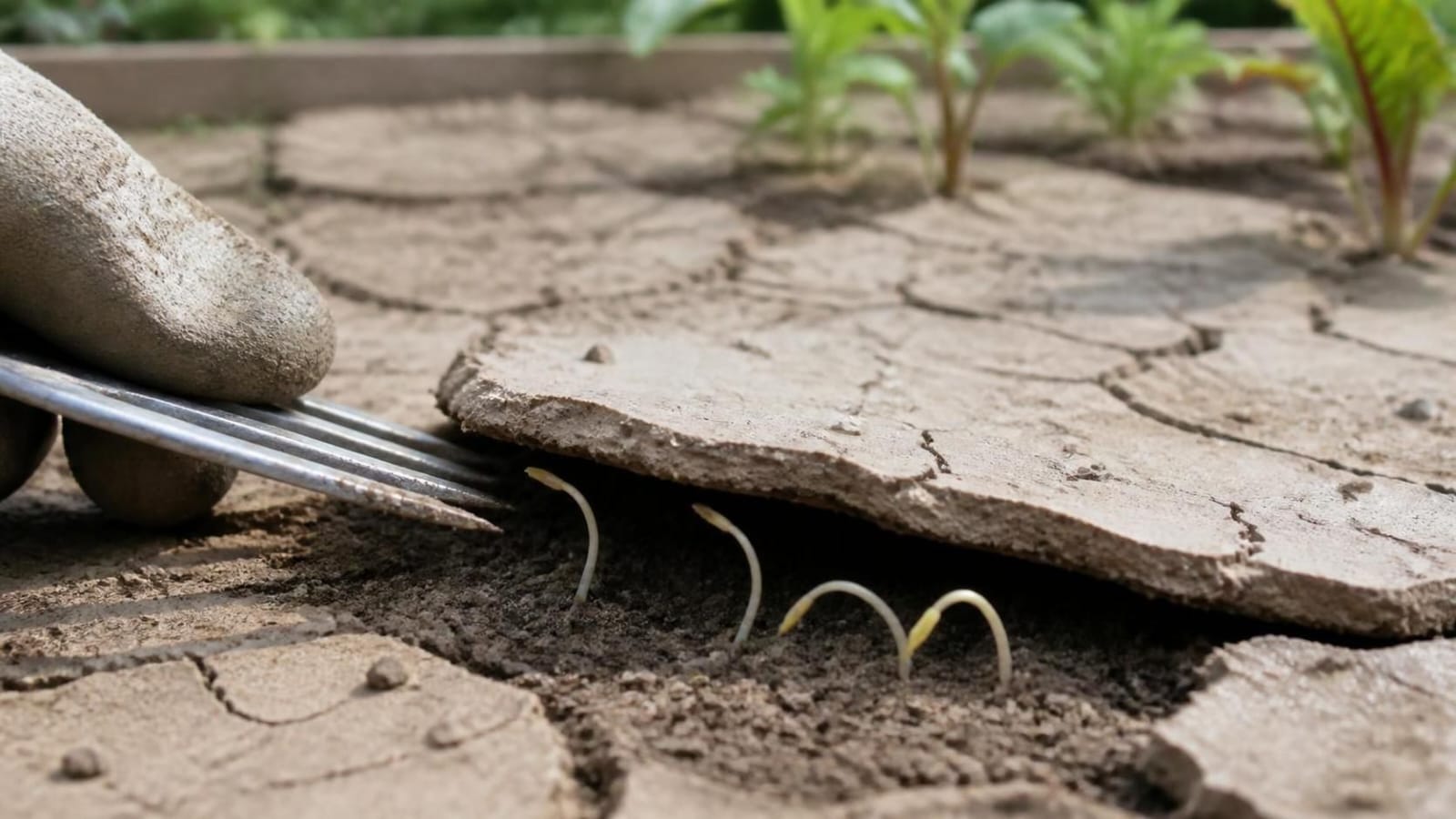
The shelf can have several origins. Soil around new homes is typically compacted by construction traffic, and years of cultivation at the same depth can create a hardpan. There is also a subtler version that gardeners build themselves. When two soils of different texture meet, water must fill the upper layer completely before it moves into the lower one, even if the lower layer has larger pores. That is why topsoil spread over hard subsoil, a raised bed filled with fresh compost on top of clay, or a layer of stones under planting soil can all hold more water than you would expect. The recommended remedy is to cultivate so the layers mix.
Groundwater, springs and leaks
Sometimes the water is not coming from above at all. The RHS asks gardeners to identify the source first: heavy rain, groundwater flooding or overflowing drains. It also notes that natural springs may occur and need piping away, and that broken pipes can cause wet spots until they are mended. A patch that stays wet through dry weeks while the rest of the garden dries out suggests something is feeding it from below, although only a test pit or a plumber can confirm that. If you believe the water comes from overflowing drains outside your garden, the RHS advises contacting your water company.
More water is arriving than the ground can take
Every patio, path and driveway sheds rain onto whatever soil is left. The RHS points out that hard landscaping stops rainfall soaking in, so the remaining soil must absorb more runoff. Downpipes discharging onto a lawn, paving that falls towards a border and sprinklers running too often all add to the load. Colorado State notes that many surface drainage problems come from irrigating too much or too often, and suggests several shorter cycles when water runs off instead of soaking in. Even a grade that looks reasonable can hide shallow low spots where water collects.
Match the fix to the cause
Once the pit has told you where the water is stuck, the repair becomes a short list. Start at the top and go only as far down as your garden needs.
- Stop making it worse. Stay off wet ground, because walking on it squeezes out the air that is left; the RHS advises keeping off until the soil is workable. If you irrigate the area, cut back.
- Sort out the outlet first. Where there is nowhere for water to go, the RHS suggests a ditch or seasonal pond at the lowest part of the garden, or a rain garden or bioswale, to catch surplus water and let it soak in slowly. Where an outfall crosses boundaries, talk to neighbours.
- Break the barrier. Colorado State recommends that a compacted layer less than two feet thick be ripped or double dug when the soil is dry enough to work, then irrigated to settle and re-graded once it dries. For thicker layers, it describes boring holes through them, four to six inches wide at roughly six-foot intervals, and filling them with coarse sand or fine gravel. That is heavy work and often a contractor’s job.
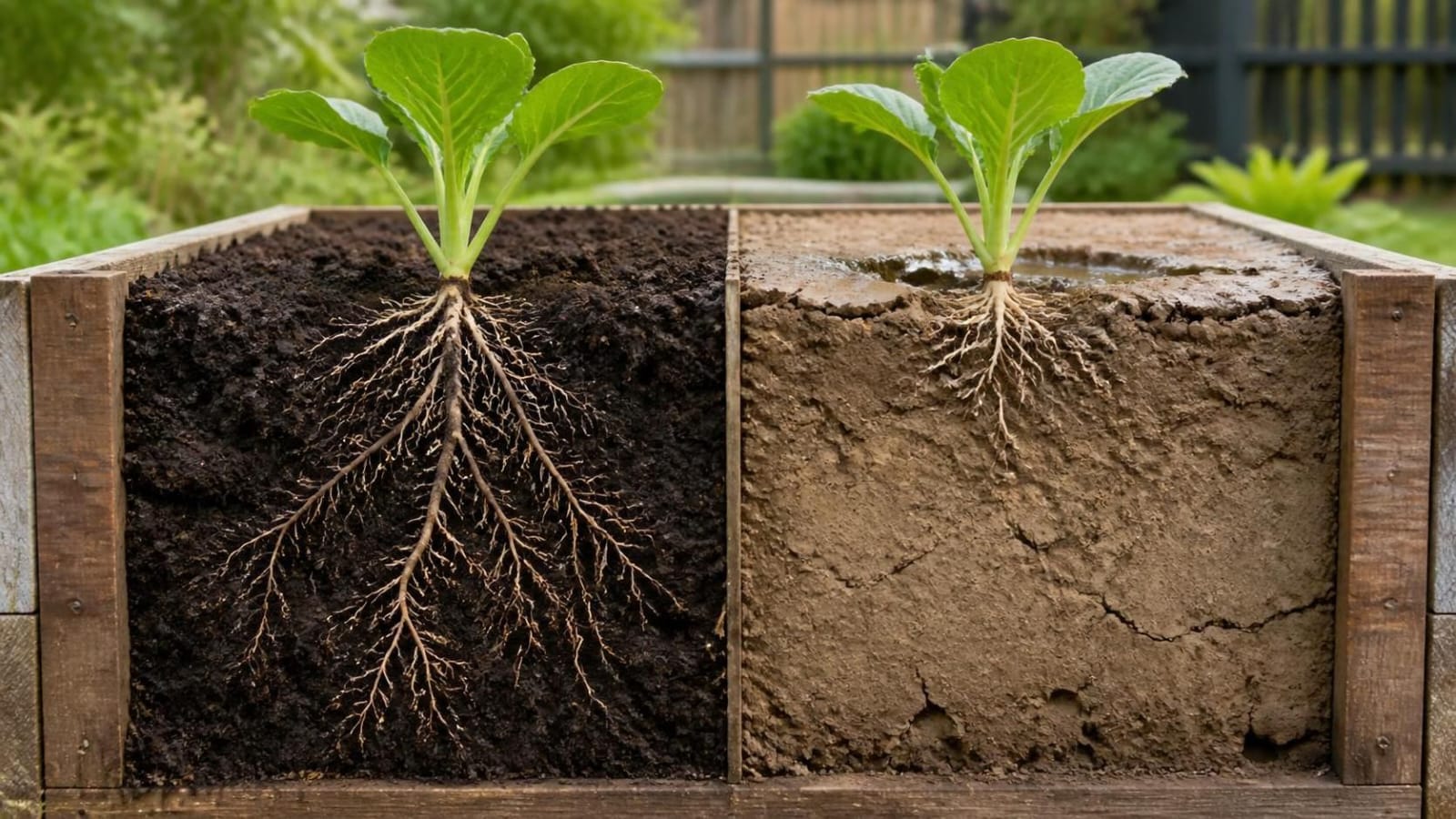
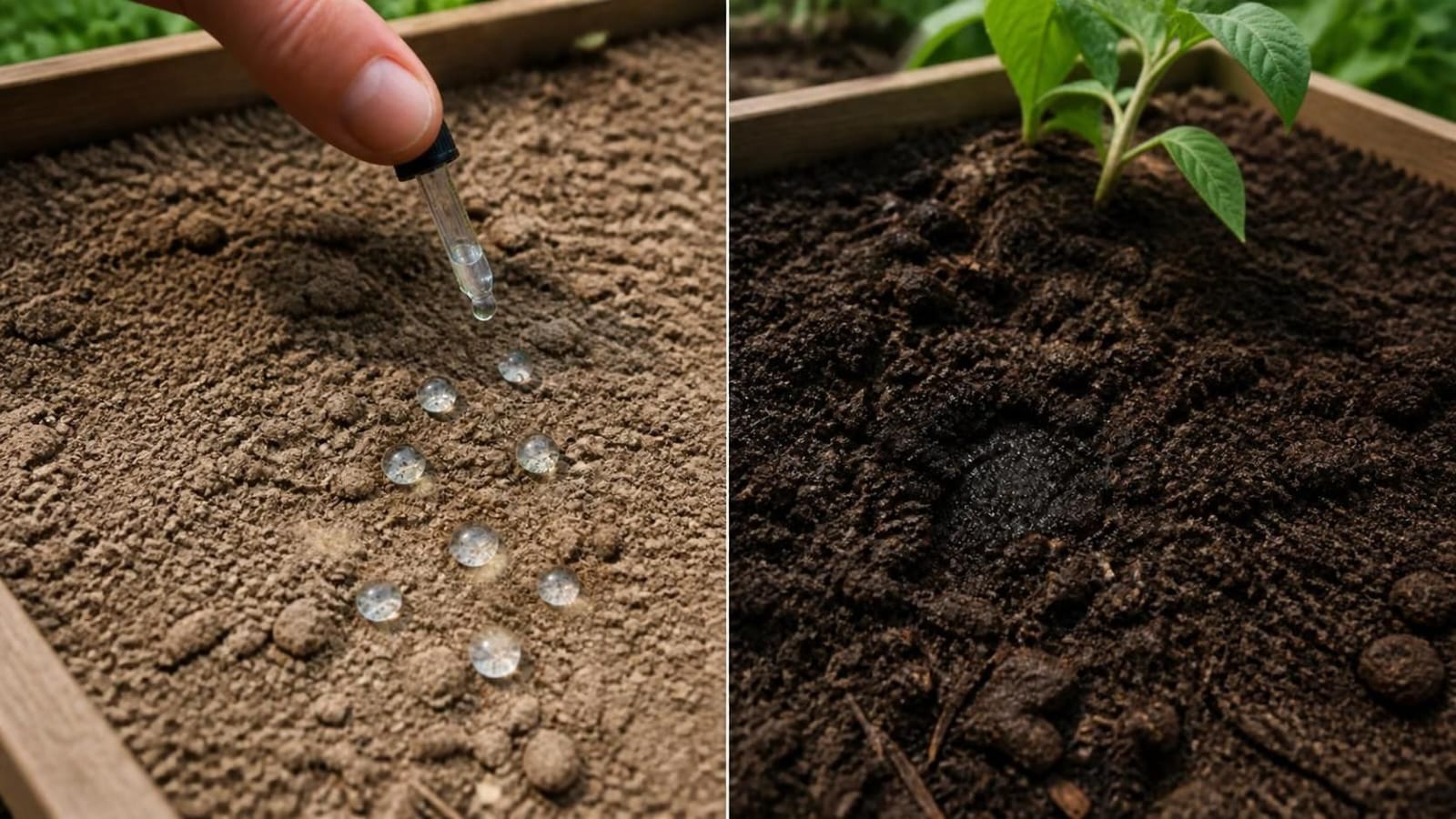
- Feed the structure. Organic matter helps clay particles bind into crumbs and opens up pore space. The RHS says about one barrow load per square metre is needed to make a significant difference, and that sand or grit is seldom effective because it is rarely practical to add enough. Expect improvement over seasons, not weeks.
- Lift the root zone. Raised beds, ridges and shallow mounds for trees and shrubs keep roots above saturated ground. Loosen the surface underneath first and mix the layers where you can, so you do not create the texture boundary described earlier. Where thick clay or rock lies close to the surface, the RHS says raised beds may be the practical answer.
- Be honest about a high water table. If the pit fills from below, Colorado State says the only solution may be to raise the soil level. The RHS offers two routes: accept the wetness and plant a bog garden, or install drainage that has a legitimate outlet.
- Reduce what arrives. Permeable surfaces for paths and patios, diverted downpipes and water butts all lessen the load. The RHS adds that water butts only help if there is space for them to collect water.
If you do decide to install drainage, timing and construction matter. The RHS says burying porous pipes is disruptive and hard in wet soil, so late summer to early winter, when the ground is usually driest, is the best window. For a French ditch, it advises filling the trench with coarse gravel, topping it with a permeable membrane or upturned turf to keep soil out, and finishing with topsoil. Colorado State recommends a slope of at least 1 to 3 per cent, which overlaps with the RHS figure of 1 in 40. Guidance varies with soil and site, so let local conditions and a specialist decide anything large.
What not to do
- Do not add sand or grit to heavy clay hoping to open it up. The RHS says this is seldom effective.
- Do not rely on a layer of stones under the soil to act as a drain. Water has to saturate the soil above before it can enter the layer beneath.
- Do not walk on or dig soil that is still wet. You will compact it and make the problem worse.
- Do not smear the sides of planting holes on heavy soil. The RHS advises pricking the sides with a fork before planting, so the hole does not behave like a bowl.
- Do not connect garden drainage to a sewer or storm drain unless local rules allow it. Rules differ by country and region, and the RHS says byelaws usually prohibit it.
Will the plants recover?
That depends mostly on how long the roots sat in saturated soil and what time of year it was. Roots that are still firm and pale usually regrow once air returns. Black, mushy, foul-smelling roots have often rotted away; the RHS notes that roots can rot away completely, leaving few behind.
Once the soil is workable, the RHS suggests removing damaged shoots, applying organic matter or a balanced fertiliser in spring and mulching over the root area. Foliar feeds during the growing season may help leaf colour and encourage new roots. Follow the product label for any fertiliser and check local rules. The RHS also advises watering thoroughly in dry spells afterwards, because plants that have lost roots are more prone to drought stress.
Wet soil also invites root disease. According to the RHS, Phytophthora root rot is a common example on wet soils, so if shrubs keep declining after the drainage is fixed, it is worth investigating. And if flooding came from overflowing drains, the RHS says root crops and plants eaten raw near harvest should be discarded, and that it is prudent to avoid growing salads and other uncooked crops for two years. Crops that will be cooked should be safe the following year.
Timing, and when to call a specialist
Look at your garden in more than one season. The RHS points out that soil which is wet in winter and dry in summer is a characteristic of clay, whereas a truly wet soil stays wet all year. That distinction decides whether you need drainage or simply better plant choices. Test again after the first heavy rains of autumn, because that is when a repair shows whether it worked.
Bring in a specialist when the wet area is large, the garden is on a slope, water is reaching a building or retaining wall, there is no obvious outlet, or the pit fills from below. Permits, approved methods and discharge rules vary by country and region, so check local requirements before connecting anything.
Quick answers
Can a French drain fix a wet garden on its own?
Only if two things are true: the soil can deliver water to the trench, and the pipe discharges somewhere that will accept it. If a compacted layer or a high water table is the real cause, the drain treats a symptom. Fix the layer or the level, or combine the drain with raised planting.
How can I tell waterlogging from drought stress?
Look underground, not at the leaves, because both cause wilting. Check how wet the soil is at root depth and what colour the roots are. Blue-black roots with a sour smell point to waterlogging, while dry, crumbly soil around pale roots points to thirst.
Will raised beds solve the problem?
They often do, because they lift roots above saturated ground. How well they work depends on what lies underneath. If a bed sits on compacted clay, loosen the ground beneath it and, where practical, mix the bottom of the bed into the soil below so water is not stopped at a sharp boundary.
What can I grow while the soil is still wet?
The RHS’s top picks for wet soils include Cornus alba, Hydrangea paniculata, hostas and Zantedeschia aethiopica. Its wet-soil guidance also warns that drought-tolerant Mediterranean plants dislike waterlogging, so keep them for the driest, best-drained spots.