
Walk down the cucumber row on any morning in early summer and you may find a happy mess of yellow blooms, dozens of them, and not a single baby cucumber anywhere. The vine looks healthy. The leaves are glossy. Yet every flower you inspect seems to sit on a thin, straight stalk with nothing behind it.
In many gardens this is not a fault at all, only a stage. In others it signals a real problem with temperature, stress or feeding that is holding female flowers back. The trick is knowing which situation you are in, and that starts with looking closely at the flowers themselves.
The short answer: young cucumber vines normally open male flowers first, and female flowers follow a few weeks later, so waiting is often the right move. If the vine is mature and still mostly male, look at heat, long days, crowding, stress, and heavy nitrogen with too little water. Also check your variety, because some cucumbers are bred to carry many more female flowers than others.
Start by checking which flowers you actually have
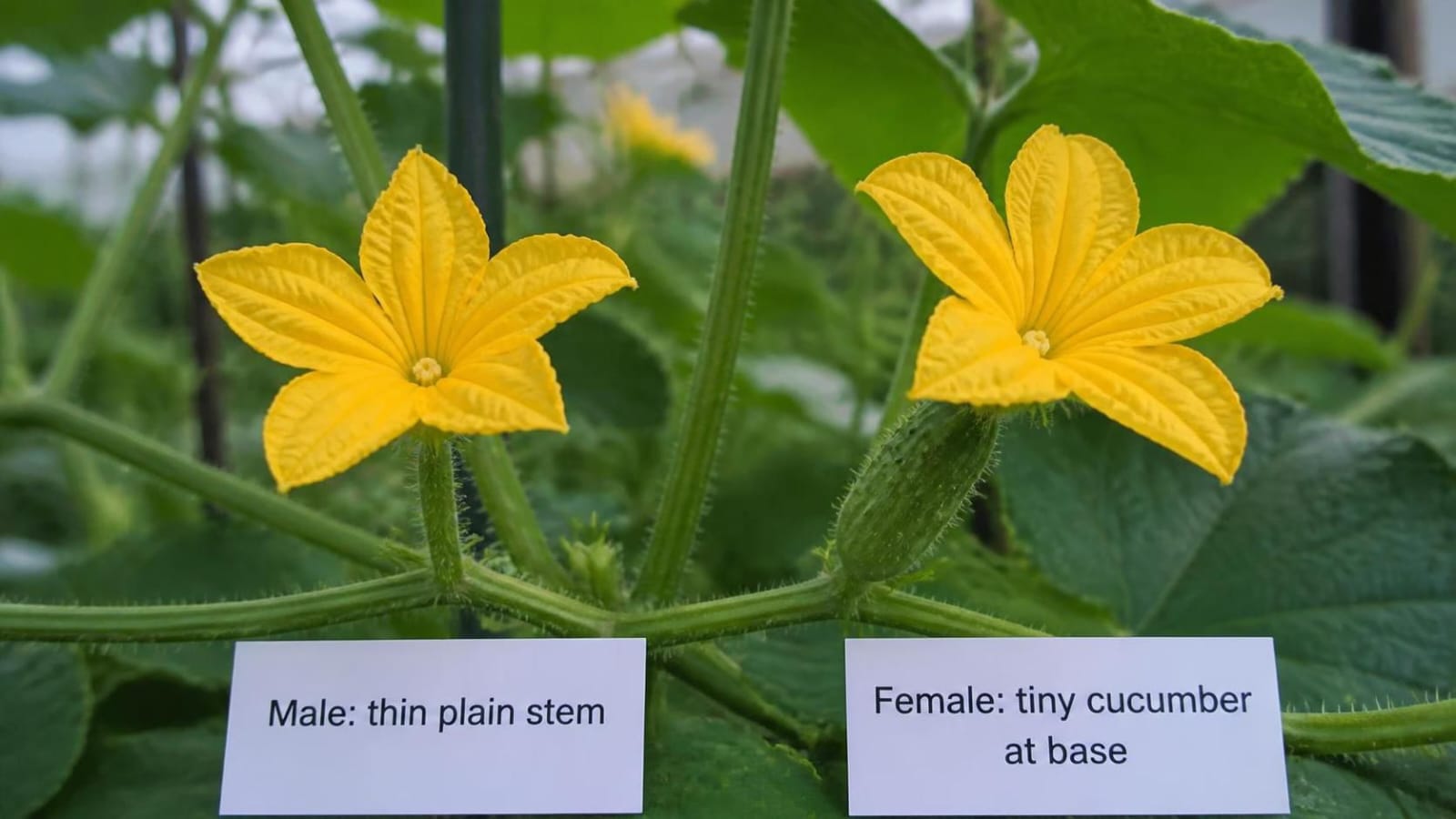
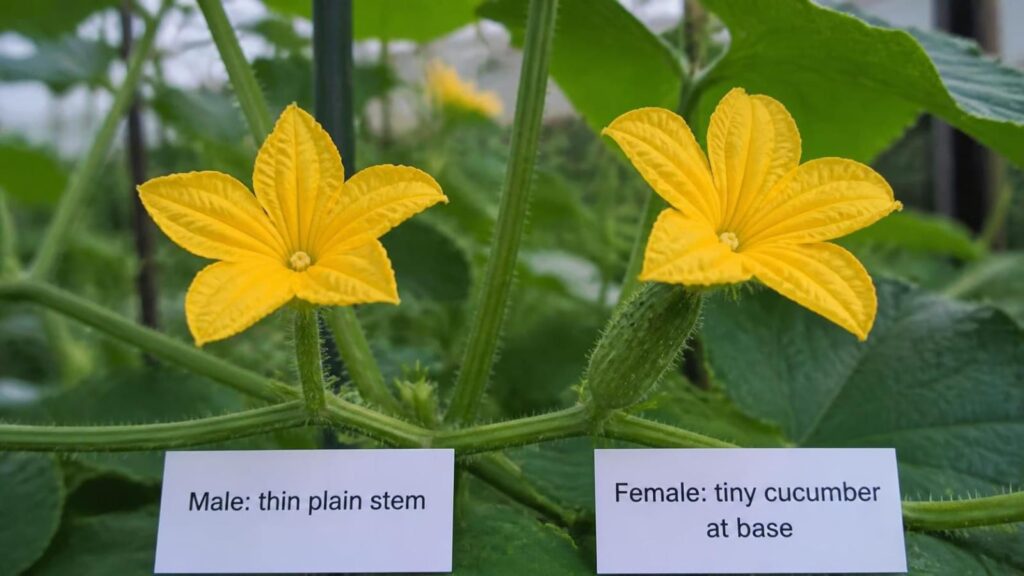
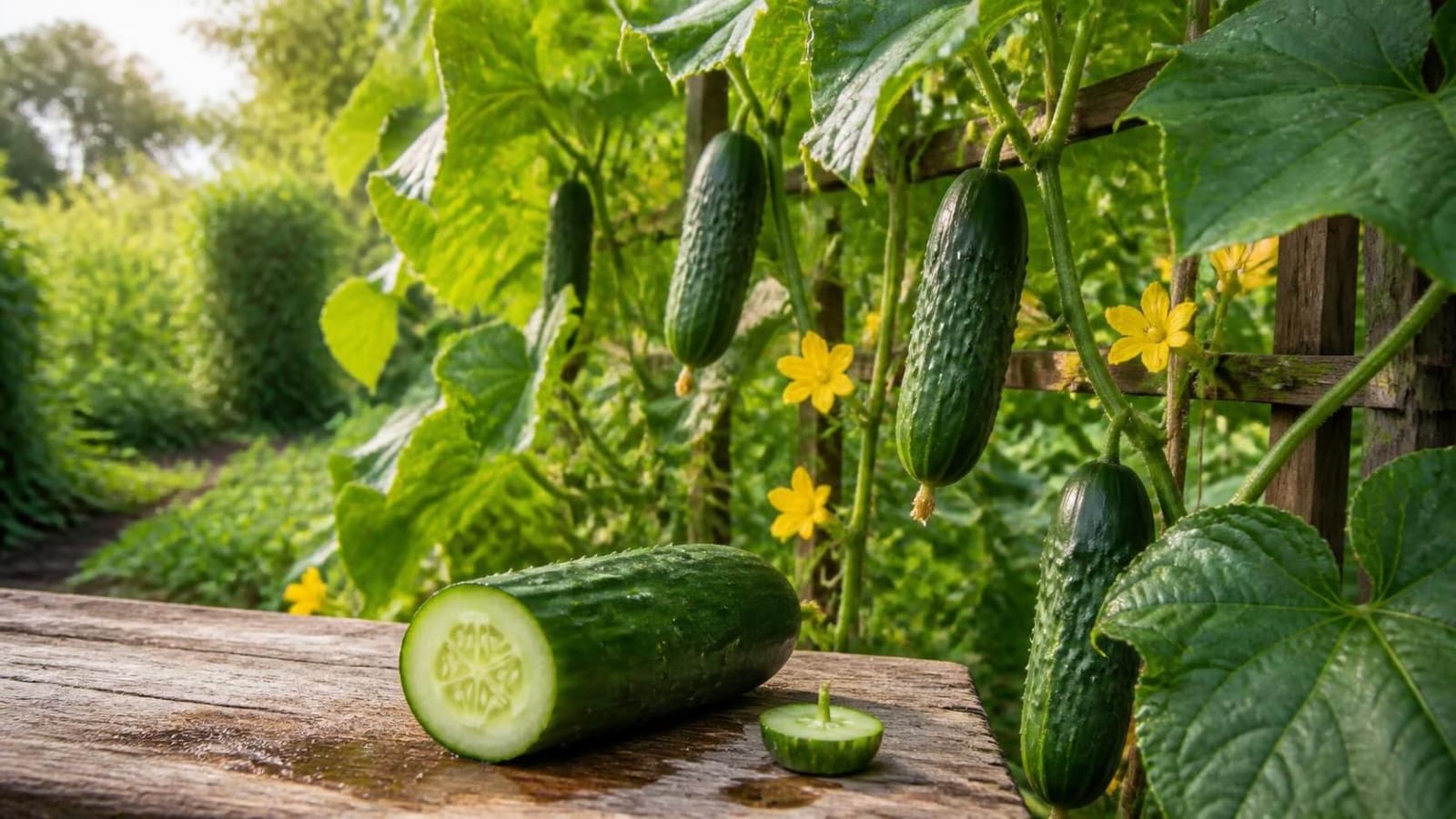
Cucumbers are monoecious, meaning each plant carries separate male and female flowers. The two look alike from the front. The giveaway is behind the petals: Iowa State University Extension explains that female flowers have a small, immature fruit at their base, shaped like a miniature cucumber, while male flowers sit on a plain thin stem. Ask Extension gives the same tip, noting that male flowers lack that tiny cucumber.
Spend two minutes counting before you worry. Look at the nodes along the main vine and the side shoots. Tiny swollen ovaries tucked among the leaves are easy to miss, especially when the flowers have already closed for the day.
Why a vine full of male flowers is often perfectly normal
The same Iowa State page says the first flowers on cucumbers and other vine crops are predominantly male, which is why fruit production looks poor at first, and that a good crop should start within a few weeks as female flowers increase. The University of Hawaii cucumber production guide describes the same order: staminate (male) flowers come first, followed by pistillate (female) flowers that become the fruit.
There is also a built-in surplus. In ordinary monoecious varieties, male flowers keep outnumbering female ones for the life of the plant. That is simply how the plant makes sure there is plenty of pollen. You should not expect an even split, and you should not remove male flowers, since female flowers on these varieties need them for pollination.
So the first question is about age and timing. If your vines are young, are still putting on length, and have only just begun to flower, give them time. If they have been flowering for several weeks and the nodes still show no ovaries, the plant may be under pressure of some kind.
What pushes a cucumber toward male flowers
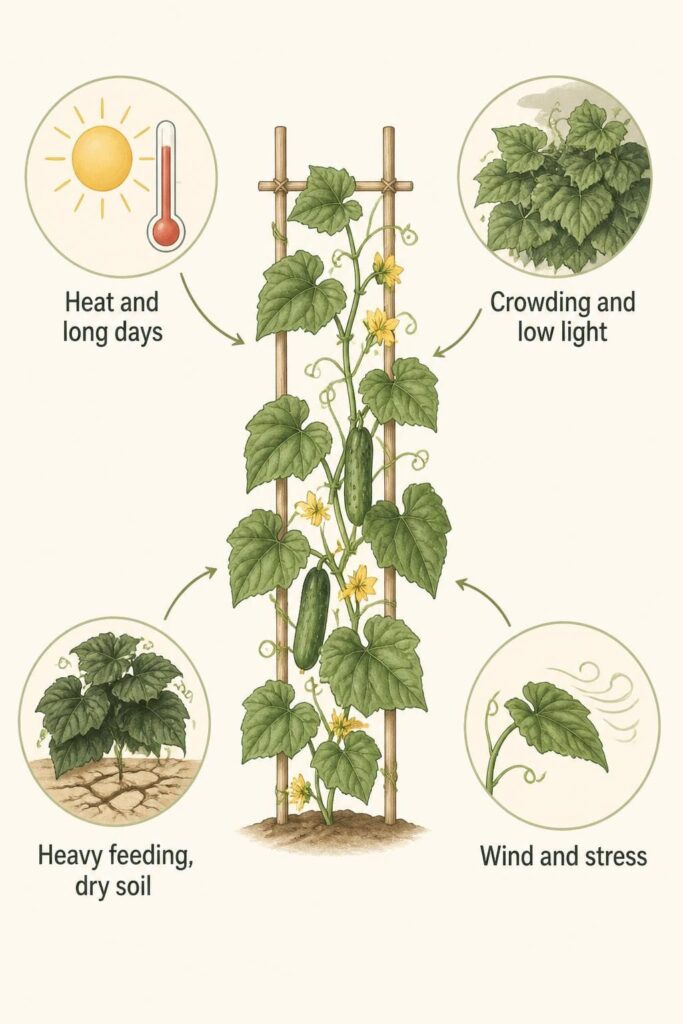
Cucumber sex expression is unusually flexible. A review in the journal Molecular Breeding, which you can read through the Springer paper on cucumber sex determination, describes the system as very sensitive to outside conditions, with day length, light intensity, temperature and hormones all shifting the pattern of flowers. The practical lessons from that research and from extension guidance fall into a handful of groups.
Heat and long days
The same review reports that long days and high temperatures stimulate male flower formation, while female flowers form under shorter days and cooler conditions. In one controlled study of photoperiod, long days cut the female flower ratio by roughly 18 to 53 percent, and the effect was stronger under cooler conditions; you can see the data in the photoperiod and sex expression paper. A companion temperature and photoperiod study notes that high temperature and long days both lower the female ratio, with temperature the stronger influence.
Night temperature seems to matter on its own. In one experiment on a single cultivar, researchers working on night temperature found that a cool night encouraged female flowers while a warm night produced only male ones. That was one cultivar under controlled conditions, so treat it as a clue rather than a rule. Still, it fits what many gardeners see: a vine that sulks through a hot spell and then starts producing females when nights cool.
Stress, crowding and low light
The Hawaii guide lists several stresses that can lower female flower numbers even in varieties bred to have lots of them: dense planting, insect attack, wind damage, and low light combined with high temperatures. A crowded trellis in a shady corner during a hot week is exactly this recipe.
Heavy feeding with too little water
An older Michigan State University thesis on cucumber sex expression reports that high nitrogen and low water favored male flowers, while other work in the same area found nitrogen effects depended on the setup. A more recent study of nutrient levels, linked here as the nutrient and pollination experiment, found that high nutrient conditions raised flower numbers overall and, at one pollination level, raised male flower numbers specifically. The takeaway is cautious. Very lush, heavily fed vines that are also running dry are the ones most worth checking. Underfeeding is unlikely to help either, since female flowers cost the plant more energy to make than male ones.
Variety type
Some cucumbers are bred to flower very differently from the old-fashioned kind. The table further down explains the main groups. If you are growing a monoecious heirloom, a long male-heavy start is normal. If you are growing a hybrid sold as all-female, a surplus of male flowers is the unusual result.
Work out what fits your vine
Use this table to match what you see with the most likely explanation. More than one row can apply at once.
| What you notice | Likely cause | How to check | What to do |
|---|---|---|---|
| Vine is young, flowering has just started, all flowers are male | Normal early male phase | Look at the age of the plant and wait a couple of weeks | Keep watering evenly and do nothing drastic |
| Mature vine, hot weather, long days, and hardly any ovaries on the nodes | Heat and day length favoring male flowers | Compare the stretch of hot days with when female flowers stopped | Shade the vine in the hottest part of the day, water evenly, and wait for cooler spells |
| Crowded trellis, shaded patch, or windy site | Stress from crowding, low light or wind damage | Check spacing, light on the leaves, and torn or battered foliage | Thin or retrain vines, add a windbreak, and improve light |
| Very dark green, soft growth after generous feeding, soil drying quickly | Heavy nitrogen with uneven watering | Review what you applied and how often the soil dries out | Ease off the feeding and keep moisture steady |
| Plenty of ovaries present but small fruit yellow and shrivel | Poor pollination rather than a flower-sex problem | Look for few bees, cold or rainy spells, or recent insecticide use | Hand-pollinate and protect pollinators |
| Only one or two female flowers on a variety sold as monoecious | Normal for that type, or immature plant | Check the seed packet or plant tag for the sex type | Be patient and make sure male flowers are left in place |
Steps that help the vine make female flowers
- Confirm the problem by counting ovaries along the vine before changing anything.
- Give young vines time. A few weeks of male-only blooming at the start is common.
- Keep the soil evenly moist. Dry spells add stress, and the research above ties low water to more male flowers.
- Shade during heatwaves where you can, for example with a light cloth over the hottest hours, and help the roots stay cool with mulch.
- Thin crowded growth so light reaches the leaves, and tie vines up on a trellis rather than letting them pile up.
- Feed according to a soil test or product label, and avoid pushing growth with heavy nitrogen.
- Look again after a cooler stretch, since female flowers often return as nights cool.
What not to do
- Do not pull off the male flowers on ordinary varieties. They are the pollen source for your fruit.
- Do not reach for plant hormone products. Ethylene-related compounds are used by breeders to alter flowering, but doses and approvals vary by country, and home use is not something to guess at. Read the label and check local rules if you ever consider one.
- Do not keep adding fertilizer in the hope of forcing flowers. That tends to push leaves and can make the imbalance worse.
- Do not replant too soon. A slow vine often catches up once the weather settles.
When female flowers are there but fruit still does not form
Sometimes the count is fine and the fruit still disappoints. A female flower only stays open for about a day, and the pollen has to arrive during that window. The Ask Extension answer points to cold, rainy weather that keeps bees away and to insecticides that harm them as common reasons for poor fruit set. If the same pattern sounds familiar from your tomatoes, note that tomatoes carry both parts in a single flower, so their problems have different roots; our guide to tomatoes flowering but not setting fruit walks through those causes so you can compare them with what you see on your cucumbers.
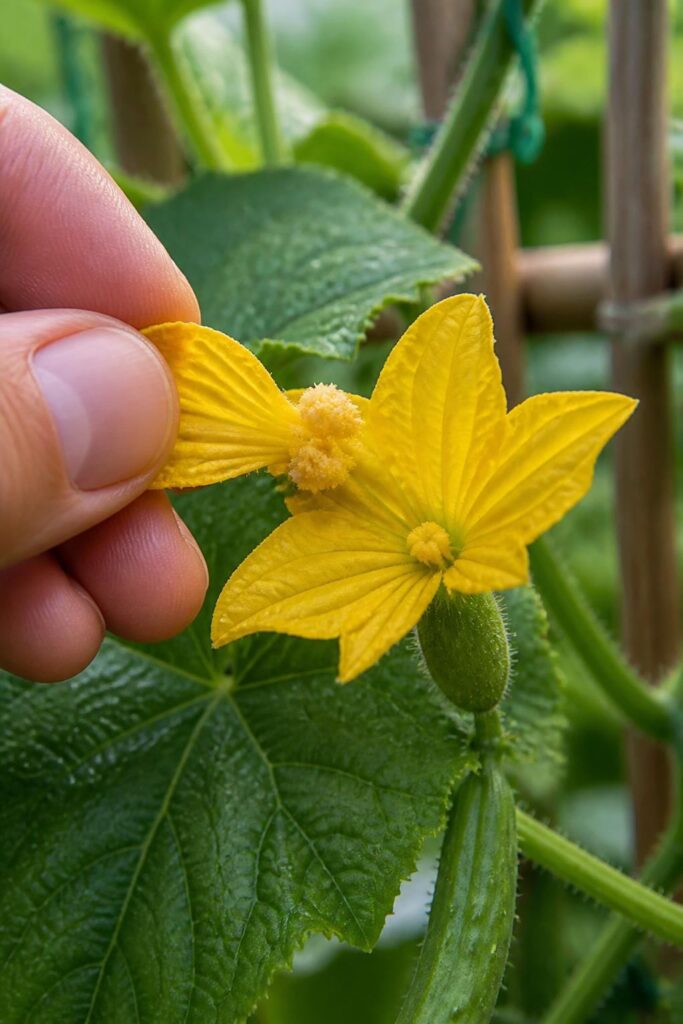
Hand-pollination is simple and works well for a short run of poor weather. The Ask Extension advice is to remove a male flower, peel back its petals, and gently transfer the pollen into the female flowers, using a small brush, a feather, or the male flower itself. Do it in the morning while the flowers are open. A female flower can be pollinated with pollen from any male flower on the vine.
Know your cucumber type before judging the flowers
| Type | Flowers to expect | What it means for you | Pollination |
|---|---|---|---|
| Monoecious (most traditional varieties) | Male flowers first, female flowers later, and more males than females overall | A male-heavy vine is normal; wait for ovaries to appear | Needs male flowers and pollinators |
| Gynoecious (all-female hybrids) | Almost only female flowers, up to many times more than monoecious types | Many male flowers would be unusual for this type | Usually sold with some monoecious seed as a pollen source |
| Predominantly female hybrids | Mostly female, with a small number of males | Expect few males; do not remove them | Needs pollen from the few males present |
| Seedless greenhouse-type cultivars | Flowers set fruit without pollination | Pollination can distort the fruit, so keep bees away if growing under cover | Pollination not wanted |
The Hawaii guide supports the key points in this table: gynoecious cultivars can bear up to thirteen times more female flowers than monoecious ones, the so-called PF hybrids produce mostly female flowers with a few male ones, and pollination of some cultivars causes misshapen fruit. When in doubt, check the seed packet, because the type is often printed there.
How long should you wait?
There is no exact number, because weather and variety change the timing. As a general guide from the extension sources, a young vine that has just started to bloom should begin producing ovaries within a few weeks. If the plant is well grown, has had steady moisture, and several weeks pass with still no female flowers, go back to the heat, crowding and feeding checks above rather than adding more products.
If a hot spell is the cause, expect the pattern to improve when conditions ease, particularly when nights cool. Fruit already formed will keep growing, and new female flowers should open on fresh growth.
Quick answers
Is it bad if my cucumber has only male flowers?
Not at the start of the season. It becomes worth investigating only when a mature, healthy vine stays male-heavy for weeks.
Can a male flower turn into a female flower?
No. Each flower is already one or the other, but new flowers that open later can be female as conditions and plant age change.
Do squash and zucchini behave the same way?
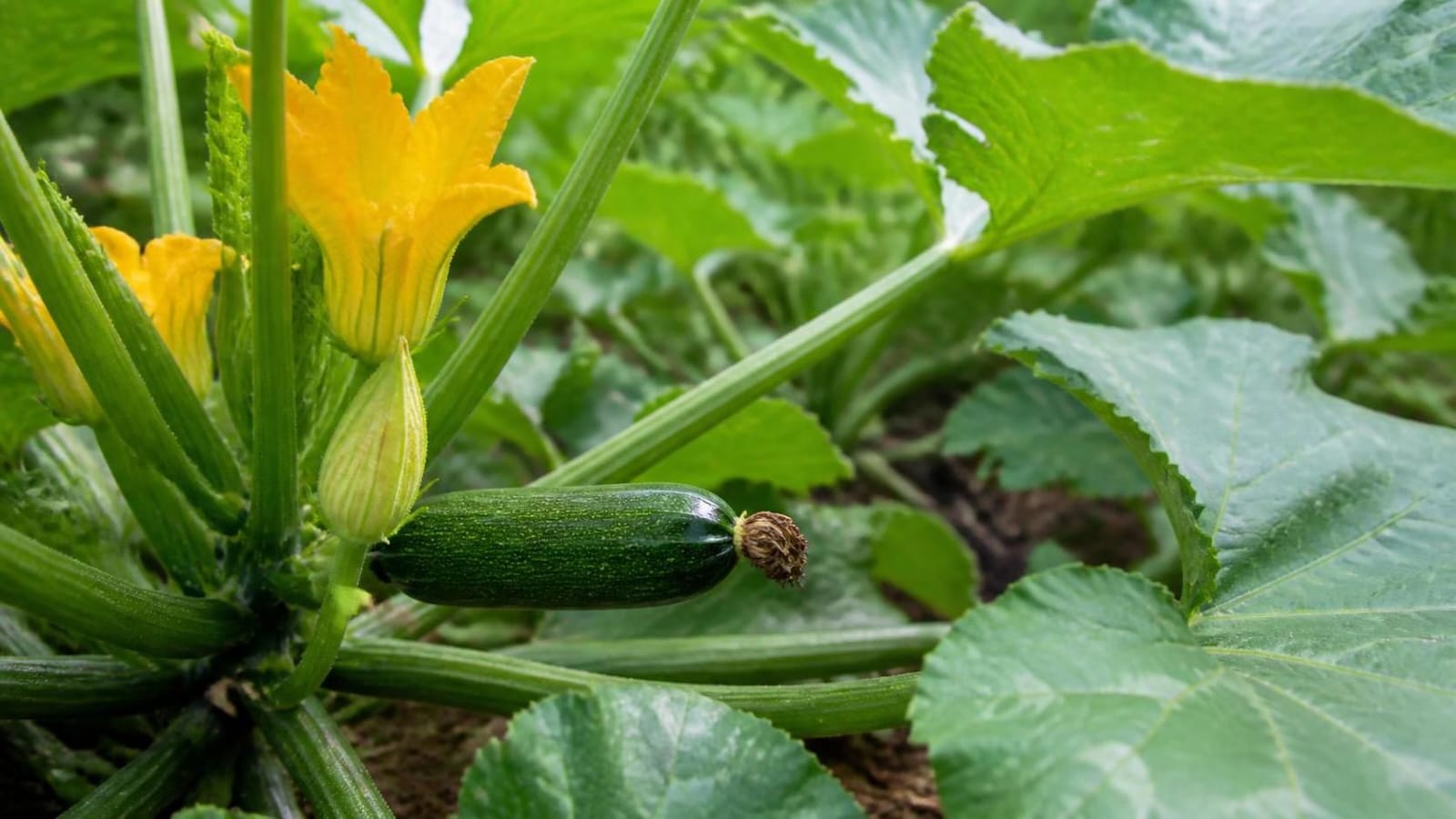
Largely yes. The Iowa State and Ask Extension answers describe cucumber, squash and melon as plants that often bear many male flowers before females appear, so the same patience and checks apply.
Once you can tell the two flowers apart and have ruled out heat, crowding and feeding problems, a male-heavy vine usually stops looking like a mystery and starts looking like a plant that simply needs a little more time.
2 thoughts on “Cucumber Male Flowers but Few Female: Causes & Fixes”