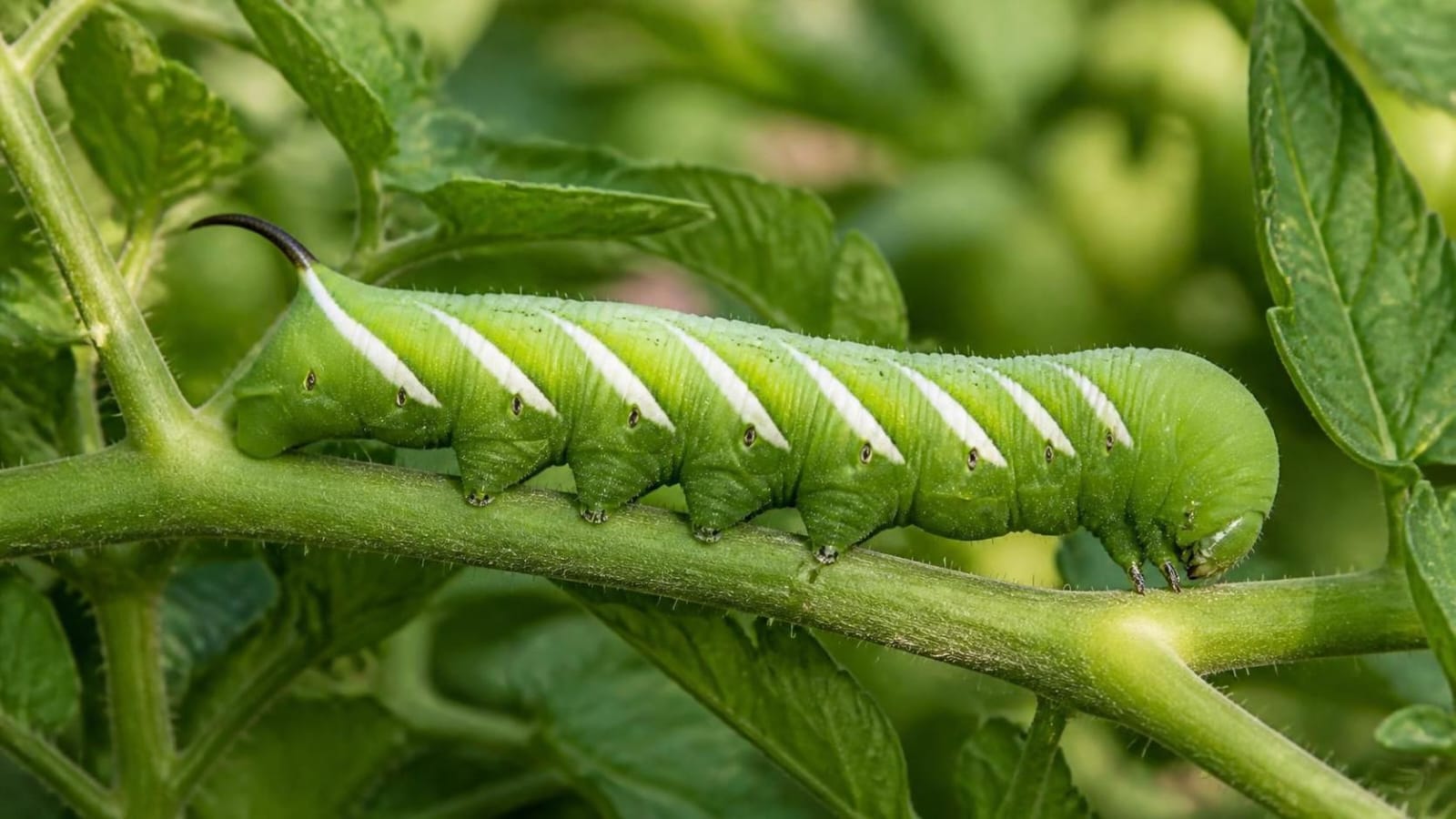
Quick answer: Tomato hornworms are large green caterpillars that can strip a tomato plant of its foliage. Handpick them when that is practical, leave any hornworm carrying white parasitic wasp cocoons alone, and use Bt on young caterpillars if you need more help.
A tomato plant can look fine on Monday and be half stripped by Friday. Hornworms are behind many of those sudden losses, and the odd part is that a caterpillar as long as your finger can sit in plain sight and still go unnoticed.
This guide helps you confirm the culprit before you act, shows what to do and what to skip, and covers the steps that lower your numbers next year. Where a product is involved, the label on the container is the final word.
First, make sure it is a hornworm
Several pests chew on tomatoes, and they call for different responses. Match what you see to the clues below before you reach for a spray.
| What you see | Likely cause | How to confirm |
|---|---|---|
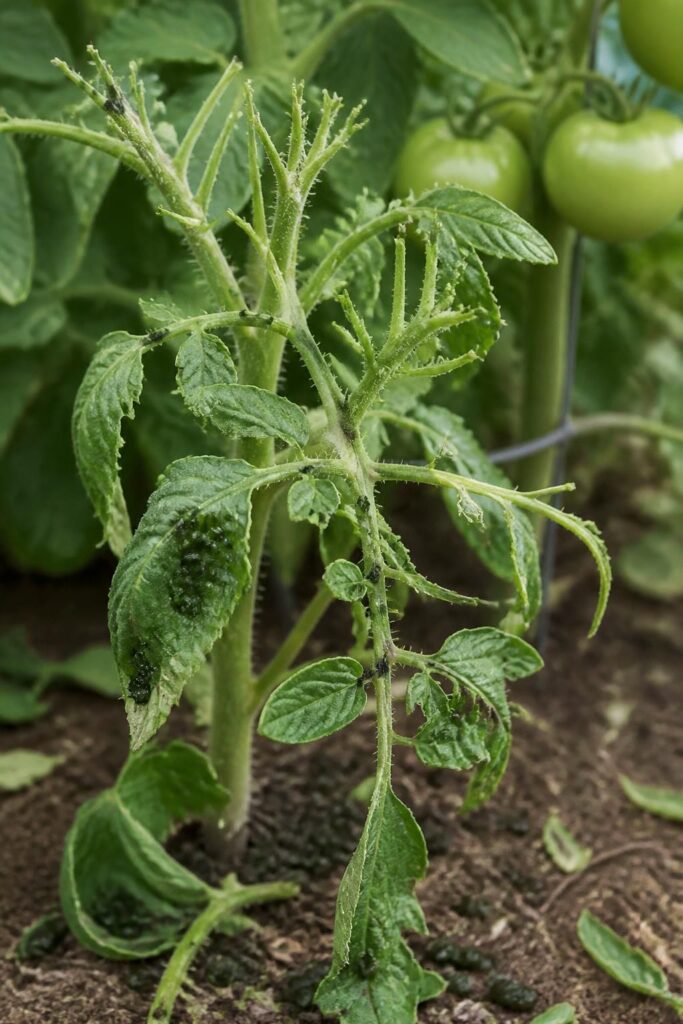
| Whole leaves and stem tips stripped, starting near the top, with large dark green or black droppings below | Tomato or tobacco hornworm | Search stems and leaf undersides for a large green caterpillar with a horn on its tail. The droppings are dark and blocky, and bigger droppings point to a bigger caterpillar. |
| Deep holes in ripening fruit, usually from the stem end, while leaves stay mostly intact | Tomato fruitworm | Look for a caterpillar feeding in or beside the hole. Fruitworm mainly damages fruit, while hornworms mostly eat foliage and only sometimes chew fruit. |
| Thin, winding white trails inside the leaf | Leafminer | The trails show on the upper leaf surface, and the damage stays inside the leaf tissue. |
| Twisted new growth with a sticky residue | Aphids or whiteflies | Turn leaves over and look for tiny insects clustered on the undersides. |
| Leaves look healthy, but flowers fall before fruit sets | A flower-drop or fruit-set problem, not a chewing pest | No missing leaf tissue and no droppings. Hornworms can feed on blossoms too, but they normally leave obvious leaf damage as well. |
One more distinction helps when leaves are missing. University of Maryland Extension notes that caterpillar damage tends to sit on interior leaves or spread across the canopy, while deer browsing usually removes leaves from one side of the plant. And if the foliage is fine and the flowers are the part that is failing, the answer lies elsewhere. This guide to tomato flowers dropping before fruit covers the usual causes.
What tomato hornworms look like at each stage
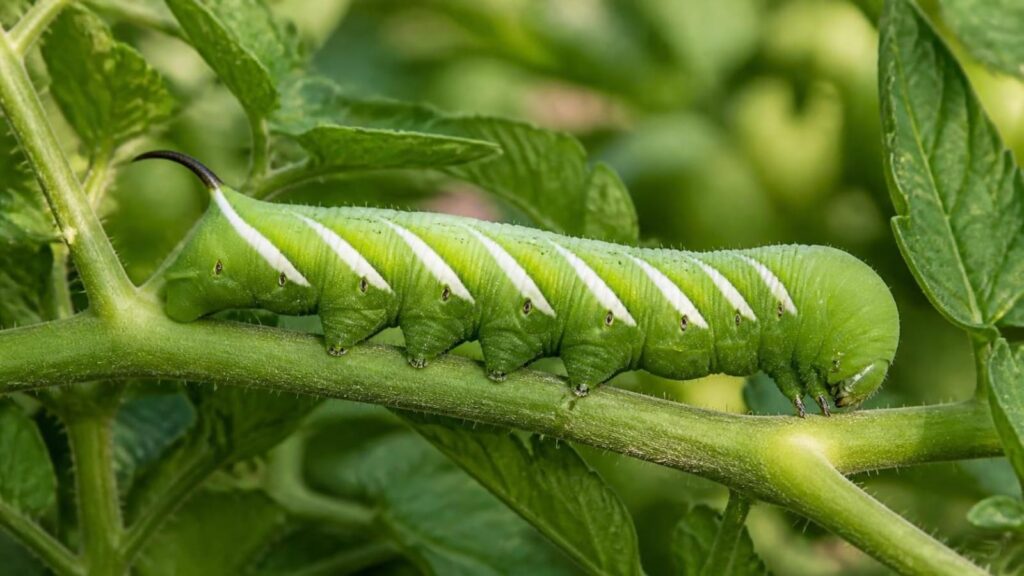
The caterpillar does the damage. Fully grown, it is among the largest caterpillars in a vegetable garden, reaching up to about four inches, according to University of Minnesota Extension. The same source notes that newly hatched ones are yellowish white and carry none of the markings, so the telltale pattern is not a reliable guide while they are small.
Tomato hornworm or tobacco hornworm?
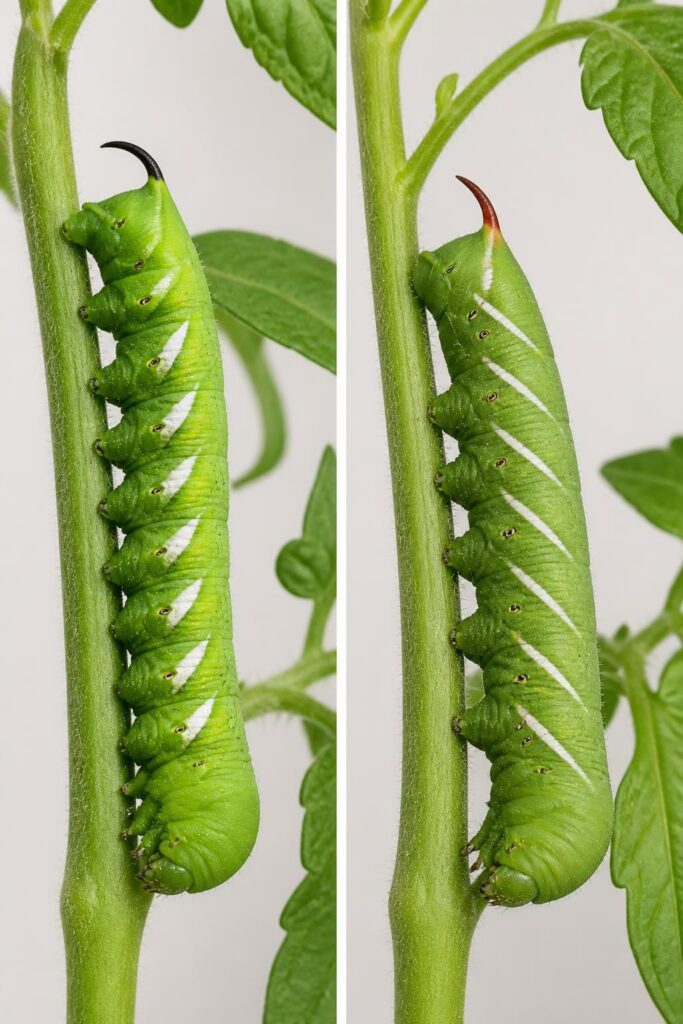
Two closely related species turn up on tomatoes, and they are easy to confuse. The markings on the sides of larger caterpillars are the clearest difference.
| Feature | Tomato hornworm | Tobacco hornworm |
|---|---|---|
| Side markings | Eight white V-shaped marks on each side | Seven diagonal white stripes |
| Horn | Black and less curved | Reddish |
| Adult moth | Five-spotted hawkmoth, with five pairs of yellow-orange spots on the abdomen | Carolina sphinx moth, typically with six pairs |
| Where you are most likely to meet it | Widely distributed in North America but uncommon in the Southeast | Replaces the tomato hornworm in much of the Southeast, including Florida |
| Scientific name | Manduca quinquemaculata | Manduca sexta |
The marking and horn details come from University of Maryland Extension and UF/IFAS, which also reports that tobacco hornworm is the usual cause of hornworm damage on Florida tomatoes. Both species feed mainly on tomato and, less often, on pepper, eggplant and potato, and they are handled the same way, so a mix-up costs you nothing.
The eggs and the moth
Eggs are small, smooth and pale green, laid singly on leaves. The adult is a heavy-bodied, mottled gray-brown moth with a wingspan of four to five inches. It feeds on flower nectar at dusk and after dark, hovering like a hummingbird, which is why it is also called a hummingbird moth or hawk moth. The moth does not eat your plants. The caterpillars do.
How to find a hornworm that blends into the leaves
The green body matches the foliage almost perfectly, so search by clues instead of by eye alone.
- Start where the damage is freshest. Feeding usually begins at the top of the plant, so look for missing leaves and bare leaf stalks there, then check the stems and leaf undersides nearby.
- Follow the droppings. Dark, blocky droppings on leaves or on the ground mean a caterpillar is feeding above. Late-stage caterpillars leave droppings about the size of a pea.
- Look at dusk, dawn or after dark. Hornworms feed in the open at lower light, so a flashlight sweep can find ones you missed by day.
- Treat a UV flashlight as an extra, not a test. UV light can make some hornworms easier to spot at night because they may fluoresce, but results vary, and a clear result does not mean the plant is clean.
- Check on a schedule. University of Minnesota Extension advises inspecting plants at least twice a week through summer. Spraying plants with water to make hidden caterpillars move is sometimes suggested, but it is only a minor aid.
What to do once you find one
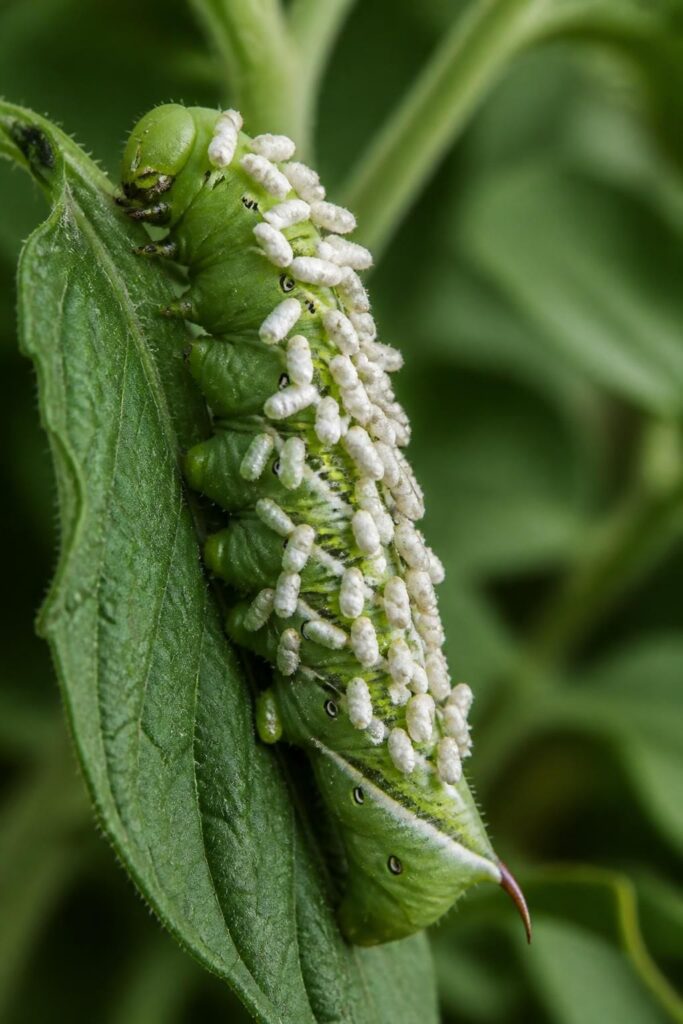
- Look for cocoons before you remove anything. A hornworm carrying small white, rice-like cocoons has been parasitized by a braconid wasp. University of Maryland Extension advises leaving it alone: a parasitized hornworm stops eating and eventually dies, so it will not cause more damage, and the wasps that emerge go on to suppress future hornworms.
- Pick off the rest by hand. For a home garden this is the most effective method, according to University of Minnesota Extension. Large caterpillars grip the plant firmly, so pulling takes some force, and UC IPM also suggests snipping them with shears. Dropping them into soapy water is the usual way to dispose of them.
- Treat only if numbers keep climbing. Hornworm damage rarely calls for an insecticide, but if hand removal is not keeping up, act while the caterpillars are still small, since young ones are far easier to stop than large ones.
Choosing a treatment, if you need one
Three options come up most often in extension advice. What each one does matters more than the brand name:
- Bt (Bacillus thuringiensis var. kurstaki). A soil bacterium that works only when caterpillars eat it, and it works best on young ones. UF/IFAS notes that rain or irrigation can wash it off, so repeat applications may be needed. It targets caterpillars, so it does not harm bees, but it can also harm butterfly and moth caterpillars you want to keep, so keep it off plants that host them.
- Spinosad. Made from a soil microorganism, it affects the nervous system of insects that eat or touch it. UF/IFAS says the wet spray is toxic to bees and other beneficial insects, with much less effect once residue dries. That does not make it harmless: do not spray open flowers while bees are foraging, apply outside peak foraging hours, and follow every direction on the label.
- Insecticidal soap. It works only on direct contact, mostly on small caterpillars, and leaves no lasting protection, so it may need repeating. Because it kills on contact, it can also harm beneficial insects the spray reaches, so use it selectively.
Approved products, crops listed and rules differ between countries and regions. Use only a product whose label names tomatoes and caterpillars, and follow its directions for rate, timing, protective gear and the wait before harvest. Check your local regulations too. Neem-based products are not a dependable answer for large hornworms, so hand removal is the better choice for those.
What not to do
- Do not destroy a caterpillar covered in white cocoons. It is already carrying the wasps that will help you next.
- Do not start with a broad-spectrum insecticide. University of Minnesota Extension notes that pyrethroid-type products last longer but also kill beneficial insects, including the ones that keep hornworms in check.
- Do not wait for the damage to become obvious. According to University of Minnesota Extension, the last growth stage eats nearly as much as all the earlier stages combined.
- Do not expect Bt to rescue you from big caterpillars. They have to eat it, and it works best on young ones.
- Do not assume a natural product is harmless to bees. Spinosad is the clearest example.
- Do not mix homemade sprays you cannot verify. If the plant safety and legal status are unknown, skip them.
Will the plant recover?
Healthy tomato plants can often recover from moderate leaf loss, but severe defoliation reduces the leaf area available for photosynthesis and may leave fruit exposed to sunscald. A plant stripped to bare stems late in the season has much less time to rebuild than one hit early. Fruit that hornworms have fed on may not mature properly, according to UF/IFAS, so check it before counting on it.
Why they keep coming back
Hornworms spend the winter as pupae in the soil. Moths emerge in spring, mate and lay eggs on the plants, and the caterpillars are fully grown in roughly three to four weeks before they drop to the ground and burrow in to pupate. In Minnesota a second generation of moths appears in mid-summer, and caterpillars can keep feeding into late summer or early fall. UC IPM describes damage as most common in midsummer, with a smaller peak later. Maryland sees one to two generations a year, while UF/IFAS reports three to four in northern Florida, so gardeners in warm regions have a longer checking season.
Preventing hornworms next season
- Cultivate the soil after harvest. UC IPM says discing or rototilling after harvest destroys pupae in the soil, and University of Maryland Extension says tilling in spring or fall may uncover and kill them. Appropriate cultivation will not remove every pupa, and it may not suit a no-dig bed.
- Pull nightshade-family weeds. Horsenettle, jimsonweed and nightshade are alternate hosts, as University of Minnesota Extension points out, and they give moths more places to lay eggs.
- Cover young plants until they flower. Insect netting or row cover can keep egg-laying moths off small plants for a time. It must come off when flowering starts so bees can pollinate, and UNH Extension warns that temperatures under a cover can run as much as 15°F higher than outside. It buys time rather than a permanent fix.
- Rotate where practical. UF/IFAS lists crop rotation among the cultural controls. Moths fly, so do not expect rotation alone to keep them away.
- Protect the helpers. Skip broad-spectrum sprays and leave parasitized caterpillars where they are.
- Scout early. Check leaves for small pale-green eggs and tiny caterpillars at the start of the season, when picking is easiest and Bt works best.
Common questions
Are tomato hornworms dangerous to touch?
They are not known to bite or sting, and the horn is not a stinger. Large ones grip the stem tightly, so pulling takes some force. Gloves are a matter of preference.
Can tomato hornworms kill a tomato plant?
They can cause complete defoliation if they are not removed, per UF/IFAS. Whether the plant survives depends on how much growth is left and how much of the season remains.
Do tomato hornworms eat peppers and eggplants?
Yes. Tomato is the usual target, but peppers, eggplants and potatoes are also hosts, so check them when you check your tomatoes.
What does a tomato hornworm turn into?
A tomato hornworm becomes a five-spotted hawkmoth, and a tobacco hornworm becomes a Carolina sphinx moth. The mature caterpillar burrows into the soil to pupate, and the pupa overwinters there before the moth emerges.