Bright Orange Spots on Pear Leaves: What Pear Rust Is and What Helps
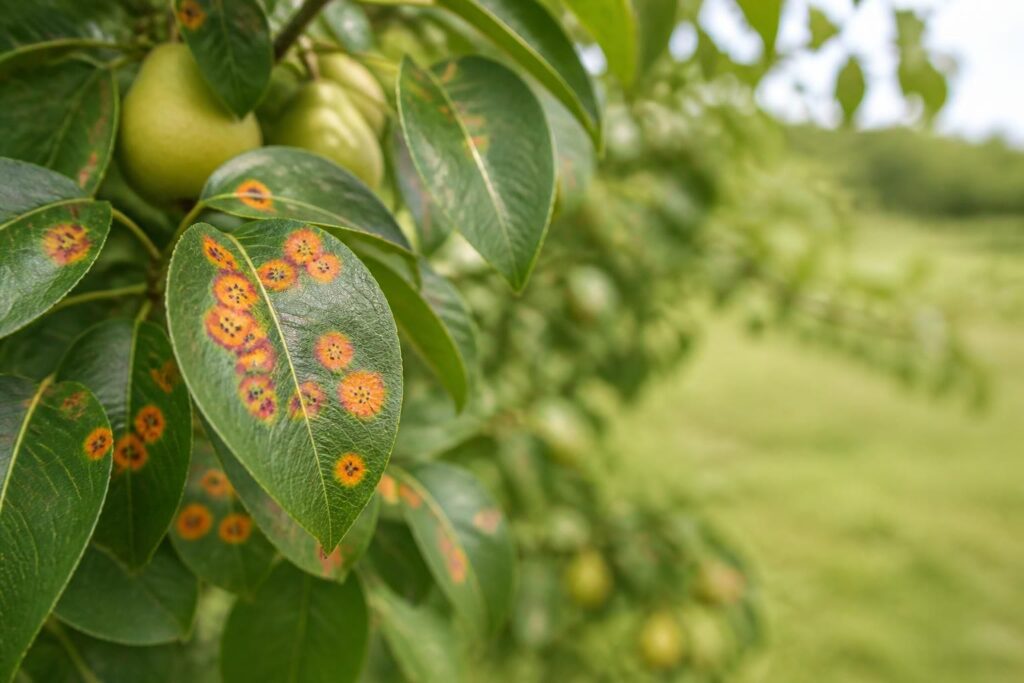
They tend to show up between late spring and early summer: round patches of vivid orange on the upper side of pear leaves, sometimes fringed with red. The tree still looks vigorous, yet the leaves look as if they have been splashed with paint.
Bright orange spots on pear leaves are most often pear rust, a fungal disease that needs two hosts to survive: a pear and a juniper (or a related conifer such as cedar). On the pear it is usually more of a cosmetic problem, though heavy infections can cause early leaf drop and fruit loss. Spraying or stripping leaves in summer will not clear spots that already exist. Real control means breaking the link with the juniper and protecting new leaves in spring.
This guide shows you how to confirm it is rust, why it keeps coming back, and which steps are worth your time.
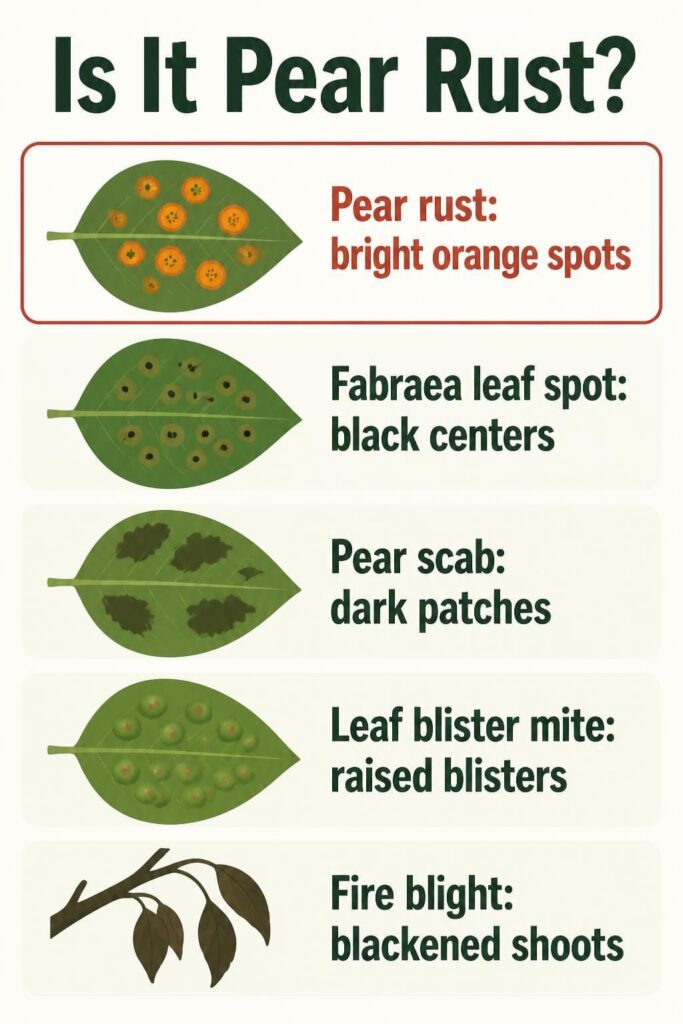
How to tell pear rust from other leaf problems
Color is the first clue, but the underside of the leaf settles the question. As summer goes on, each orange spot develops a matching swelling on the lower surface. The University of Connecticut describes brown, blister-like swellings in late summer, followed by acorn-shaped structures with open, trellis-like sides, which is where the name pear trellis rust comes from. Black dots also appear in the middle of the spots on the upper surface by midsummer.
Another clue is where the spots are. Pear leaves can only be infected in spring, so as Oklahoma State University Extension explains, the older leaves carry the spots while the young leaves growing at the shoot tips stay clean. Spots on the newest growth in late summer may point to something else.
| What you see | Likely problem | How to tell |
|---|---|---|
| Bright orange spots on top, black dots in the middle, swellings underneath later | Pear rust | Check under the leaf in late summer for blistered swellings and tube-like or trellis-like growths beneath each spot. |
| Small round spots with a reddish-brown edge and a black center; leaves drop early | Fabraea leaf spot | Tiny black pustules sit in the center of each spot. Fruit can show sunken black spots. |
| Dark olive to black patches on leaves, often on fruit too | Pear scab | The color is dark rather than orange. Scab behaves much like apple scab. |
| Greenish-yellow or reddish raised blisters that turn brown | Pear leaf blister mite | The blisters are raised bumps on unfolding leaves, caused by mites living inside the leaf tissue. |
| Scorched, blackened leaves that hang on dead shoots | Fire blight | Whole shoots die back and the dead leaves stay firmly attached. Treat this as the more serious problem. |
These descriptions follow the Connecticut Agricultural Experiment Station pear guide. If your leaves do not fit any row, take a clear photo of the top and underside to your local extension office.
Why it keeps coming back: the juniper connection
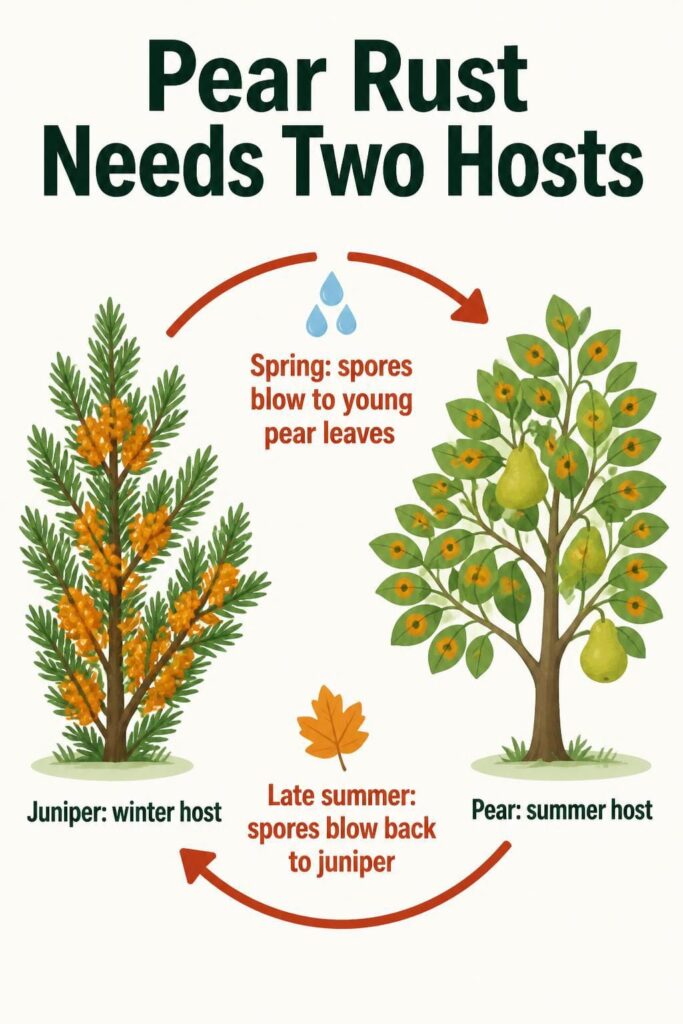
Pear rust cannot complete its life cycle on pear alone. The Royal Horticultural Society explains that the spores from infected pear leaves cannot reinfect pears. They blow onto junipers instead, and the junipers later release the spores that infect pears again.
Here is the sequence, which also explains the timing of everything you see:
- Spring: on an infected juniper, swollen galls on the branches turn into orange, jelly-like masses during wet weather. Wind carries their spores to pear leaves that are just unfolding.
- Late spring to summer: yellowish-orange spots appear on the pear leaves and slowly turn a brighter reddish orange as they enlarge.
- Late summer to leaf drop: spore-producing structures form on the underside of the leaf and release spores that drift back to nearby junipers.
- The following years: infection on the juniper is invisible at first. The galls take around two years to mature and can keep producing spores for several springs.
Dates shift with climate. The British Columbia Ministry of Agriculture notes the first spots on pear in late May, while Oklahoma State reports juniper spore masses from late February through early May. What does not change is the pattern: wet spring weather on an infected juniper, close to a pear.
Distance matters, but it will not solve everything. The British Columbia guide says damage stays minimal when the two hosts are at least 150 meters apart, yet Oklahoma State notes spores can blow a quarter of a mile or more, and UConn mentions distances up to three to four miles. A neighbor’s juniper can be the source.
Is pear rust harmful to the tree?
In many years it is mostly a cosmetic problem. K-State Extension describes it as often causing only aesthetic damage, with little effect on overall tree health. It can be worse than that. Oklahoma State reports that heavily spotted leaves are commonly shed in hot, dry weather, and that rust-related leaf loss can cost edible pears an entire crop. Fruit and young twigs can also be infected, and infected fruit may mummify. The long-term effect on tree health is still unknown, so keep the tree well watered during summer to reduce its overall stress.
What helps this season
Once the spots are there, you cannot cure them. New leaves stay clean because infection stops after spring, but the existing spots may keep enlarging. The useful work now is limiting how much spore reaches junipers and keeping the tree comfortable.
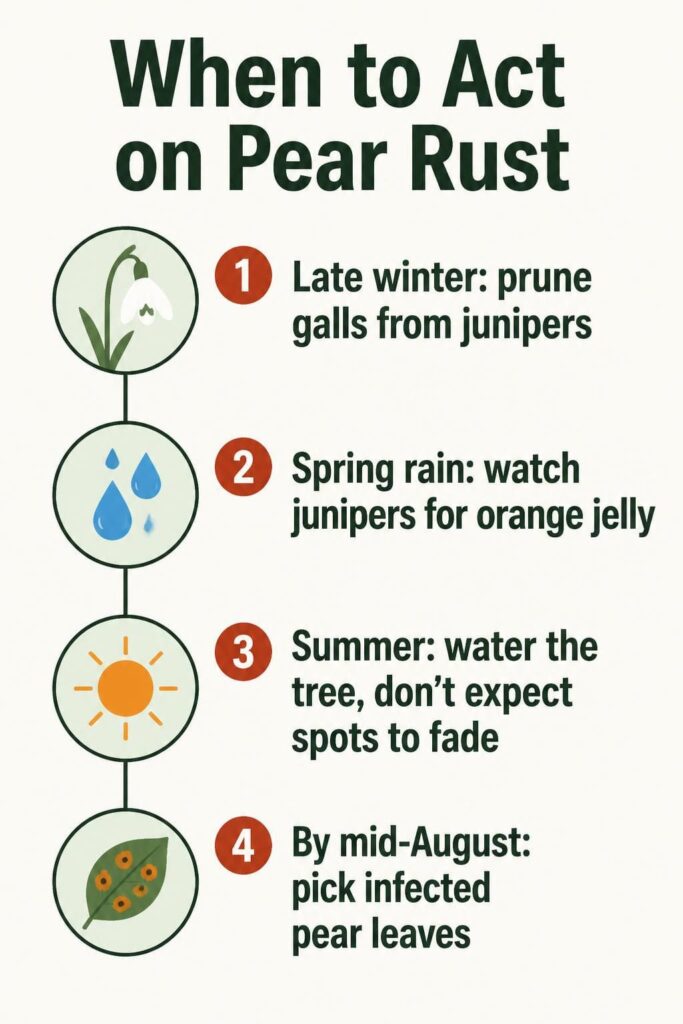
- If only a modest number of leaves are affected, pick them off before mid-August. The British Columbia guide says no special disposal is needed, because the fungus dies within days once the leaves shrivel.
- Do not strip a heavily infected tree. RHS warns that removing leaves from a badly affected pear may do more harm than good, and UConn notes this is not practical on large or heavily infected trees anyway.
- Prune out any gall-like swellings at the base of twigs on the pear.
- Water the tree through hot spells so it can carry its leaves.
A note on tidying up: many guides tell you to rake up every fallen leaf to stop the disease from overwintering. For rust, that advice has limits. The fungus cannot survive on dead leaf material, and spores from pear leaves go to juniper, not back to the pear. Clearing fallen leaves is harmless, but it is not what breaks the cycle.
Breaking the cycle before next spring
The strongest control is working on the juniper, because that is where the spring spores come from.
- Remove or prune galls on junipers. UConn suggests pruning galls from junipers before April 1st if you want to protect your pear. The galls are hard to spot when they are dry, so look for them after spring rain, when the orange masses swell.
- Increase the distance. If a pear and a juniper are close, consider removing one of them. The British Columbia guide also warns against leaving juniper brush piled in the yard, because the fungus can release spores from it and spread to pears.
- Choose juniper species with care. Both British Columbia and UConn list Juniperus squamata, J. communis, and J. horizontalis as more resistant species, or you can choose a different conifer.
- Avoid ornamental pears near junipers. They are susceptible too.
What about fungicides?
This is where advice differs by country, so check what is allowed where you live. Oklahoma State recommends protective applications in places where rust has been a recurring problem, starting as leaves and blooms emerge in spring, and notes that treating pears in summer does not help. K-State Extension makes a similar point: sprays go on before the disease appears, not after, and the orange jelly on junipers after spring rain is the signal that the window is open.
In other regions the picture is different. The RHS recommends not using fungicides and says none with rust activity are currently produced for home gardeners on pears whose fruit will be eaten. British Columbia lists no fungicides registered for pear trellis rust on pear, and UConn says none are labeled specifically for it. If you do use a product, it must be labeled for rust and for your type of pear, edible or ornamental, so follow the label and your local regulations. Homemade sprays are unregulated and usually untested, according to the RHS, so they are not a safe bet.
What not to do
- Do not spray in midsummer hoping the spots will fade. Existing spots stay, and the infection window has already closed.
- Do not pull all the leaves off a heavily infected tree.
- Do not leave pruned juniper brush stacked near your pear.
- Do not panic about the tree’s survival. The sources describe leaf loss and crop loss, but watch for heavy leaf drop year after year.
Choosing and siting pears with rust in mind
If you are planting new trees, put the pear as far from junipers as you can, including your neighbors’, and avoid ornamental pears in rust-prone areas. Resistance is unclear: Oklahoma State says resistance to pear rust is unknown, though Bartlett appears moderately resistant in Oklahoma gardens, and field trials were started to learn more. Treat any variety claim as local until proven otherwise.
Frequently asked questions
Will pear rust kill my pear tree?
The sources describe leaf loss and crop loss rather than dead trees, though Oklahoma State says the long-term effect on tree health is unknown. The main risk is repeated heavy leaf loss, which stresses the tree and can reduce or wipe out the crop on edible pears. Keep the tree watered and prevent new infections where you can.
Does pear rust harm the juniper?
Usually not much. UConn says juniper health is not typically severely affected, and infected junipers often continue to look healthy. That is partly why people do not notice the source.
Can one pear tree give rust to another?
Not directly. According to RHS, spores from pear leaves cannot reinfect pears. The route runs through a juniper, which is why two pear trees close to the same juniper tend to get it together.