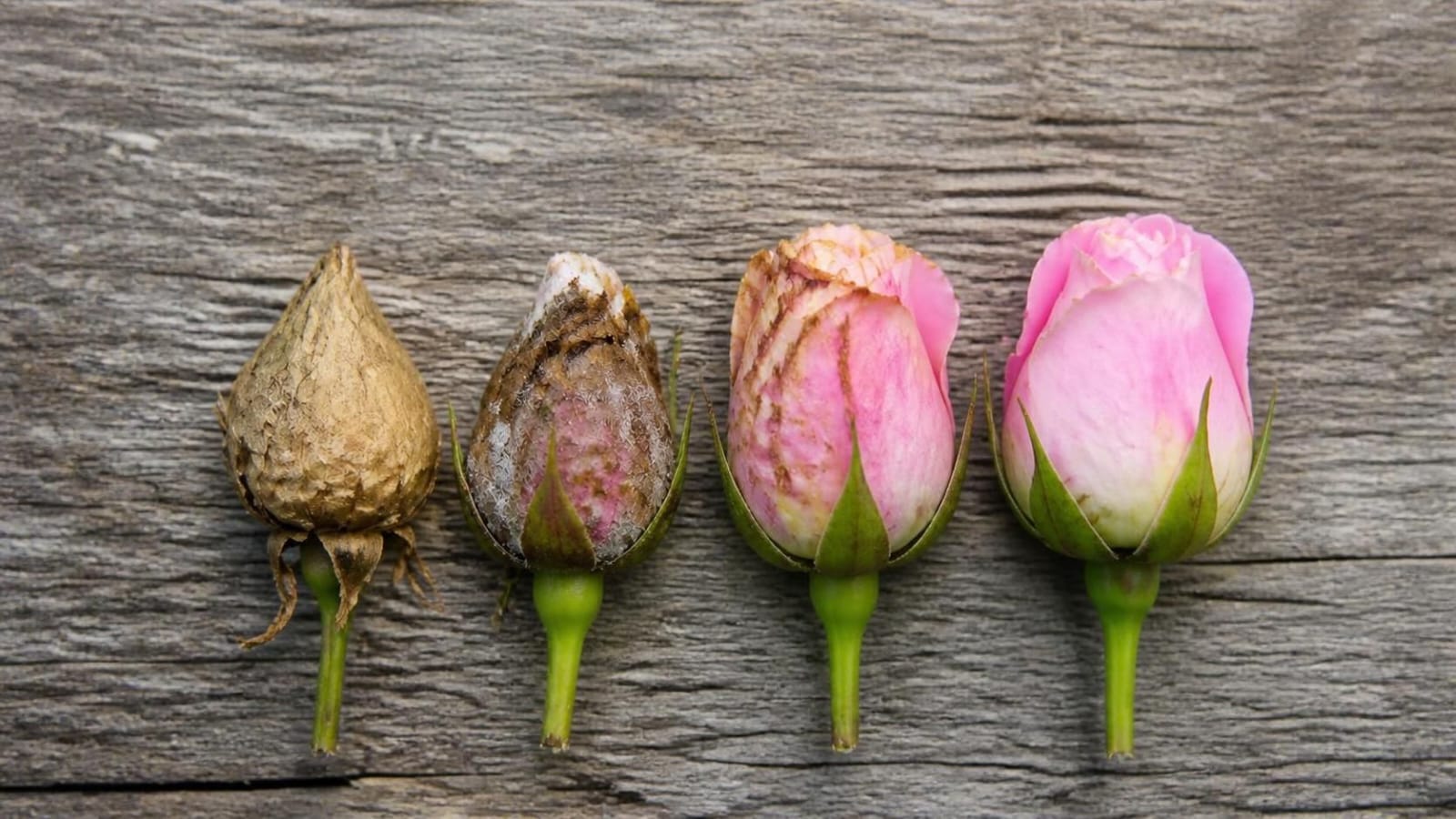
Rose buds that stay tight and then turn brown and papery are often showing balling, especially after wet weather: rain soaks the outer petals, and a sunny spell dries them into a shell. Gray mold and thrips can cause the same stall, though, and a bud or flower that is genuinely green is a different problem altogether. Peel back one outer petal and look inside, and you can often tell which of these you are dealing with.
A rose bud that stops just short of opening is one of the more disheartening sights in a garden. It swelled, showed color, and then stalled. The difficulty is that several quite different problems end in the same picture, and the right response to one can make another worse. So the useful question is not “how do I fix this?” but “what is this particular bud telling me?”
Two meanings of “green”, and why the difference matters
A green, unopened bud is not the same thing as a green flower, and it helps to keep the two apart from the start. A bud looks green on the outside because its sepals, the small leaf-like parts that wrap it, are green by nature. That is normal. A bud that is green and closed has not necessarily gone wrong, and if it is firm and undamaged on a bush that is growing well, it may simply be developing at its own pace.
A green flower is something else: the petals themselves are green, or the bloom produces small leaves where petals should be. That is a flower-development disorder, not a stuck or rotting bud, and it has its own section further down, along with the roses that are green on purpose. A bud that is truly stuck is a third situation, and it usually looks brown, papery or mushy rather than green. Everything before the green-flower section deals with that third case.
Start with the bud, not the plant: a five-minute check
This costs nothing, and each step rules something out. Work through it on one affected bud, ideally one that has not yet fallen.
- Notice the texture. A dry, papery shell suggests balling. A mushy bud, or one with gray fuzz on it, suggests gray mold (botrytis), either on its own or following balling.
- Think back over the last week or two. Drenching rain or heavy dew followed by sun fits balling. Cool, humid, still weather fits gray mold. A spell of ordinary dry weather with no rain at all makes thrips worth checking.
- Lift away one outermost petal. If the layers beneath look clean and normal, the problem is probably mechanical, which fits balling. If they are streaked, scarred or brown from the inside, look for insects.
- Tap the bud over white paper. Snip off a damaged bud, hold it above a sheet of plain paper and tap or shake it. Tiny specks that start to crawl are thrips. A hand lens makes this easier.
- Look at the whole bush. Healthy leaves and strong new growth point toward a weather or flower-level problem. Stunting, yellowing, very small leaves or crowded, bunchy shoots point toward something deeper, which matters mostly for the green-flower question.
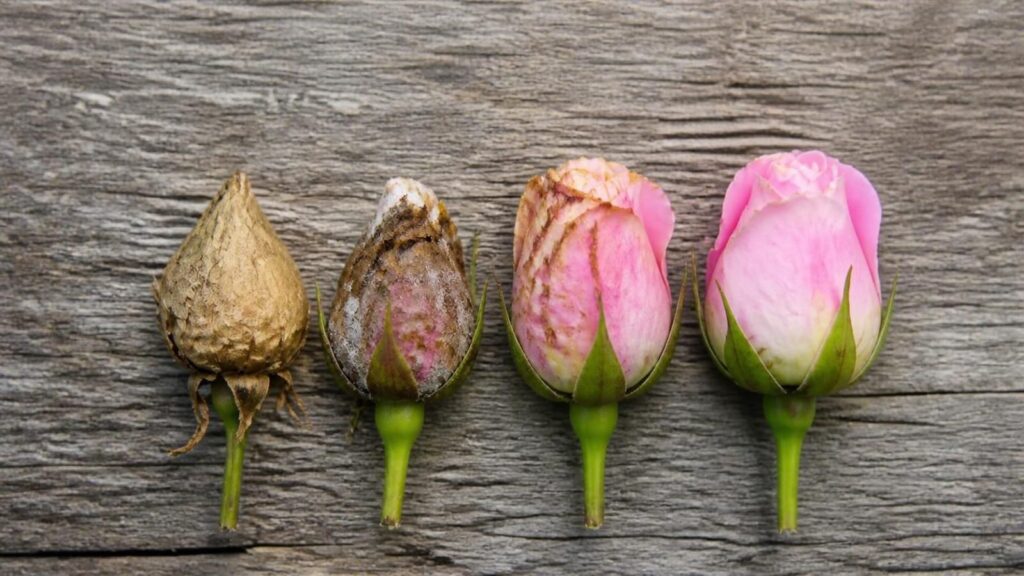
Several of these causes overlap, so the table below sets the clues side by side.
| Likely cause | What you see | Weather clue | How to confirm |
|---|---|---|---|
| Balling | Crisp or papery brown outer petals, bud sealed shut, inner petals look normal | Rain or heavy dew followed by sun; cool, damp spells | Lift one outer petal and look at the layer beneath |
| Gray mold (botrytis) | Brown spots on petals, mushy bud, gray fuzzy growth; stem below may turn pale green, then brown | Cool, humid, still air; can follow balling | Look for gray fuzz and check the stem under the bud |
| Thrips | Brown streaks, scarring or distorted petals; tiny insects inside the bloom | Not necessarily tied to wet weather; worth checking in dry spells | Tap the bud over white paper |
| Chewing pests | Neat holes in the bud, ragged petals, a beetle or caterpillar | Seasonal; weather is not the clue | Look for the hole, the insect or its droppings |
| Green-flower disorder | Petals green, or leafy structures where petals should be | Often follows hot or dry spells while buds were forming | Compare with other blooms on the same bush |
Balling: healthy inside, sealed shut
Balling is a common reason a fully formed rose bud may fail to open, and it is a weather-driven disorder rather than an infection. Moisture settles between the petals, the damp surfaces soften slightly and stick to their neighbors, and sunshine then dries the whole bundle into something close to a welded shell. The Royal Horticultural Society describes it as a disorder that usually occurs in wet weather, and garden writer David Hurrion notes that it is regularly seen in fall, at the end of the flowering season.
It tends to affect roses with many thin petals packed into a cupped form. The RHS names thin-petaled double roses, peonies and camellias as the most susceptible, and Antique Rose Emporium points to peony-shaped and cabbage-shaped roses in particular. That may be why one bush in a garden balls in every wet spell while its neighbor, with fewer and thicker petals, sails through.
Can a balled bud be saved?
The sources disagree, and it is worth being straightforward about that. The RHS says some affected flowers can be rescued. Hurrion takes the view that once the petals have welded together the bloom will not open, so it should be removed. A sensible middle path is to judge the bud in front of you. One that is still firm, with clean layers beneath the shell, deserves a single gentle attempt. One that is mushy, moldy or collapsing does not.
- Wait until the bud is dry to the touch.
- With clean, dry fingers, lift away only the outermost papery petals. Stop at the first layer that looks fresh and pliable.
- Let the inner petals loosen on their own. Do not unroll or pull them apart.
- If the bud tears, resists, or shows gray fuzz or mush, stop and remove it instead.
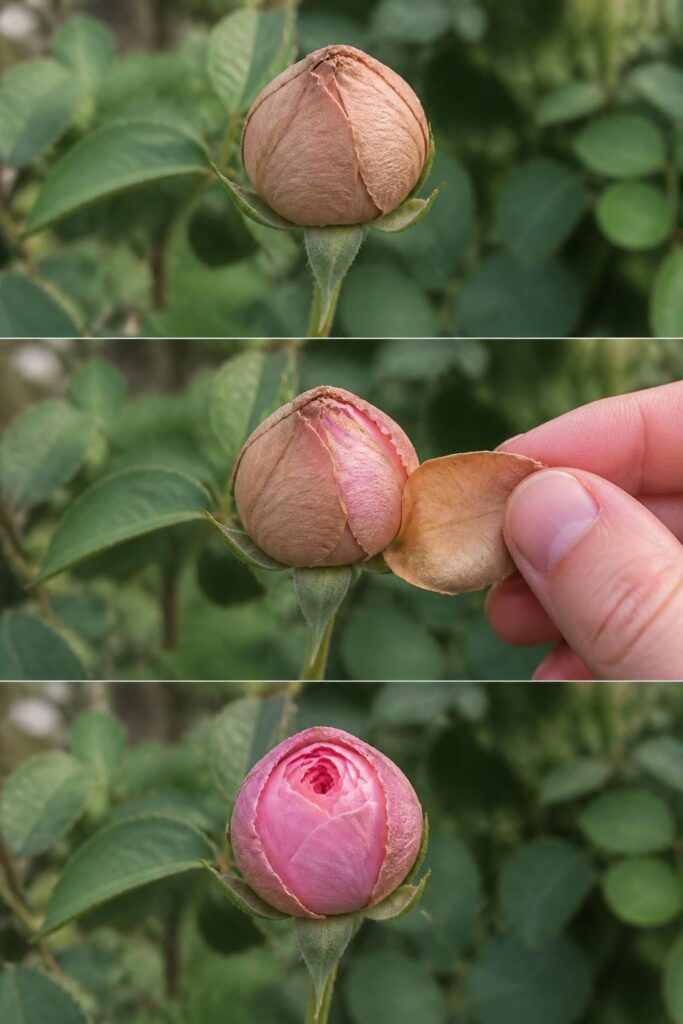
If it opens, the bloom may be a little ragged along one edge, but a ragged rose is better than none. If it does not, the plant itself is unlikely to be harmed.
Resist the urge to spray. According to the RHS, there are no chemical treatments for balling, which is a weather-related disorder rather than a disease. What does help is removing balled buds promptly, since gray mold can develop on them and spread to other blooms and nearby plants, and can cause dieback of stems.
Gray mold: when the bud is rotting, not only stuck
Gray mold, caused by the fungus Botrytis cinerea, is the second thing to rule out, and the two problems can occur together. The University of California IPM Program describes it as a disease of high humidity and cool temperatures: spotted petals, buds that fail to open, woolly gray spores on decaying tissue, and sometimes twig dieback. A useful extra clue comes from Gardening Know How, which notes that the stem just beneath an affected bud often turns pale green and then brown as the fungus advances.
Hurrion makes an important point about the order of events. Gray mold can follow as a secondary infection on blooms that have already balled, and he considers it generally not the original cause. That changes the early response. A dry, papery bud points to a weather problem. A soft, gray, spreading one suggests disease has moved in as well, and sanitation becomes urgent.
Begin with the plain measures UC IPM recommends: lower the humidity around the plants through sensible irrigation and pruning, cut back dense ground cover, collect fallen leaves and petals, and prune out infected buds and canes. If gray mold returns every season despite this, ask your local extension service which fungicides, if any, are approved for home roses where you live. Products and the rules around them differ from one country to the next, and any product should be used exactly as its label directs.
Thrips: tiny insects, brown streaks and a dry-weather clue
If the weather has been dry and the buds are still browning, look closer. UC IPM says western flower thrips and related species feed on rose flowers, streaking petals with brown or distorting them, and the damage can be severe when the attack comes while the flower is still a bud. The insects are tiny, yellow or black, and hide inside the bloom, which is why the white-paper test in the five-minute check is so useful.
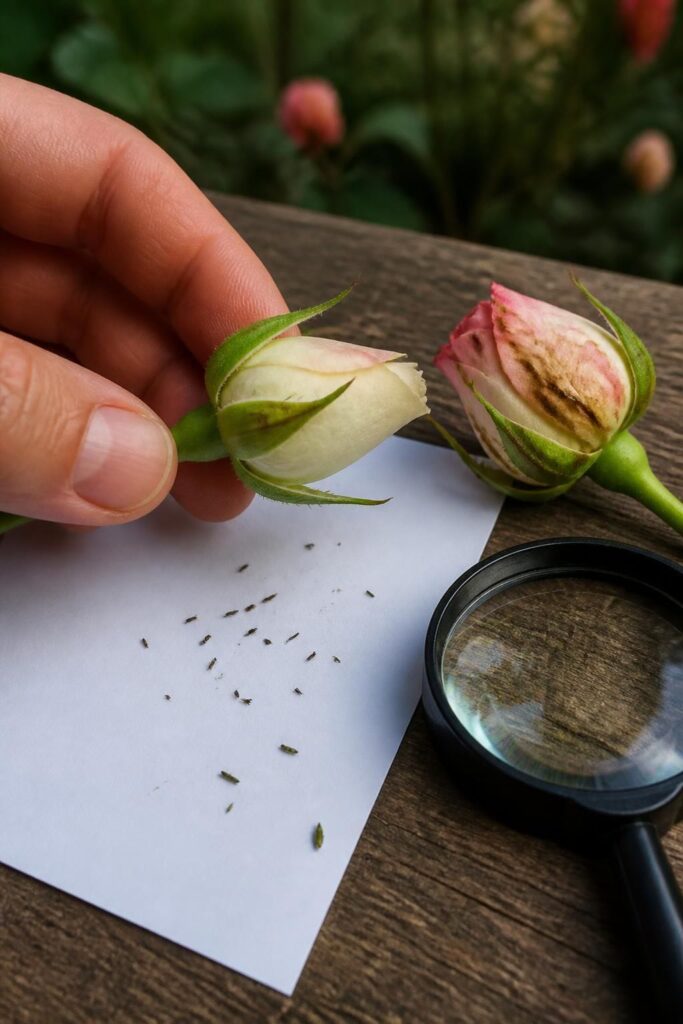
The same guide offers a few details that help set expectations. Fragrant, light-colored and white roses are the ones most often attacked, and thrips problems are more likely to be severe where many roses grow close together and bloom continuously. Cultivars whose sepals stay wrapped tightly around the bud until it opens have fewer thrips problems. Insecticides are difficult to use well, because the insects feed deep inside buds and flowers where sprays may not reach.
Antique Rose Emporium offers a calmer way to look at it: thrips damage is generally more of a flower-quality problem than an immediate threat to an established rose. Remove damaged buds, drop them straight into a bucket of soapy water so the insects cannot escape, and keep the plant healthy. UC IPM adds that frequent clipping and prompt disposal of spent blooms can reduce thrips problems. Antique Rose Emporium also notes that the goal is not to eliminate every thrips, only to reduce numbers and protect new growth when damage becomes significant.
Two less common culprits are worth a glance if you find a hole rather than a streak. UC IPM notes that the rose curculio, a small snout weevil, drills into buds and lays its eggs inside, and that some caterpillars also bore into buds. For both, the guide suggests picking off the adults or caterpillars and pruning out infested buds.
When the petals themselves turn green
A green flower belongs to a different family of problems from a stuck bud, and two terms help keep it straight. Virescence is when petals turn green but keep their normal shape. Phyllody is when flower parts are replaced by leaf-like structures. The RHS guide to phytoplasmas lists both as ways flowers can green up, and UC IPM says the underlying cause seems to be a change in the plant’s hormone balance, brought on either by environmental stress or by living infectious agents.
The reassuring part is what UC IPM says about roses specifically. The most common cause is environmental stress, such as hot weather while the buds are forming, or water stress. When that is the cause, the bush typically carries normal and abnormal flowers at the same time, otherwise looks healthy, and returns to producing normal flowers when the weather cools. The same guide adds that phytoplasmas, the insect-spread bacteria behind green flowers in many other plants, play a smaller and poorly documented role in roses.
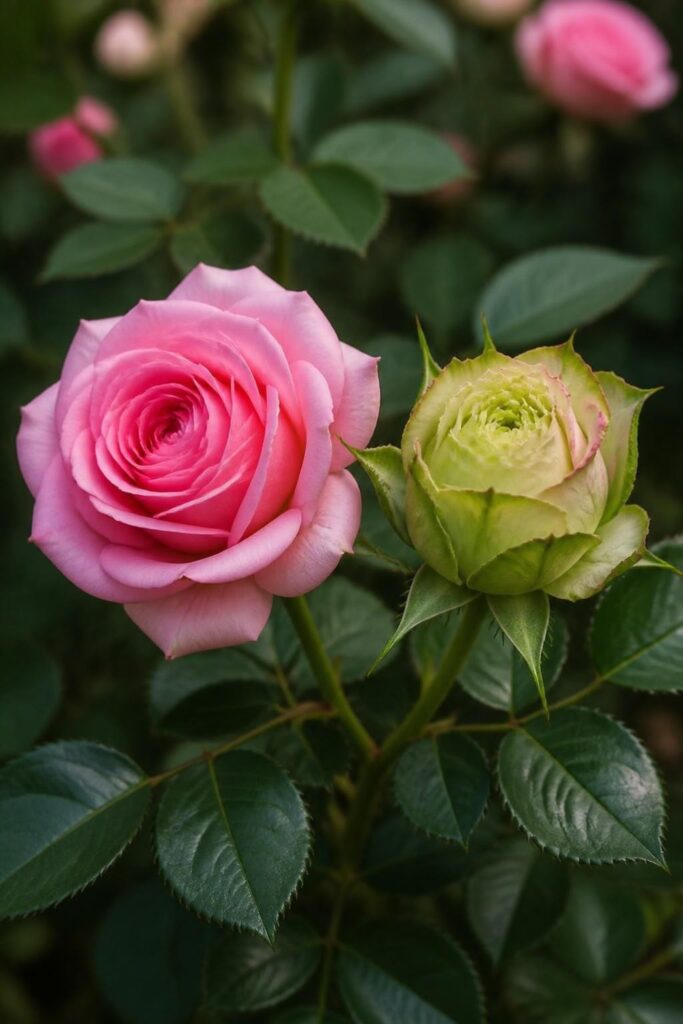
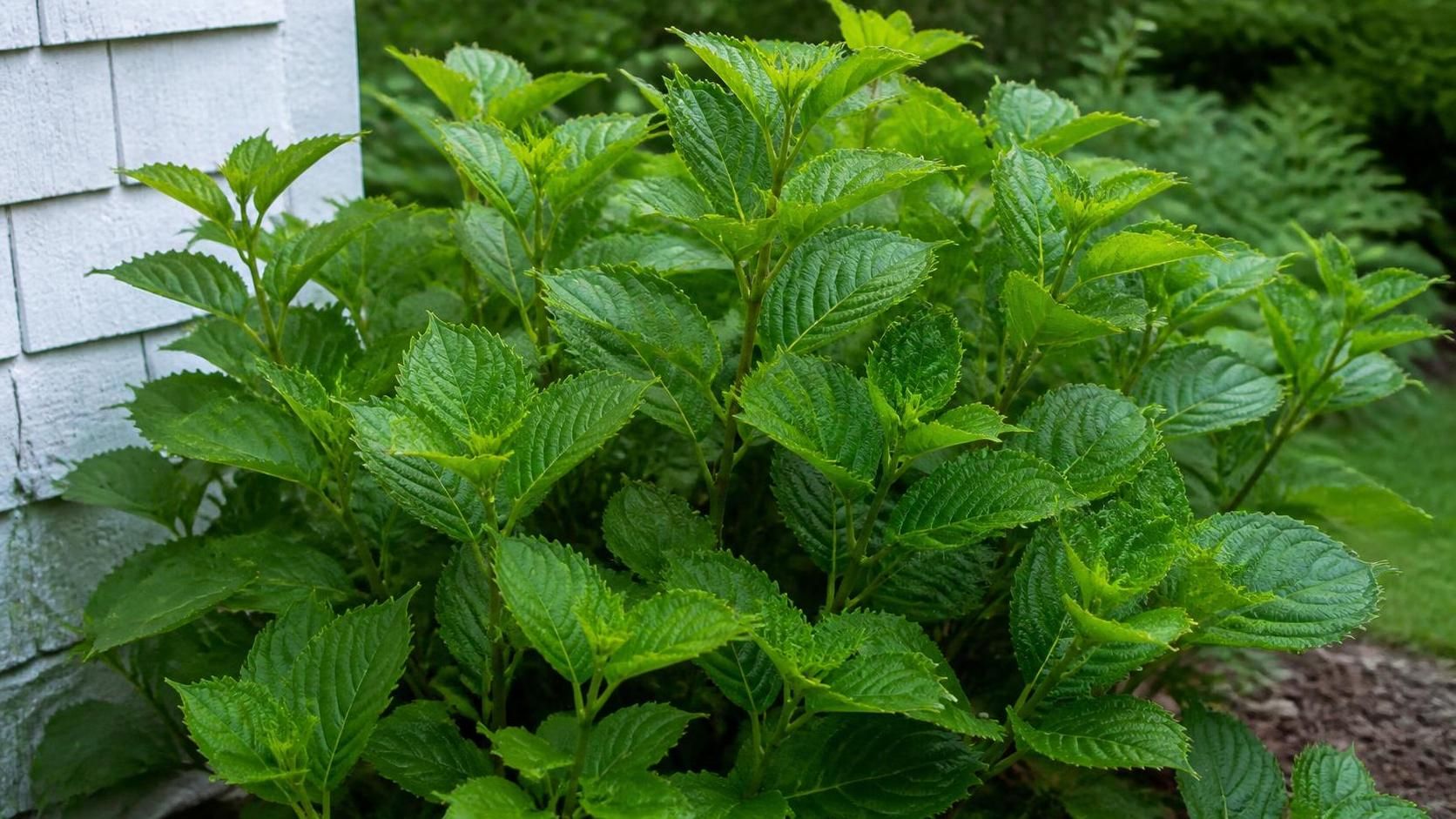
To tell the difference on your own bush, look beyond the flower. If only some blooms are affected, growth is vigorous and the leaves are a normal size and color, stress is the likelier explanation. If you also see stunting, yellowing, very small leaves or crowded, bunchy shoots, the RHS lists these as typical of phytoplasma infection. There is no chemical control, and plants showing the full combination of symptoms are probably best removed.
In parts of the United States east of the Rocky Mountains, UC IPM also warns about rose rosette disease, which brings excessive thorny shoots, witches’ broom and red pigmentation, and is spread by a tiny mite. Suspected plants should be removed, roots included. If your symptoms sound like that, contact your local extension service rather than waiting to see what the next flush does.
Finally, some roses are green on purpose. The old “Green Rose”, a form of Rosa chinensis, carries a stable mutation that makes all of its flowers leafy, so green petals on that variety are the point, not a problem. UC IPM also notes that floribundas are somewhat more prone to phyllody in general. For stress-related cases, UC IPM suggests no management beyond pruning out the affected blooms. Since water stress is one of the triggers, consistent watering through hot spells is a sensible precaution, and the next flush will show whether the bush has settled.
What to do now, in order
- Take one bud and run the five-minute check so you know which problem you have.
- Remove balled, moldy and thrips-damaged buds, along with fallen petals and leaves beneath the bush. Where mold or insects are involved, put the material in the trash rather than the compost pile.
- Open up the plant. Cut out crossing or crowded growth so air can move through the center.
- Water at the base and keep the flowers dry.
- For thrips or gray mold that keeps coming back, ask your local extension service about approved options, and follow the product label and local regulations.
- Make a note of which varieties fail repeatedly. Replacement is sometimes the only lasting remedy.
What not to do
- Do not pull open a mushy bud or one with gray fuzz. You could spread spores to healthy blooms.
- Do not spray a fungicide or insecticide at balling. The RHS says there is no chemical treatment for it.
- Do not spray before you know the cause. A fungicide will not help thrips, and an insecticide will not help gray mold or green flowers.
- Do not leave failed buds hanging on the bush. Gray mold can develop on them and spread, and infested buds keep pests close to new flowers.
Will the rose recover?
In most cases, yes. Most of these problems mainly spoil flowers rather than harm the plant. Antique Rose Emporium puts it well: a rose with healthy foliage, vigorous new growth and a strong root system has ruined flowers, not a ruined rose. Repeat-flowering roses should form fresh buds, though how soon depends on the variety, the weather and the stage of the season. The exceptions are the systemic cases described above, such as rose rosette, where removal is the advice.
Keeping it from happening next season
- Give them air and sun. The RHS recommends an open but not exposed site. Hurrion suggests pruning to outward-facing buds so the bush forms an open goblet shape, and deadheading through the season so air keeps moving.
- Water the soil, not the plant. Water at the base, avoid wetting flowers and leaves unnecessarily, and choose a time of day that lets any wet foliage dry reasonably quickly in your climate. The RHS and UC IPM word their timing advice a little differently, with the RHS suggesting evening watering away from hot sun and UC IPM, writing about foliar diseases, suggesting enough time for foliage to dry before nightfall. That likely reflects differences in climate and in the problems each is addressing. The aim is the same either way: soak the soil and keep flowers and leaves as dry as you reasonably can.
- Keep the ground tidy. Clear fallen petals and leaves, and do not let diseased buds lie beneath the bush.
- Choose the flower form to suit your climate. Antique Rose Emporium notes that single-petaled roses are less likely to ball, and the RHS notes that modern cultivars are said to be less affected. For thrips, favor cultivars whose sepals stay wrapped around the bud.
- Protect special plants. The RHS notes that a temporary shelter over a whole plant or individual buds can keep rain off in a bad spell.
- Feed sensibly. Avoid over-fertilizing and follow the label on whatever product you use. Feeding is not a fix for balling, but a moderate, steady program helps keep the plant healthy overall.
Frequently asked questions
Can I force a stuck rose bud to open?
A gentle rescue is really only worth trying with balling. Lift away the dry outer petals and let the rest unfurl by itself. If the bud is mushy, moldy or insect-damaged, forcing it open will not help and may spread the problem.
Why do only some of my roses ball?
Flower form is a major factor. Roses with many thin, tightly packed petals trap moisture more easily than those with fewer, thicker ones. Position may matter too: a bush in a still, shaded corner can stay damp longer than one in an open, sunny spot.
Is a green rose flower contagious?
That depends on the cause. UC IPM says the most common cause in roses is environmental stress, which is not something a bush can pass on, while phytoplasma-related greening is reported less often in roses and is spread by insects. If only some flowers are affected and the bush looks otherwise healthy, stress is the likelier explanation. If the bush also shows stunting, yellowing, tiny leaves or bunchy shoots, get a proper diagnosis from your local extension service.
Should I cut off the stuck buds or wait?
If the bud is firm and dry, you can give it a short while or try the gentle rescue above. If it is soft, brown, moldy or full of insects, cut it off and dispose of it. Leaving it gives gray mold or thrips a place to build up.