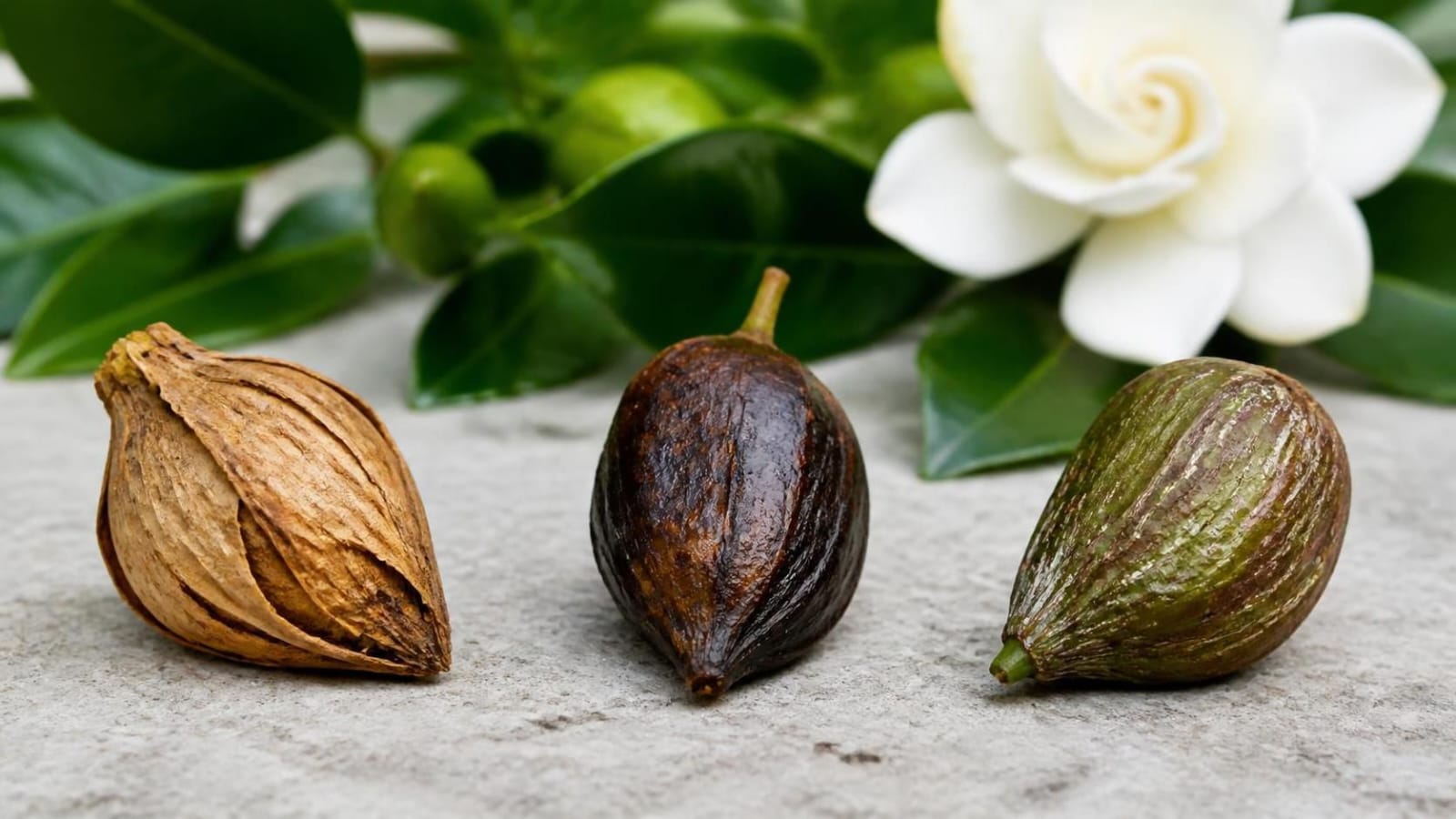
Gardenia buds that brown and fall before they open are almost always reacting to stress or sudden change, not to one single disease. In containers the usual causes are uneven watering, a pot that overheats, dry air, a recent move, and thrips. The fallen bud itself often shows which one to suspect.
Pick up one of the fallen buds and look at it closely before you reach for fertilizer or a spray. Is it dry and papery, or soft and dark? Is the break at the base clean, or is the surface scarred and streaked? That small detail keeps you from fixing the wrong thing, which is how many potted gardenias end up dropping a second and third round of buds.
The general picture is consistent across good sources. The University of Florida IFAS Extension says numerous stresses cause green, unopened flower buds to drop, naming dry, hot or unusually cool weather, flower thrips and nematodes, too much fertilizer, and poor drainage. The trouble with a container is that each of those stresses arrives faster, and with less warning, than it would in a garden bed. The sections below follow the order that is quickest to check.
Start with the bud: telling the causes apart
Several different problems end the same way, with a bud on the ground, so the symptom alone is not enough. Use the table as a first pass, then run the check in the third column before you change anything.
| What you see | Likely cause | How to confirm it | First move |
|---|---|---|---|
| Dry, brown, papery bud; leaf edges crisp; pot feels light | Mix or air drying out | Lift the pot and push a finger into the mix. If it is dry well below the surface, or water runs straight out of the drainage holes, this is it. | Rewet the whole root ball evenly, then keep moisture steady. |
| Soft, dark bud; mix stays wet for days; leaves yellowing | Wet roots or poor drainage | Check for blocked drainage holes and standing water in the saucer. Slide the plant out and look for dark, mushy roots. | Restore drainage and let the surface dry slightly between waterings. |
| Firm green bud that falls cleanly soon after a move, heat spike or cold snap | Environmental shock | Think back over the last week or two: was the pot moved, repotted, or exposed to a sharp temperature change? | Stop changing things and hold conditions steady. |
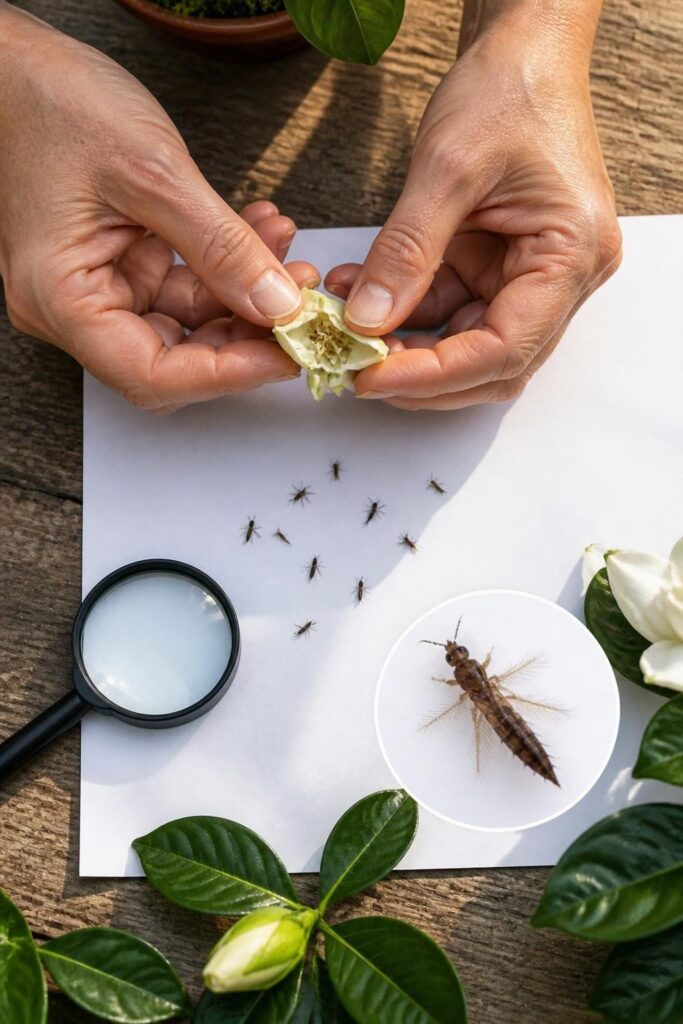
| Bud scarred or streaked; silvery flecks on new leaves; tiny slender insects | Thrips | Break a fallen bud apart over white paper and watch for movement, or tap an open bloom over the paper. | Remove affected buds and identify before treating. |
| Buds drop along with speckled, dull leaves and fine webbing underneath | Spider mites and dry air | Tap a branch over white paper and wipe your finger across it. Reddish streaks suggest mites. | Rinse foliage with water and raise humidity. |
| Buds drop, growth is stunted, and the plant wilts despite moist mix | Root trouble, possibly nematodes | Hard to confirm at home. More likely if the pot holds garden soil rather than fresh potting mix. | Contact a local extension office before taking action. |
If two rows seem to fit, that is normal. Container gardenias are often hit by a heat spike and a dry root ball at the same time, and sap-feeding insects tend to favor plants that are already stressed. Correct the watering and heat first, because they are the cheapest to fix and the most common.
Why pots make bud drop more likely
A gardenia in the ground has a large volume of soil to buffer it. Moisture changes slowly, the root zone stays at a steadier temperature, and nobody carries it to a new corner. A pot removes all three buffers. The mix holds only a small reserve of water, the roots are exposed to sun and wind on every side, and a container is easy to shift around, which is exactly what people do on a patio.
That does not mean gardenias cannot be grown in containers. Clemson Extension notes that smaller cultivars grow well in pots. It does mean the margin for error is thinner, and a week of careless watering that a bed-grown shrub would shrug off can cost a potted plant most of its buds.
Heat deserves special attention on patios. A dark pot against a sunny wall or on hot paving can warm the root zone well beyond the surrounding air. That is general horticultural reasoning rather than a measured figure for any particular patio, but it matches the published advice: Clemson recommends morning sun with afternoon shade, and the New York Botanical Garden warns that gardenias scorch in the strongest direct sun. If your pot takes the full afternoon, treat heat as a prime suspect.
Watering: it is the swing that drops buds, not the amount
Clemson Extension lists both overwatering and under-watering among the causes of bud drop. That tells you something useful: the plant is not asking for more water or less water, it is asking for consistency. A potted gardenia that dries out, gets flooded, and then sits damp for days is being pushed through exactly the kind of swing buds do not tolerate.
When the mix is too dry
Peat-heavy potting mix that has dried out completely can be slow to take water back up, so a quick pour may run down the sides of the pot while the center stays dry. A pot that feels strikingly light is a good sign of this. Water slowly in several rounds, or stand the pot in a basin of water until the mix is evenly damp, then let it drain fully.
A root-bound plant makes the problem worse, because roots have taken the place of mix and there is little left to hold water. If the roots circle densely when you slide the plant out, the New York Botanical Garden’s gardenia guide suggests moving up just one pot size, and doing it in spring rather than mid-budding. It also notes that repotting a plant straight after bringing it home can make flowers drop, so leave a newly bought plant in its original pot and mix while it settles.
When the mix is too wet
UF/IFAS names poor drainage as a contributor to bud drop. Check that the drainage holes are open, that the saucer is not holding water, and that the pot is not sitting inside a decorative outer pot with no holes. The New York Botanical Garden’s houseplant guidance is to water when the top half inch of mix is dry and to empty the run-off after about 15 minutes. Outdoors in summer the interval will be shorter, so judge by touch rather than by the calendar.
Water quality and where the water lands
Gardenias need acidic conditions, and the New York Botanical Garden points out that tap water can gradually change the pH of the mix, recommending distilled or rain water for pots. The same guide advises keeping water off buds and flowers, since water sitting on them can cause discoloration and fungal problems. Clemson makes the same point for garden plants, suggesting drip irrigation to keep water off blossoms and foliage. Water the mix, not the buds.
Heat, cool nights and the bud-forming window
Gardenias need cooler nights than days while buds form, and they punish sudden swings once buds are set. The exact numbers depend on the source because the sources describe different settings. Clemson, writing about outdoor shrubs in the Southeast, says night temperatures between 50 and 55 degrees Fahrenheit are necessary for flower bud formation. The New York Botanical Garden, writing about houseplants, recommends a steady night temperature of 60 to 63 degrees Fahrenheit while buds are forming. Treat these as two reference points rather than a single rule. What they share is a night-time dip and no sudden changes.
Two situations catch container growers out. The first is a heat wave or cold snap after the buds have already formed, since UF/IFAS lists both hot and unusually cool weather. The second is the summer-outdoors, autumn-indoors move. The New York Botanical Garden explains that a gardenia brought inside may lose emerging buds because indoor light is lower and the night-time drop it relies on is missing. Its suggested remedy is to pinch off the young growth right beside each developing bud, so the plant’s energy goes into holding the flower, and to give the plant strong light with a consistent drop at night.
If you are bringing a patio gardenia indoors for the season, decide on its spot before the first cold nights and leave it there. A cool, bright room away from heating vents and drafts is a better home than a warm living room, which the same guide identifies as the most frequent reason for houseplant buds to drop.
Dry air, and how to raise humidity around a pot
The New York Botanical Garden reports that gardenias struggle when humidity falls below 60 percent, and that buds turn brown and drop when the air is too dry. A cheap hygrometer will tell you where you stand. It also links spider mites with low humidity, which is worth remembering if the leaves look dull and stippled.
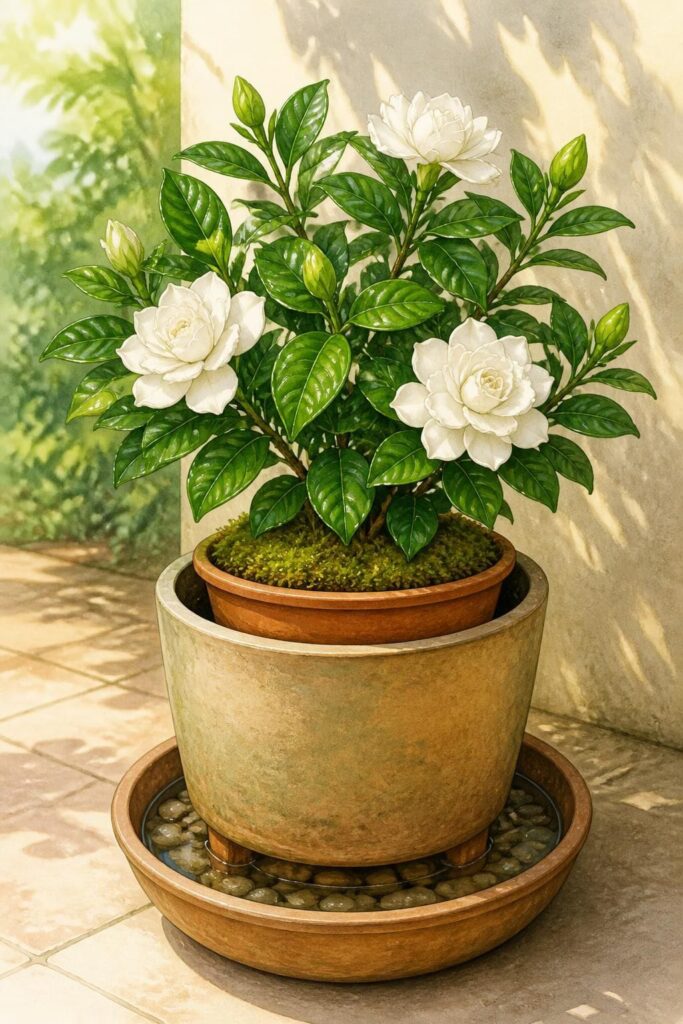
an Ask Extension answer written for a gardener with potted gardenias on an Arizona patio offers a practical set of fixes. Mulch the surface of the pot with sphagnum moss to hold moisture. Stand the pot inside a larger container so there is a half-inch to one-inch air gap between the two. Or set the pot on a one-to-two-inch bed of gravel in a deep tray and keep the gravel moist, with the pot sitting above the water rather than in it. Grouping plants together also helps, and so does shelter from drying wind.
Avoid misting the buds themselves. Water drops resting on buds and leaves are what the botanical garden warns can cause discoloration and fungal trouble, so a tray, a humidifier indoors, or a cluster of plants is the safer route.
Moving the pot: the stress you cause yourself
Gardenias are unusually sensitive to being disturbed. The Ask Extension answer describes them as extremely sensitive to being moved or even touched, the New York Botanical Garden says a change of location can be enough to make buds fall, and Clemson notes that gardenias resent root disturbance.
In practice this means choosing a spot once the buds appear and leaving the pot alone until the flowers have opened. If your diagnosis is that the current spot is too hot or too dim, move the pot once, deliberately, to a better place, and then stop adjusting. Dragging it around the patio every few days in search of the perfect light is a reliable way to lose buds.
Thrips and other small pests
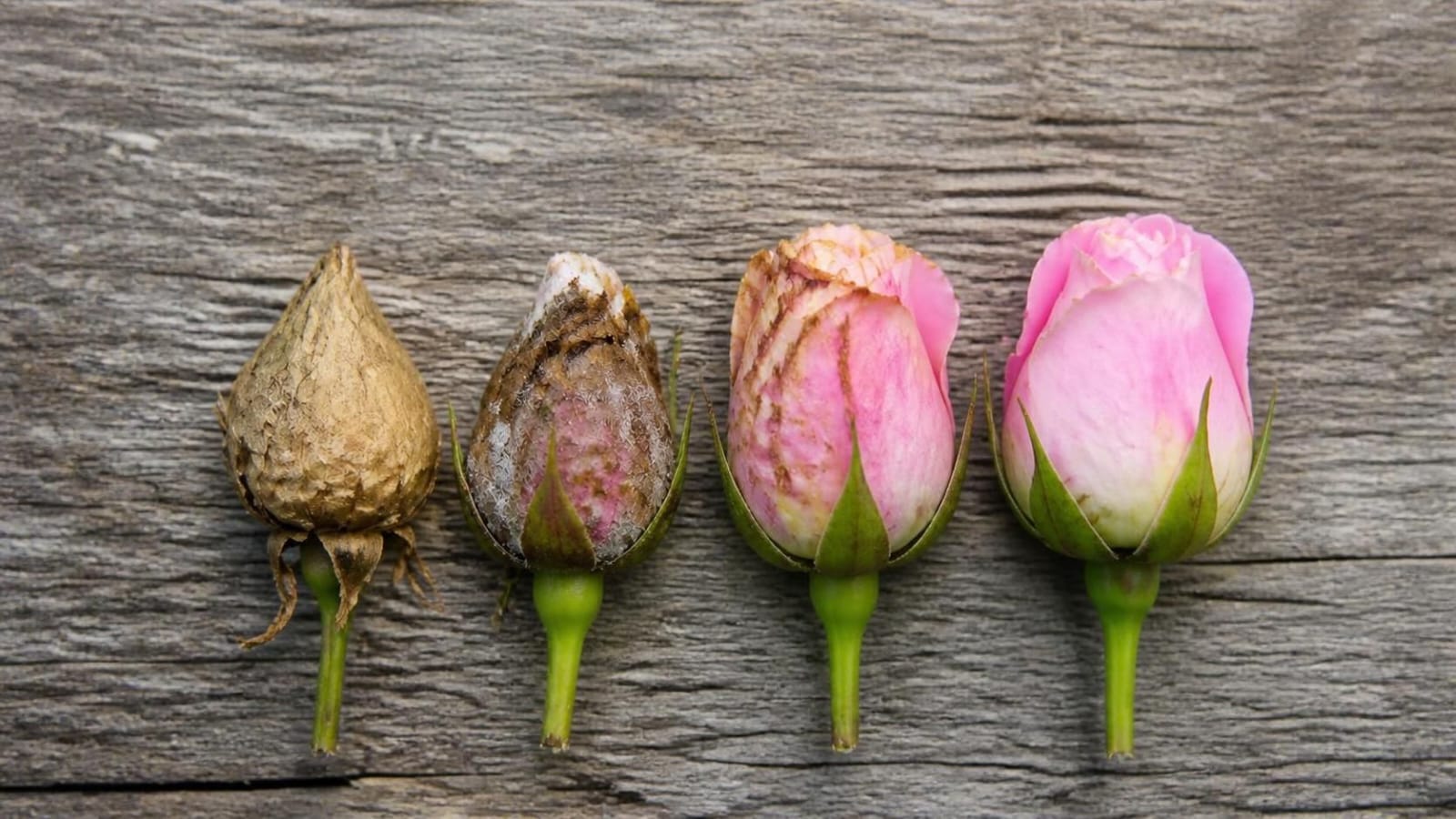
If the buds were fully formed and fell just before opening, thrips are a real possibility. They are tiny rasping insects that scar tender bud tissue, according to an Ask Extension answer, and the same source gives an easy home test: break a few fallen buds apart over a sheet of white paper and watch for movement. Thrips are described as black, brown, gray or yellow and roughly a sixteenth of an inch long. Clemson Extension’s gardenia pest guide adds that damage is often noticed before the insects are, and lists silvery speckles on leaves and flower buds that die before opening among the signs. It also suggests tapping blooms over stiff white paper in bright light, or using a magnifying lens on new growth. Thrips are not fussy about the plant, and buds that stall or fail to open are a familiar frustration on other shrubs too; if you grow roses nearby and see the same pattern, this guide to rose buds not opening and balling green buds shows how that problem is separated from simple stress.
If you do find them
Clemson recommends integrated pest management: identify the pest first, monitor, use cultural controls, and only then consider treatment. For thrips that means inspecting buds and new growth regularly, keeping grass and weeds around the plant cut back, and removing damaged buds, including the fallen ones, so they do not stay on the pot surface. Contact insecticides can also kill the natural enemies that help hold thrips down, so they are best avoided unless the problem is serious.
If treatment does become necessary, the same guide notes that gardenias are sensitive to some insecticidal soaps, so only products labeled as safe for gardenias should be used. I am deliberately not giving mixing ratios or spray intervals here. Approved products and rules differ between countries and regions, so follow the product label and check your local regulations.
Spider mites
Mites are not insects, and they build up in hot, dry conditions. Clemson describes yellow or white speckling on the upper leaf surface and fine webbing underneath, and notes that a strong spray of water removes eggs, nymphs and adults in light infestations. Rinsing the foliage and raising humidity at the same time deals with both the pest and the condition that invited it.
Roots, feeding and soil chemistry
Too much fertilizer appears in the UF/IFAS list of bud-drop contributors, so a stressed gardenia is not a plant to push with extra feed. Clemson advises light spring feeding with an acid-forming, extended-release fertilizer and no feeding in fall, which would stimulate tender growth. The New York Botanical Garden describes a more frequent, half-strength acid feed for indoor plants during the growing season. Schedules differ with climate and setting, so follow the product label, keep it light, and choose a fertilizer made for acid-loving plants.
Soil acidity matters too. The recommended pH ranges vary slightly by source, around 5.0 to 6.5 from UF/IFAS and 4.5 to 6.0 from the botanical garden, but all point the same way: acidic. If new leaves turn yellow while the veins stay green, UF/IFAS explains that a micronutrient shortage, usually iron, is often involved and may trace back to soil that is not acidic enough. That is a related problem rather than the cause of bud drop, but it often appears in the same pots.
Nematodes, microscopic soil worms that feed on roots, are mentioned by UF/IFAS as a contributor to bud drop. They are difficult for a home gardener to confirm, and they are far more of a concern in garden soil than in fresh potting mix. If you suspect them, your local extension office is the right place to ask.
What not to do
- Do not keep relocating the pot once buds are showing. Choose a spot and leave it.
- Do not repot a budded plant simply because it looks unhappy, unless the roots are clearly in trouble.
- Do not feed a stressed plant heavily. Excess fertilizer is itself a listed cause of bud drop.
- Do not mist the buds to raise humidity. Use a tray, grouping or a humidifier instead.
- Do not spray the first product you find. Identify the pest, and read the label for gardenia safety.
- Do not leave the pot standing in water in the saucer.
A checking order that saves time
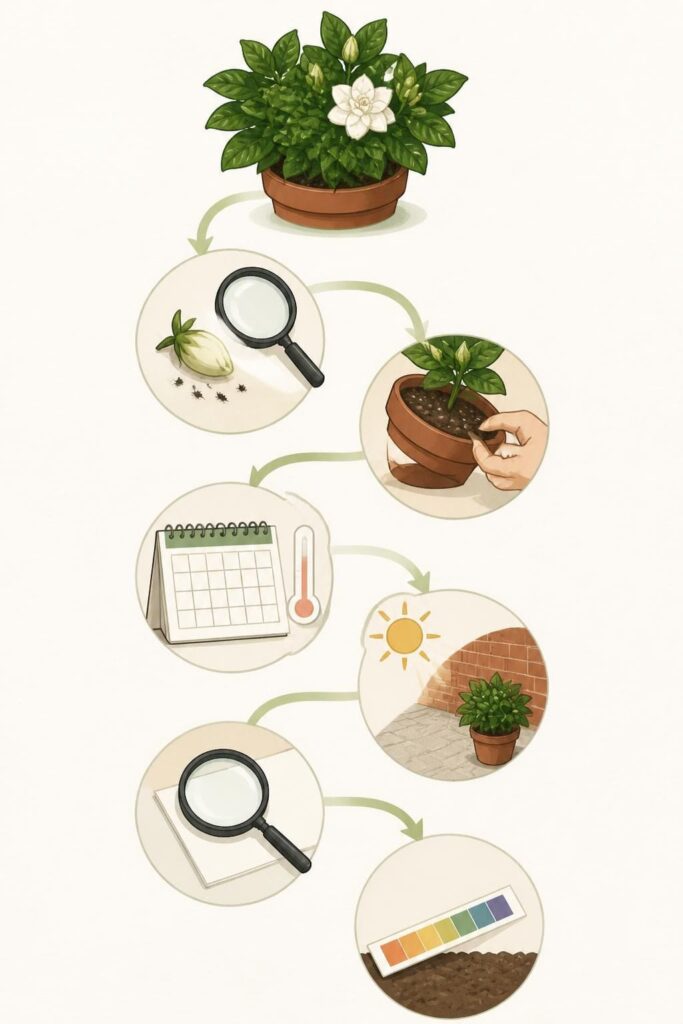
When you are standing beside the pot with a handful of fallen buds, this is the sequence that finds the cause fastest.
- Look at the buds: dry and papery, soft and dark, or scarred.
- Lift the pot and feel the mix at depth, then check the drainage holes and saucer.
- Ask what changed in the last two weeks: a move, a repot, a heat spike, a cool night, a new fertilizer.
- Check the pot’s exposure: how many hours of afternoon sun and reflected heat it takes.
- Test for thrips with white paper, and check leaf undersides for mites.
- Only then look at feeding, pH and the roots.
Will it recover, and when will buds stay?
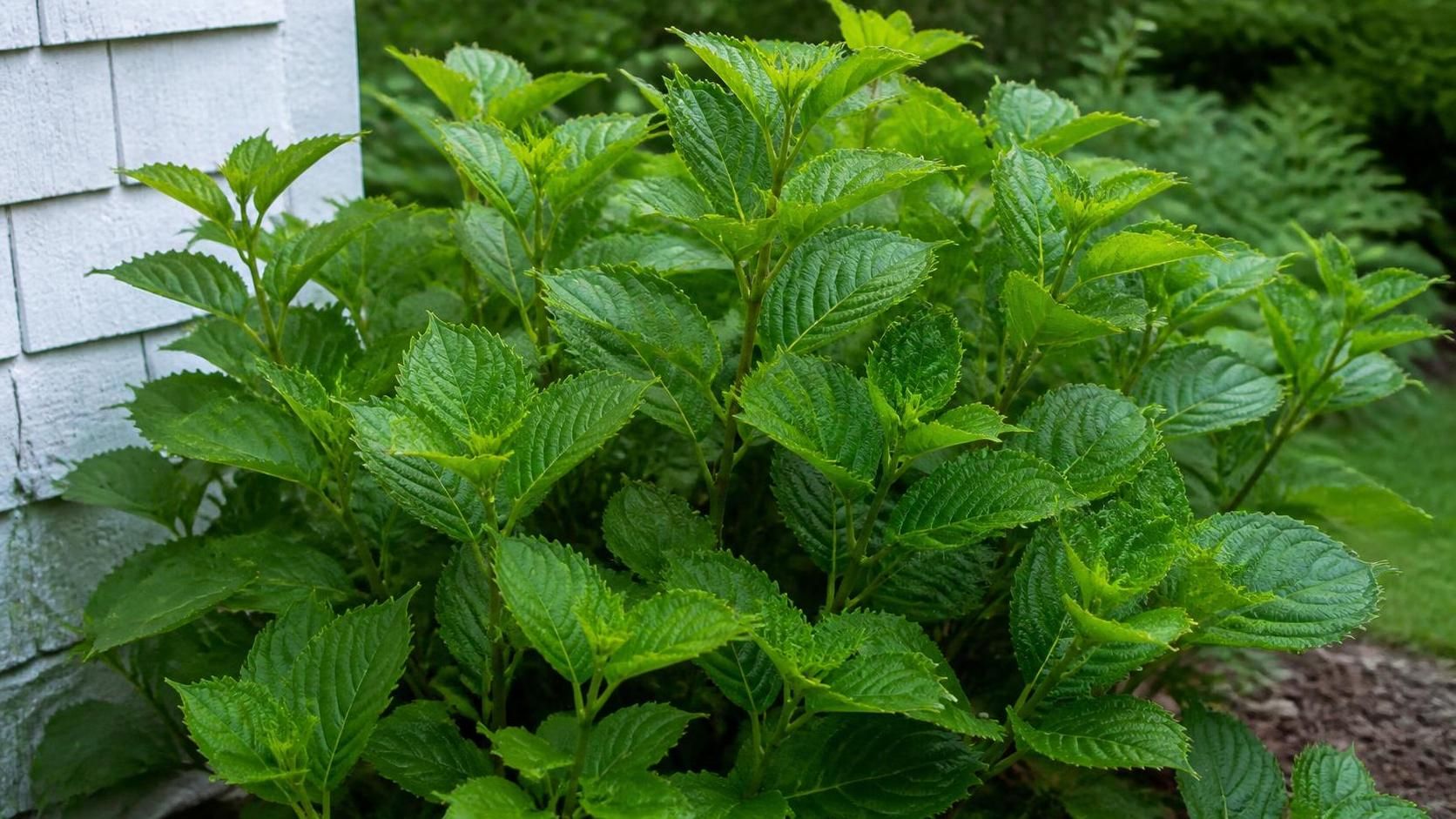
A bud that has dropped is gone, and nothing you do will put it back. What you can influence is the next round. Once the cause is corrected, judge progress by whether new buds stay on through the following weeks, not by the calendar, because timing varies with cultivar, climate and season. Clemson lists a number of repeat-blooming cultivars, so a lost flush is not always the end of the season. It is also worth keeping this apart from the opposite complaint, a healthy leafy shrub that never sets buds at all, which is a different diagnosis; the guide on hydrangea leaves but no flowers walks through that case.
Seasonal timing matters for the work you do afterwards. Prune just after flowering, since UF/IFAS cautions that hard pruning after early October reduces next year’s blooms in Florida conditions, and skip fall feeding, as Clemson advises. As autumn approaches, settle where the pot will spend the colder months before nights turn cool, rather than moving it in the middle of the bud-forming period.
Questions gardeners often ask
The buds drop even though I water every day. Why?
Daily watering can mean a wet-dry cycle if the pot dries out hard in the afternoon, or it can keep roots waterlogged if the mix is not draining. Judge by the feel of the mix and the weight of the pot rather than by frequency, and look at the bud: dry and papery points to drying, soft and dark points to excess water.
Should I mist my gardenia to help the buds?
It is better not to. The New York Botanical Garden warns that water sitting on leaves and buds can cause discoloration and fungal disease. A pebble tray, a pot-in-pot setup, a humidifier indoors, or grouping plants raises humidity without wetting the buds.
My plant arrived from the nursery with dropping buds. Is that my fault?
Not necessarily. Plants that have just changed environment often shed buds. The botanical garden’s advice is to leave a new plant in its original pot and mix while it adjusts, protect it from drafts and sudden temperature changes, and avoid repotting straight away.