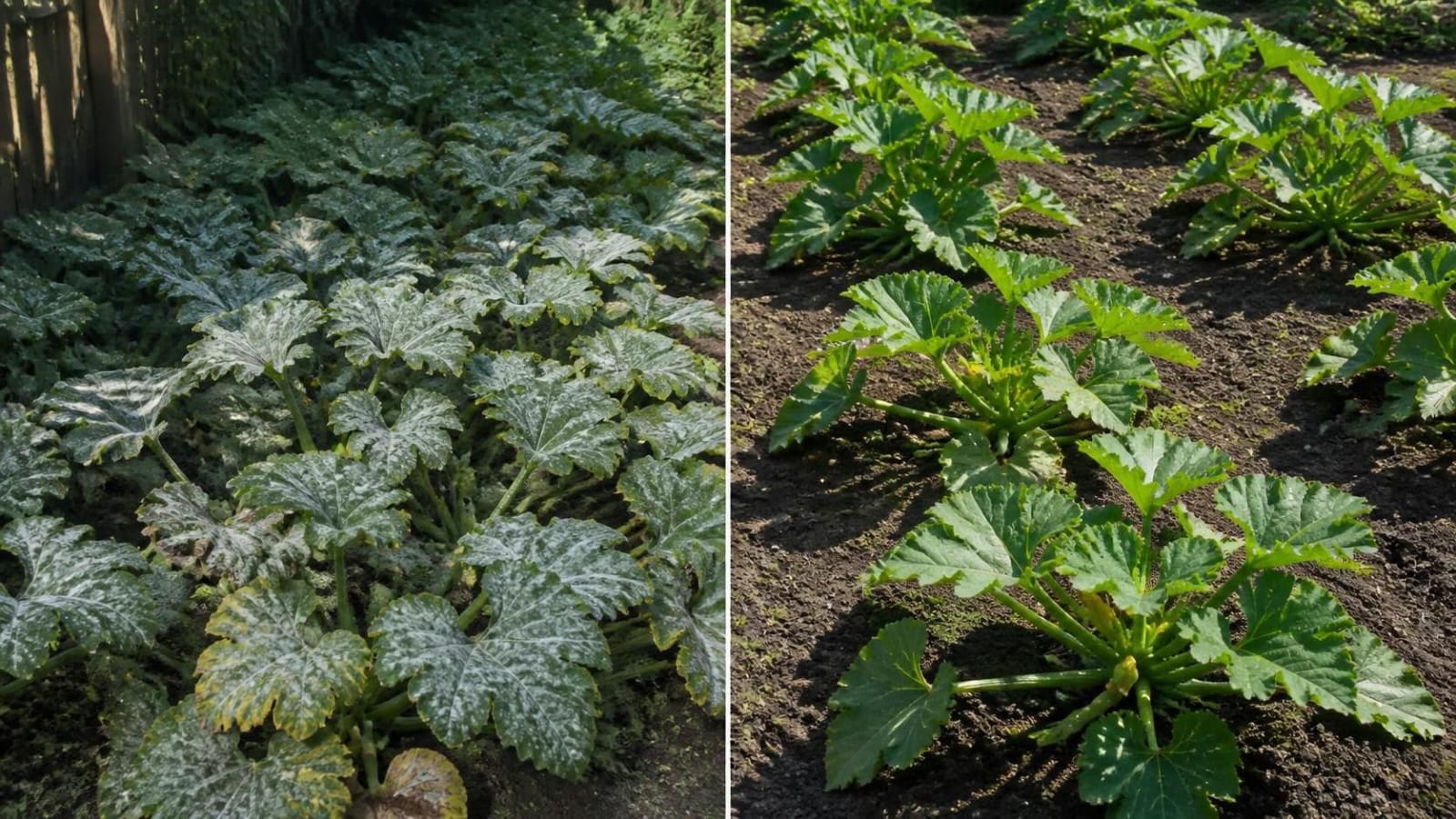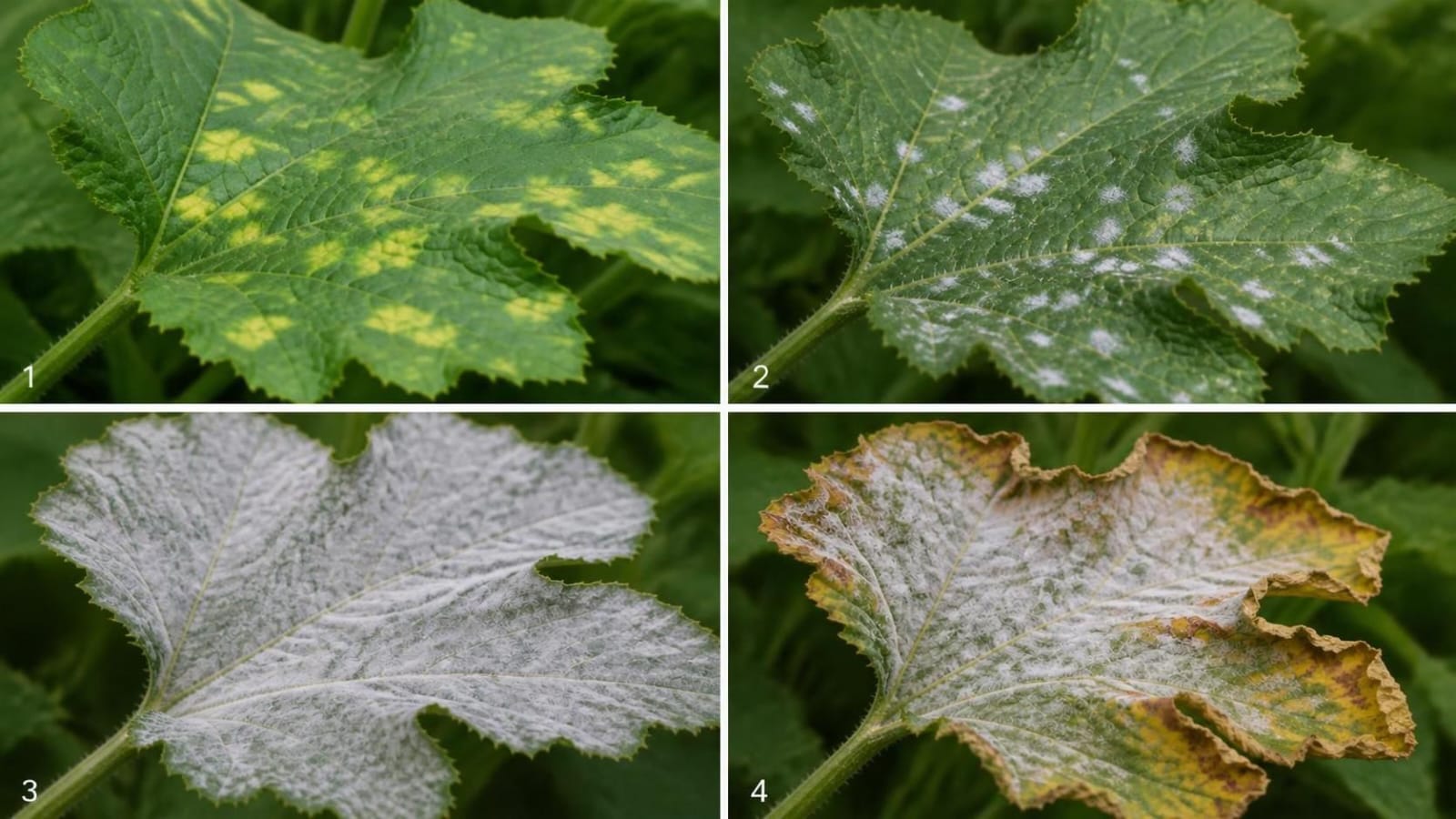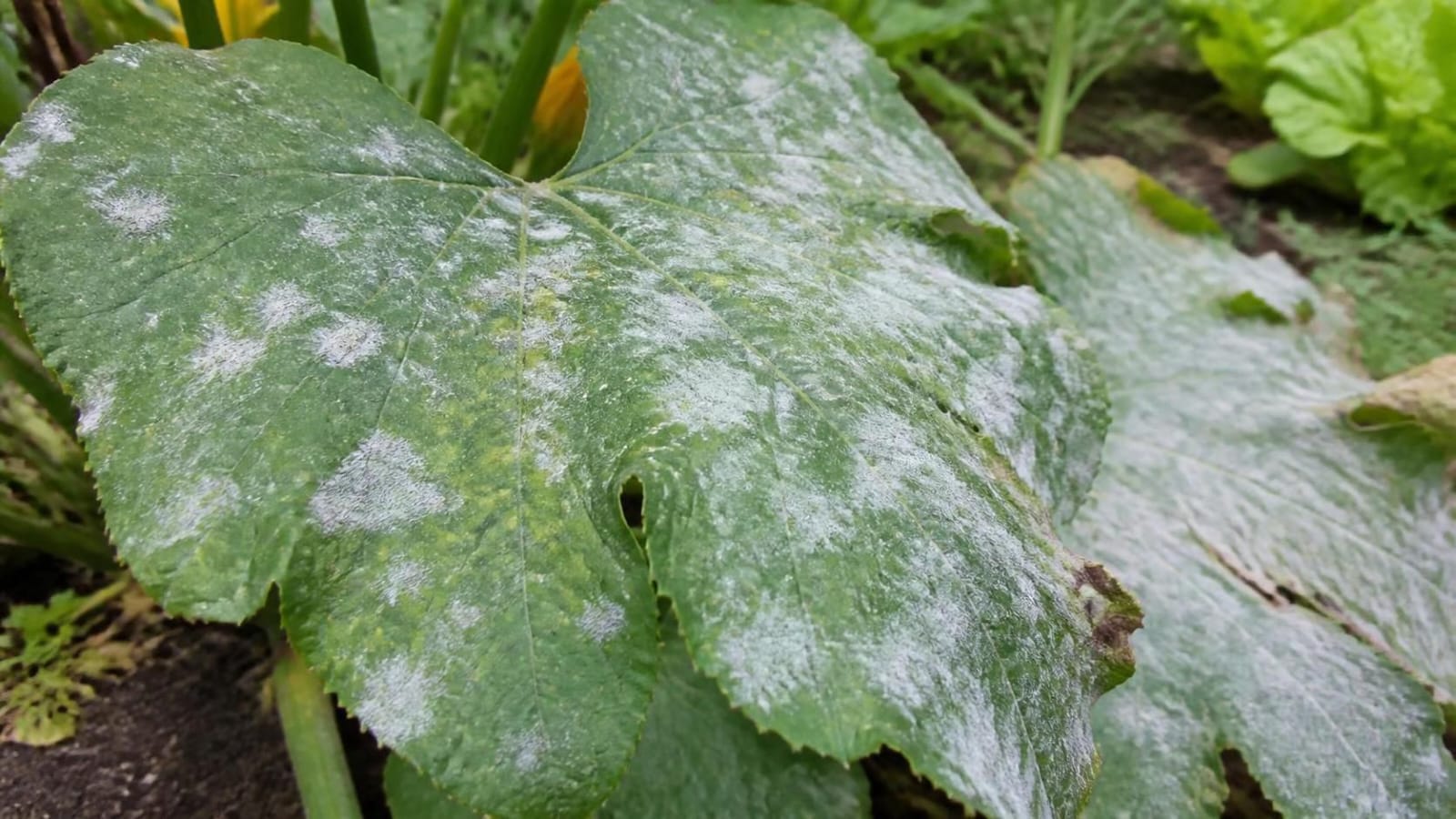
Best Fungicides for Powdery Mildew: Organic & Conventional Options
Most advice on the best fungicide for powdery mildew reads like a shopping list. The more useful question is about timing: has the mildew shown up yet, and how much of it is there?
A product that protects clean leaves beautifully may do almost nothing for a leaf that is already white. A spray that knocks back a light dusting can scorch the same leaf once the mildew is well established. So the best fungicides for powdery mildew are the ones that fit the stage of the disease, the plant in front of you and the weather on the day you spray. The options below are sorted along those lines, organic and conventional side by side.
Short answer: No single product wins everywhere. Sulfur and other protectants are the dependable choice before mildew appears. Horticultural or plant-based oils are the usual organic choice once a mild infection has started. Synthetic fungicides such as myclobutanil are strong conventional options where they are legal, but they work best applied early and rotated with products from a different group.
Start with the stage of the disease, not the product
Extension specialists at UC IPM separate fungicides into two jobs. A protectant keeps new infections from taking hold, so it has to be on the plant before the fungus arrives. An eradicant can stop an infection that has already started. Most organic materials are protectants. The oils are the main exception, and potassium bicarbonate has some eradicant action as well.
There is a catch with eradicants. Powdery mildew fungi live in the surface cells of the leaf, so killing the fungus can kill those cells too. That is why UC IPM advises using eradicants early in the disease cycle, when little tissue is involved, and why control with any product becomes harder once the growth is extensive.
| Situation | Best-fit approach | Why it fits | Watch out for |
|---|---|---|---|
| Leaves still clean, but mildew is likely | A protectant: sulfur, potassium bicarbonate, a Bacillus-based biological or a synthetic protectant | Protectants work on contact or by blocking infection, so they must be in place first | Sulfur in hot weather; biologicals have tested weaker than sulfur or oil |
| A few white patches on a handful of leaves | An eradicant: horticultural oil or a plant-based oil such as neem, or potassium bicarbonate used with care | Oils work best as eradicants and can clear mild to moderate infections | Oil within two weeks of sulfur, high heat, drought-stressed plants |
| Mildew covering most leaves | Cut off the worst growth, then protect the new growth that is still clean | Control gets harder once growth is extensive, and potassium bicarbonate on advanced disease can cause severe injury | Stepping up to stronger or more frequent sprays |
| Mildew appearing late in the season on mature plants | Often no fungicide at all | Michigan State University Extension notes that many plants with mildew from mid-August onward do not need treatment | Crops where yield still matters, such as squash or melons |
The organic and low-toxicity options
Many of these are labeled for organic use in some countries, but organic rules differ by region and certifier, so check before relying on that.
Sulfur
Sulfur has been used against powdery mildew for centuries, and it is a protectant. UC IPM is blunt that it works only when applied before the disease appears. Formulations made with a built-in spreader stick and spread across the leaf better than dusts, which UC IPM describes as harder to use and irritating to skin and eyes.
Heat is the main hazard. Both UC IPM and the University of Arizona Cooperative Extension warn against applying sulfur near or above about 90°F, and some squash and melon varieties are easily damaged by it. A Washington State University guide rates the resistance risk for sulfur as low, which is one reason it stays useful in a rotation.
Horticultural oils and plant-based oils
Oils are the organic option that can work on mildew already present. UC IPM recommends them to eradicate mild to moderate infections, including refined horticultural oils and plant-based oils such as neem and jojoba. Refined horticultural oils are the least likely to injure plants, though some are sold only to licensed applicators. Never apply oil within two weeks of sulfur, in temperatures above 90°F, or on water-stressed plants. For a closer look at one of them, see Neem Oil for Powdery Mildew: Does It Work?
Potassium bicarbonate
Potassium bicarbonate products act on contact. The University of Arizona describes them as effective but with no lasting residual activity, so new growth is unprotected again soon after. UC IPM adds two cautions: these products can injure plants that are already infected, and they should not be used on advanced mildew because the injury will be severe. Household baking soda follows the same logic with less refinement, and the Arizona publication lists it as an effective contact material that can burn leaves. We compare it in Baking Soda Spray for Powdery Mildew: Does It Work?
Bacillus-based biologicals
Products built on Bacillus subtilis or Bacillus amyloliquefaciens (also known as Bacillus velezensis) are gentle on people, pets and beneficial insects. UC IPM says they stop the fungus from growing and attaching to the plant, but that research has not shown them to be as effective as oils or sulfur. They suit early-season, low-pressure situations better than a mildew problem that is already running.
Copper and phosphonates
Copper appears on many powdery mildew lists, but the evidence is mixed. UC IPM calls it not very effective on vegetables, while Cornell Cooperative Extension treats it as a broad-spectrum protectant for cucurbits. Phosphonates, which move through the plant, are listed by UC IPM among the less toxic options for ornamentals, though it gives little performance detail, so read the label closely.
Conventional fungicides: what a home gardener can realistically use
Synthetic fungicides fall into two camps: products sold to home gardeners and products restricted to licensed applicators. Where the line falls depends on your country and sometimes your state or region.
UC IPM names myclobutanil as a home-garden active ingredient that works as both a protectant and an eradicant against powdery mildew and rust. The University of Arizona lists myclobutanil and thiophanate-methyl among compounds available to homeowners. Commercial growers have a longer list, including products from the DMI, SDHI, QoI and quinoline groups, but those come with crop-specific limits that university spray guides spell out.
Local resistance changes the advice, and it is easy to miss. A 2017 Cornell Cooperative Extension table on cucurbit powdery mildew flagged strobilurin (QoI), thiophanate-methyl and boscalid products as not recommended because resistance had been confirmed, and it also advised against myclobutanil because of partial cross-resistance. That does not contradict the Arizona advice. Resistance is local, crop-specific and changes over time, so a product that performs well in one region can disappoint in another. Your regional extension service is the best place to check.
Do organic fungicides work as well as chemical ones?
Often close, rarely identical. In a 2016 Virginia Tech pumpkin trial, a conventional program gave the best powdery mildew control, with a potassium bicarbonate product and a copper-based product next. Several organic materials were statistically as effective as the conventional program, though the conventional one was numerically ahead, and one plant-defense product did no better than plain water. It was a single season at a single site, so treat it as a signal rather than a verdict.
A greenhouse trial on cucurbit seedlings, reported through the World Vegetable Center, tested sixteen treatments. Sulfur and a fish oil plus sesame oil product were the most effective organic-approved options, while penthiopyrad, myclobutanil and a cyprodinil plus fludioxonil mix led among conventional ones. The common thread across both studies is that early, thorough application counts for more than whether the label says organic or synthetic.
Why rotating matters more than the brand name
Fungicides are sorted by mode of action into numbered groups from the Fungicide Resistance Action Committee, or FRAC. The Washington State University guide explains the rule that matters: if a fungus population becomes resistant to one product in a group, it is likely resistant to all of that group, and resistance is much more likely when the same group is used again and again.
Risk differs by group. The same guide rates sulfur, narrow-range petroleum oil and potassium bicarbonate as low risk, DMI products such as myclobutanil and quinoline products as medium, and QoI (strobilurin) products as high. Cornell adds that resistance to some groups is all-or-nothing, while DMI resistance builds gradually and cross-resistance is only partial.
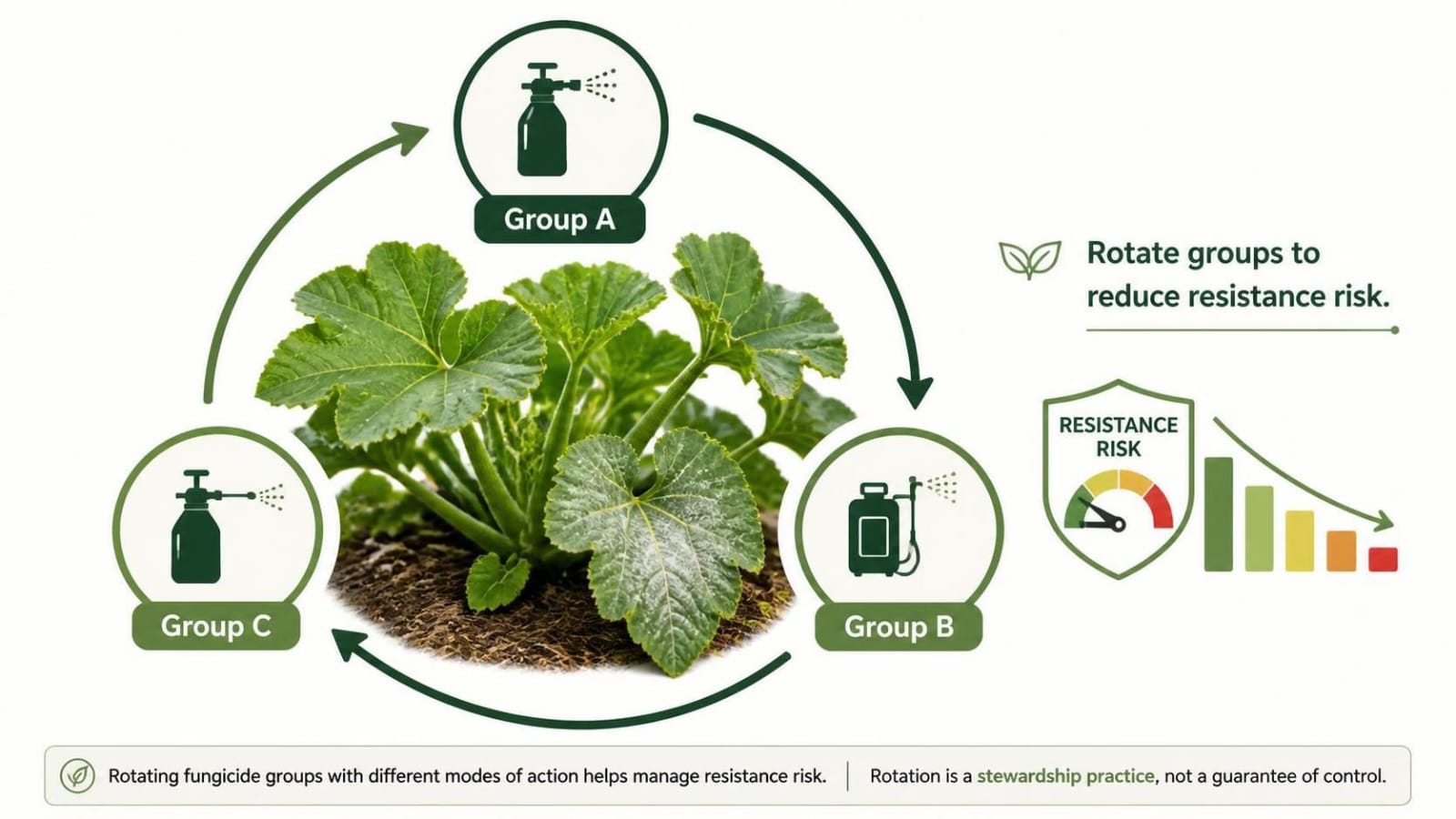
For a home garden, a workable habit is simple. Look for the group code or a note about consecutive sprays on the label, and treat any limit literally. Cornell notes that labels typically allow only one or two consecutive sprays. Then switch to a product from a different group for the next application. Rotation has one wrinkle for organic growers: sulfur and oil cannot follow each other closely because of the two-week gap, so plan the order instead of improvising mid-season.
Matching the fungicide to the plant
Roses and other ornamentals
Roses, crape myrtle and euonymus are among the ornamentals UC IPM singles out as likely to need fungicide protection when conditions favor mildew, especially susceptible varieties. Sulfur sprays can damage some ornamental cultivars, so check the label’s plant list and cautions before treating a prized shrub. Mildew on perennials like roses can overwinter in buds or as small black fruiting bodies, which is why UC IPM also recommends removing infected buds during dormancy and choosing resistant cultivars where you can.
Squash, cucumbers and melons
Cucurbits are the vegetable group most likely to need a fungicide program, according to UC IPM’s vegetable guide, and some squash and melon varieties are also sensitive to sulfur. Cornell describes the first signs on the undersides of squash leaves and near the crown of the plant, where moisture collects, so scouting there catches it early. The fruit itself is rarely colonized, but check the label for crop listings and the wait before harvest. The dedicated guide, Powdery Mildew on Squash and Cucumbers: Treatment & Prevention, goes deeper.
Grapes, strawberries, apples and other fruit crops have their own spray programs in university guides, so treat the general advice here as a starting point.
How to spray so the fungicide can actually work
Most of the materials above work only where they touch the fungus, and UC IPM says plainly that applications must cover all susceptible plant parts. Mildew grows on both sides of the leaf, so thorough coverage includes the undersides.
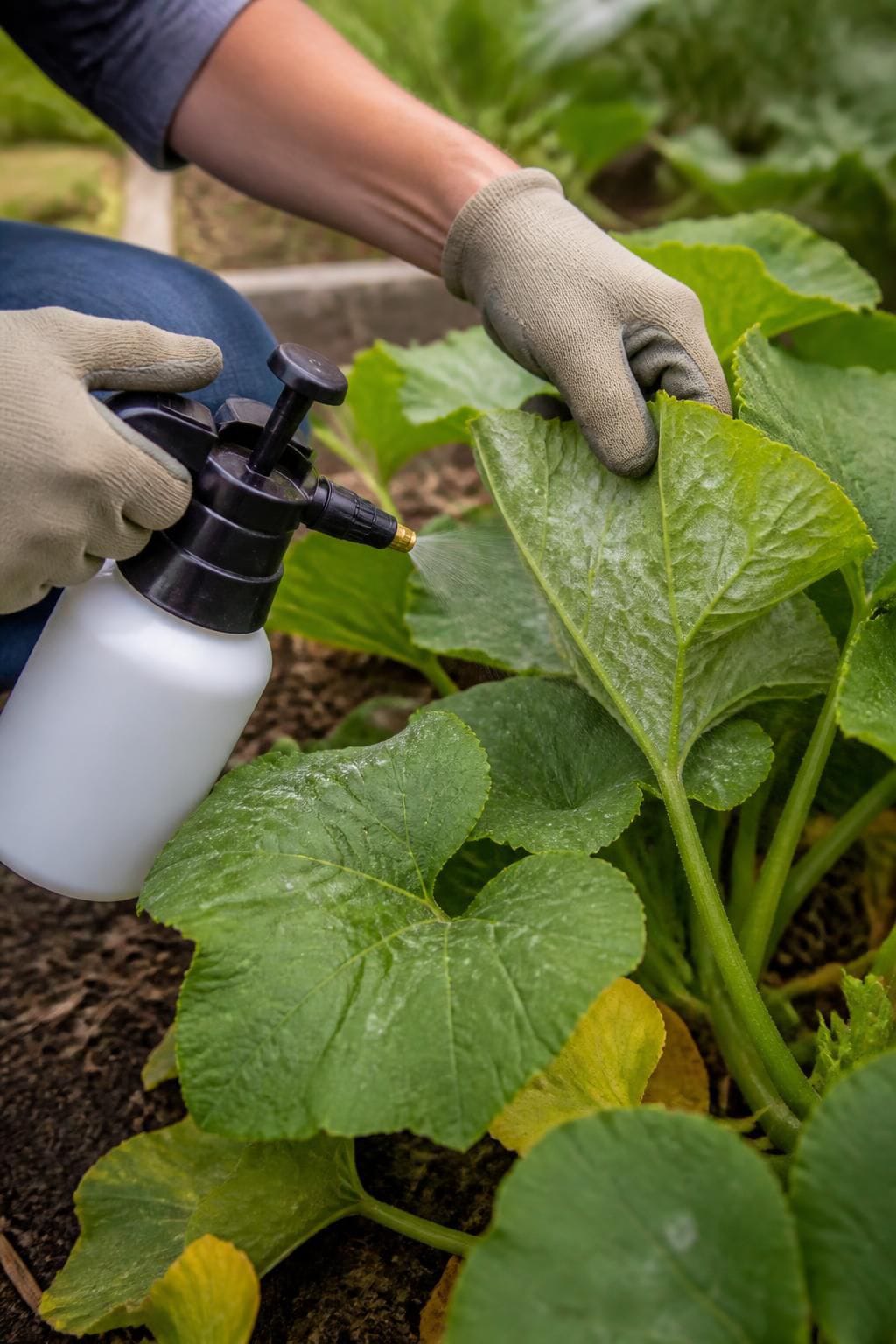
- Start before symptoms on plants that get mildew every year, or at the very first spots on others, as UC IPM advises.
- Re-apply as new leaves grow. UC IPM suggests 7- to 10-day intervals while conditions favor the disease, or whatever interval the label sets.
- Keep the 90°F ceiling for sulfur and oil in mind, and water dry plants first, because oils should not go on drought-stressed foliage.
- Cut off the worst infected growth and bag it. UC IPM allows disposal in compost, green waste or trash, noting that properly maintained compost kills spores.
Mildew or fungicide burn? Reading the leaf after you spray
Spraying can leave marks that people mistake for a failing treatment. Because eradicants kill leaf cells along with the fungus, UC IPM warns of phytotoxicity, and sulfur or oil used in heat, or too close together, can injure plants. As a practical rule of thumb rather than a firm diagnostic, mildew sits on the surface as white to gray growth, while injury shows up as brown, bleached or spotted tissue within a few days of a spray, often worst on the hottest, most exposed leaves.
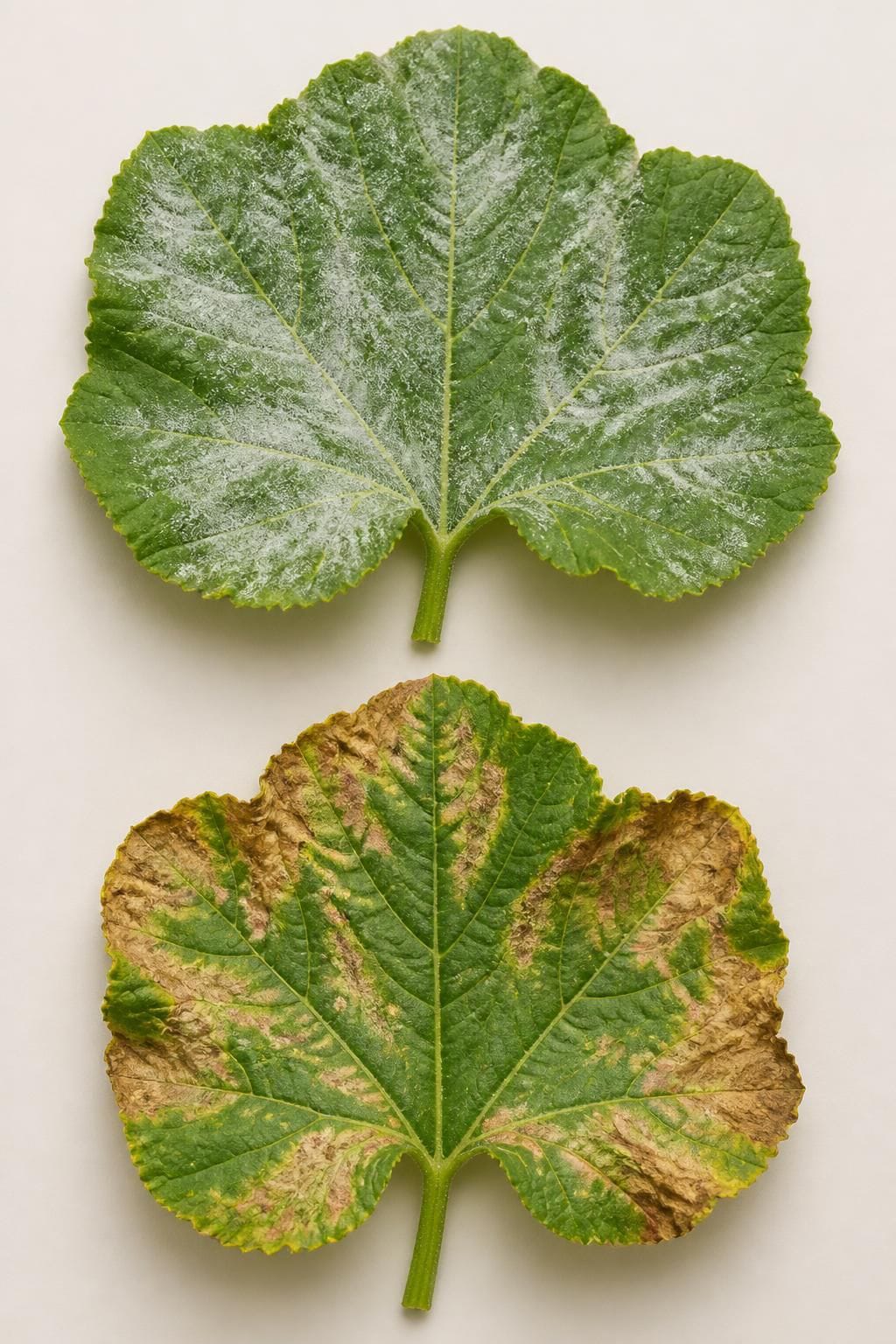
The better test of success is the new growth. If fresh leaves unfold clean while the old, distorted ones stay as they are, the program is working. Damaged leaves do not return to normal.
Also make sure the problem is powdery mildew in the first place. Downy mildew can look powdery too, but its spores grow on branched stalks like tiny trees, mostly on the lower leaf surface, and it favors cool, very humid weather around 50° to 70°F, according to UC IPM. The two diseases are managed differently, so confirm which one you have with What Does Powdery Mildew Look Like? Signs, Symptoms & Identification before buying anything.
Before you buy: five label checks
The label is the legal document, and it varies by country, so these are worth reading before the product goes in the sprayer.
- Powdery mildew and your plant are both named. Approval for one crop does not carry over to another.
- For edible crops, the wait between the last spray and harvest.
- The FRAC group code, if shown, and any limit on consecutive or seasonal applications.
- Temperature limits, and whether the product can follow or be mixed with sulfur or oil.
- Local rules. Approved products and organic standards differ by region, and some products are limited to licensed applicators.
When you may not need a fungicide at all
Fungicide is one layer, not the whole plan. UC IPM puts resistant varieties, sunny sites, good air circulation and moderate fertilizing ahead of sprays, because lush, nitrogen-fed growth and shade create the conditions mildew likes. The full prevention picture is in Powdery Mildew: Causes, Symptoms, Treatment & Prevention.
Quick answers
What kills powdery mildew fastest?
Nothing is instant. Oils and potassium bicarbonate are the organic options extension specialists recommend for existing mild infections, but they only clear the fungus from the surface. Leaves that are already distorted or dying will not recover.
Can I mix sulfur and oil?
No. UC IPM says never to apply an oil within two weeks of sulfur because plants may be injured, and the University of Arizona gives the same warning. Check the product label for any special precautions.
Which is better, neem oil or sulfur?
They do different jobs. Sulfur protects clean growth and is no use once mildew has appeared. Neem and other oils can cut back a mild infection. The choice depends on whether the mildew is already there, and the same two-week gap applies if you use both.
How often should I spray?
UC IPM suggests repeating at 7- to 10-day intervals while conditions favor the disease and new leaves are forming, or at the interval printed on the label. If the label says otherwise, follow the label.