
What Does Powdery Mildew Look Like? Signs, Symptoms & Identification
Run a fingertip across a leaf that looks dusted with flour. If the white comes away as a fine, dry powder, there is a good chance you are looking at powdery mildew. But a handful of other things leave pale marks on leaves too, and the disease itself looks different on a rose than it does on a squash vine. This guide shows what to look for at each stage, where on the plant to check, and how to separate the real thing from its look-alikes.
Quick answer: Powdery mildew looks like a white to gray, flour-like dust lying on top of leaves, stems, buds and sometimes fruit. It usually starts as small, round patches that spread and merge. Underneath, the leaf may turn yellow, purple or red, then curl, brown and drop.
Why Powdery Mildew Pictures Rarely Match Your Plant Exactly
If you have been scrolling through powdery mildew pictures trying to match your own leaf, the mismatch can be confusing. The name covers a whole group of related fungi, and the Royal Horticultural Society explains that each one attacks only a limited range of plants. The fungus on your peas is not the one on your apple tree.
They all produce the same basic look, but the starting point, the thickness of the coating and the damage underneath differ from plant to plant. The same infection also looks different in its first week than it does a month later. So it helps to learn the stages first and the plant-specific details second.
What White Powdery Mildew Looks Like, Stage by Stage
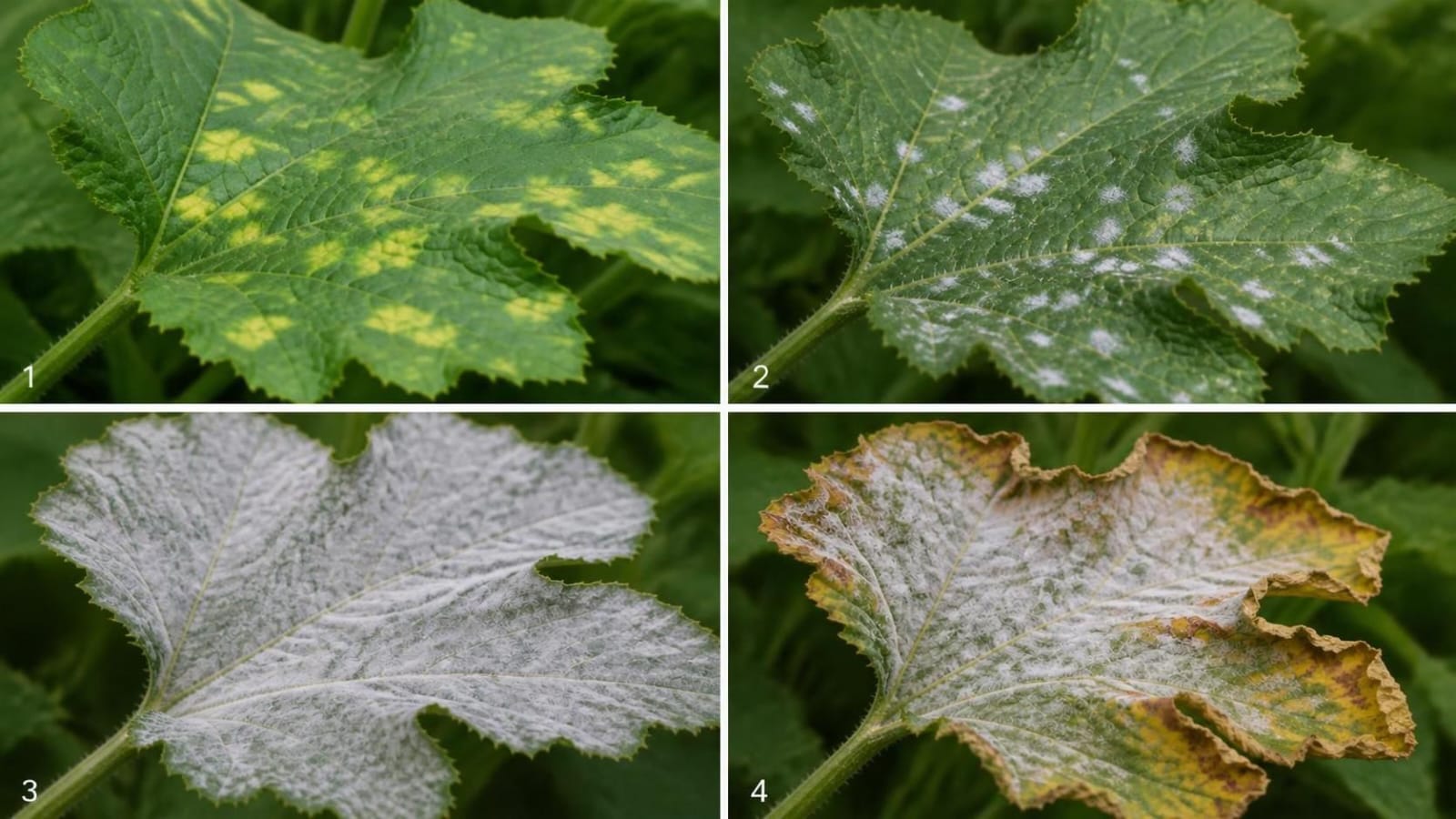
Stage 1: Before the powder appears
The white is not always the first thing you see. The Connecticut Agricultural Experiment Station notes that early symptoms can be irregular yellowish or purple areas, or small dead patches, with the familiar white powder following afterward. On lettuce and similar vegetables, the University of California’s Statewide IPM Program describes yellow spots on the upper surface of older leaves that later develop the powdery growth. On cucumbers and squash, University of Minnesota Extension lists pale yellow leaf spots as the first sign.
Look at older, lower and middle leaves first. The Connecticut fact sheet points out that infections often begin there and slip by unnoticed when plants are not checked regularly.
Stage 2: Small, round white spots
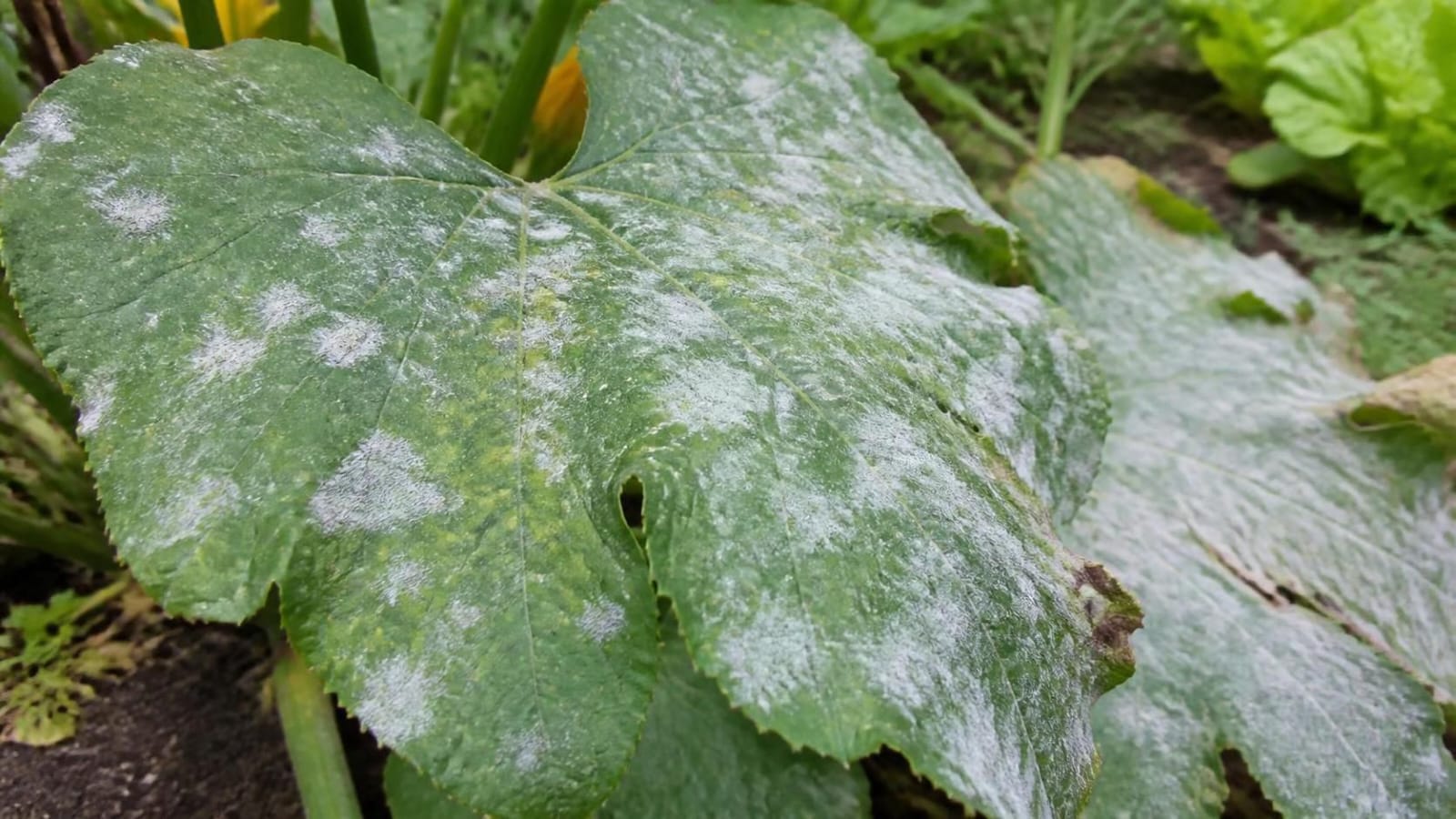
The sign most people recognize is a scatter of small, circular, powdery white spots. They widen, touch and run together as the infection grows. UC IPM’s powdery mildew quick tips say the spots can appear on both leaf surfaces, and its comparison chart lists the circular outline as a feature that sets powdery mildew apart from downy mildew.
Tilt the leaf toward the light as you look. The fine dust catches it, and faint early patches that disappear when you look straight on often show up at an angle.
Stage 3: A spreading white-to-gray coat
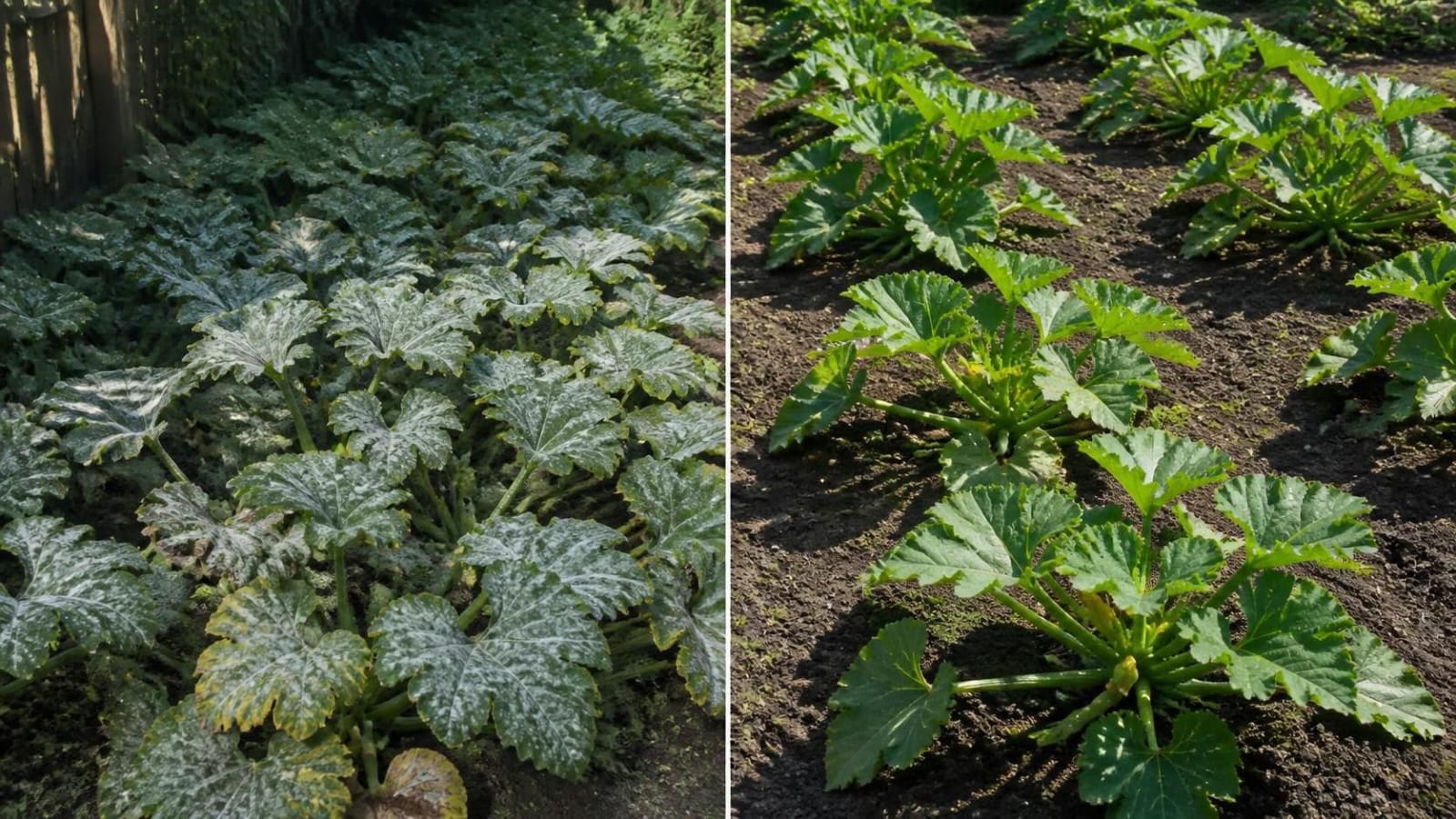
Once the patches merge, the leaf can look as if it were dusted with flour or talcum powder. The color runs from bright white to dull gray. On cucumbers and squash, the University of Minnesota says the blotches can spread across the leaf, the leaf stalk and the stem.
The coating sits on the surface. UC IPM’s vegetable guidance explains that most powdery mildew fungi grow as a thin layer of mycelium on the outside of the affected plant part. That is why the white can be rubbed off, even though wiping does not cure anything.
Stage 4: Distortion, browning and black specks
Heavily infected leaves may yellow or turn brown and fall early, and UC IPM warns that losing leaves can expose the plant or its fruit to sunburn. New leaves and shoots can twist or become distorted. Late in the season, some powdery mildews produce tiny black, pepper-like specks called cleistothecia within the white growth, which the Connecticut fact sheet describes as resting structures. They can start out yellow or orange before darkening, and a 10x hand lens makes them easy to see.
What It Looks Like on Different Plants
The basics hold across plants, but a few differences can help confirm what you are seeing.
| Plant | What you will see | Detail worth checking |
|---|---|---|
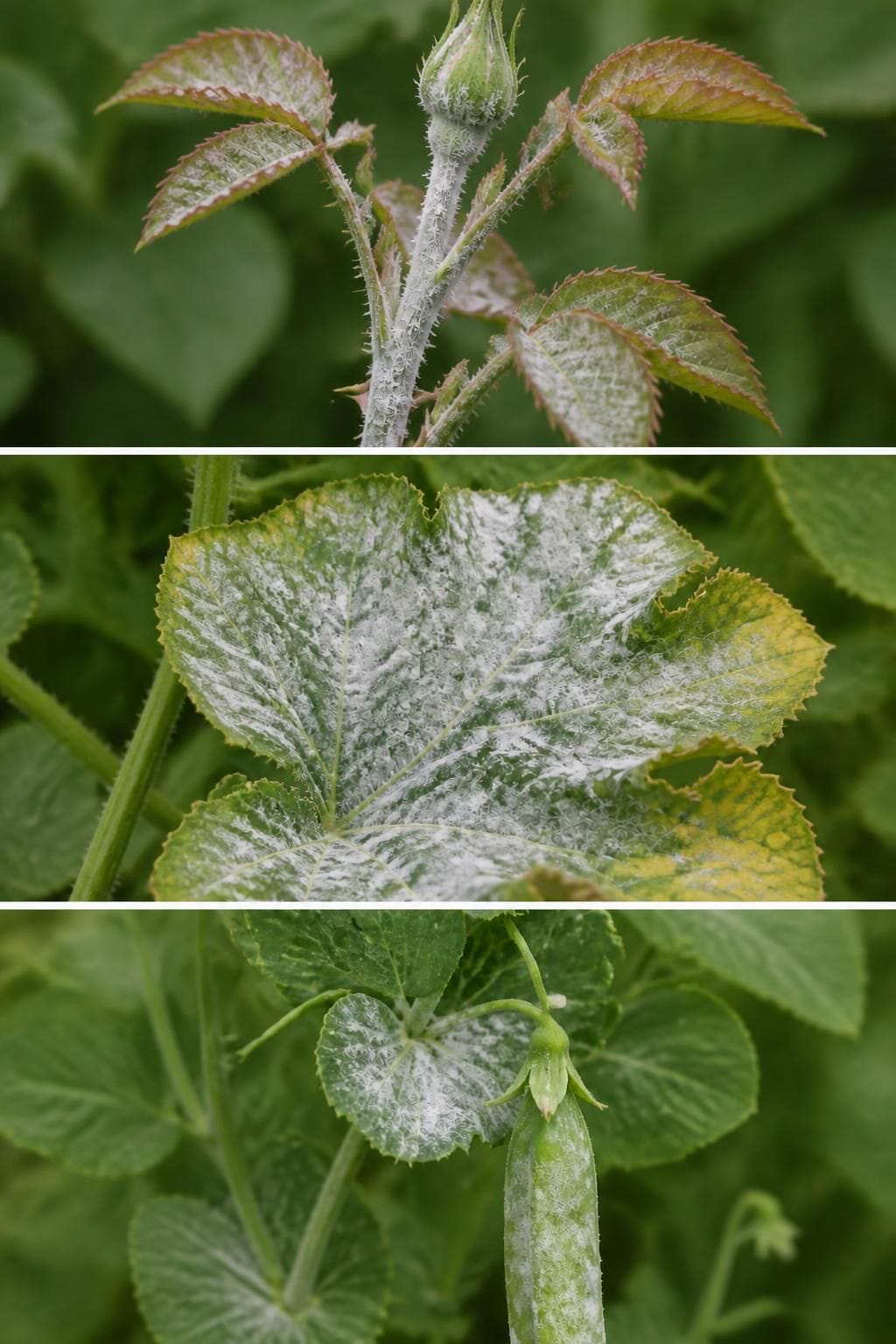
| Cucumber, squash, pumpkin | Spots on both sides that grow into large blotches | Older leaves go first, and pale yellow patches often come before the powder |
| Roses | White-gray dust on leaves, shoots and buds | Thicker, felt-like growth around thorns that browns with age; young leaves may twist or turn reddish |
| Lettuce and peas | Yellow patches that turn powdery | Starts on older upper leaf surfaces, then reaches undersides and stems; pea pods can be coated too |
| Carrots | White powder on leaf stalks and older leaves | Younger leaves show small circular spots that slowly enlarge |
| Grapes and apples | Gray-white dust, later web-like scarring on fruit | Apples, grapes and stone fruits can scar, while most vegetable fruits are usually unaffected |
The table draws on University of Minnesota Extension for cucurbits, the RHS for roses, UC IPM for carrots and fruit, and the Ontario Ministry of Agriculture for grapes. If yours is a rose or a squash vine, our guides to powdery mildew on roses and powdery mildew on squash and cucumbers go deeper on symptoms and treatment.
Four Quick Checks to Confirm It
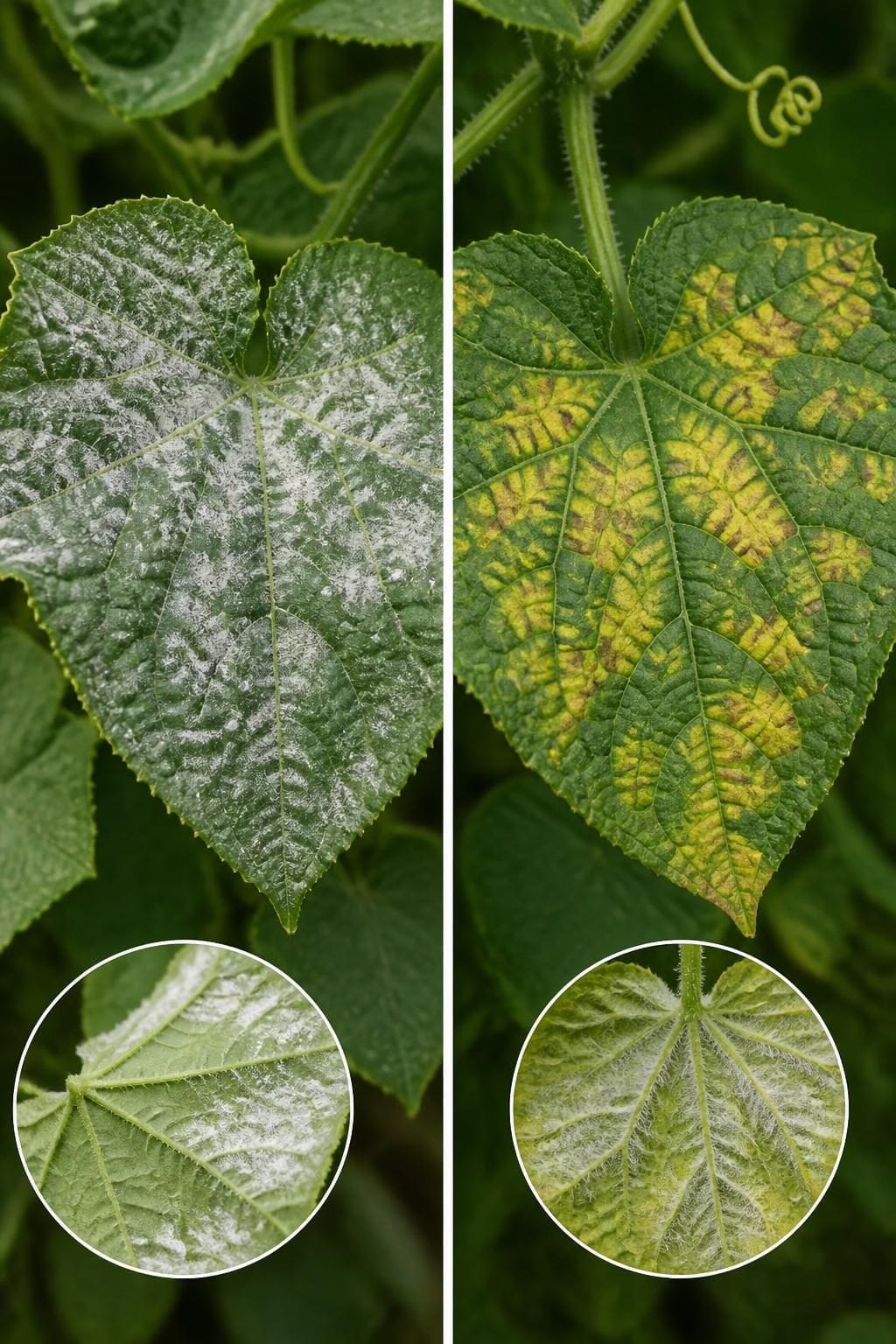
- Look at both sides of the leaf. White growth on top, underneath, or on both sides fits powdery mildew. Growth confined to the underside leans toward downy mildew or an insect problem.
- Check the shape. Powdery mildew spreads in rounded patches that ignore the veins. Angular patches that stop at the veins suggest something else.
- Rub gently with a fingertip. Powdery mildew smears away as a fine, dry dust. Crusty, gritty specks that will not budge point to mineral deposits, and cottony tufts point to insects. Treat this as a test only, since wiping does not remove the infection.
- Use a hand lens if you have one. According to UC IPM’s identification chart, powdery mildew spores form in chains on a single stalk, while downy mildew spores sit on branched stalks.
Powdery Mildew or Downy Mildew?
The two are often confused, and they call for different handling, so the minute it takes to tell them apart is well spent. Both leave whitish growth on the leaf. The University of California’s pest management team sets out the differences in one side-by-side chart.
| Clue | Powdery mildew | Downy mildew |
|---|---|---|
| Where the white growth sits | Both sides of the leaf | Mostly the underside |
| Shape of the affected patch | Circular, spreading outward | Jagged, bordered by veins |
| Weather it favors | Warm, dry conditions | Cool, wet conditions |
| Needs rain or irrigation to produce spores? | No, spores are abundant even without water | Yes, only after rain or irrigation |
| Under a hand lens | Spores in chains on a single stalk | Spores on branched stalks |
These are general patterns rather than iron rules, because symptoms vary by plant. When the picture stays unclear, a hand lens or a sample taken to your local extension office settles it faster than guessing.
White Marks That Are Not Powdery Mildew
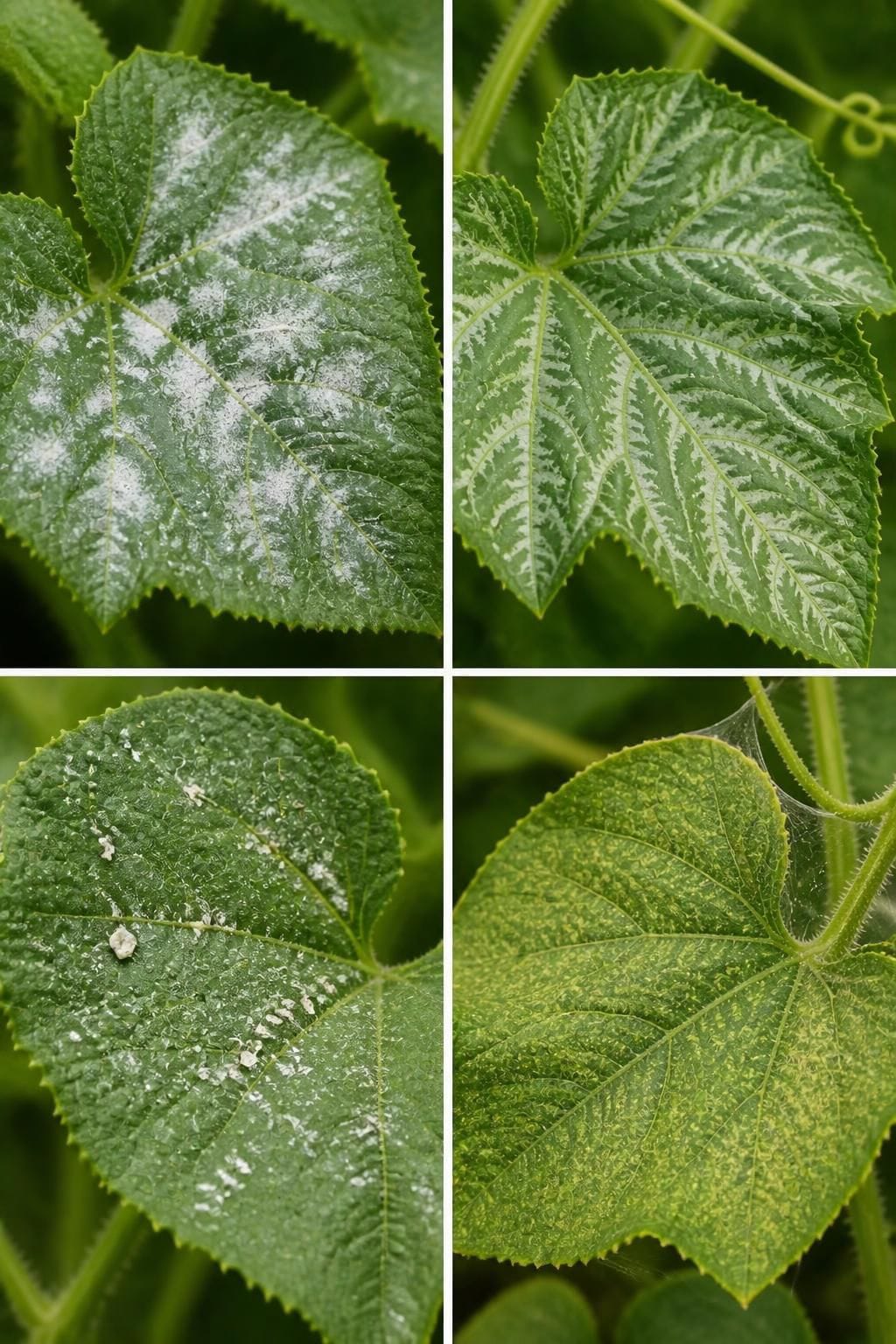
The shortcut “white means mildew” is so strong that plenty of harmless or differently caused marks get misdiagnosed. Rule these out before reaching for any spray.
- Natural leaf silvering. Some squash and pumpkin varieties carry silvery-white patterns along the veins of perfectly healthy leaves. Purdue Extension’s Vegetable Crops Hotline shows a healthy variegated pumpkin leaf beside a mildewed one. The silvering follows the veins, while mildew colonies are scattered at random across the leaf.
- Mineral or spray residue. Oregon State Extension lists salt residues from transpiration and pesticide residues among the causes of white spots, alongside fungi and insects. Hard, gritty or crusty specks that will not wipe off are more likely mineral than mildew.
- Spider mite damage. Mites usually cause fine, pale stippling, often with delicate webbing near leaf joints and on the undersides. There is no powder to wipe away.
- Whiteflies and mealybugs. NC State Extension warns that the white waxy residue linked to whitefly eggs can be confused with powdery mildew. Mealybugs leave cottony tufts instead of a fine dust. Check the undersides for tiny insects.
How Serious Is It?
Seeing white does not automatically mean an emergency. UC IPM says powdery mildew on lettuce rarely becomes serious enough to need treatment, and a Purdue Extension publication on landscape plant diseases says it seldom does serious harm to its host.
Squash, cucumbers and pumpkins are the exception. The University of Minnesota reports that heavy infection weakens the plant, ripens fruit prematurely and leaves fewer, smaller fruit. On roses, the RHS notes that repeated heavy infection reduces vigor. How worried to be depends on the plant and on how much of its foliage is covered.
What to Do Once You Have Confirmed It
Where the infection is limited, UC IPM advises pruning out the diseased tissue as soon as it appears and discarding it. Then work on the conditions around the plant. Give it sun and air movement, and hold back on heavy feeding, since the University of California notes that too much lush foliage encourages the fungus.
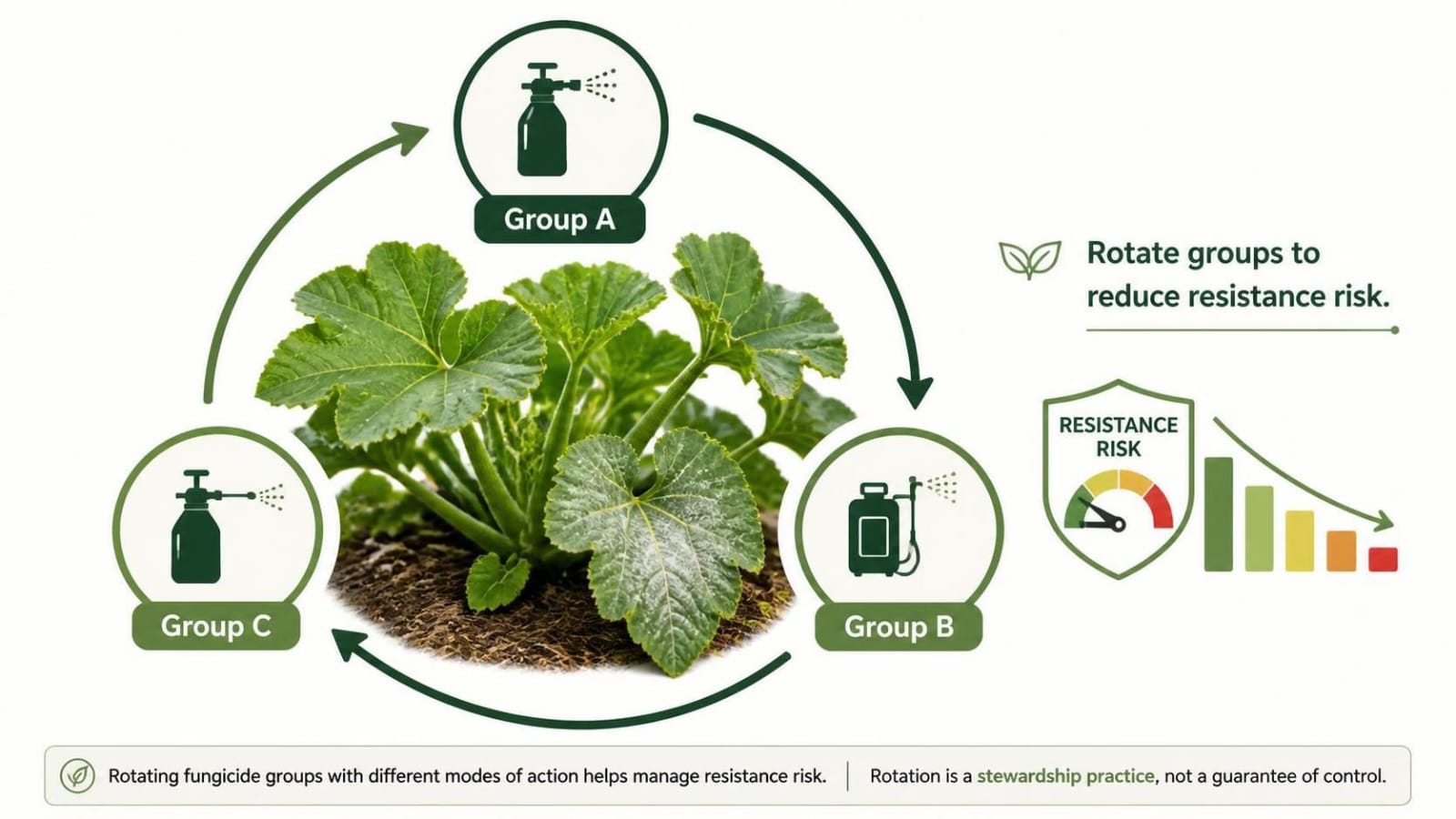
Our full guide to powdery mildew causes, symptoms, treatment and prevention covers the next steps in detail. If you are weighing home remedies or products, see how a baking soda spray performs and how organic and conventional fungicides compare. Whatever you choose, follow the product label and check local regulations, because approved products and rules differ by country and region. The RHS, for example, advises home gardeners against fungicides altogether, while other extension services list options for severe cases.
What not to do
- Do not spray before you have identified the problem. A silvered leaf, a hard-water film or mite damage will not respond to a mildew treatment.
- Do not feed with nitrogen-rich fertilizer to help the plant recover. Soft, leafy growth is the easiest for the fungus to colonize.
- Do not leave infected fallen leaves where they drop. The RHS says destroying them in autumn reduces the spores available the following spring.
Questions People Often Ask
Can powdery mildew be wiped off?
Yes, the dust comes off the leaf surface with a finger or a damp cloth. But wiping only removes the visible growth. The fungus stays attached to the plant and keeps producing spores, so the white tends to return unless the infection and the conditions behind it are dealt with.
Is powdery mildew always white?
Usually white to gray, but not always. On roses, the RHS notes that the growth can turn browner as it ages, and late-season black specks can appear in the coating. The leaf tissue beneath may look yellow, purple or reddish.
Will it spread from one plant to the rest of my garden?
It spreads readily among related plants, but most powdery mildew fungi are restricted to a small group of hosts, as the RHS describes. Mildew on your squash is therefore a risk to your cucumbers and pumpkins, but not usually to your roses.
Is white powdery mildew safe to eat?
An Ask Extension answer states that powdery mildew does not infect humans, though some people are sensitive to fungal spores. University of Minnesota Extension Master Gardeners say cucumbers still growing on a mildewed plant can be eaten. Wash produce well, and if the leaves themselves are coated, as with herbs and lettuce, it is simpler to pick clean growth instead.
One thought on “What Does Powdery Mildew Look Like? Signs, Symptoms & Identification”