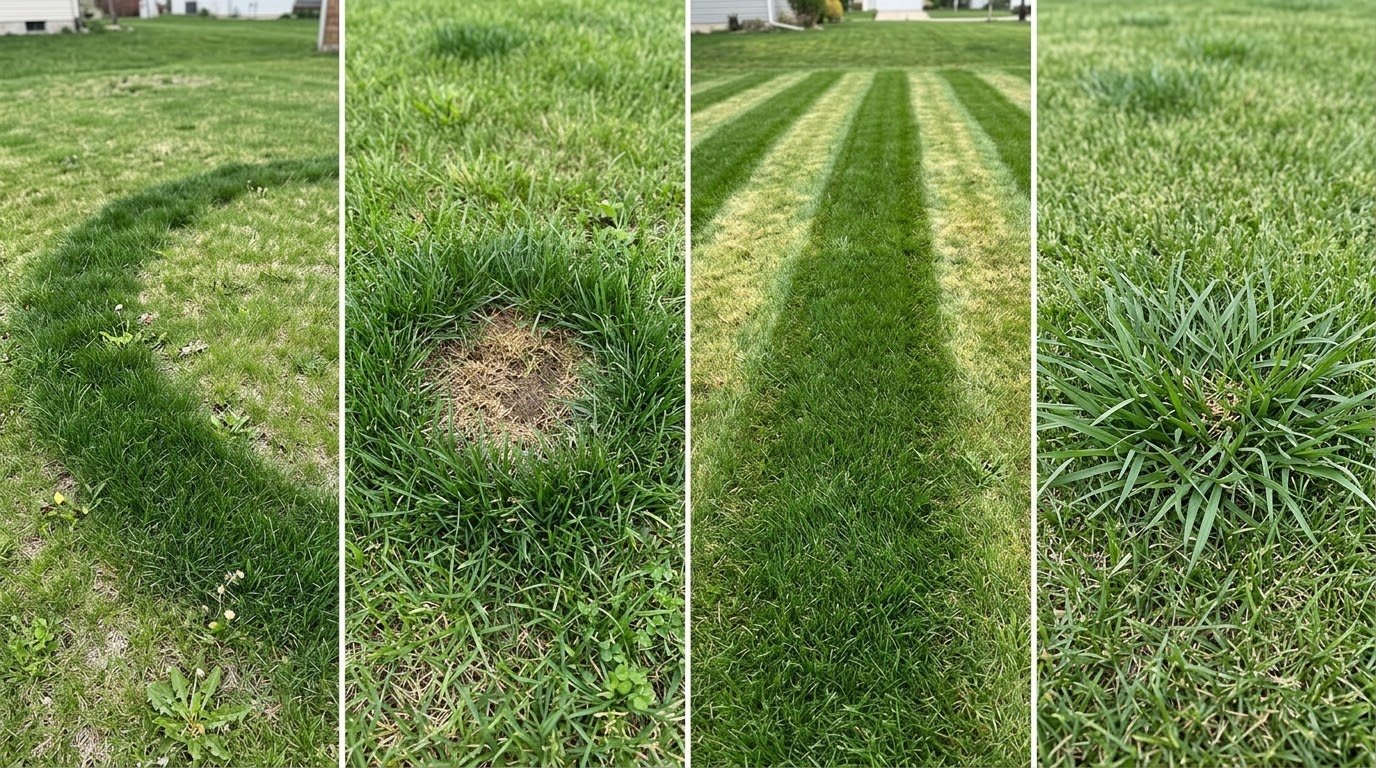
Extra nitrogen is the most common reason for dark green patches in grass, but it isn’t the only one. A patch of naturally darker, coarser grass growing in a lighter lawn can look much the same. The extra nitrogen often comes from dog urine, a fungus breaking down buried wood or thatch (a fairy ring), or fertilizer spread unevenly. Check the shape first, because it is a useful clue: a ring or arc most likely points to fungus, a round spot with a brown center to a dog, straight bands to a spreader, and a ragged clump of coarser blades to a different grass.
Most of these patches are only a cosmetic nuisance.
Why does my grass have dark green patches?
Nitrogen is a major driver of leaf color and growth, so a spot that receives extra of it often grows darker and faster than the grass around it. Several unrelated things can deliver that extra nitrogen to one small area, and a naturally darker grass can mimic the effect without any extra nitrogen at all. That is why the color alone can’t tell you what you have, and why the outline of the patch is the better clue. Even then, appearance is a starting point rather than a verdict.
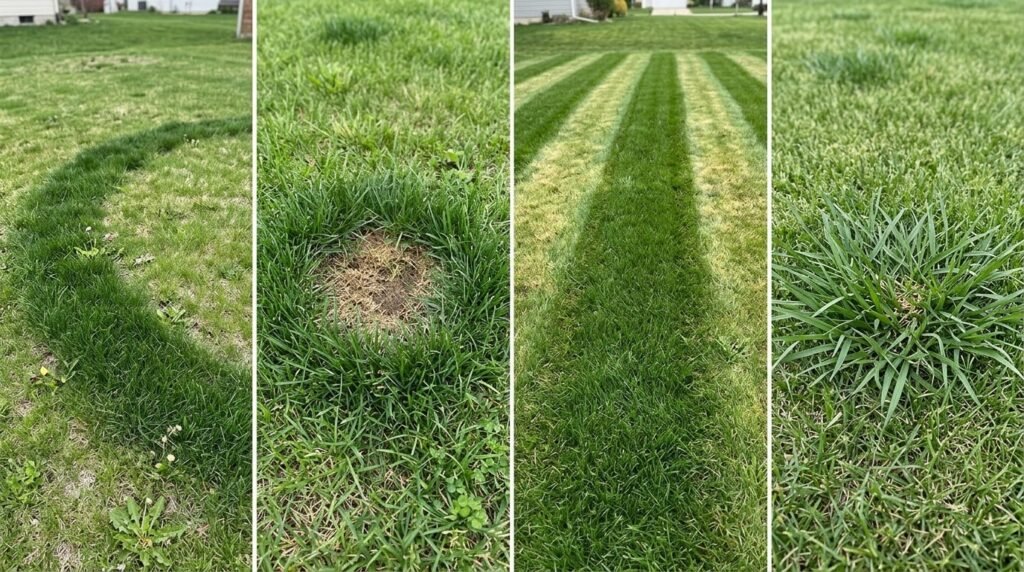
| What you see | Most likely cause | How to confirm | Is it a problem? |
|---|---|---|---|
| A ring or arc, sometimes with mushrooms after wet weather | Fairy ring (type II) | The band slowly widens over the seasons and the grass inside it looks normal | Usually not. The grass keeps growing |
| A round spot a few inches to a foot across, often where a dog goes, sometimes with a brown center | Dog urine | Dead grass sealed in a plastic bag may give off an ammonia smell (one clue, not proof) | The center may die while the green edge recovers on its own |
| Straight or curved bands that follow your walking lines | Uneven fertilizer | Bands match the passes of a spreader, with paler bands between them | Only if the grass starts to scorch |
| A ragged clump with wider or coarser blades that keeps its shape | A different grass in the lawn | Pull a few blades and compare them with the lawn around the patch | No. It is a matter of looks |
| Lush, spongy green over a buried tank or drain line, even in dry weather | Possible septic system trouble | Slow drains, odors, or damp ground near the system | Possibly. Have it inspected |
Rings and arcs: the fungus underneath
Most people assume a feeding mistake and start looking for spreader tracks. A ring doesn’t come from the spreader. South Dakota State University Extension explains that the greener grass in a ring is a fungus at work, feeding on decomposing matter such as old tree stumps, leaves, or roots and releasing nitrogen as it goes. The circle starts small and widens as the fungus spreads through the soil. In cool, wet weather it may push up mushrooms, and some of those can be poisonous, so keep them out of the kitchen.
If the ring is simply greener and the grass is otherwise healthy, it is most likely a type II fairy ring, which NC State’s turf program describes as a ring or arc of dark green turf growing faster than the grass around it. The same fungi can produce other symptoms. A type I ring kills turf because the soil and thatch turn water-repellent, and a type III ring shows mushrooms or puffballs, most often after long wet spells. Only the type II appearance matters for dark green patches, but it helps to look closely at the grass just inside and outside the band to rule out the others.
If the green comes with brown grass that stays brown after rain, you may be looking at more than a nitrogen boost. The Royal Horticultural Society says dark green patches that turn brown and don’t recover after rain are poorly understood, with water-repellent fungi appearing to be a major factor, and the remedy is rewetting the soil, which can be tricky. Pour a little water on the brown area and watch whether it soaks in or beads up and runs off.
What helps a plain dark green ring
Nothing urgent. Fairy rings don’t usually kill grass and may fade on their own. Aerating, bagging clippings to reduce thatch, and feeding the lawn all help keep them in check. NC State adds that a type II ring can be masked with nitrogen or iron, with a warning to be careful applying nitrogen to cool-season grass in summer. Here’s the catch with fungicides: they work best as a preventive on intensively managed turf, so they are rarely a practical homeowner fix and are hard to justify for a ring that is only a color difference. If you truly can’t live with it, the heavy option is removing the soil from the affected area, adding fresh soil, and reseeding. For a fuller walkthrough of all three ring types, see Fairy Rings in Lawns: How to Identify Them and What to Do.
A caution about diagnosing from a description. If the ring is killing grass rather than just greening it, your county Extension office or a lab can tell you far more than a general article can.
Round spots: a dog got there first
The first thing most of us do is blame the lawn feeder. If the dark green is a round spot, a few inches to a foot across, and it sits on the route the dog takes out the back door, the dog is the first suspect.
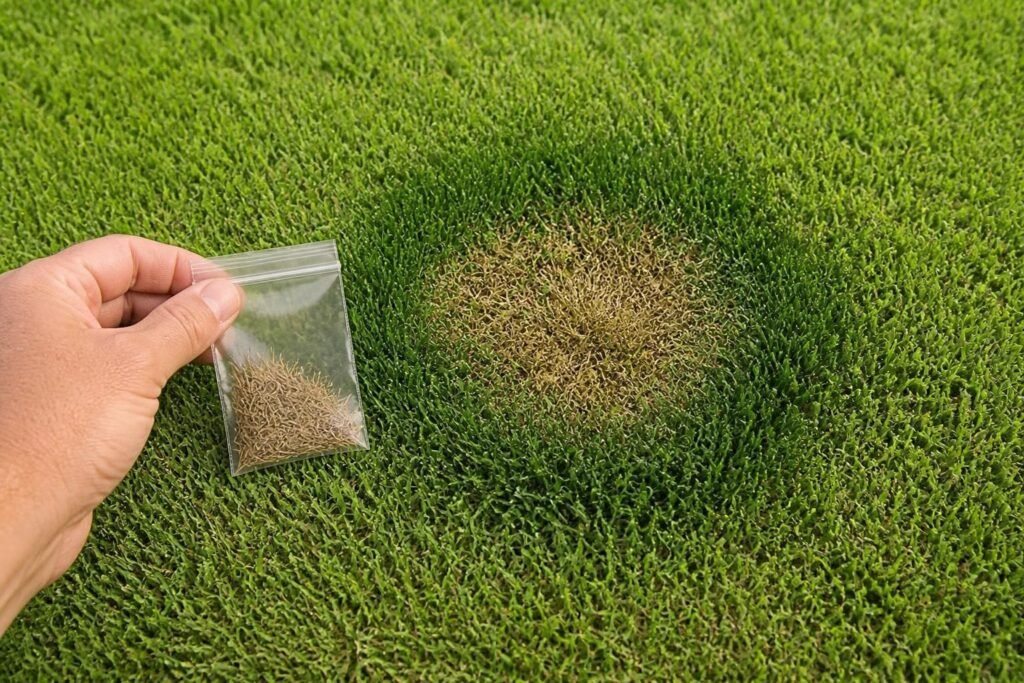
A Purdue Extension publication on animal urine describes the classic pattern: a central crater of brown turf 3 to 6 inches wide, surrounded by a dark green ring 6 to 12 inches across. It also notes that the dead center doesn’t always appear, and that for homeowners pets, dogs especially, are the most frequent cause of dark green and brown patches clustered in one part of the lawn. So a spot with only the green ring and no dead center can still be urine.
One clue can help separate urine from similar-looking fertilizer or salt injury. The Washington State University HortSense fact sheet says dead grass from a urine spot gives off ammonia when sealed in a plastic bag, while fertilizer or salt spills that look similar do not. The same sheet warns that urine damage can be mistaken for several patch diseases, so treat the smell as one clue alongside the location and the pattern, not as proof.
To limit the damage, water the spot heavily as soon as you can after the dog has been there. WSU notes that female dogs are usually the more damaging, and that urine does more harm on dry soil. Overseed any dead center with a mix similar to the rest of your lawn. Purdue points out that grass responding to urine nitrogen doesn’t necessarily mean the whole lawn needs fertilizer. And if a product claims to stop your dog’s urine from harming grass, check with your vet before giving it. For repair and prevention in more detail, see Dog Urine Spots on Grass: How to Repair and Prevent Them.
Bands and stripes: a spreader remembers
Straight or gently curved bands are the easiest case, because the pattern is a record of how someone walked. Golf.com quotes turf professional David Phipps on exactly this: the dark stripes are heavily fertilized turf and the pale ones are turf that missed out, which happens with uneven overlap or a spreader that isn’t set up correctly.
Think back to your last feeding. If the bands appeared after it, that is a strong clue. If the dark band also turns brown and crispy, it has stopped being a color issue. The RHS lists brown stripes after feeding as a sign of fertilizer overdose, and advises following the dose on the packet, calibrating a mechanical spreader before use, and watering after feeding if no rain is forecast. It adds that controlled-release products may be less likely to scorch.
A dark band on healthy grass needs no rescue. For the pale bands next to it, a careful, even pass at the label rate is the way to balance things, never a heavy one. For help with overlap and spreader setup, see How to Spread Lawn Fertilizer Evenly Without Stripes.
A different grass, not a different problem
The move people reach for first here is a disease treatment, and when the patch is simply a different grass it does nothing, because nothing is sick. If the patch has a ragged outline, keeps its color from spring through fall, and the blades look wider or coarser than the grass beside it, pull a few and compare them side by side. A ragged outline alone doesn’t prove a different species, so the blade comparison counts for more than the shape.
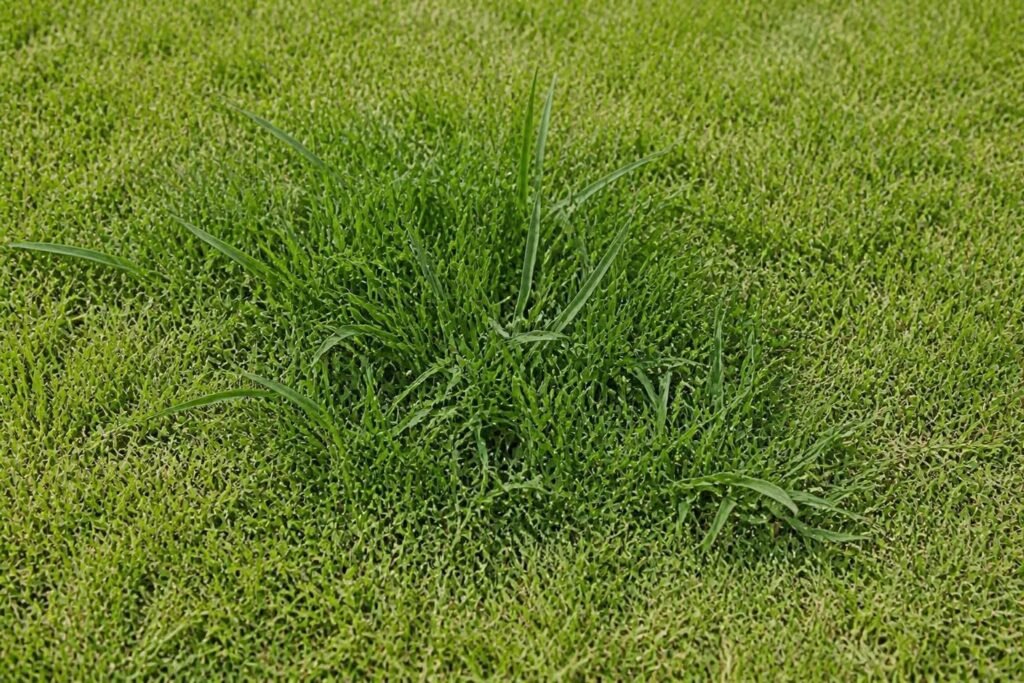
The Purdue turf team describes a common spring example: patches of tall fescue or perennial ryegrass that look much greener than Kentucky bluegrass, simply because the bluegrass is slow to green up. In that note the bluegrass catches up in about a week, and no control is needed unless the patch bothers you.
Some invaders don’t fade at all. Family Handyman’s lawn guide lists tall fescue, Poa trivialis, annual bluegrass, and creeping bentgrass as grasses that can form thick patches that slowly grow larger. The non-chemical fix is to cut the patch out with a spade or sod cutter, then seed or sod the hole. Purdue’s other option is a non-selective herbicide, which kills everything it touches, so follow the label and local rules, and on a small patch the spade is the safer first move. If you simply dislike the look of it, fair enough: digging it out is a legitimate fix.
One more look-alike runs the other way. If the patch is paler rather than darker, NC State Extension describes rough bluegrass as yellowish-green patches that spread by stolons, a different problem from the one in this article. For paler patches in general, see Light Green Patches in Lawn: Causes and Fixes.
When the lawn is only the messenger
A patch of grass can’t be blamed for a plumbing problem. If the lush green sits over a buried septic tank or drain field, treat the color as information. The Washington State Department of Health lists bright green, spongy, or lush grass over the tank or drainfield, even during dry weather, among the signs of on-site sewage system trouble, alongside slow drains, bad odors, and damp spots near the system.
One green patch proves nothing on its own. A green patch plus any of those other signs is a reason to call a licensed septic professional. Don’t dig it up or treat it yourself.
How to Get Rid of Dark Green Patches in Grass
There is no single treatment, because the right fix depends on the cause. You usually don’t treat the dark green color itself. You correct the underlying cause or reduce the contrast with the rest of the lawn: water and overseed after urine, even out the feeding after stripes, dig out a different grass, maintain or mask a fairy ring, and have a septic system inspected if the warning signs line up.
Are the patches harmful? By themselves, usually not, because the grass in a dark green patch is growing well. What deserves attention is a patch that turns brown afterward, which points to urine, fertilizer overdose, or water-repellent soil rather than a healthy flush of growth. If that is what you’re seeing, Brown Patches in Grass: How to Tell the Cause covers the next step.
In most cases you are blending a color difference rather than removing anything. If the lawn is due for a feeding anyway, an even application across the whole lawn can make the contrast less obvious, and NC State’s fairy ring guidance mentions nitrogen or iron for masking a type II ring. Always follow the product label and your local regulations on what you may apply and how much.
What not to do
- Don’t spray a non-selective herbicide on a patch until you have confirmed it is a different grass. On a fairy ring or a urine spot you would only create a bare hole.
- Don’t pile fertilizer onto the dark patch itself. It is already getting plenty of nitrogen.
- Don’t treat a urine spot with fungicide. WSU lists no chemical treatment for dog injury.
- Don’t pick or eat the mushrooms that appear in a ring.
- Don’t ignore unusually lush grass over a septic area if drains are slow, odors appear, or the ground stays damp.
A check you can do this afternoon
- Trace the outline. Ring or arc, round spot, straight bands, or ragged clump?
- Pull a few blades from the patch and from the lawn beside it. Wider, coarser blades mean a different grass.
- If there is dead grass in the middle, seal a pinch of it in a bag and smell it later for ammonia. Treat that as one clue, not proof.
- Look around and below the patch: an old stump, buried wood, or a septic tank or drain line close by changes the answer.