
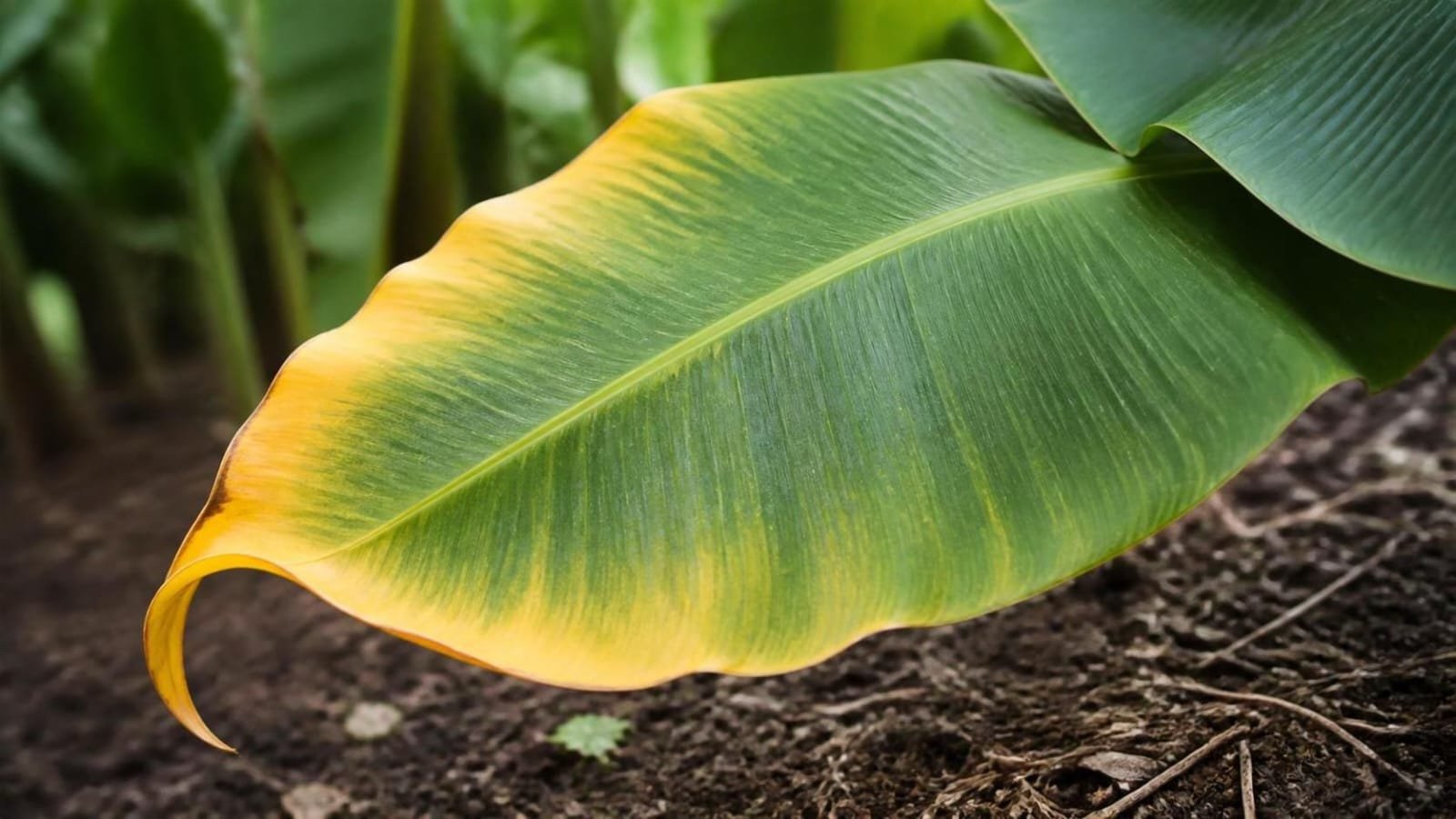
Most banana tree problems come down to water, potassium, or cold, and the plant usually tells you which one before the damage becomes permanent. If the oldest leaves are yellowing at the edges while the center stays green, suspect potassium before you reach for a general fertilizer. If the soil stays wet and the newest leaf droops, suspect the roots, not the sun. Cold shows itself differently again: firm stalks with brown, papery leaves can recover; mushy tissue cannot. The first useful move is to read the pattern, before any feeding or pruning.
A banana is not a tree. It is a giant herbaceous plant built from overlapping leaf sheaths, and almost everything about its care follows from that strange architecture. It has no woody trunk to store reserves, no deep taproot to chase water, and no patience for cold soil. The pseudostem is soft, the root system is shallow, and the leaves are enormous surfaces that lose water fast. Once you see the plant this way, the care stops being a list of chores and becomes a set of decisions.
The basics are well known: full sun, rich soil, regular water, a balanced fertilizer. Those things matter. What gets blurred is the order of diagnosis. A yellow leaf can mean several different things, and so can a brown edge. The common reflex of watering more, feeding more, and cutting off everything brown can make two of the three most likely causes worse. This guide is built around telling them apart before you act.
Start with the oldest leaf, not the newest
When a banana looks unhappy, look at the bottom of the plant first. Nutrient problems and water problems announce themselves on different leaves, and that single distinction saves a lot of guessing.
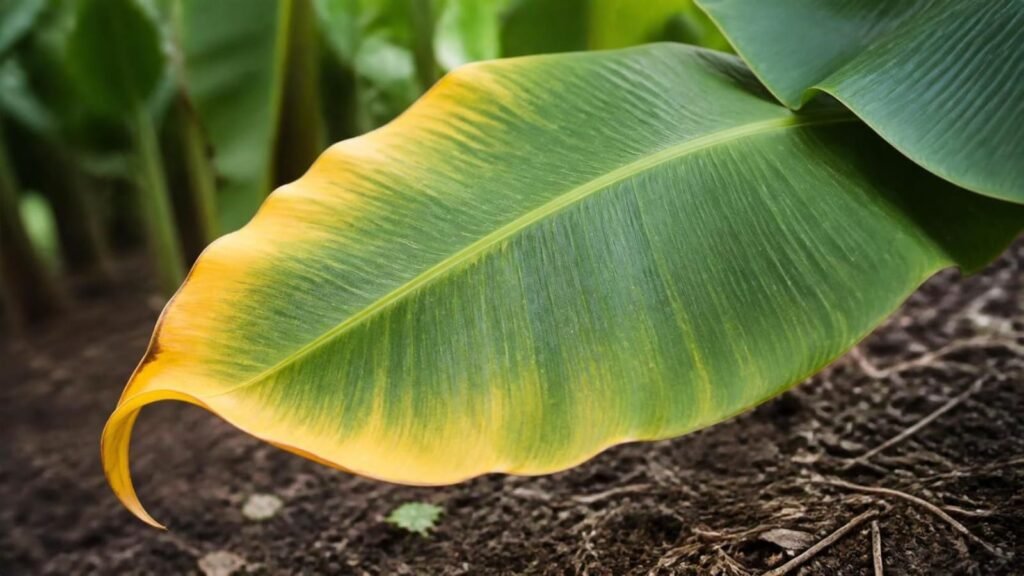
Yellowing that begins on the oldest, lowest leaves and moves upward is a mobile-nutrient pattern. The plant is pulling what it can from older tissue to keep the growing point alive. Potassium is the usual suspect in bananas, and it has a fairly specific look: the leaf yellows unevenly, often starting at the tip and margins, and the tip may curl downward. In a wind-protected planting, the yellowing can be distinctly orange. The NSW Department of Primary Industries describes this pattern clearly: older leaves yellow and die prematurely, and the leaf tip curls under when wind is not shredding the evidence.
Magnesium deficiency is the common confuser. It also starts on older leaves, but the yellowing sits between the veins rather than at the tip, and the midrib and margins often stay green longer. The difference matters because large potassium applications can reduce the amount of magnesium available to the plant and induce a deficiency that looks like a shortage but is actually an antagonism. The same NSW DPI guide notes that high potassium can bring on magnesium deficiency, particularly in light, weathered, or acid soils with low cation exchange capacity. If you are already feeding a high-potassium fertilizer and the old leaves still look pale between the veins, the problem may not be “not enough K.” It may be too much of one thing relative to another.
Leaf symptoms are clues, and they don’t settle the question on their own. Before you increase any fertilizer, confirm the direction with a soil test, and with a leaf tissue test if your extension service offers one. A yellow old leaf can also mean waterlogging, root damage, or nematodes, and adding more potassium to a root problem does nothing useful. The test is what turns a plausible diagnosis into a decision.
Yellowing that starts on the youngest leaves or the growing point is a different conversation. It points toward immobile nutrients, root damage, or a vascular problem. Don’t treat it with a general feed and hope. Check the roots and the pseudostem first.
Water: the line between thirsty and drowning
Bananas use a lot of water, but “a lot” is not a fixed number. Published field measurements put daily crop water use anywhere from around 1.6 liters per plant early in the season to nearly 20 liters at peak demand, depending on leaf area, temperature, humidity, radiation, and whether the soil is mulched. In one drip-fertigation study with plastic mulch, the range ran from 0.66 to 17.71 L per plant per day across the season. The number that matters for your plant depends on its growth stage, the weather, and how much soil volume the roots can draw from.
The same shallow, soft root system that makes the plant thirsty also makes it intolerant of standing water. The symptoms of too little and too much water overlap more than most care pages admit: wilt, yellowing, slow growth, brown edges. Fair enough, a drooping banana looks thirsty, and that is exactly why so many get drowned.
The reliable distinction is in the soil and the pattern, not in the leaf alone. Push a finger or a blunt stick into the root zone. If the soil is dry a few inches down, the plant is short of water. If it is soggy, cold, or smells sour, the roots are suffocating. Wilting that recovers overnight points toward daytime heat stress; wilting that persists into the cool of the morning points toward root damage, salt buildup, or a vascular problem. The Royal Horticultural Society is blunt about the winter version: soggy, cold compost can kill the roots, which is why potted bananas need less water indoors, not more.
Deep, less frequent watering is a useful default in many garden soils, but it is not a universal rule. Sandy soils drain quickly and may need smaller, more frequent applications to keep moisture within the shallow root zone. Heavy clay soils hold water longer and can go longer between waterings, but they also risk saturation if you apply too much at once. Containers dry faster than ground beds and need more frequent checks, especially in heat. A young plant with a small root system needs lighter, more frequent watering than a mature plant with a wide root spread. Watch the plant and the soil rather than following a calendar.
For plants in the ground, wet the soil to the depth of the active root zone, then let the surface begin to dry before watering again. In containers, water until a little runs out of the drainage holes, then wait. The goal is consistently moist soil that never turns waterlogged. If the pot sits in a saucer, empty it.
Soil and planting: get the hole right before you worry about the fertilizer
Bananas are not fussy about pH the way blueberries or azaleas are. The ranges reported by extension and horticultural sources vary, but the practical message is broad tolerance with a preference for slightly acid to neutral soil. ICAR puts the optimum at pH 5.5–8.0 in one guide and 6.5–7.5 in another, while other sources describe good performance from pH 5.5 to 7.0. The plant is more sensitive to poor drainage and low organic matter than to a half-point of pH.
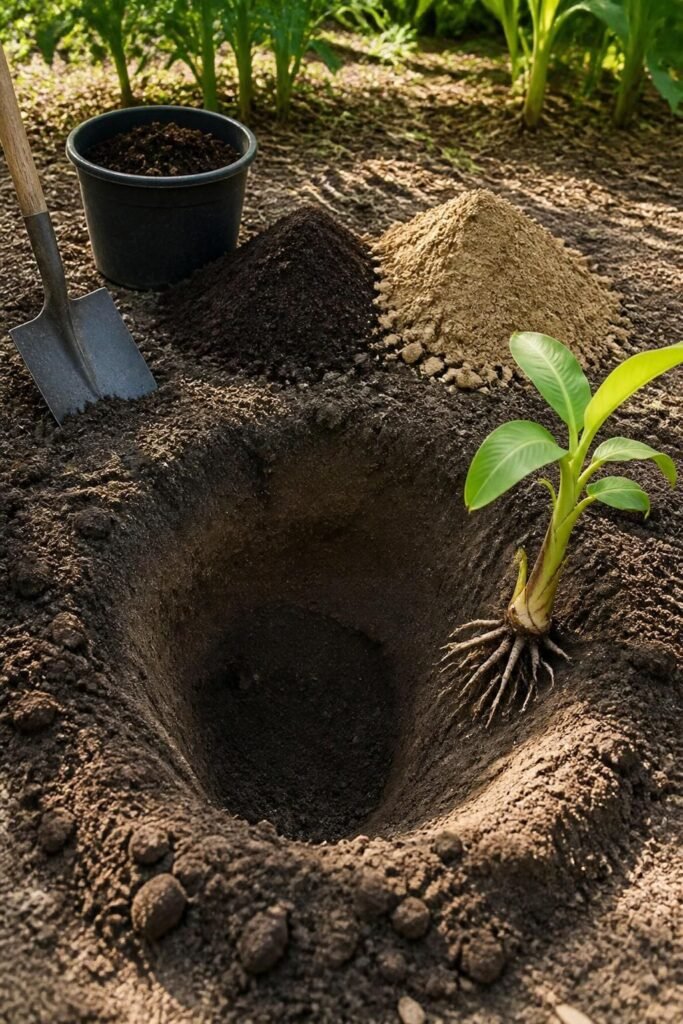
What the plant needs is a deep, well-drained soil with plenty of organic matter. The root system is shallow and wide, and it resents compaction. A widely cited field guideline is a planting hole of 60 cm in each direction, but that figure is only a starting point. A JICA field manual recommends 60 × 60 × 60 cm “although this may vary depending on water availability,” and suggests 90 cm holes in dry and semi-arid areas. Other extension and industry guides give smaller dimensions for container-grown transplants. Give the roots room to establish before the surrounding soil pushes back. Mix compost into the backfill, and keep the topsoil and subsoil separate so the richer topsoil goes back around the root zone.
If drainage is marginal, don’t assume that adding sand will fix it. In clay soils, sand particles bind with clay and can produce a denser, more concrete-like structure unless the sand fraction is extremely high, far more than is practical in a planting hole. The more reliable route is organic matter: compost, aged manure, or leaf mold, worked into the backfill and maintained as a surface mulch. In a site that holds water badly, planting slightly high or on a raised bed does more for the roots than any amendment placed in the hole. If the soil is very sandy and drains fast, the opposite applies: extra compost helps hold moisture long enough for the roots to use it. The details of texture, structure, and amendment belong in our Banana Tree Soil guide, but the diagnostic rule is worth carrying with you: yellowing plus soggy soil is a drainage problem first and a nutrition problem second.
Feeding: potassium first, balance second
A banana crop removes more potassium than almost any other nutrient. The plant builds its pseudostem and fruit from water and carbohydrates, but it needs potassium to move those carbohydrates and to fill the fruit. Nitrogen drives leaf and stem growth; phosphorus is needed in surprisingly small amounts; potassium is the workhorse. A soil test is the only way to know what your soil actually supplies, but the visual pattern on the oldest leaves is a useful field clue.
The easy mistake is to hear “banana needs potassium” and add more potassium. Large applications can reduce magnesium uptake, and research on banana nutrition describes a K/Mg balance below which physiological problems become more likely. A plant that is yellowing between the veins despite regular feeding may be showing the consequence of an imbalance rather than a shortage. Feed a balanced product with a potassium bias during active growth, and watch the new leaves rather than the old ones. Old leaves will not green back up after a deficiency is corrected; they are a record of what already happened. The standard schedule and product types are set out in our Banana Tree Fertilizer guide. If the plant is growing vigorously and the newest leaves are deep green, the feed is roughly working. If growth stalls and the old leaves continue to yellow, check drainage and confirm with a soil or tissue test before increasing the dose. Follow the product label, and check local rules, since approved products differ by region.
Stop feeding before dormancy. Potted bananas brought indoors for winter are not using nutrients at summer rates, and fertilizer that sits in the soil becomes salt stress. Skip the winter feed and let the plant rest.
Mulch: the cheapest root protection you can give it
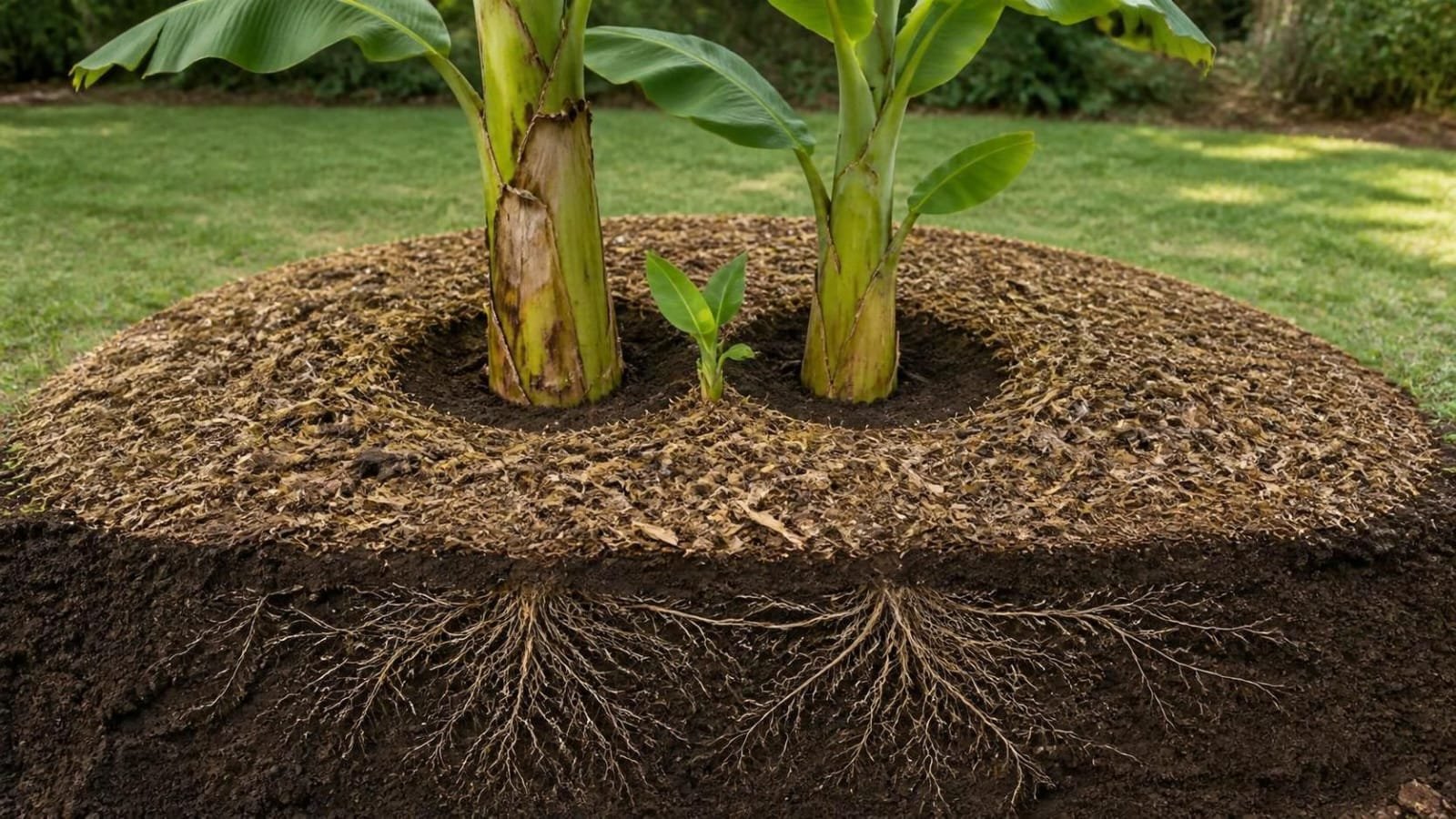
A banana’s roots live near the surface, where soil temperature and moisture swing fastest. Mulch buffers both. A layer of dry grass, straw, shredded leaves, or compost keeps the root zone cooler in heat, slows evaporation, and adds organic matter as it breaks down. For a plant that needs steady moisture but hates waterlogged soil, that is a useful combination.
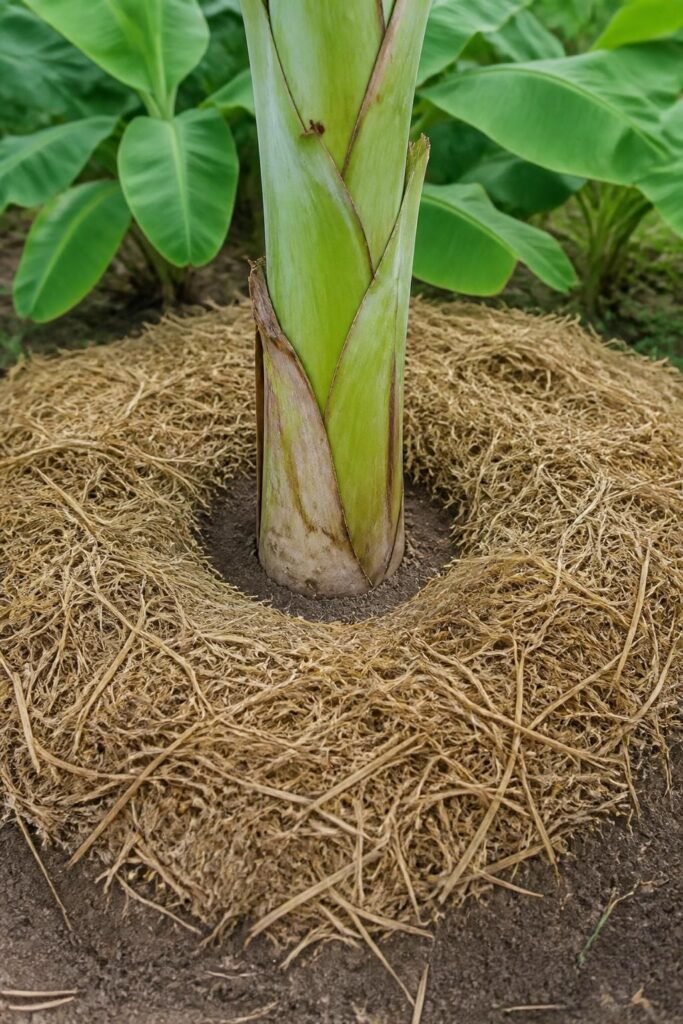
Keep the mulch a few centimeters away from the pseudostem. Packing organic material against the stem holds moisture against soft tissue and creates a bridge for pests and rot. Shape it as a ring with an open gap around the stem. When carbon-rich material such as straw or stalks is used, soil microorganisms can temporarily tie up nitrogen as they break it down. That effect is most relevant at the soil surface and early in decomposition, and it does not mean you must routinely add extra nitrogen fertilizer. Aged or composted material reduces it, and a mulch layer that stays on the surface limits how much soil nitrogen is affected. The material options and depth are covered in our Mulch for Banana Trees guide; what matters here is that mulch changes the moisture curve your finger feels when you check the soil.
Brown leaves: what to cut, what to leave, and when to wait
Brown leaves are the most overmanaged part of banana care. A completely dead, dry, papery leaf is no longer photosynthesizing and is not helping the plant. It can be removed cleanly at the base. A leaf that is brown at the edges but still green in the center is still working, and cutting it off throws away productive tissue. Separate dead tissue from damaged tissue that is still alive.
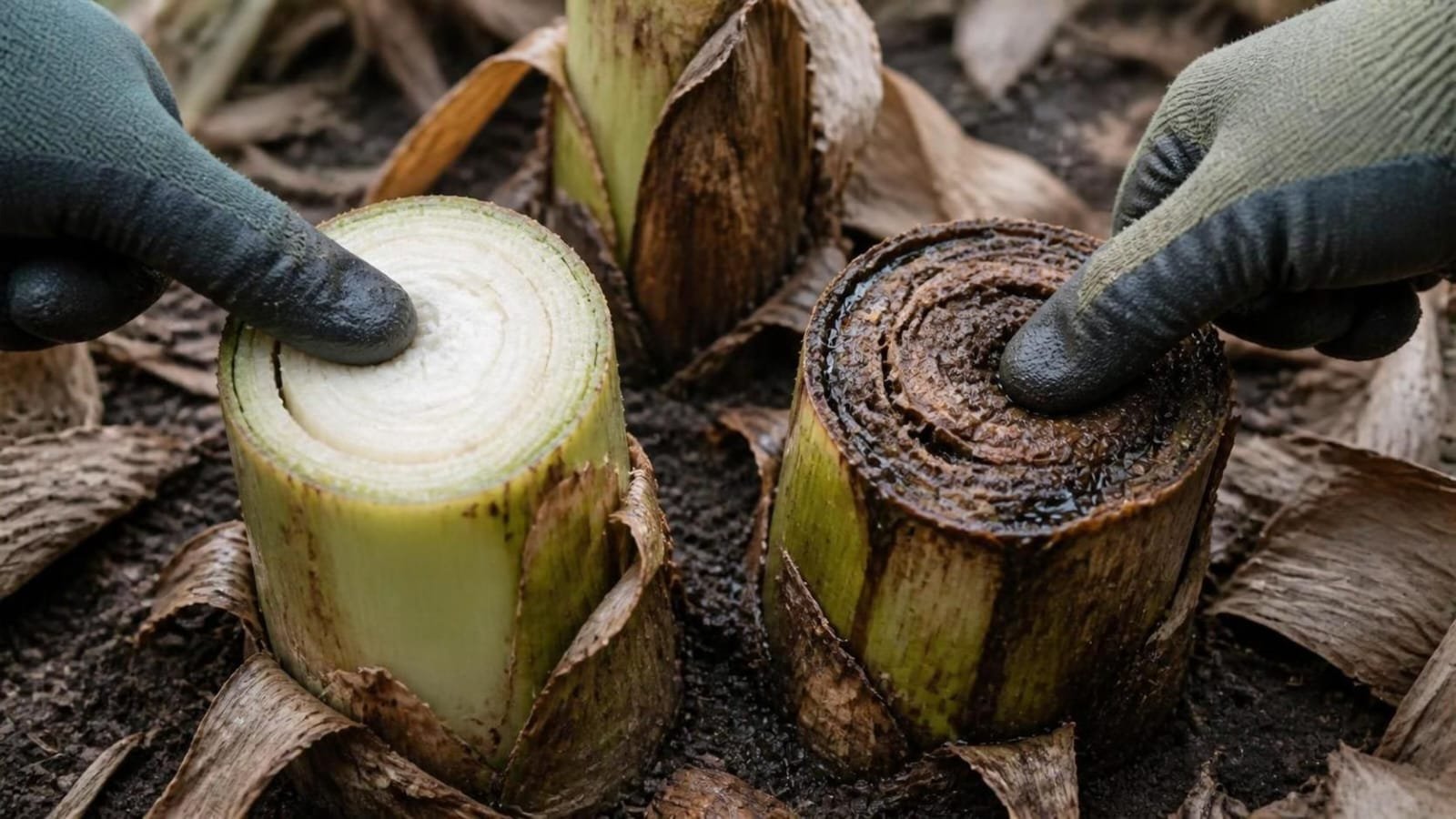
After a cold event, the picture is more nuanced than “wait and see” or “cut everything.” Damaged leaves do not reliably protect the living tissue beneath them; whether they offer any insulation depends on the severity and duration of the freeze, the cultivar, and how much healthy canopy remains. The pseudostem is the better diagnostic organ. Wait a week or two, then feel it from the top down. If it is firm, the growing point and corm are likely intact, and the plant can push new growth from the underground rhizome even if every leaf is lost, a pattern documented across banana-growing regions. If the pseudostem is mushy or collapses when squeezed, that above-ground portion is gone, and the plant’s future depends entirely on the corm and any surviving suckers.
For year-round grooming, remove a leaf when it is fully brown and dry, or when it is diseased or riddled with pest damage. Make the cut clean and don’t tear the sheath. The full timing and tool guidance is in our Banana Tree Pruning and Brown Leaves guide. The short version: brown is not an emergency, and a green leaf with a brown edge should stay.
Pots change the rules
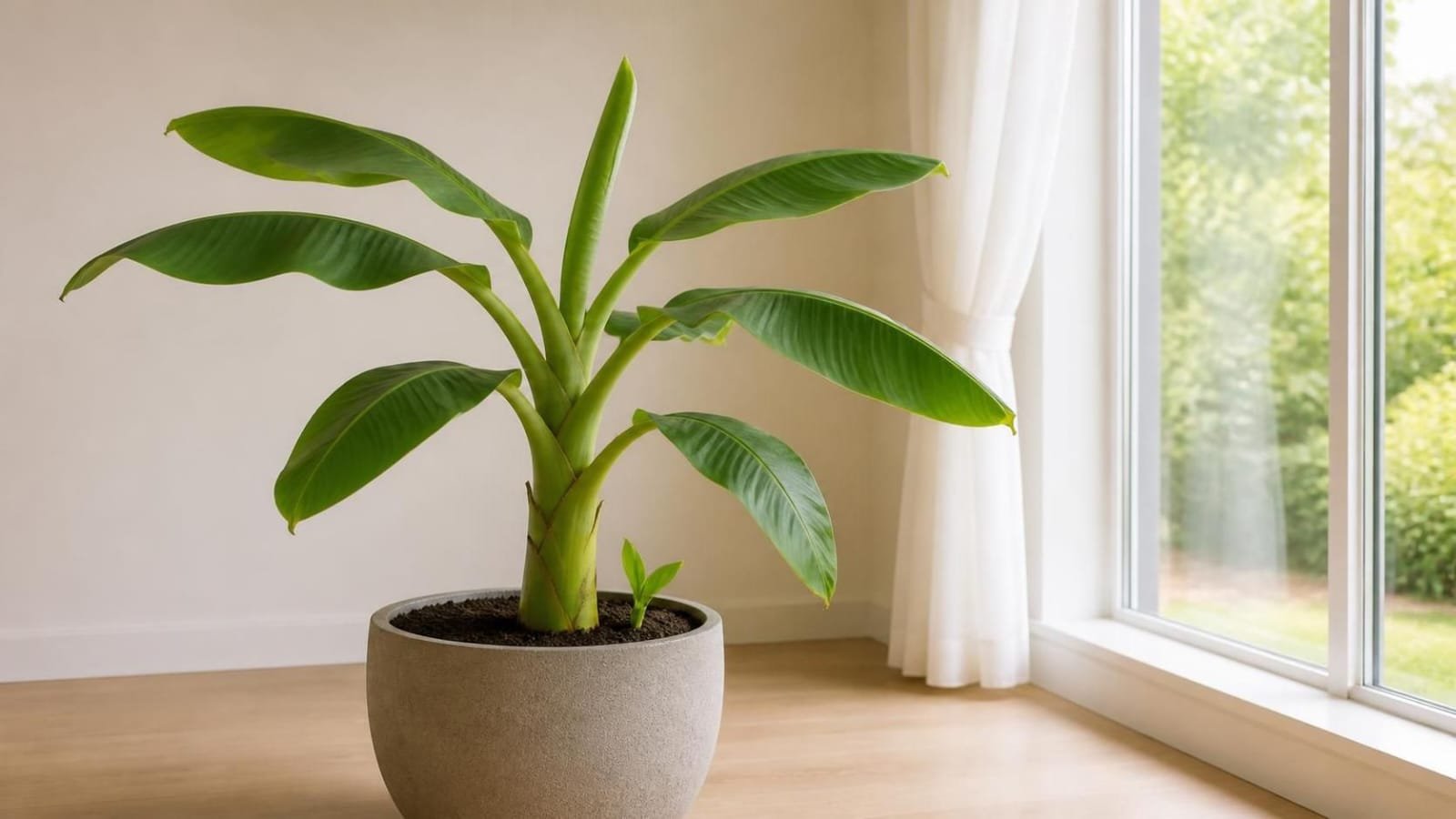
A banana in a container is living in a smaller, faster-changing root environment. The pot heats up faster, dries out faster, and can waterlog faster if drainage is poor. The plant still wants full sun and steady moisture, but steady is harder to achieve. The largest container you can reasonably manage gives the roots enough volume to buffer a missed watering, and fruiting varieties need even more room. A loam-based compost with added grit or coarse material improves drainage. The detailed container setup is in our Banana Trees in Pots guide.
The potted plant’s main diagnostic trap is winter. A banana indoors is not dormant in the tropical sense; it is cold-slowed. It still needs light, but it needs far less water. Soggy compost in a cool room is the fast track to root rot. University of Maryland Extension puts it plainly: when plants receive reduced light, their need for water declines, and overwatering during the adjustment period is a common cause of decline. Check the top few centimeters before watering, and let the surface dry between drinks. A plant that wilts indoors in winter is more likely to be sitting in cold wet soil than to be thirsty.
Wind and cold: the two forces that shape the plant before you notice
Banana leaves are built to move. Wind shreds them along the veins, and that shredding is not automatically a sign of poor health; it is how the plant reduces sail area. The damage becomes a problem when it is severe enough to strip the canopy or topple the pseudostem. A sheltered site, such as the lee of a wall, a building, or a windbreak, reduces leaf shredding and keeps the plant looking intact. In exposed sites, shorter or sturdier cultivars are a better bet than the tallest ones.
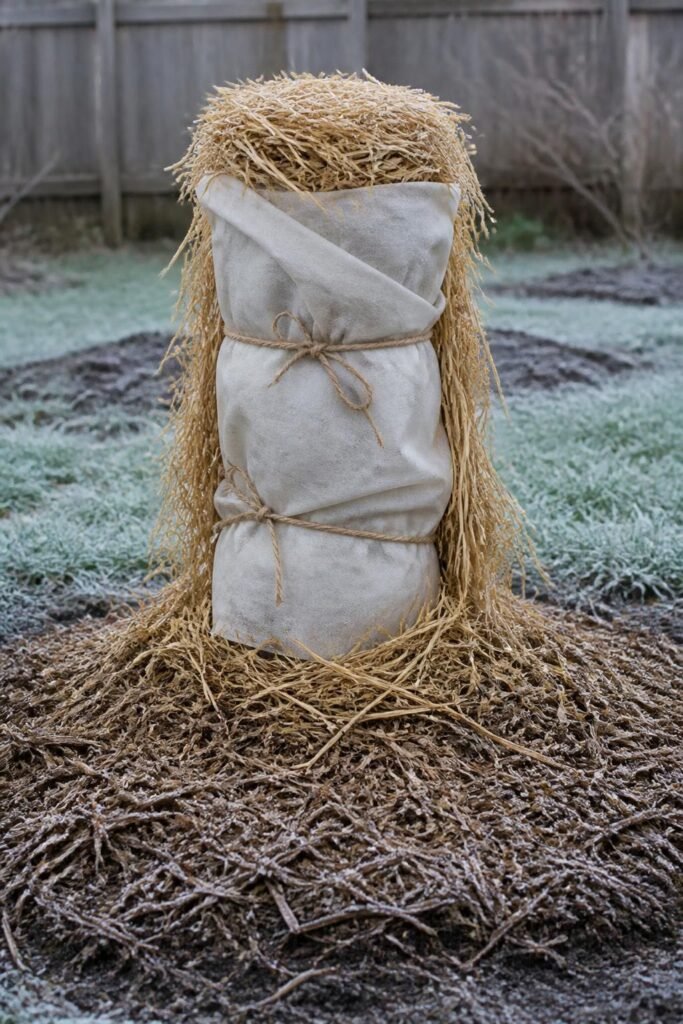
Cold is the harder limit. Most bananas are tropical or subtropical and stop growing well before freezing. A widely cited synthesis in the scientific literature on Musa acuminata puts shoot growth optima at 26–28°C, with growth slowing below 16°C and stopping completely below 10°C, while chilling injury can occur below 16°C even without frost. Those thresholds are general. Cultivars and acclimation vary, and the damage that matters in a garden is often driven by the duration and severity of the cold, not by a single overnight low. The pseudostem can survive light frost in some varieties, but the leaves typically brown and collapse. The corm is the survivor. In marginal climates, protect the pseudostem and corm with insulation, or accept that the above-ground growth will die back and regrow in spring. RHS notes that even the hardiest banana, Musa basjoo, benefits from wrapping in cold areas. NC State Extension gives the corm hardiness of M. basjoo as minus 10°F when properly pruned and mulched, with growth dying back to the ground in zones 5–8. Please don’t judge a cold-damaged banana on its third day. Wait, feel the stem, and let the plant show what survived.
Suckers: the next plant is already there
A banana mat produces suckers from the corm. Left alone, the mat becomes crowded, and the suckers compete with the fruiting stem for water and nutrients. The usual practice is to keep one strong, well-placed sucker as the successor and remove the rest at or slightly below ground level. Small suckers are easier to remove cleanly than large ones, and removing too many at once can shock the mat. The UF/IFAS pruning guide recommends cutting unwanted suckers at ground level and keeping the largest, healthiest one for the next cycle. In a pot, sucker management is also how you keep the plant from becoming root-bound in a single season.
What not to do when the plant looks bad
- Do not add more water just because the plant is wilting. Check the soil first. Wilting in wet soil is a root problem, and more water makes it worse.
- Do not apply a high-potassium feed without considering magnesium and calcium. An imbalance can look like a deficiency.
- Do not cut every brown leaf immediately after cold. Wait, feel the pseudostem, and let the plant show you where the living tissue ends.
- Do not pile mulch against the pseudostem. A ring with a gap is safer than a mound.
- Do not fertilize a dormant or cold-slowed potted banana. The roots are not using it, and the salts will accumulate.
A quick decision table for the most common symptoms
| What you see | First thing to check | Most likely direction |
|---|---|---|
| Oldest leaves yellow at the tip and edge | Soil moisture and recent K applications | Potassium deficiency or K/Mg imbalance |
| Oldest leaves pale between veins, midrib greener | Potassium-to-magnesium ratio | Magnesium deficiency, often induced by high K |
| Wilting that persists overnight, soil wet | Drainage and root condition | Waterlogging, root rot, or vascular problem |
| Wilting only in afternoon heat, recovers by evening | Water depth and mulch | Daytime heat stress or insufficient deep watering |
| Brown, dry leaves after cold; pseudostem firm | Pseudostem firmness | Foliar cold damage; corm likely viable |
| Pseudostem mushy or collapsing | Corm condition and suckers | Above-ground death; rely on corm or suckers |
The limits of what a description can tell you
Not every banana problem can be solved from a leaf photograph. Panama disease, bacterial wilt, nematode damage, and severe salt stress can produce yellowing and wilting that overlap with water and nutrition problems. If the plant is collapsing quickly, if the pseudostem splits or smells, or if the problem spreads from one plant to the next, the next step is a local extension service or a diagnostic lab, and another round of fertilizer will only delay it.
Until then, check the oldest leaf, then the soil, then the pseudostem. Squeeze the stem, push a finger into the root zone, and write down which leaves changed first. Those three observations tell you whether you are dealing with a mobile nutrient, a root environment, or tissue damage, and they are what an extension advisor will ask you for anyway.
2 thoughts on “Banana Tree Care: Watering, Feeding & Common Problems”