
Banana tree pruning usually begins with brown leaves, and most of us reach for the clippers. Fair enough, because a leaf that is completely brown is finished and can come off. What matters more is what the brown is telling you, and whether it has been cold lately.
You can trim a banana leaf once it is fully brown, but that is mostly tidying. The useful work is finding out why the banana tree leaves are turning brown. Old leaves dying from the bottom up are normal. Brown edges usually point to dry roots, wind or salt. Narrow streaks along the veins suggest leaf spot disease. And after a frost, wait before cutting anything, because the stem underneath may still be alive.
Rule out cold before you cut anything
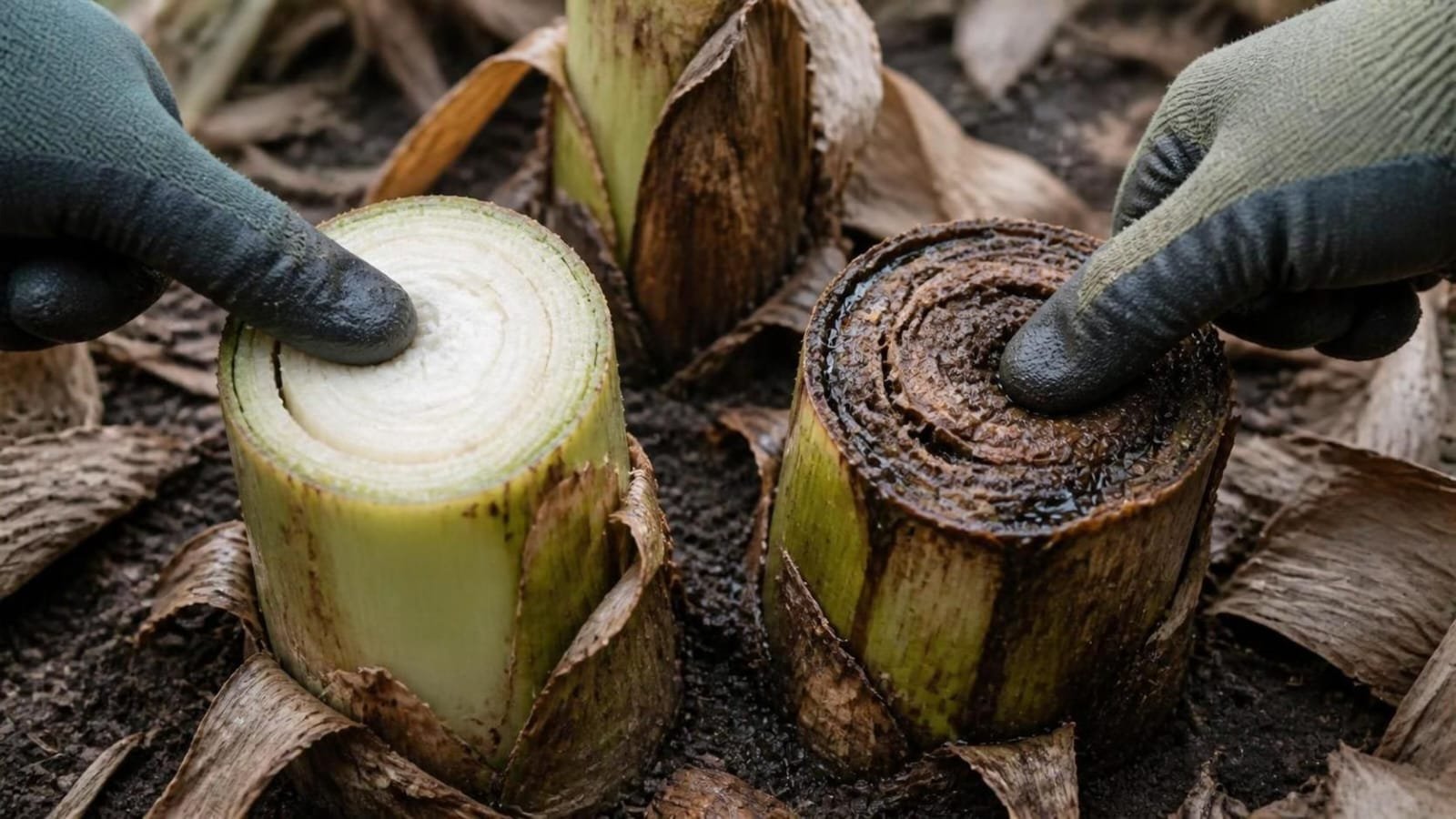
If there has been a frost or a hard chill in the past few weeks, the leaves are the least reliable part of the plant to judge. Frozen leaves go brown and limp fast, and they look dead long before you can tell whether the stem survived. That stem, the pseudostem, is really tightly wrapped leaf bases, and underneath it sits the rhizome (botanically a corm). Please don’t judge a plant on its third day.
Horticulturist Dan Gill, writing in the Baton Rouge paper The Advocate, advises pruning nothing for a week or more after a freeze, then checking the stem. A dead banana trunk looks brown, feels mushy, sits loose in the soil and bleeds heavily when punctured. A stem that is firm and tight in the ground is very likely alive. That is worth protecting, because one nursery’s grow guide says a main stalk hurt by cold but not killed will most likely recover and fruit the next summer. Leave the firm stem alone and take off only what is clearly dead.
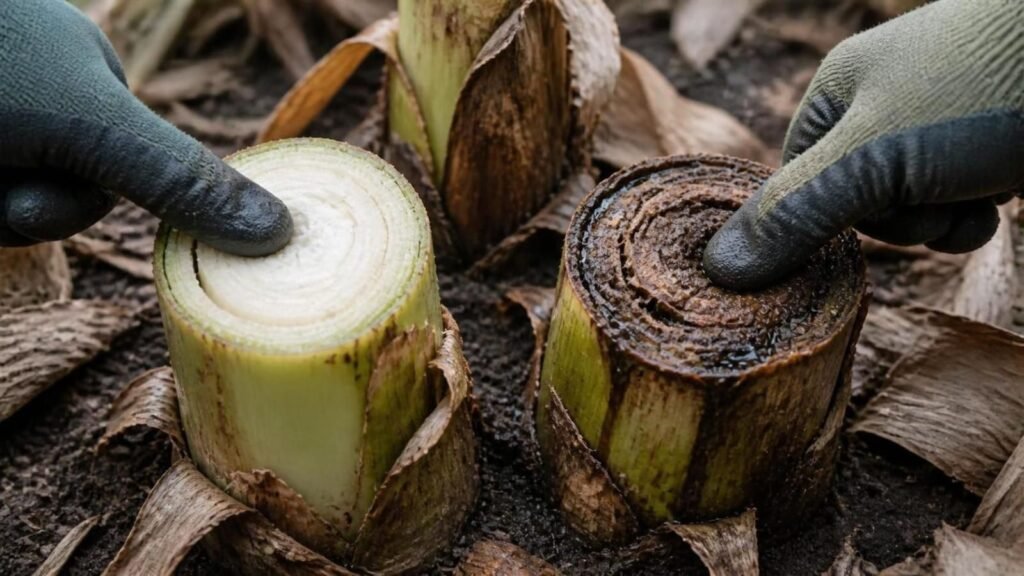
If the stem does turn out to be dead and soft, take it out. A plant with a healthy rhizome will usually send up new shoots once the weather warms, so a bare brown clump in late winter isn’t automatically lost. How far that holds depends on how hard and how long the freeze was. From a description alone, nobody can tell you how deep the damage goes. The stem test and a few weeks of patience are your real diagnosis.
Banana tree leaves turning brown: which leaves, and where on the leaf
With cold ruled out, look at which leaves are browning and where on the leaf the brown begins. The pattern separates the causes faster than the color does.
| What you see | Likely cause | How to check | What to do |
|---|---|---|---|
| Lowest, oldest leaves yellow, then brown, one at a time | Normal aging | Younger leaves are green and a new one is still unfurling | Cut each leaf when it is fully brown |
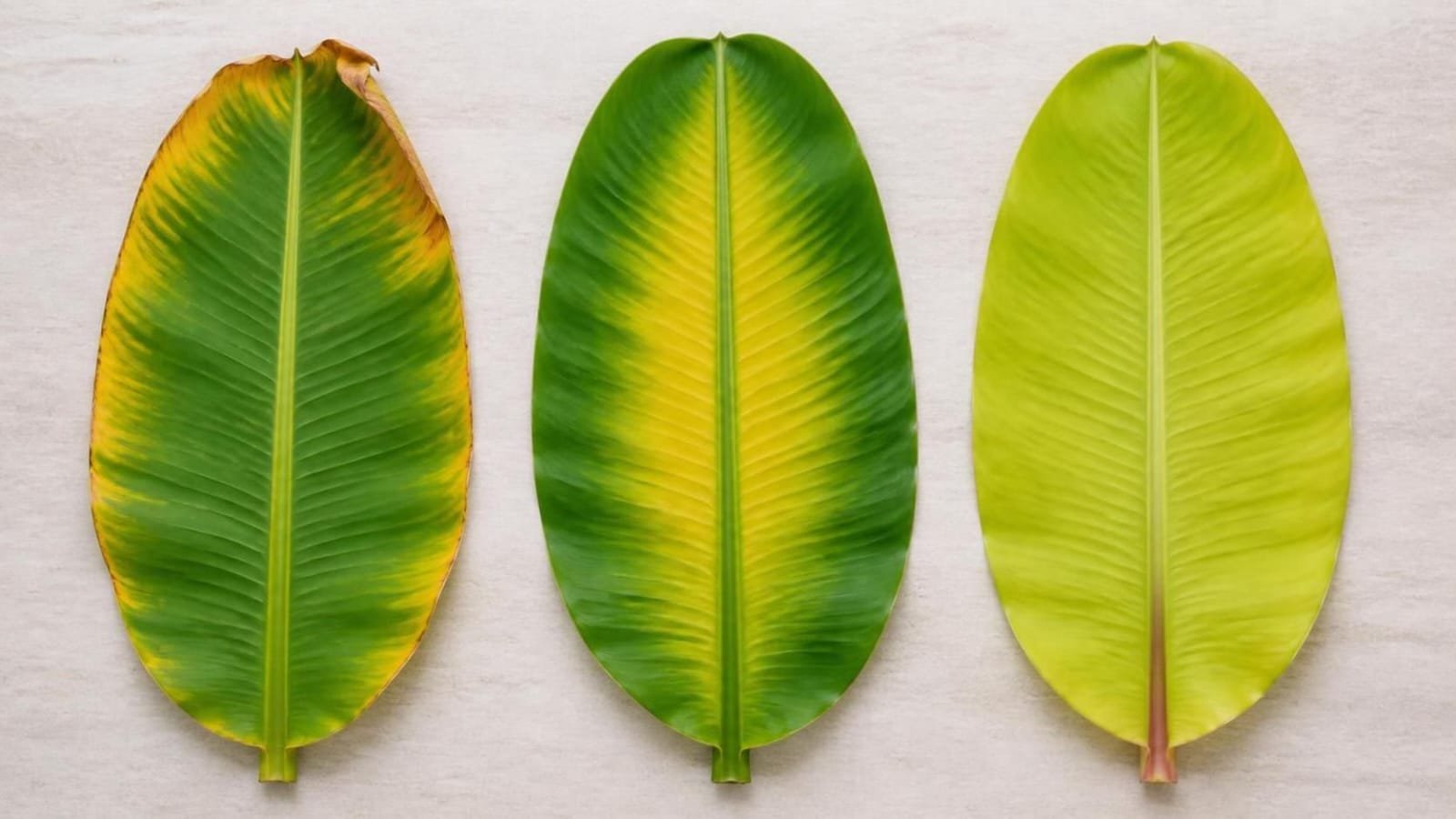
| Brown margins and tips, torn edges, worse on the windward side | Wind, dry roots or salt | Squeeze the soil a hand’s depth down; think about your fertilizer and water | Fix the watering, shelter the plant, then trim dead edges if you like |
| Orange-yellow older leaves, scorched margins, small spots along the edge | Low potassium | Soil test, since salt burn looks similar | Feed according to the test and the product label |
| Thin brown streaks along the veins, yellow halos, starting on younger leaves | Leaf spot disease (Sigatoka) | Look for tiny flecks on the third or fourth open leaf, underside first for black Sigatoka | Remove the worst leaves, open up airflow, keep foliage dry |
| Water-soaked, then brown and limp leaves after a cold night | Cold injury | Wait a week or more, then test the stem | Hold the saw until the stem’s condition is clear |
| Yellowing, wilting and browning across the plant, soft base, wet soil | Waterlogged roots | Dig beside the plant and look at the roots and the smell of the soil | Fix drainage before anything else |
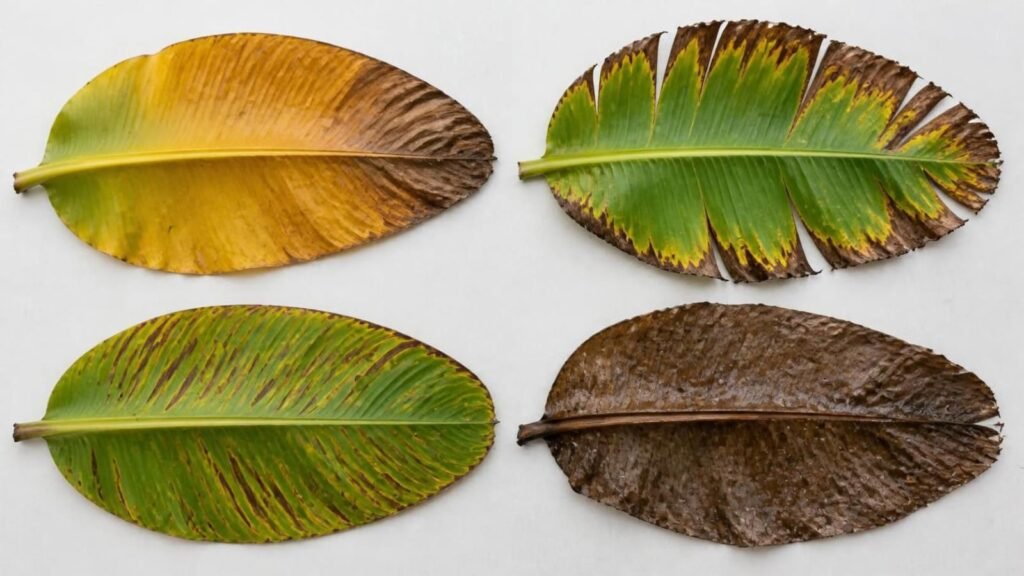
Start with the easy one. If only the lowest leaves are dying, one at a time, while the crown keeps pushing out fresh green ones, the plant is just renewing itself. Nothing needs treating.
Edges and tips: dry roots, wind or salt
Most of us reach for the watering can first. Sometimes that is exactly right, and sometimes it makes things worse. A University of Florida publication on growing bananas lists drought, wind and salt among the usual reasons for leaf margin damage. It also warns that bananas don’t tolerate flooding, so a waterlogged bed brings yellowing and stunting of its own. Wind shreds leaves along the veins too, and the plant generally copes with that.
To tell dry from soggy, dig down about a hand’s depth beside the plant and squeeze a handful. Crumbly, dusty soil means thirsty roots. Soil that stays heavy, cold and muddy, perhaps with a sour smell, points to drainage, and our guide to banana tree soil covers how to correct that. Salt is the awkward third possibility. It builds up from fertilizer or from hard or brackish water. You won’t see the salt itself, just the scorched margins it leaves behind.
Scorched margins on older leaves: the potassium question
Here’s the kicker: salt burn and a potassium shortage look almost identical from a few feet away. Bananas pull a lot of potassium out of the soil. A University of Hawaii note describes how harvesting a potassium-hungry crop can slowly drain the limited reserves in tropical soils. In a study on banana seedlings, old leaves yellowed, veins and margins turned orange-yellow, and small oval spots showed up along the edges. In severe cases the tissue near the veins blackened and died.
If that sounds like your plant, get a soil test before you feed, and ask for salinity as well as nutrient levels. A plant suffering from salt will not thank you for more fertilizer. Once the test confirms a shortage, our banana tree fertilizer guide covers what to give it. Leaves alone can’t settle it. You need the soil test, or a look at your irrigation water.
Streaks along the veins: leaf spot disease
Edge browning follows the outline of the leaf. Disease follows the veins. Agriculture officials in Dominica describe the first signs of black Sigatoka as tiny pale spots on the underside of the third or fourth open leaf, which grow into thin brown streaks held between the veins. The fungus travels on wind, rain and irrigation water. It favors warm, humid weather, so it matters most in wet climates and seasons. Iowa State University Extension adds that the spots enlarge and merge until much of the leaf yellows and browns. Removing diseased leaves and improving airflow both help.
In practice, take the worst leaves out of the bed entirely instead of leaving them under the plant, and water at the soil rather than over the foliage. If you are thinking about a fungicide, approved products and rules differ from country to country, so follow the label and check what is permitted where you live. Several leaf diseases look alike, and your local extension office or a lab is the only way to name the exact one.
Should you cut brown leaves off a banana tree?
Not urgently. A brown leaf no longer feeds the plant, but a yellowing one is still passing nutrients back to it, so wait until it’s fully brown. Taking it off tidies the clump, gives pests and rot less dead material to hide in, and lets you see the base. A leaf that is brown at the edge but mostly green is still working. Researchers in Brazil studying defoliation counted a leaf as functional when more than half of the blade was free of disease symptoms and age-related yellowing. It’s a handy rule of thumb for a half-brown leaf: if more than half is gone, cut it.
How much leaf can a fruiting plant afford to lose? In a Colombian field trial on Grand Naine bananas, plants were cut back to 6, 8, 10 or 12 leaves at flowering, and bunch weight, fruit size and ripening quality were not affected. Don’t read that as permission to strip a backyard plant. Those plants grew in a banana-producing region, not a backyard, and a Taiwanese trial on the ‘Formosana’ banana found that plants left with only two leaves after flowering yielded less than plants left with six. Taken together, the trials suggest that a few dead leaves cost the plant very little, and that stripping it to a tuft can.
How to trim a banana tree
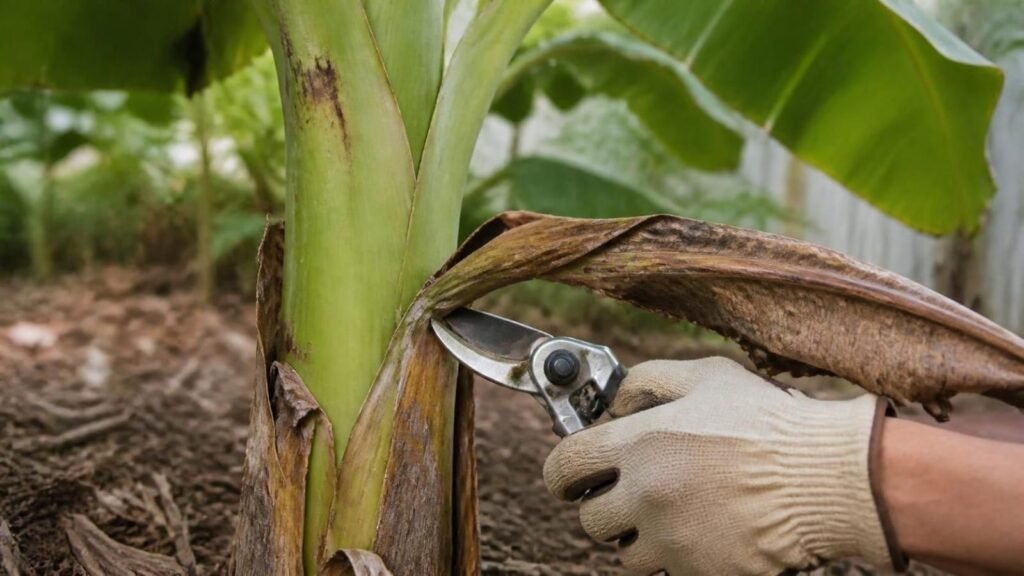
Use a sharp, clean knife, pruning saw or loppers. The RHS recommends cutting at the base of the leaf stalk with a sharp knife or secateurs. A blunt blade crushes the sheath instead of slicing it. Home for the Harvest warns that damage to the stem hurts fruiting and invites disease. Guidance from UF/IFAS Extension in St. Lucie County comes down to sanitized tools, a sloping cut at the leaf stalk that leaves the base itself in place, and never taking more than a third of the plant at once.
- Begin with fully brown leaves on the lowest, outer side of the clump. Pull the leaf gently away from the pseudostem so you can see where the stalk joins it.
- Cut the stalk close to the pseudostem, sloping the blade upward, and leave the leaf base behind.
- Cut, don’t pull. A torn sheath is a wound on the stem.
- Wipe the blade after any leaf with spots or streaks before moving to the next one.
- Bag diseased leaves. Healthy dead ones can be chopped and laid around the base.
As for timing, dead leaves can come off in any month. Thin suckers during the growing season. Take down a stalk after it has fruited, or after frost has killed it. A stalk that has not yet fruited should stay, unless it is dead.
Suckers: keep one, remove the rest
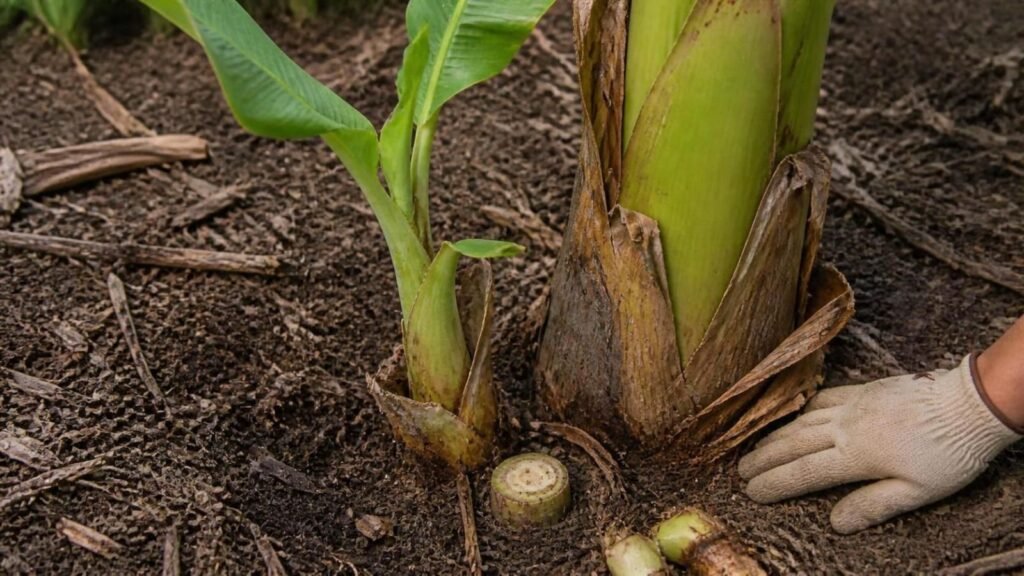
A banana clump sends up suckers, also called pups, around the base, and each one competes for water and nutrients. Only one follower needs to stand ready for next season. Choose a vigorous sucker with narrow, sword-shaped leaves; weak ones with broad leaves, often called water suckers, make poor followers. Stark Bro’s suggests allowing one sucker to develop once the main stalk is six to eight months old and removing the rest as soon as they appear. The St. Lucie County guide agrees and says to keep the largest, healthiest one. It adds that the male bud at the end of the flower stalk can be removed, which sometimes speeds fruit maturity.
Digging out the base of a cut pup, rather than just slicing it at the surface, slows its return, says the Perfect Plants nursery guide. A pup with its own roots doesn’t have to be thrown away. Our guide on how to plant a banana tree covers depth and spacing for a new spot. After harvest, advice on the spent stalk varies. Some growers cut it to the ground, while Stark Bro’s leaves a stub about 30 inches high for several weeks before removing it. Either way, the stalk can be chopped up and used as mulch.
Potted and indoor bananas
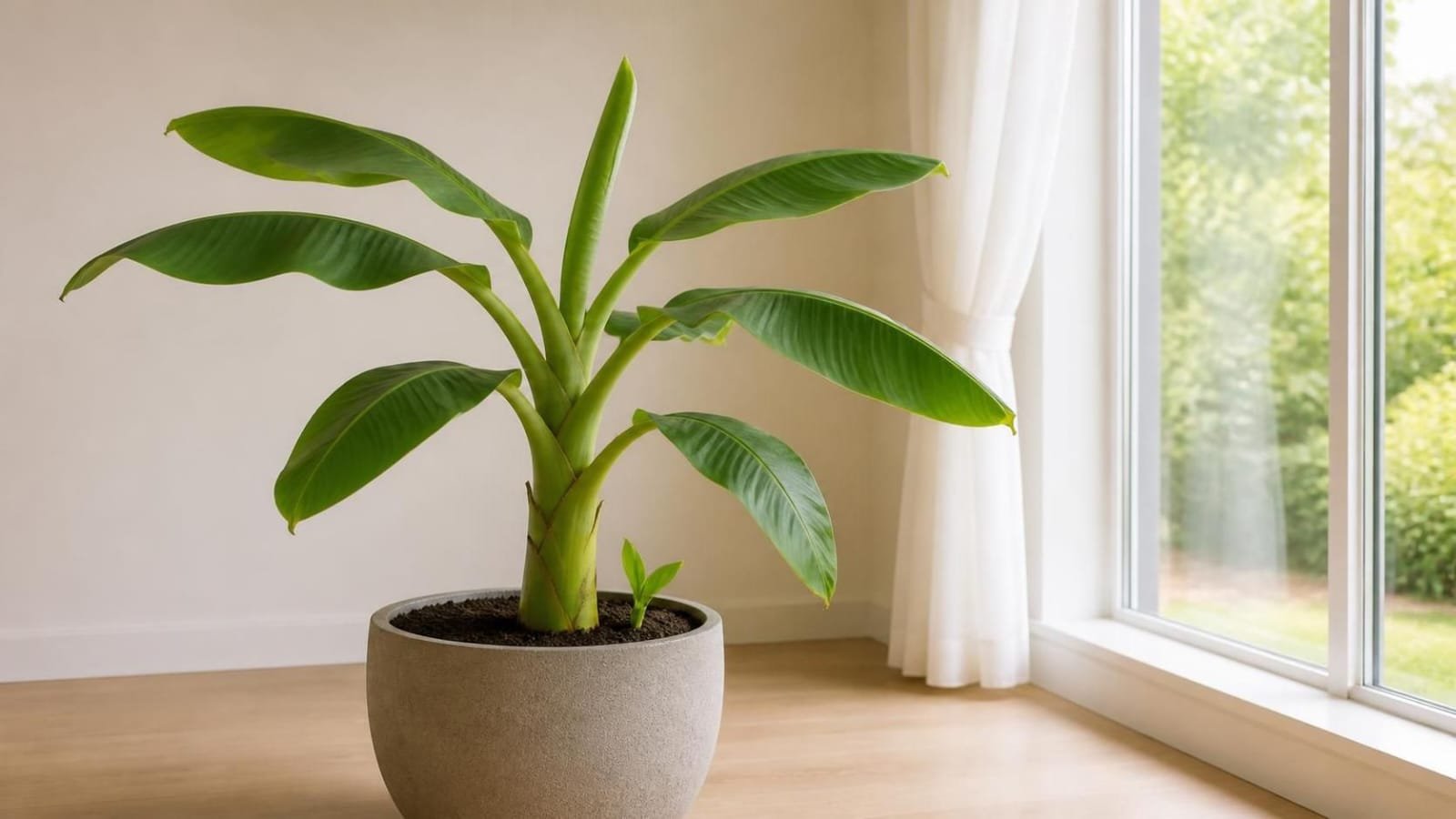
Containers change the odds. Salts from fertilizer and tap water build up faster in a pot than in the ground, so edge burn is more likely. Flushing the pot with plenty of plain water until it drains freely is the usual remedy. Dry indoor air gives crisp brown edges too, and so does moving a plant suddenly into stronger sun. Turn a few leaves over and look for fine stippling or webbing, which means spider mites. A banana kept indoors through winter often sheds old leaves as light drops, and that alone isn’t a diagnosis. Our guide to banana trees in pots covers pot size and drainage.
What not to do
- Don’t cut a frost-browned plant to the ground in the first week.
- Don’t strip a fruiting plant down to a few leaves to make it look tidy.
- Don’t answer margin burn with extra fertilizer until salt and soil moisture have been ruled out.
- Don’t leave streaked or spotted leaves lying under the plant.
Three quick questions people ask
Can you cut a banana tree down to the ground?
Yes, when the stalk has finished fruiting or a freeze has killed it. Cutting a healthy, unfruited stalk throws away its progress toward fruiting, since a stalk needs more than a year to set and ripen a bunch. The rhizome underground usually sends up new shoots, so the plant itself is not lost.
Can you shorten a banana tree that has grown too tall?
For an ornamental plant, the RHS says you can remove the tallest leaves for a small reduction, or saw through the stem at any point above about 60 cm (2 ft) from the base, during the growing season. New leaves should sprout from the top of the shortened stem. If the stalk was already heading toward fruit, that bunch is lost.
Do banana leaves grow back after you cut them?
No. A cut leaf is gone for good. The plant replaces it by unrolling a new leaf from the center of the crown, which is why a healthy growing point matters more than any single leaf.
After trimming: keeping the browning from coming back
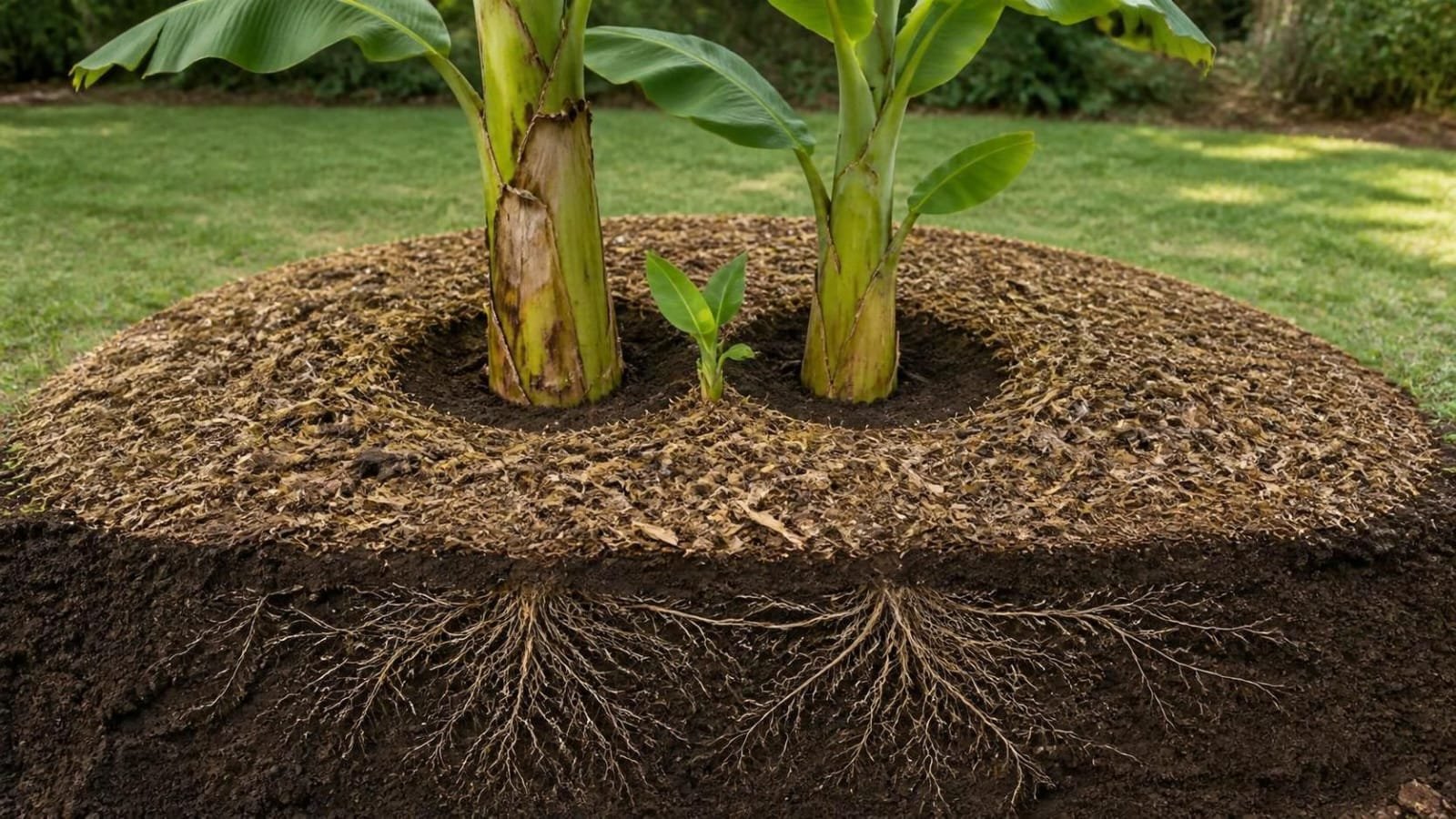
Once the plant is trimmed, a layer of mulch for banana trees evens out moisture swings and cushions the roots in cold snaps. If browning keeps returning on fresh leaves, review the whole routine in our banana tree care guide.
One thought on “Banana Tree Pruning: Brown Leaves and When to Cut”