White Salt Crust on Soil: What It Means and How to Fix It
A white, crystalline crust on soil is almost always dissolved salt left behind when water evaporates from the surface. A thin film is often harmless, but a thick crust, or one that keeps coming back, means salt is arriving faster than water is carrying it away. Confirm that it really is salt, find where it is coming from, then flush the soil slowly with clean water, as long as the soil can actually drain.
Some mornings the top of a bed looks frosted. The soil underneath is dark and ordinary, but the surface has a pale, crunchy skin that flakes when you press it. It tends to gather at the edge of a raised bed, in low spots, around the base of plants, or in a ring along the rim of a pot.
That frost is really a message about water. Salts dissolve in soil moisture and travel with it, and when the water evaporates from the surface, the salt stays behind. Whether that matters depends on how much salt there is, where it came from and whether your soil can wash it out again. The sections below follow that order: what you are looking at, what it does to plants, how to put a number on it, and how to clear it without making things worse.
First, Check That It Is Actually Salt
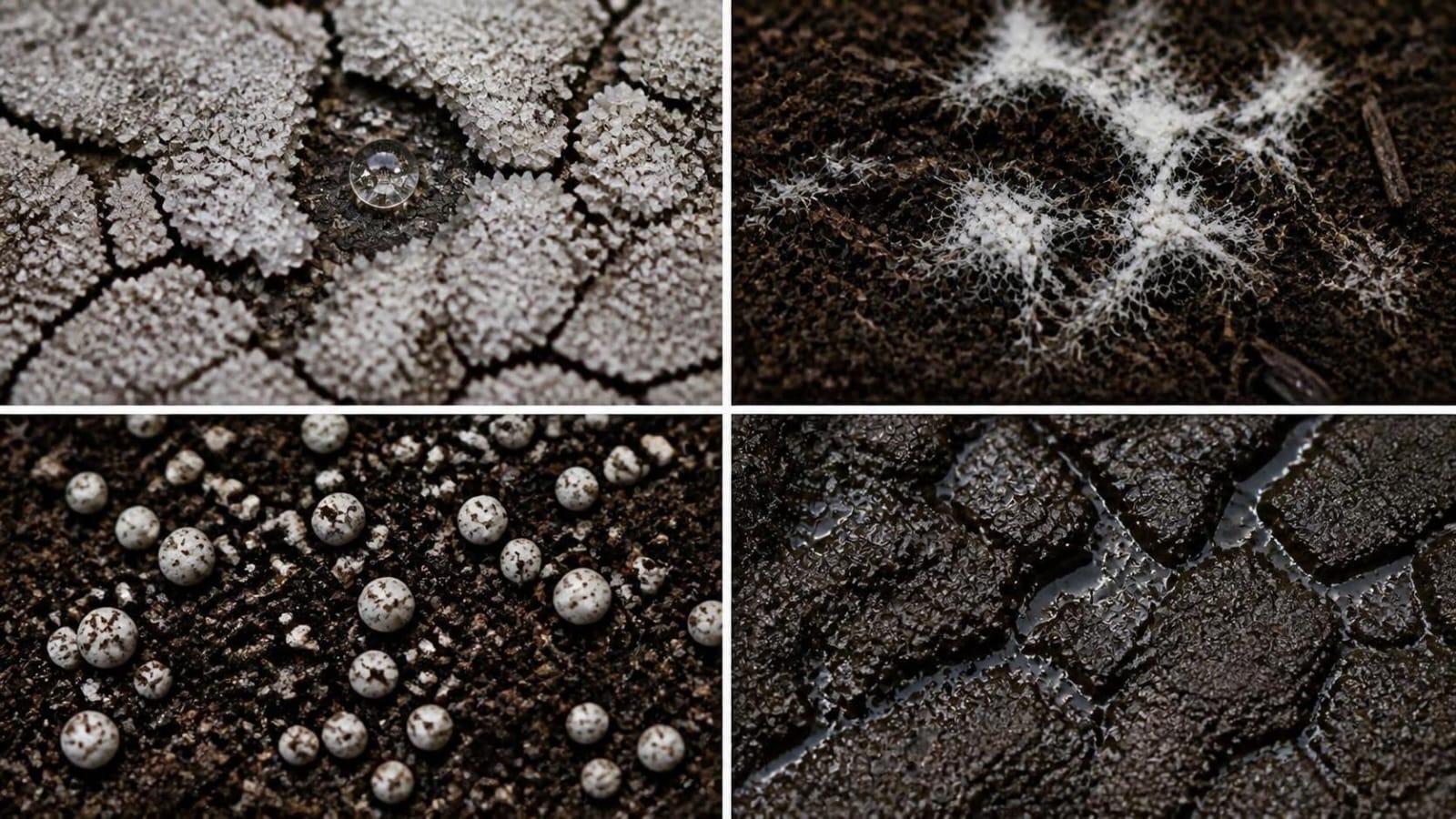
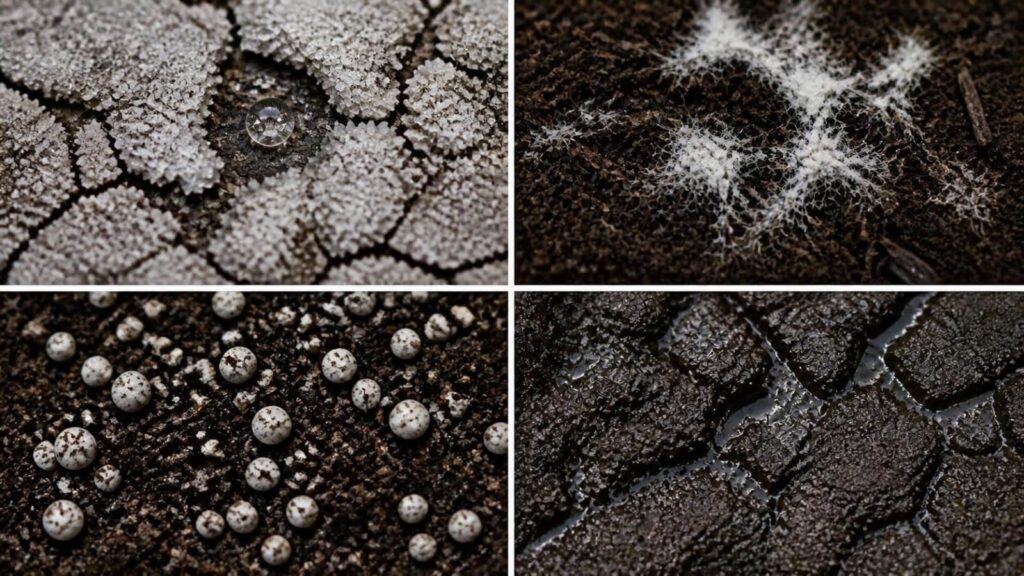
Plenty of white things turn up on soil, and they need very different responses. Press the patch with a stick or a gloved finger before you change anything.
| What you see | What it probably is | Quick check | What to do |
|---|---|---|---|
| Hard, crunchy, chalky or crystalline crust, often at bed edges, low spots or pot rims | Soluble salts from water, fertilizer or compost | Gritty rather than soft; a drop of water makes it darken and seem to melt away | Confirm with a soil test, then flush if drainage allows |
| Soft, fluffy or cobweb-like patches on damp soil or mulch | Harmless mold-like fungus feeding on organic matter | Smears when touched; earthy smell; shows up after wet, still weather | Let the surface dry and open it to air; no salt treatment needed |
| White beads mixed through the soil that never dissolve | Perlite or another ingredient in the mix | Light, rounded and porous; unchanged by water | Nothing, it is part of the soil |
| Pale film that stays put when wetted | Lime-type mineral deposit from hard water or alkaline soil | Does not dissolve readily; may fizz faintly if you add a drop of vinegar | Test pH and salt level; the crust is only part of the picture |
| Dark brown to black crust, slick when wet, water pooling | Sodium-heavy (sodic) soil, a different problem from white salt | Poor drainage and patchy seedling emergence | Get a lab test before any treatment |
The water-drop test is quick but only a hint. Colorado State University Extension points out that salts differ in how easily they dissolve: table salt dissolves readily, gypsum is less soluble, and limestone dissolves mainly in acidic water. A crust that resists water can still be mineral, which is one more reason to rely on a soil test rather than a single trick.
Why Salt Climbs to the Surface
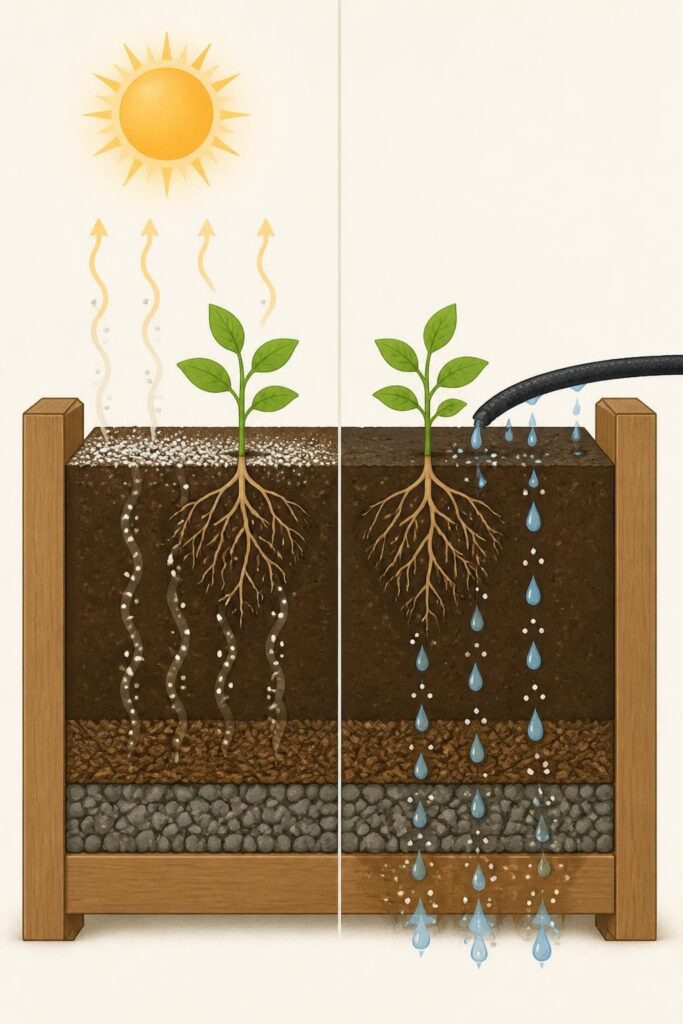
According to Colorado State University Extension, soluble salts move with soil water. Water that drains downward carries salt out of the root zone, while evaporation at the surface concentrates it where you can see it. A crust shows up wherever evaporation is winning: sunny bed edges, low spots, the top of a raised bed in midsummer, or a pot standing on a hot patio.
This also explains why a bed can look healthy and still grow a crust. Frequent light watering tends to wet only the top few inches. Each dry-down pulls dissolved salt upward, and not enough water ever passes through to carry it below the roots.
Where the salt comes from
Working out the source matters, because flushing a bed that is being re-salted every week is a losing game. The usual suspects are:
- Irrigation water. The University of Nevada, Reno Extension describes irrigation water as often the biggest source of salt on farmland, and even modest salinity adds up over a season.
- Fertilizer. Colorado State notes that unnecessary fertilizer applications raise soil salt levels, and fertilizer placed too close to seeds or roots can burn tender tissue.
- Manure and manure-based compost. These can be high in salt, so a bag labeled as compost is not automatically low-salt.
- Softened water, road salt, pet urine. Nevada Extension lists water softeners and salted roads as sources, and Colorado State adds pet urine and de-icing salts near paths and driveways.
- The ground itself. In dry regions, salts occur naturally and build up where there is too little rainfall to wash them through.
Is It Hurting Your Plants?
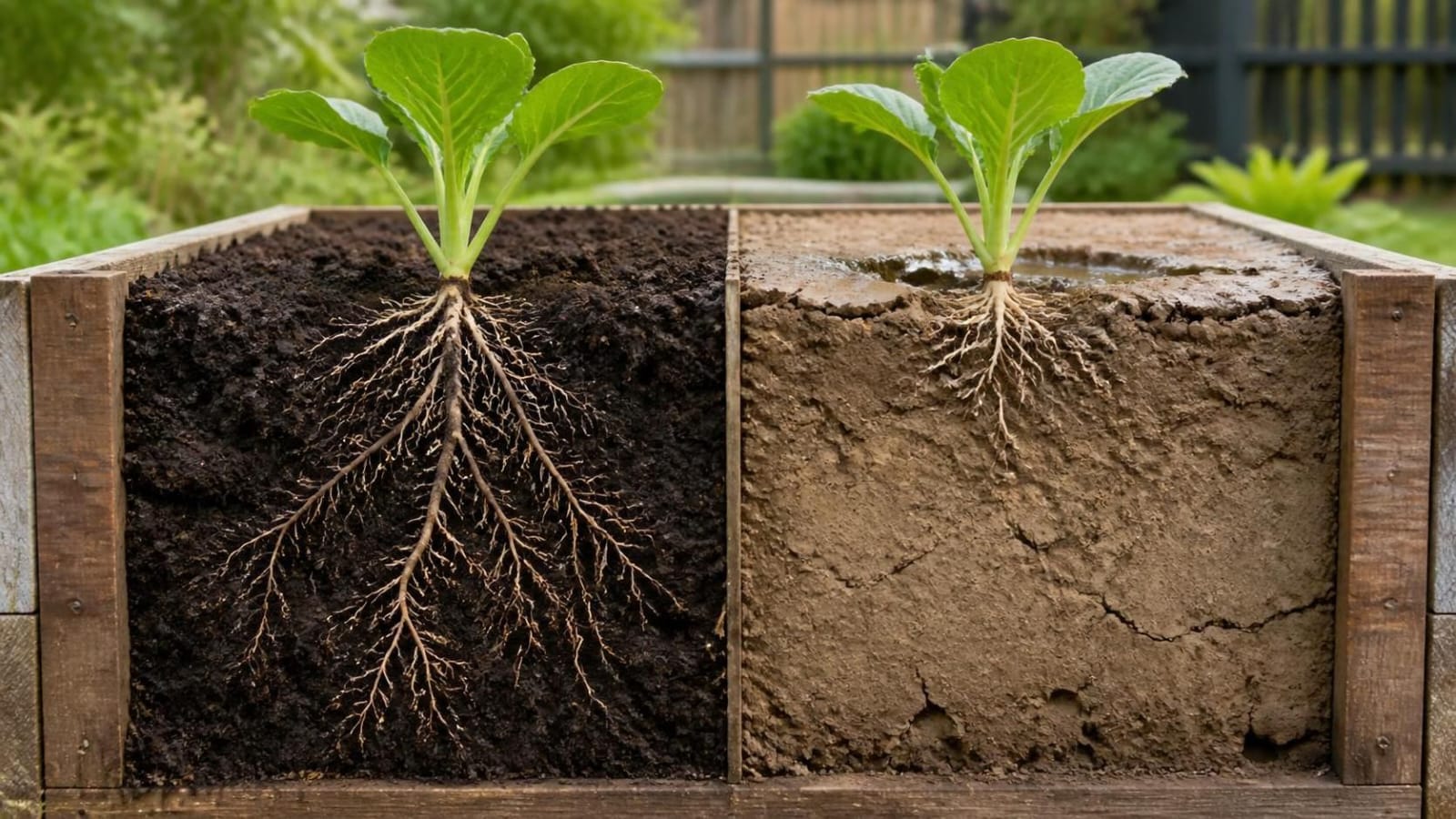
The crust is evidence, not the injury. The injury happens in the root zone, where a high salt concentration makes it harder for roots to take up water even when the soil is damp. Colorado State lists reduced water uptake, restricted root growth, scorched leaf margins, poor germination and lower yields, and says yields can fall by as much as a quarter before damage is easy to see.
Look for a pattern rather than a single symptom:
- Plants that wilt or look thirsty even though the soil is moist.
- Brown, crisp leaf tips or margins, usually worse in hot, dry weather.
- Irregular bare spots or uneven growth across a bed; seeds and seedlings are more sensitive to salt than mature plants.
- A crust that reappears within days of watering.
None of these proves salt on its own. Overwatering, root rot and heat can scorch leaves as well. What points toward salt is the combination of a crust, stress that worsens in hot weather and trouble concentrated in the same patch each time.
Colorado State also suggests a simple living test: beans are salt-sensitive, so sow some in a pot of the suspect soil on a windowsill and see how they do. A second pot of fresh mix makes a handy comparison, because if the beans struggle only in the garden soil, salt moves up your list of suspects.
White Crust or Dark Crust: Saline Versus Sodic
The Colorado State diagnostic fact sheet separates two problems that are often confused. A saline soil has too much total salt, and its typical signs are a white surface crust, water-stressed plants and leaf-tip burn. A sodic soil has too much sodium, which breaks soil structure apart. It tends to show poor drainage and a brownish-black crust, and the first thing gardeners notice is usually weak seedling emergence. A soil can also be both, and then it looks like a saline soil.
This matters because the fixes differ. Saline soil responds to flushing with good-quality water. Sodic soil needs calcium, commonly from gypsum, before flushing will work. Nevada Extension warns that gypsum on a soil that is salty but not sodic only adds more salt. So do not buy gypsum on a hunch, and follow the product label and your local extension advice if a test does call for it.
Get a Number Before You Treat It
Colorado State is blunt about this: visual symptoms can suggest a problem, but a soil test is the best way to diagnose it. Labs routinely report pH and electrical conductivity (EC), which tracks how much dissolved salt is present. If pH is high, ask for sodium adsorption ratio (SAR) as well. Sample the top 6 to 12 inches, take the worst-looking patches separately from the healthy areas, and tell the lab you suspect salt. If you irrigate, send a water sample too, since you need to know whether the water is part of the problem.
| EC (dS/m) | Salinity level | Effect on plant growth |
|---|---|---|
| 0 to 2 | Non-saline | None |
| 2.1 to 4 | Slightly saline | Sensitive plants are inhibited |
| 4.1 to 8 | Moderately saline | Many plants are inhibited |
| 8.1 to 16 | Strongly saline | Most cultivated plants are inhibited |
| Over 16 | Very strongly saline | Few plants will grow |
These ranges, from Colorado State, assume a saturated paste extract. Labs that use a different method report on a different scale, so read the interpretation printed with your own result instead of comparing it blindly to this table.
How to Flush Salt Out of a Garden Bed or Raised Bed
Colorado State calls leaching the only practical way to remove excess salt, and it works only if water can move down through the soil and out of the root zone. That is why the order of the steps matters.
- Test the drainage first. Water a small patch and watch what happens. If it soaks in, you can flush. If it ponds or runs off, fix that first (see below).
- Remove the loose crust. Scrape off the thin, crusty surface layer and discard it away from your beds, rather than digging it back in.
- Use clean, low-salt water and go slowly. Colorado State advises applying it slowly enough that it soaks in without running off. A slow soaker or low-pressure sprinkler for a long stretch beats a quick blast from the hose.
- Judge the amount by soil type. For scale, Colorado State says 6 inches of water applied in one continuous irrigation leaches about half the salt, 12 inches about four-fifths and 24 inches about nine-tenths. Nevada Extension suggests that clay soils do better with several smaller applications of 2 to 6 inches, with time between them to soak in.
- Pick your moment. Nevada Extension says leaching works best before planting or at the end of the season, when you are not drowning seedlings.
- Retest. A fresh EC reading a few weeks later tells you whether the flush actually worked.
Those figures come from field soils in dry western states, so treat them as a sense of scale, not a recipe. Soil depth, texture, local rainfall and your water quality all shift the numbers.
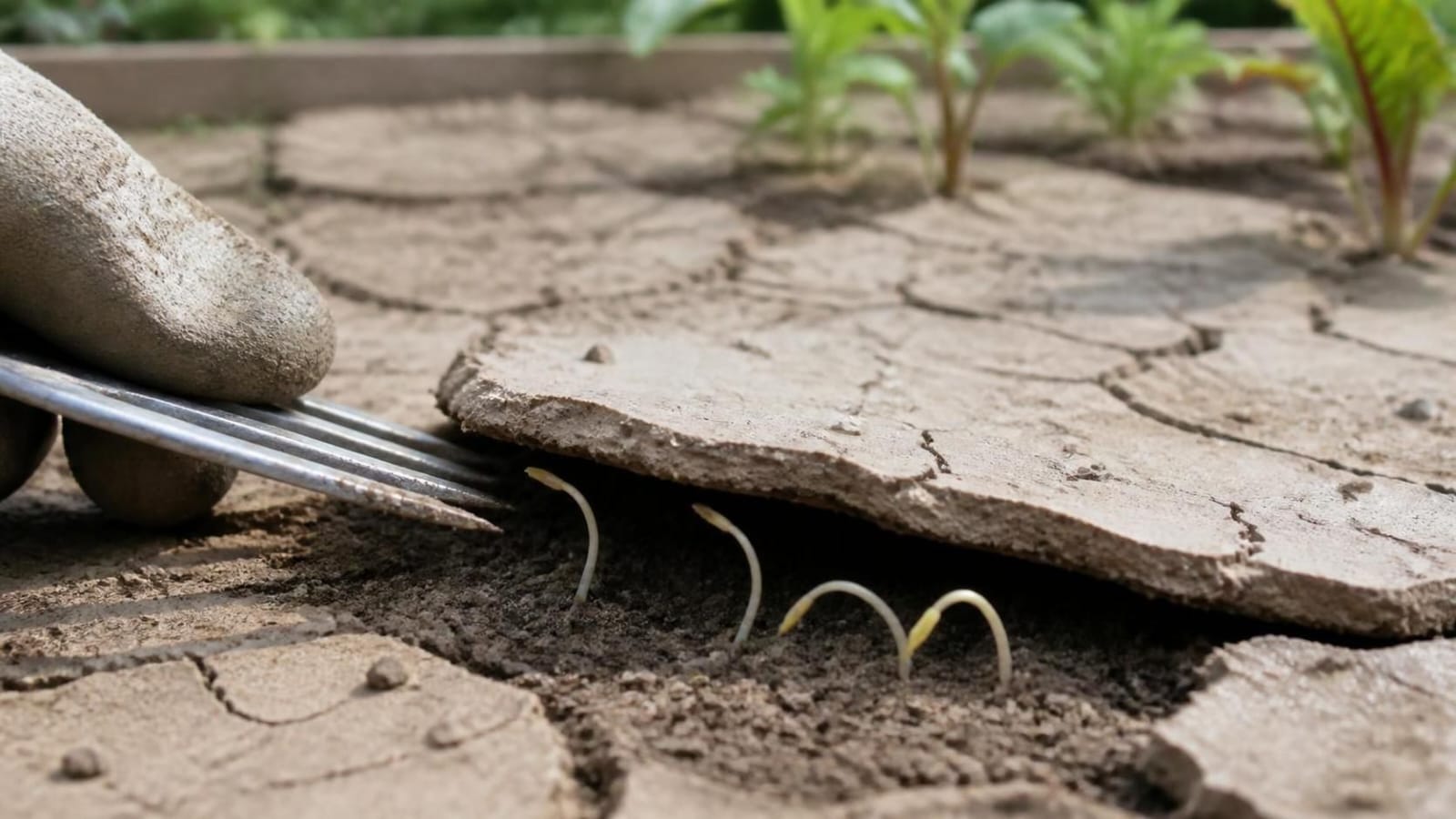
Two other problems can sit in the way. If water beads up and runs off a dusty, dry bed instead of soaking in, you are dealing with hydrophobic soil in raised beds, and that has to be rewetted before any flush will carry salt anywhere. And if the surface is sealed hard and seedlings cannot push through, read about a hard crust on garden soil that blocks seedlings, because some crusts are structural rather than salty.
Flushing a Pot, Planter or Grow Bag
Containers build salt faster than beds because the soil volume is small and every drop of fertilizer stays in the pot. The method from Oregon State University Extension is simple. Remove the crust first, taking no more than an inch of soil. Water thoroughly, wait about five minutes, then water again and let the excess run out of the drainage holes. The first watering dissolves the fertilizer salts and the second washes them out.
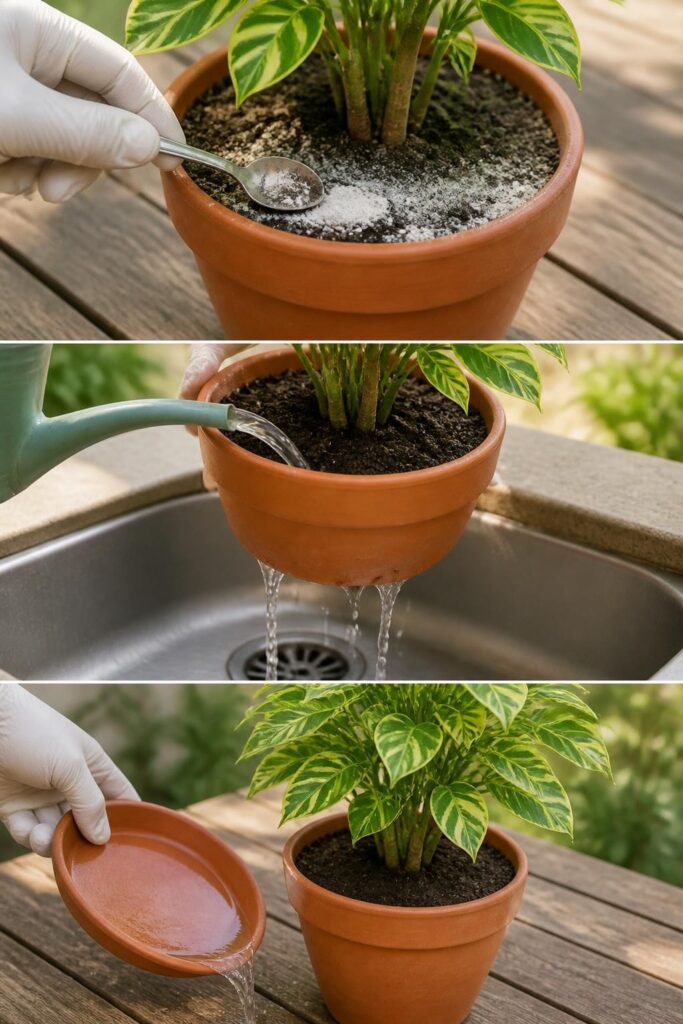
Oregon State suggests this every four to six months for houseplants. Heavily fed outdoor containers in hot weather may need it more often, so let the returning crust guide you. Empty the saucer after each watering, because drained salty water can be pulled straight back into the soil, even through the wall of a clay pot. If salt levels are very high, or the pot is coated in white residue, Oregon State recommends repotting into a clean container. Never try to flush a pot that has no drainage holes.
When Flushing Will Not Work
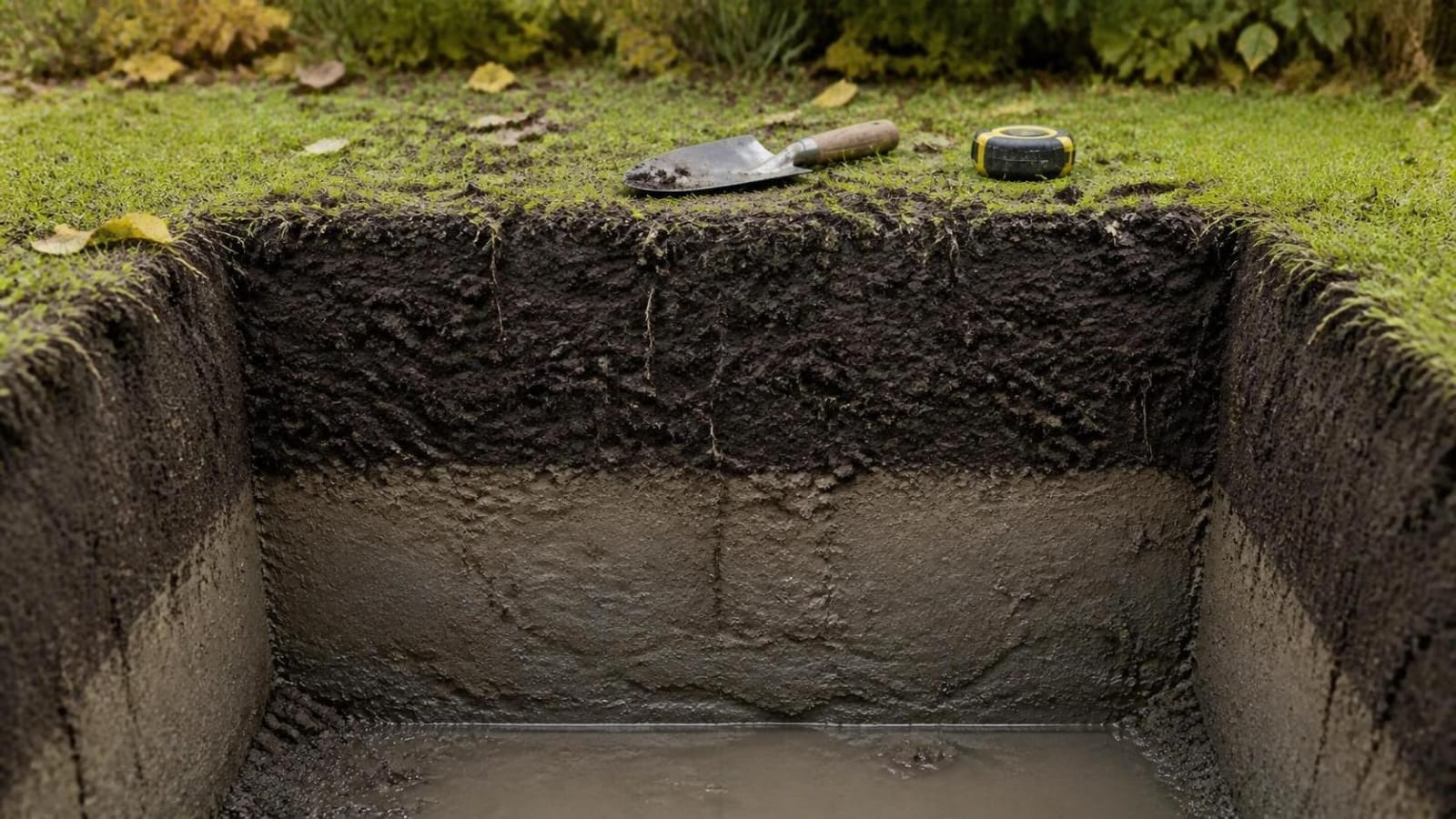
Colorado State is clear that salty soil is not reclaimable when clay content, compaction or a hardpan stops water from moving through. Nevada Extension adds that without drainage, even good water can leave a soil saline or sodic over time, and that compacted layers, hardpans and shallow water tables should be dealt with before you leach.
In a raised bed, the usual culprit is a packed, shallow or poorly mixed fill. If that sounds familiar, start with the guide on compacted raised bed soil. If the bed stays soggy even though it has drainage holes or an open base, work through why garden soil stays waterlogged despite drainage and solve that first, because flushing a waterlogged bed just swaps one root problem for another. In a small bed or planter, replacing the worst of the soil with fresh, low-salt mix can be simpler than trying to flush a bed that will not drain; whether that makes sense depends on your soil volume, so ask your local extension office if you are unsure.
What Not to Do
- Do not add gypsum unless a test shows a sodium problem. On soil that is salty but not sodic it adds more salt.
- Do not spray fungicide. A hard, gritty crust that dissolves in water is not a fungus.
- Do not answer yellow or pale leaves with extra fertilizer. Unneeded fertilizer raises soil salt levels.
- Do not flush a bed that cannot drain. You will only move salt around and drown roots.
- Do not use softened water to flush. Water softeners are listed by Nevada Extension as a source of salt.
- Do not dig the crust back into the root zone and call it done.
Keeping It From Coming Back
Once the soil is clean, the goal is to stop re-salting it. A few habits do most of the work.
- Know your water. A water test shows whether the hose is part of the problem. If it is, rainwater or a lower-salt source helps for sensitive plants.
- Water to dilute and to flush. Once crops are growing in salty soil, Nevada Extension recommends more frequent, smaller applications to keep salt diluted around the roots, plus an occasional deliberate flush when plants are not actively growing.
- Mind your drip lines. Nevada Extension notes that drip irrigation wets a narrow zone, so salt gathers in a ring at its edge and just above the wet spot. Plan occasional heavy leaching irrigations, ideally before planting or in cooler months.
- Choose compost carefully. Colorado State advises against adding more than about an inch of manure-based compost per season without a soil test, and suggests asking suppliers for recent salt results. That guidance comes from Colorado, where soil amendments are unregulated, so check what applies locally.
- Feed from a test, not a habit. Fertilize according to what the soil actually needs, and keep fertilizer and salty amendments away from seeds and young roots.
- Slow the evaporation. A layer of mulch reduces evaporation at the surface, which is what drives crust formation. That is general horticultural reasoning, not a figure from the sources above, so treat it as a supporting habit and not a cure.
If one patch keeps going white, plant it with tolerant crops while you fix it. Colorado State’s tolerance list puts beans, onions, carrots, peas, radishes and strawberries among the least tolerant, tomatoes, squash, spinach and beets in the middle, and asparagus and Swiss chard among the most tolerant.
What Recovery Looks Like
Leaves that are already scorched will not turn green again. The signs to watch are healthy new growth, plants that stop wilting between waterings, and a surface that stays clear for weeks after a flush. Seeds are more sensitive than established plants, so if seedlings failed in the worst patch, resow after the soil has been flushed and retested rather than before.
Quick Questions
Can I just scrape the crust off?
It helps, and extension advice is to remove the crust before leaching. But salt below the surface will wick back up unless you flush it and deal with the source.
Will rain wash it away?
Sometimes. Colorado State notes that salt levels drop when soil is leached by rain or irrigation, but where drainage is poor, salt builds up instead. Rain helps a well-drained bed and does very little for a soggy one.
Does a salty crust mean my compost is bad?
Not necessarily. Compost is valuable, but manure-based products can be high in salt, so ask for test results and watch how much you apply.
What about white deposits on the outside of terracotta pots?
They show that salts are moving through the clay. Oregon State notes that salts can be reabsorbed through a clay pot, so flush the soil, empty saucers promptly and repot if the buildup is heavy.
A salt crust is slow to arrive and slow to leave, so a single flush rarely closes the case. Treat it as a reading on a gauge: once you know where the salt is coming from and the soil can drain, it usually stops being a mystery.