
Baking Soda Spray for Powdery Mildew: Does It Work?
Search for a home remedy for powdery mildew and baking soda shows up almost every time, usually with a recipe and a confident promise. What the recipes rarely mention is how the remedy performed when plant scientists actually tested it. That record is more mixed, and it explains why one gardener swears by the spray while another sees no change at all.
Sometimes, but not reliably. Baking soda can slow powdery mildew when it goes on early, covers the leaves thoroughly, and is paired with a horticultural oil. On its own it has ranged from partly effective to no better than plain water in plant trials. It will not clear white patches that are already on a leaf, and a mix that is too strong can scorch the plant.
Below you will find what the research showed, how to judge whether your plant is a good candidate, a careful way to try the spray, and what to switch to if it fails.
What the plant trials actually found
The kitchen recipe traces back to plant pathologists at Cornell University, who tested baking soda on roses and published the results in Plant Disease in 1992. In greenhouse experiments, weekly sprays of sodium bicarbonate combined with an ultrafine horticultural oil gave significant control of rose powdery mildew, and the pairing worked better than either ingredient alone. Two details from that work rarely survive into the recipes you see online: the oil, and the fact that the mildew tests took place in a greenhouse.
Field results have been less friendly. In a two-year trial on lilacs at a Maryland nursery, baking soda without oil failed to control the mildew and looked much like plain water, while horticultural oils performed about as well as a standard fungicide. The researchers suggested that poor sticking to the leaf and quick weathering might explain the failure. The lilacs were also planted close together with poor air movement, which is exactly the kind of humid setting mildew likes.
Washington State University extension horticulturist Linda Chalker-Scott reviewed the published studies and described the same pattern. Baking soda alone gave results that swung with disease pressure and weather, while baking soda plus oil was far more dependable. She also explains why a spray that looks strong in the lab fades outdoors: the solution runs off stems, is hard to get onto the undersides of leaves, and washes away in the next rain. And it is fungistatic, meaning it holds fungi back rather than killing them, so the benefit lasts only while the leaf stays coated.
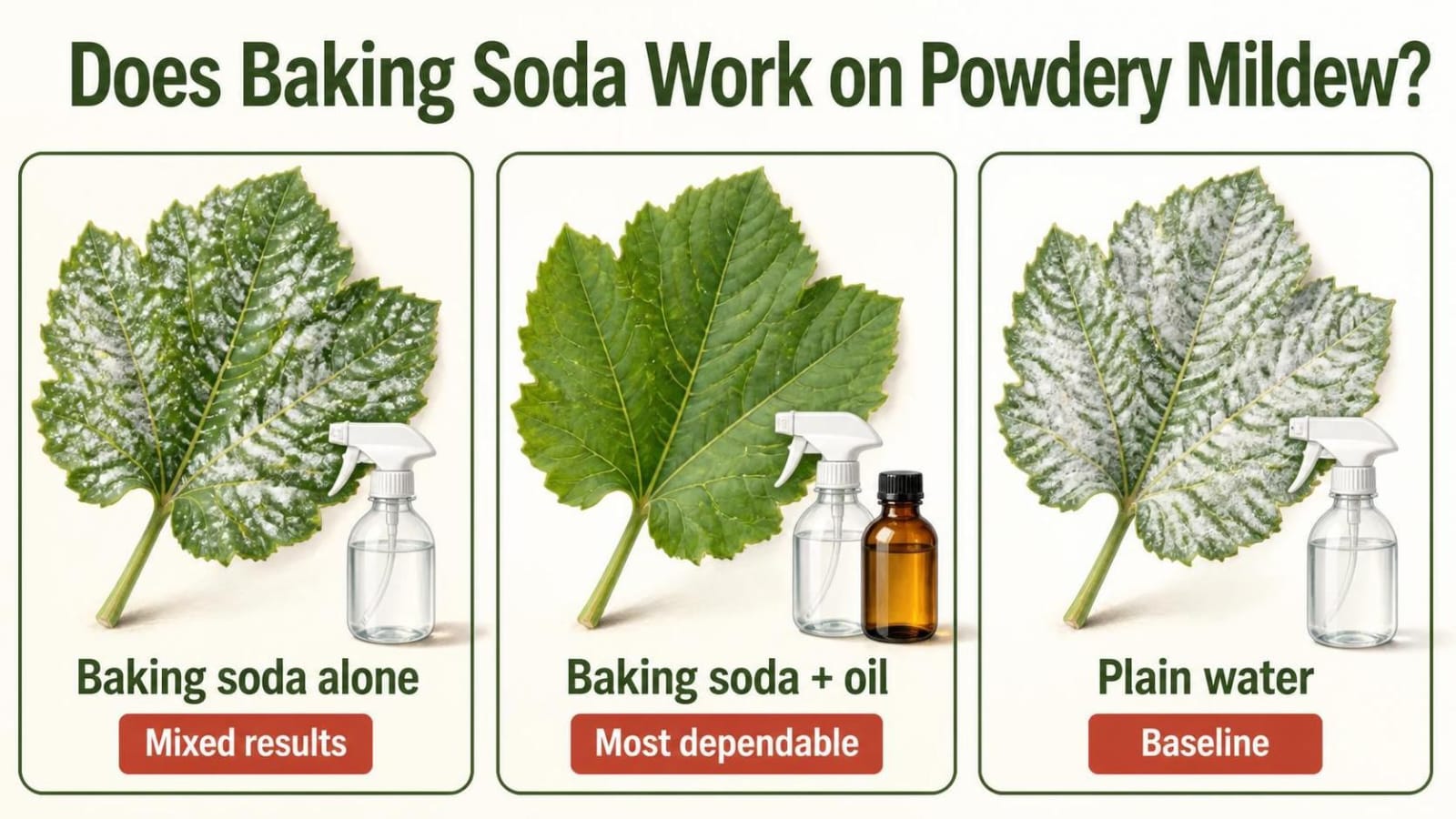
You will often read that baking soda works by raising leaf pH until spores cannot survive. The idea has some basis in laboratory work, but the claim that it destroys spores outright goes further than the evidence supports. How bicarbonate acts on fungal cells is still not fully settled, and a post on the Garden Professors blog adds that bicarbonate is a contact treatment. It only affects the fungus it touches and offers no lasting protection once it has dried.
Is your plant a good candidate?
Two quick checks can save a lot of wasted spraying.
First, is it really powdery mildew?
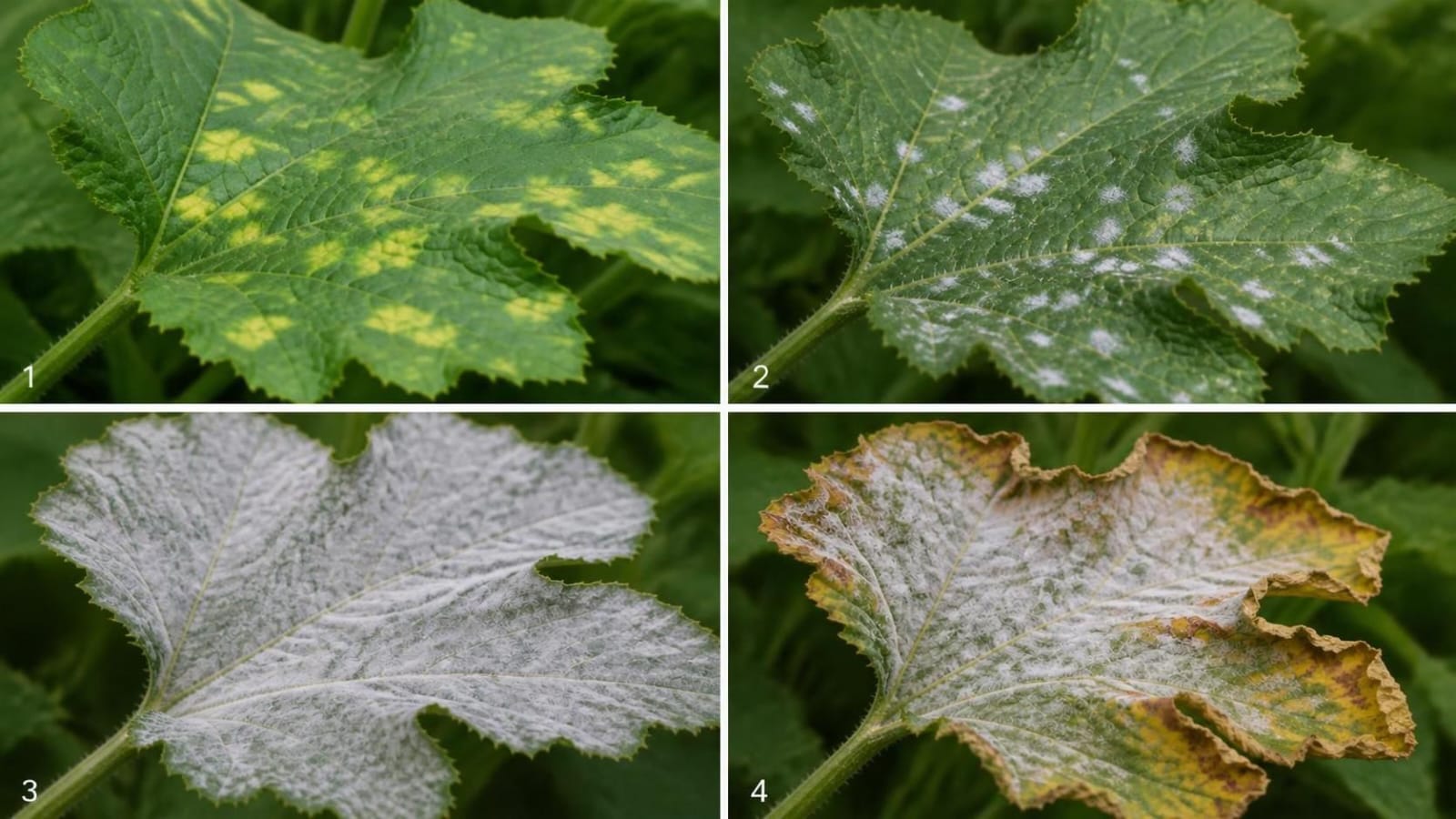
Powdery mildew is a flat, dry, white-to-gray film that sits on the surface of the leaf. It tends to build in shade, at moderate temperatures and in still, humid air, and it does not need wet leaves to spread. If you are seeing fuzzy patches mostly on the undersides of leaves during cool, damp weather, that points to downy mildew, a different disease that a spray like this was not designed for. Our guide to what powdery mildew looks like covers the other lookalikes.
Second, how far along is it?
Timing matters more than most recipes admit. Powdery mildew lives in the outer cells of the plant, so when a treatment kills the fungus it can kill those cells too. University of California IPM specialists point to this as the reason potassium bicarbonate products can injure plants and should stay off advanced infections. The same logic applies to baking soda, and Chalker-Scott likewise advises spraying while disease levels are still low.
Here is how common situations line up with the evidence.
| Your situation | Baking soda? | Why |
|---|---|---|
| A few white spots on a susceptible plant | Worth trying | Early and light is where bicarbonate sprays have the best chance, with the lowest risk of leaf damage. |
| Whole leaves already coated white | Prune first | Old patches will not clear, and spraying heavily infected tissue raises the risk of burn. Remove the worst growth instead. |
| Roses | Maybe, with oil | The strongest positive results come from rose trials, and those used oil. Plant-specific advice is in our guide to powdery mildew on roses. |
| Squash, cucumbers or pumpkins | Possible, with oil | A bicarbonate-plus-oil mix has been reported to control mildew on pumpkin, but fast-growing vines keep producing unprotected leaves. See powdery mildew on squash and cucumbers. |
| Lilac, marigold or rosemary | Unlikely to help | Field trials found no benefit on these plants, and rosemary suffered severe leaf damage. |
| A hot afternoon, or a plant wilting from dry soil | Wait | Heat and drought stress raise the odds of scorch. Spray when it is cooler, once the plant has been watered. |
Why the recipes online do not agree
Compare a handful of baking soda recipes and you will find a handful of different strengths, almost none with a source. The research gives a reference point. The Cornell rose work used a solution equivalent to about 0.5 percent, and the lilac trial used 0.5 percent by weight per volume, which is roughly 5 grams per liter of water. By my own rough conversion, one level tablespoon per gallon sits a little under that, while the three tablespoons per gallon found in some popular guides lands near 1 percent.
That matters because the margin is thin. Chalker-Scott’s review found that effectiveness rises with concentration, and so does damage, with a 1 percent solution enough to cause severe leaf injury, including yellowing between the veins. Treat any number you find, including these, as a starting point to test on a few leaves rather than a guarantee. If you use a ready-made potassium bicarbonate product instead, follow its label and check local rules, since approved products and instructions differ by country and region.
If you decide to try it
A careful trial on one plant costs you almost nothing. This sequence fits what the research says.
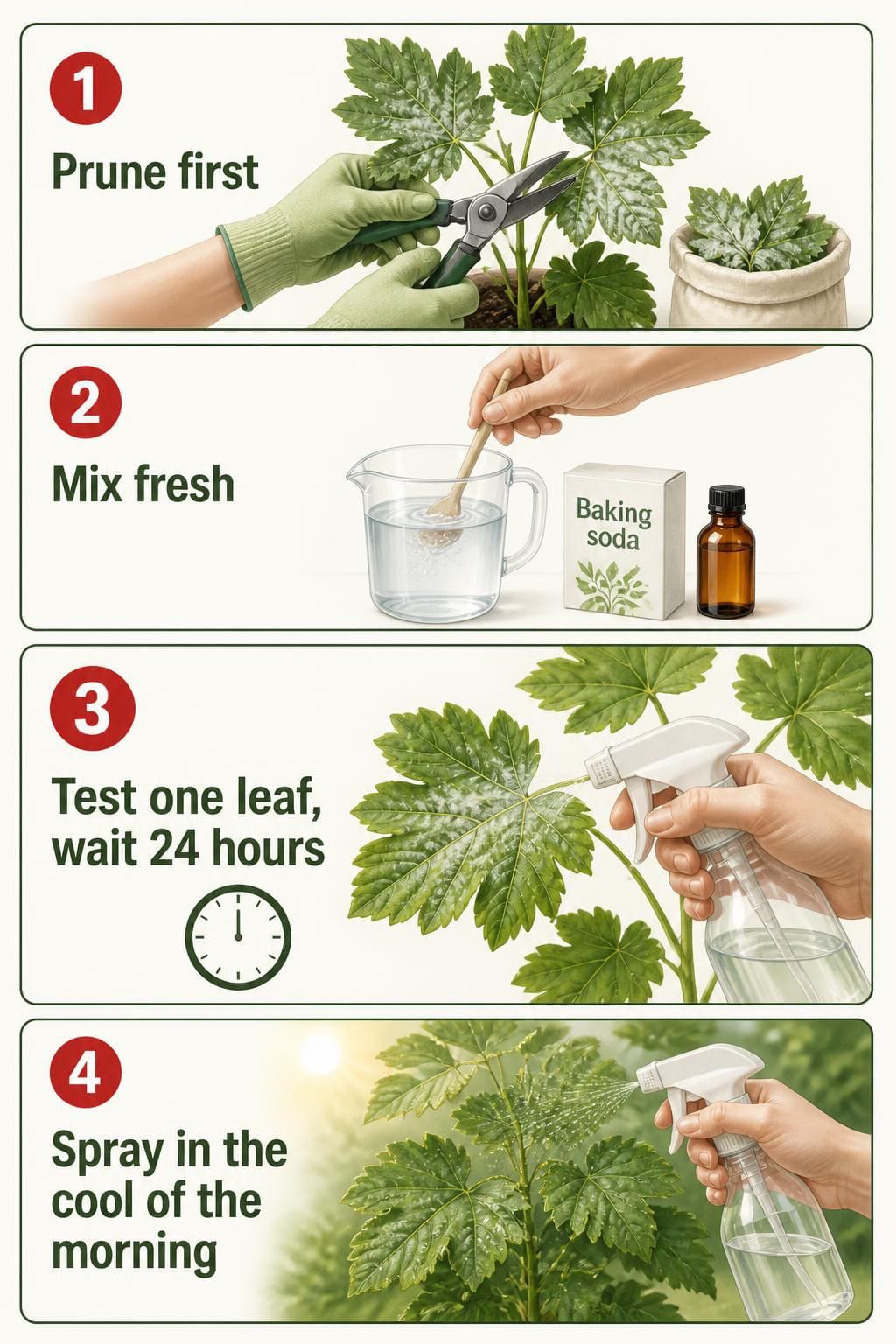
- Prune first. Cut off the worst-affected leaves and shoots and bag them. A spray cannot repair tissue the fungus already holds.
- Mix a fresh batch and stir until the baking soda has dissolved. Stay near the strengths used in the trials rather than doubling up.
- Add a sticker. The trials that worked used a refined horticultural oil, so that is the evidence-backed choice. A few drops of mild liquid soap is the usual kitchen substitute, though far less research stands behind it. Oils can injure plants above about 90°F (32°C) or within two weeks of a sulfur spray, so check the product label.
- Test before you commit. Spray a few leaves and wait at least 24 hours. Yellowing, browning or crisp edges mean the mix is too much for that plant.
- Spray in the cool of the morning or evening, not in hot afternoon sun. Wet both sides of the leaves, because the treatment only works where it touches the fungus.
- Repeat on a schedule. The Cornell sprays went on weekly. Most advice is to stay at weekly or less, since repeated use can build sodium up in the soil, and you will need to respray after rain.
- Judge by new growth. Old patches will not disappear. If fresh leaves stay clean through several sprays, it is helping. If new patches keep forming, move on.
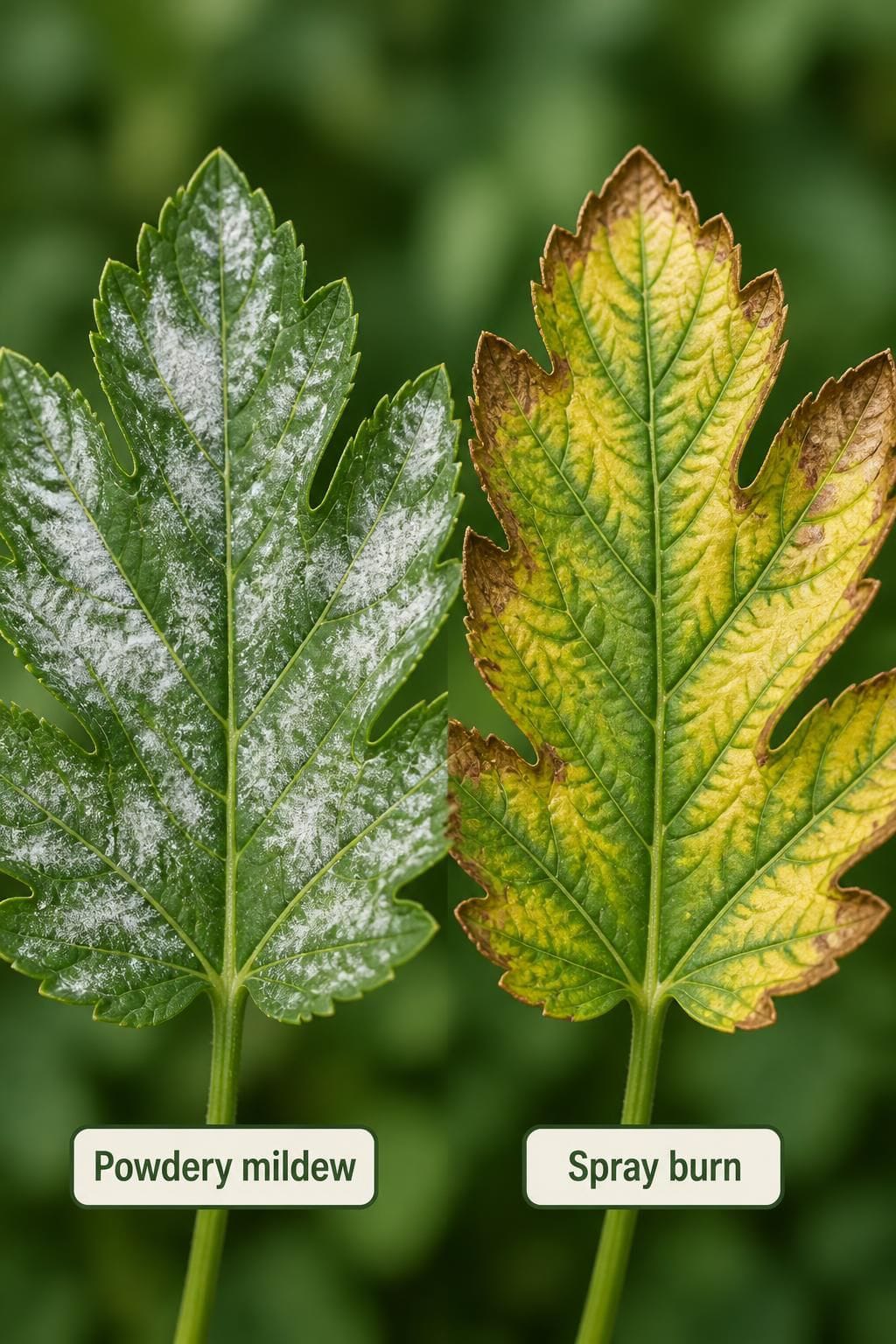
Mildew or spray burn?
If a plant looks worse after spraying, check what you are seeing. Mildew is a pale film lying on top of the leaf. Spray damage shows up in the leaf itself: yellowing between the veins, brown or scorched edges, or crisp patches that appear within days of a spray. If you see those signs, stop spraying and let the plant recover with normal watering before you decide on another approach.
Mistakes that turn a mild problem into a worse one
- Making it stronger when the first spray seems weak. More baking soda raises the risk of leaf burn along with any extra control.
- Spraying heavily infected leaves in the hope of rescuing them. Prune them instead.
- Using sulfur and oil close together. The combination can injure plants, so keep the gap the product label calls for.
- Treating the spray as the whole plan. If the plant sits in crowded shade, mildew keeps coming back whatever you spray.
When to switch to something else
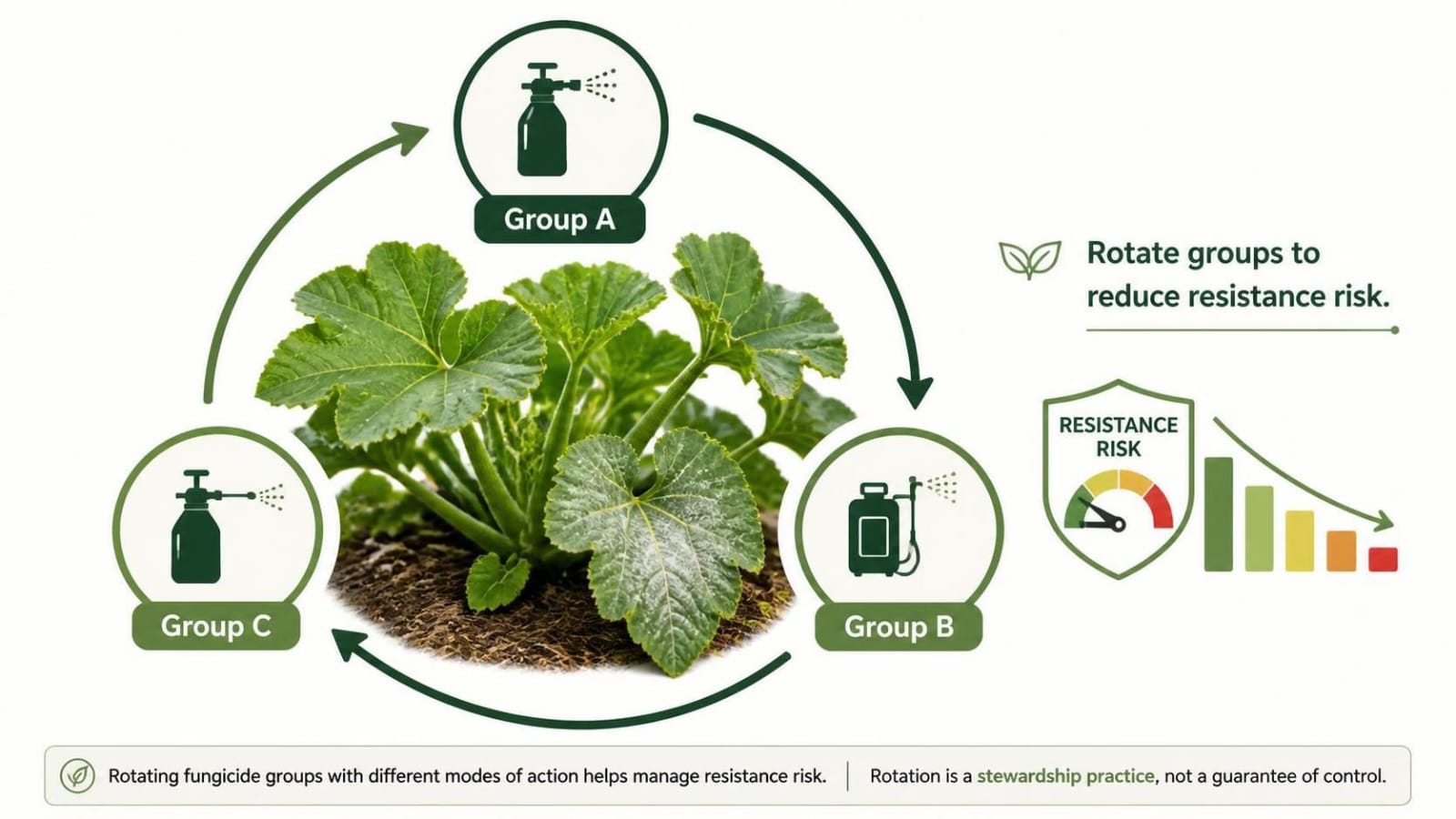
If new patches keep appearing after a few weekly sprays, baking soda is not earning its place. UC IPM lists several alternatives for home gardens. Potassium bicarbonate products are the closest step up: they can stop an existing infection to some degree, but they can injure plants and should not go on advanced mildew. Horticultural oil, including neem oil, is suggested for mild to moderate infections and should not be used above 90°F (32°C). Sulfur works only as prevention, before the disease shows up. You can compare these side by side in our guide to the best fungicides for powdery mildew.
Whichever you choose, read the label and check what is approved where you live. Products and rules vary by country, and so do the instructions for edible crops.
Change the conditions, and the spray matters less
Powdery mildew builds in shade, moderate temperatures and still air, and it favors soft new growth. So the most reliable fixes concern the plant’s setting: more sun, more space between plants, pruning to open the canopy, and restraint with nitrogen, since too much produces the lush foliage mildew likes. Resistant varieties help most of all, and they exist for roses, squash, cucumbers, pumpkins and many other plants.
One detail surprises many gardeners. Much of the advice to keep leaves dry is aimed at other diseases. Powdery mildew spores do not need water to infect, and long periods of water on the leaf surface actually inhibit and kill them. UC IPM even suggests washing spores off with overhead sprinkling in mid-morning, so the leaves dry quickly afterward. That is a cheap first step before any spray. For the full picture, see our complete guide to powdery mildew.
Quick answers
Is potassium bicarbonate better than baking soda?
For powdery mildew, it has the stronger track record. The Garden Professors post notes that most of the efficacy studies used the potassium salt, and Chalker-Scott’s rose review found sodium bicarbonate less effective than potassium bicarbonate and several other treatments. It also adds no sodium to the soil. Both are contact treatments, so coverage and timing matter either way.
Can mildew from my roses spread to my squash?
Usually not. Each powdery mildew fungus infects a particular range of plants, so the fungus on roses is a different one from the fungus on squash. That is reassuring in a mixed garden, but plants of the same kind will still pass it between them. Our guides to powdery mildew on roses and powdery mildew on squash and cucumbers cover each case.
2 thoughts on “Baking Soda Spray for Powdery Mildew: Does It Work?”