Powdery Mildew on Squash and Cucumbers: Treatment & Prevention
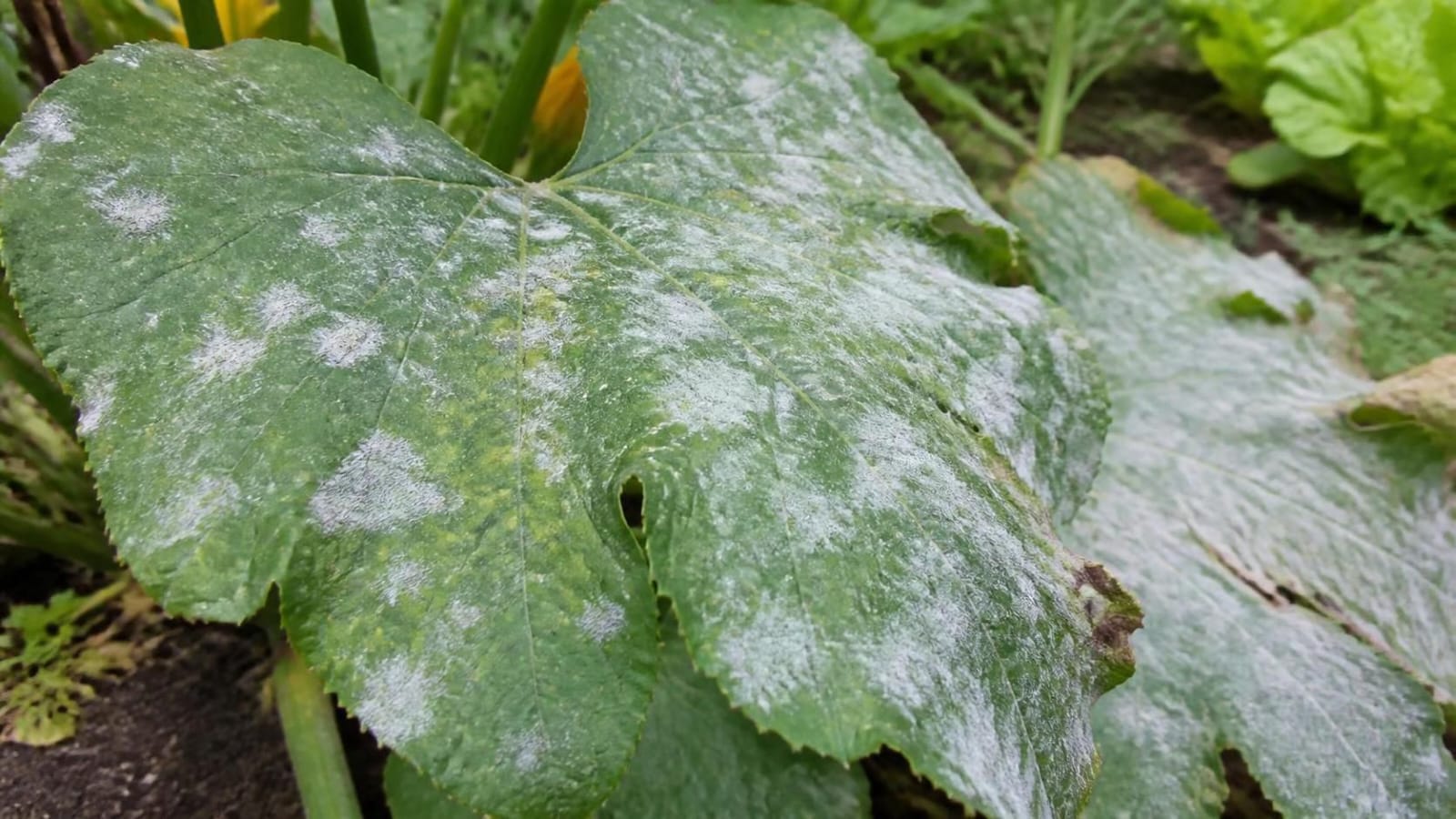
White, dusty patches on squash or cucumber leaves, often on plants that have started setting fruit, are almost always powdery mildew. Remove the worst leaves, let in more light and air, water the soil instead of the foliage, and match any spray to the stage: sulfur only works before symptoms appear, while oils are the usual choice once the powder is visible.
Flour-dusted leaves are the classic late-season sight on squash and cucumber vines. The fruit itself is rarely touched, which is the reassuring part. The catch is that the leaves feed the fruit. The University of California IPM program notes that severely infected plants can lose yield, finish producing early, and give fruit with little flavor, and that dying leaves can leave fruit exposed to sunburn.
Online advice on this disease is oddly contradictory. One guide says the fungus loves wet weather, another says water holds it back. One tells you to compost infected vines, another says never to. The sections below sort out each conflict, starting with how to be sure you have powdery mildew at all. For the wider picture across garden plants, the main powdery mildew guide covers the basics.
How to be sure it is powdery mildew
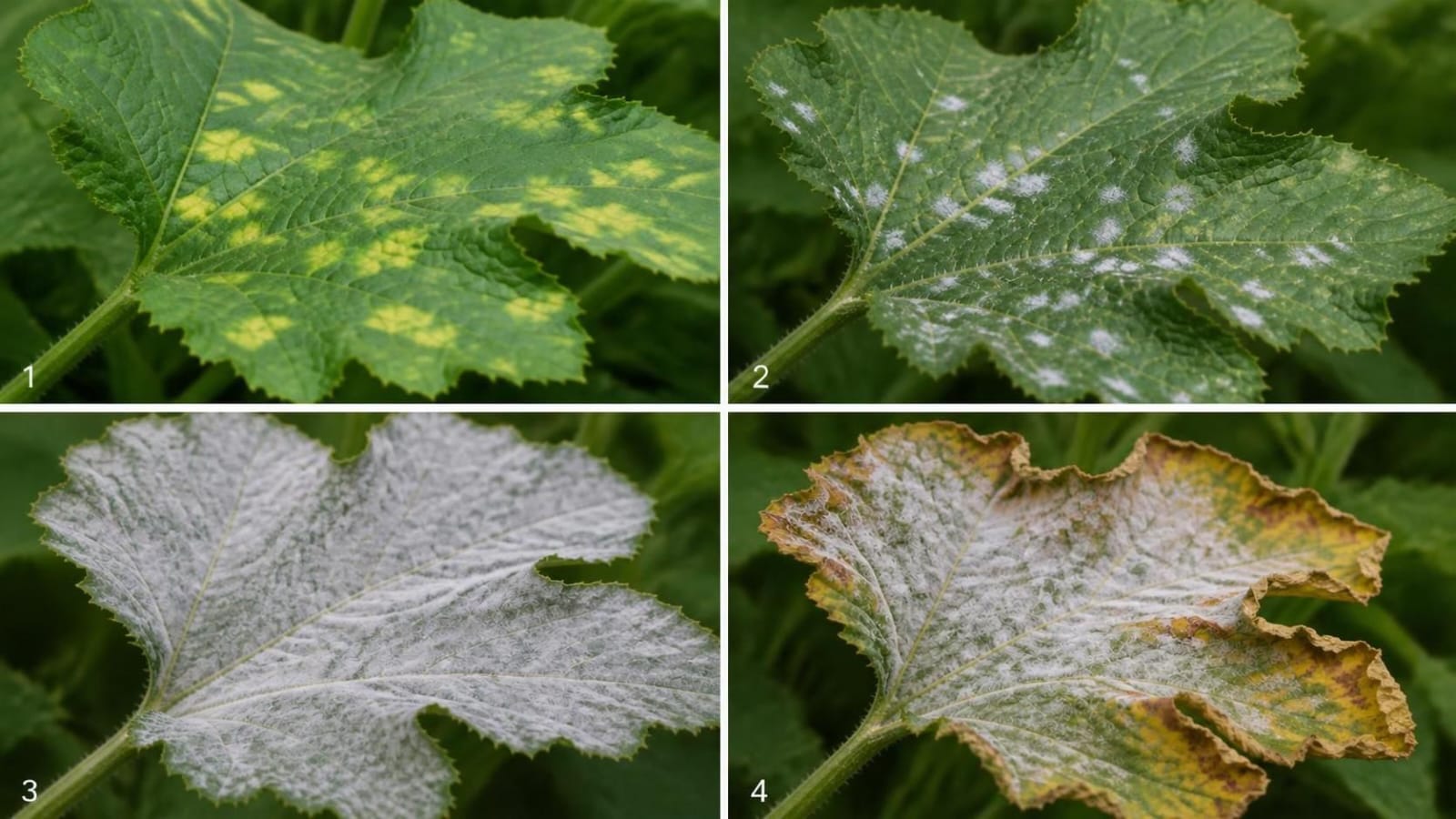
According to UC IPM’s cucurbit guide, the first sign is pale yellow spots on stems, leaf stalks, and leaves. The spots grow as white, fluffy-looking fungal growth spreads over the surface and gives the lesions their powdery look. Affected leaves turn dull and yellow, may wilt in afternoon heat, and eventually become brown and papery.
Where to look first matters. Plants that have started fruiting are often the first to show it, and Utah State University Extension suggests starting with the lowest leaves and checking both the tops and the undersides. Watermelon is the exception in the family: it gets the disease less often than other cucurbits. If you want more photos to compare against, the powdery mildew identification guide shows the disease on other plants.
Powdery mildew or downy mildew?
The two are easy to confuse, and the difference matters because they need different handling. The table below follows the clues UC IPM gives for telling them apart. A third look-alike, bacterial angular leaf spot, also makes angular spots, but Penn State Extension points out that it leaves no spores on the underside of the leaf.
| Clue | Powdery mildew | Downy mildew |
|---|---|---|
| First sign | Pale yellow spots that turn into white, powdery patches | Small pale green to yellow angular spots held in by the leaf veins, giving a mottled look |
| Underside of the leaf | Powder on both sides of the leaf | White to purple growth underneath, mainly in moist weather |
| Leaf wetness | Not needed to spread | A wet leaf surface is required; rain, fog, and sprinklers help it |
| Which leaves first | Often plants that have started fruiting; check lower leaves | Older leaves first, then upward |
| Product choice | Products labeled for powdery mildew | Recommended products differ, so a powdery mildew spray may not help |

If you cannot tell which one you have, get the diagnosis right before you buy anything. Your local extension office can usually help identify a leaf sample.
Why it shows up when it does
Some garden guides say powdery mildew needs plenty of moisture and peaks in wet seasons. Extension sources say the opposite about wet leaves. UC IPM explains that the spores can germinate and infect without free water, and that water sitting on the leaves for long periods can even kill spores or block germination in some species. Humid air still helps: University of Maine Extension notes that high humidity speeds the fungus up once infection has started.
What favors it most is moderate temperature, roughly 60 to 80°F (16 to 27°C), together with shade. UC IPM adds that spores and fungal growth are sensitive to heat above 90°F and to direct sunlight. In a garden, that points to the real drivers: crowded vines, shaded beds, and thick late-season foliage that traps humid air.
The disease also carries over between seasons. UC IPM reports that the fungus behind cucurbit mildew makes resting spores that survive winter, and Utah State notes that it overwinters on plant debris. Wind then carries spores to new plants, which is why even a tidy garden can be hit from next door.
What to do this week
- Remove the worst leaves, but not all of them. Cut off heavily coated leaves and badly affected stems as soon as you see them. The leaves feed the plant and shade the fruit, so keep enough healthy foliage; stripping a vine adds stress.
- Bag the clippings. Oregon State University Extension advises bagging or burying infected plant parts and never working them back into the soil.
- Open up the canopy. Thin crowded growth, trim anything shading the bed, and train vining types upward on a support so light and air reach the leaves.
- Water the soil. Drip lines or soaker hoses are the safest default. Overhead watering is a real trade-off: UC IPM says a midmorning sprinkle can wash spores off, but both UC and Oregon State warn that wet foliage encourages other diseases. If downy mildew has been a problem in your garden, skip it.
- Ease off the nitrogen. Too much nitrogen makes lush, shading foliage, which UC IPM lists as a trigger. A slow-release fertilizer is the gentler choice.

Sprays: timing matters more than the product
Read the label and check local rules before you buy, because approved products differ between countries and regions. Two extension views are worth holding side by side. Oregon State says pesticides are usually not warranted for powdery mildew in a home garden. UC IPM says very susceptible cucurbits may need a fungicide, and that the least-toxic options must go on no later than the first sign of disease. The sensible reading depends on your situation: if the plants are young and you want a long harvest, protect early; if the season is nearly over, pruning and airflow may be enough.
| Option | When it fits | Watch out for |
|---|---|---|
| Sulfur | Protecting leaves before mildew appears; reapplied as new leaves grow | Not effective once the disease shows. Can harm some squash and melon varieties. Avoid near 90°F and within two weeks of an oil spray |
| Horticultural oil | Mild to moderate infections that are already visible | Not above 90°F, not on drought-stressed plants, not within two weeks of sulfur |
| Neem or jojoba oil | Mild to moderate infections, as with other oils | Same heat and sulfur cautions as other oils. More in the neem oil guide |
| Bacillus subtilis products | A gentle preventive for early in the season | UC IPM found it less effective than oils or sulfur |
| Baking soda, milk, or garlic sprays | Light cases and prevention | The University of Saskatchewan says there is some evidence they reduce severity but they do not eradicate it. See the baking soda spray guide |
| Copper | Sometimes suggested in garden guides | UC IPM calls it not very effective against powdery mildew |
| Synthetic fungicides | Heavy pressure, or plantings grown for sale | Products differ by country, and repeated use of one product can select resistant mildew. See the fungicide comparison |
Protectant products only work on contact, so coverage has to be thorough, tops and undersides. UC IPM says protectants may need repeating at intervals of about 7 to 10 days as new leaves grow, for as long as conditions favor the disease. The product label overrides that general figure, and it also tells you how long to wait between spraying and harvest.
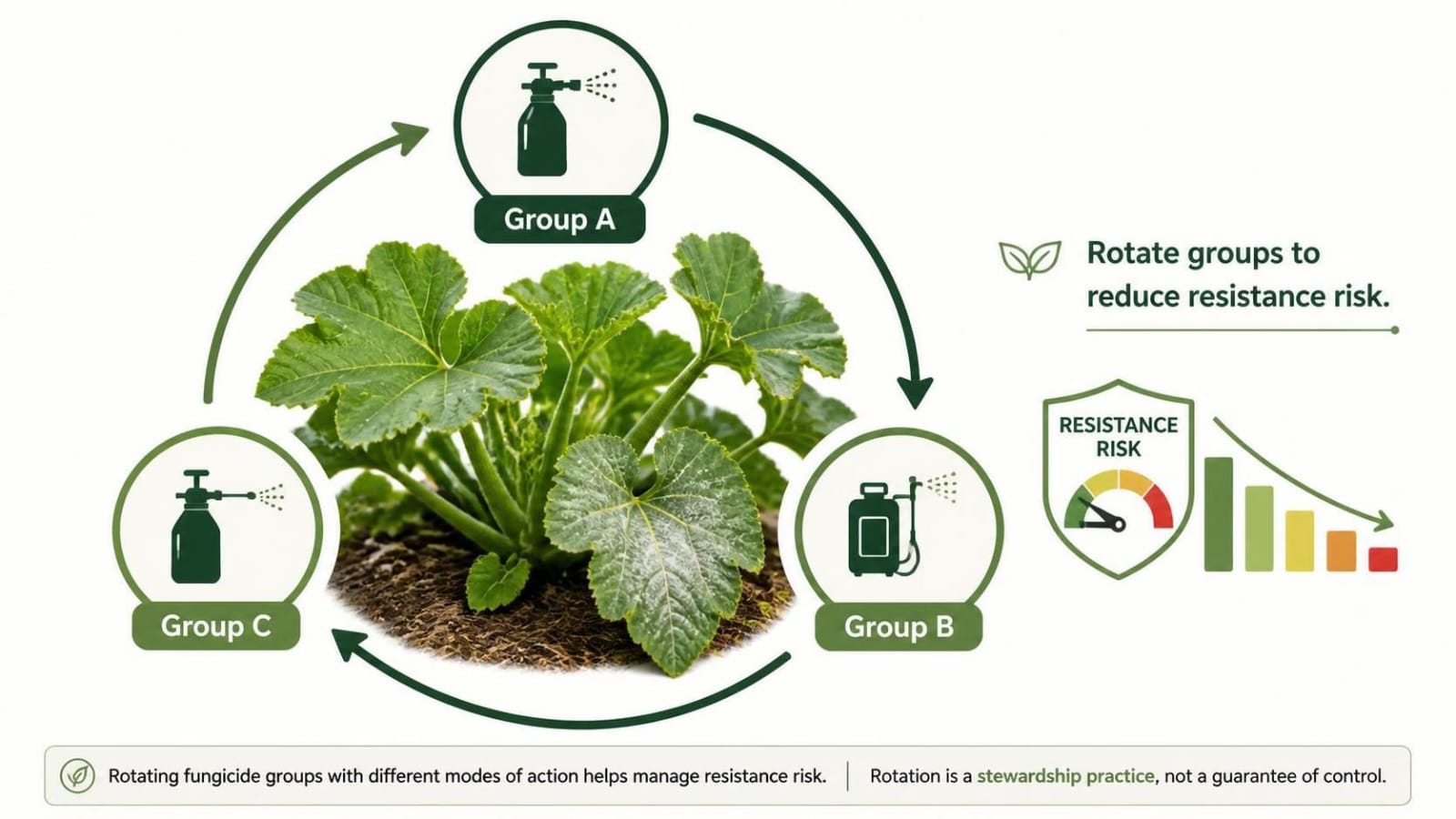
Rotate products too. UC’s commercial cucurbit guidelines recommend alternating materials with different modes of action when several applications are needed, to slow the buildup of resistant strains. Growers producing for sale should follow their local extension guidance rather than home-garden advice.
What not to do
- Don’t spray sulfur and oil within two weeks of each other. Plants can be injured, and some are more sensitive than the general rule suggests, so check the label.
- Don’t spray in the heat. Both sulfur and oils should be kept off the plants near 90°F, and oils should never go on drought-stressed vines.
- Don’t strip the vine bare. Fewer leaves means less food for the fruit and more sun on it.
- Don’t till infected vines back into the soil. Remove them from the garden instead.
- Don’t rely on rotation alone. Spores travel on the wind, so moving the bed lowers the local buildup but does not make you immune.
End of season: compost or trash?
The advice conflicts here as well. Oregon State says not to put infected material in a home compost pile. UC IPM says properly maintained compost piles should kill the spores, and gardening guides commonly put the benchmark for hot composting at around 140°F (60°C). A fair way to read that: if your pile gets reliably hot and is turned regularly, composting is defensible. If it is a cold, lazy heap, bag the vines and send them out with the trash or green waste.
Either way, pull heavily infected plants late in the season and clear away all the plant debris, since that debris is where the fungus waits out the winter.
Will it ruin the harvest?
Often not. Leaves that already carry the powder will not recover, so judge progress by new growth and by whether the plant keeps setting fruit. Many home-garden vines keep producing despite the mildew. Severe cases are another matter: UC IPM says heavily affected leaves die and, in the worst cases, the plants themselves can die. That is the main reason to act early, while most of the foliage is still clean.
Keeping it away next season
- Choose resistant varieties. Oregon State names the zucchini varieties ‘Payroll’ and ‘Sebring’ as examples and points to a longer Cornell University list of resistant cucurbits. Resistant does not mean immune: UC’s cucurbit guidelines note that resistance-breaking races of the fungus are present in California.
- Plant in full sun with room to spare. Follow the spacing on the seed packet, and grow vining types up a support to improve light and air.
- Rotate when you can. Oregon State suggests keeping squash in one part of the garden only every three to four years, which reduces the local buildup of the fungus.
- Scout weekly once fruit starts to set. Check the lowest leaves and the undersides first, and act on the first patches rather than the fiftieth.
- Clean up in autumn. Removing the previous crop’s debris cuts the number of spores available next year.
Questions that come up
Can the mildew spread between squash, cucumbers, and melons?
Yes. UC IPM lists cucumbers, melons, pumpkins, and squash as hosts of the same mildew species, so one infected bed can seed the next. Other vegetable families are mostly safe, because each mildew species attacks specific hosts, though a few species have wider host ranges, so do not assume the risk is zero.
Is it the same mildew that attacks my roses?
No. The UC IPM guidelines for ornamental nurseries explain that squash mildew can infect some other members of the cucurbit family but not roses. Your rose bed has its own fungus and its own handling, covered in powdery mildew on roses.
Why did it come back after I sprayed?
Usually for one of three reasons. New leaves keep growing and they were never covered. Protectant products only work on contact, so any missed surfaces stay open to infection. And wind can bring fresh spores from nearby plants at any time. Keep checking new growth, and repeat treatments according to the label for as long as the weather keeps favoring the disease.