
Plenty of banana plantings stall for reasons that were settled before the shovel came out: an offshoot that was too small, soil that was still cold, a corner of the yard that floods after a week of rain. If you want to plant a banana tree that actually takes off, those choices matter more than the digging.
Short answer: Start with a rooted sword sucker or a healthy nursery plant. Plant it after the last frost, in full sun, somewhere sheltered from wind and well drained. Dig a generous hole to loosen the soil, but set the plant no deeper than it was already growing, with the top of the root ball level with the soil or just above it. Water it in and mulch the ground without touching the stem. Leave about 8 to 12 feet (2.5 to 3.5 m) between fruiting plants.
The sections below follow the order you would check things in the garden, with the plant in your hands.
What you are actually planting
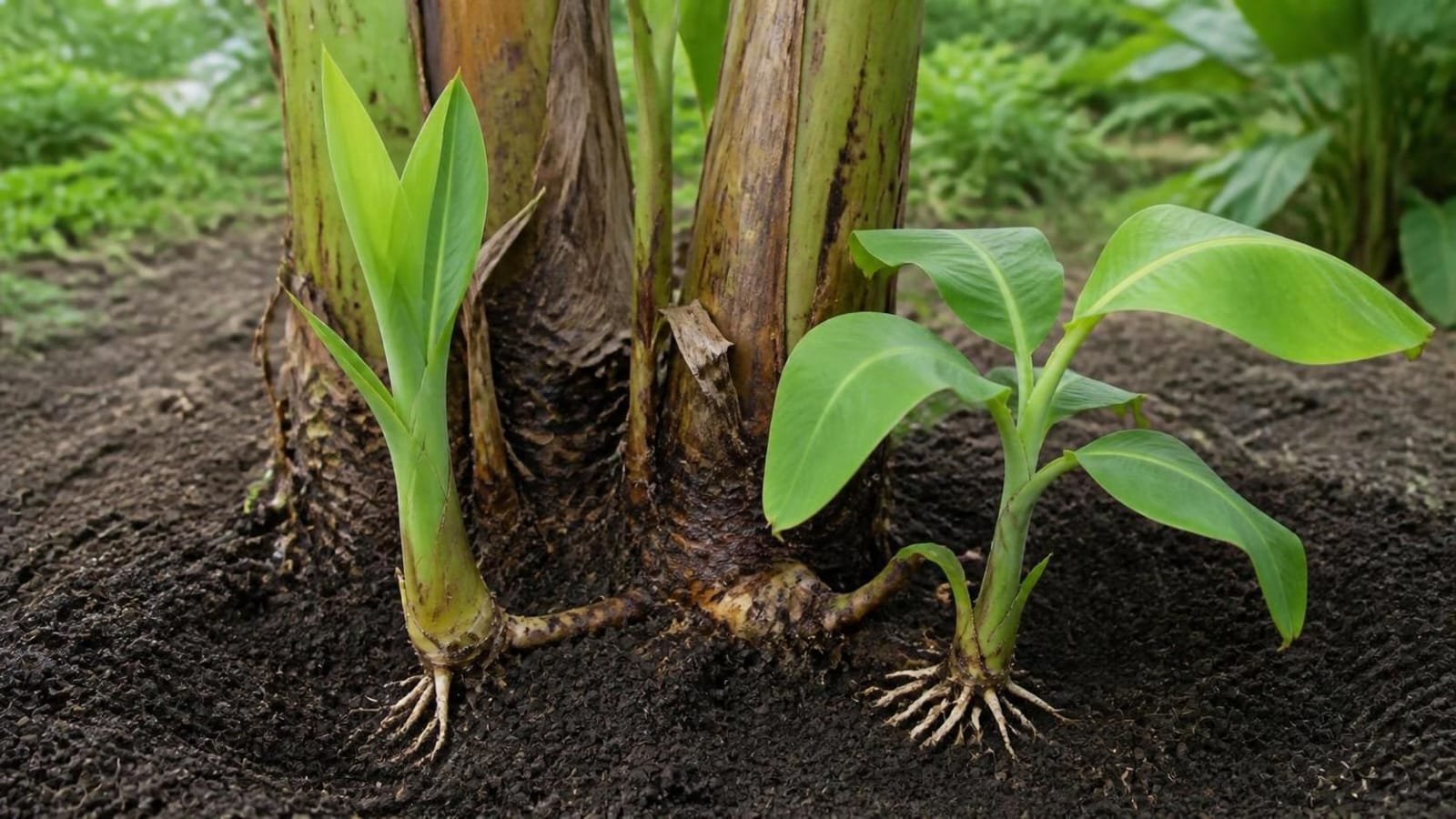
Burying a supermarket banana and waiting does not work: Growing Spaces, a greenhouse company that grows bananas under domes, points out that store-bought fruit is infertile and that bananas are propagated from rhizomes instead. What you want is a piece of living banana plant with roots on it.
The University of Florida’s extension service (UF/IFAS) sorts planting material into a few types, and the difference between the first two rows below explains a lot of weak, low-yielding plants.
| Planting material | Verdict | What to check |
|---|---|---|
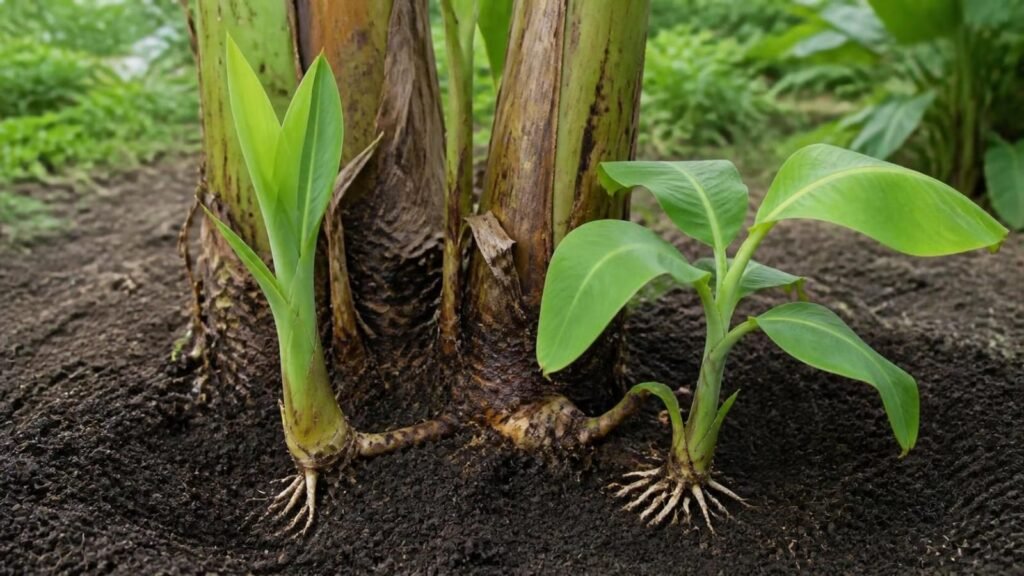
| Sword sucker | Best choice | Narrow, spear-like leaves on a wide base, firmly attached to the mother rhizome. Roots look healthy, with no dark patches or lumps. |
| Water sucker | Avoid | Broad leaves from an early age and only a shallow, weak attachment to the mother rhizome. Tends to make weak plants and less fruit. |
| Peeper (“button”) | Too small | Under about 12 inches (30 cm) tall, without enough roots to manage alone. |
| Tissue-culture plant | Reliable | Uniform and free of nematodes and most diseases. Takes longer to reach a saleable size, so it can be harder to find. |
| Rhizome piece | Fallback | A section of corm with clean white tissue and a few buds, with every dark or damaged part pared away. |
If you are taking a pup from a friend’s clump, look for a sword sucker at least 12 inches tall. One that is 2 to 3 feet tall and a few inches thick has better odds, according to Gardening Know How, which also says to take it only from a healthy mother plant that keeps three or four good offshoots of its own. Cut it free with a sharp, clean knife, lift the corm out with a spade, and keep as many roots as you can. Then cut back the biggest leaves and leave only the youngest, since the plant has fewer roots than it needs to feed them.
Buying a nursery plant instead? Epic Gardening suggests choosing one with small, spear-shaped new leaves and plump roots over one with long, stringy roots.
When to plant a banana tree: wait for warm soil, not a calendar date
A banana planted into cold ground mostly sits there. Growth slows sharply below roughly 57°F (14°C), according to Plant Delights Nursery. For temperate gardens their rule is to plant no sooner than three to four weeks after your average last frost, and no later than about ten weeks before the average first frost, so the roots have time to settle in. A plant that is not growing is not drinking much, and cold, wet soil is where rot gets its start, as BBC Gardeners’ World notes for UK growers.
Where frost never comes, water is the thing to plan around. Plant when you can keep the young plant moist, or at the start of your rainy season.
If your winters freeze
Plenty of gardeners read “zones 9 to 11” on a plant tag and either give up or plant anyway. Edible bananas are generally listed for those zones, Epic Gardening says, while some ornamental species handle far more. The Home Depot’s growing guide lists Japanese fiber banana (Musa basjoo) as hardy to zone 5 with good mulching, though it is not an edible variety.
So where does that leave someone who wants fruit and gets hard freezes? Frost kills the leaves, and a hard freeze can kill the plant to the ground. Yet Texas A&M AgriLife Extension notes that unprotected but well-established bananas across South Texas, with some exceptions, regrew after both the 1983 and 1989 freezes. What survives is the rhizome underground, which is why protecting the base counts for more than saving the leaves. In the UK, Gardeners’ World says year-round outdoor growing is limited to the mildest, most sheltered sites and usually still needs a move indoors or heavy winter protection.
A fair compromise: where freezes are routine and you want fruit, a large pot that can come indoors is less work than guarding a bed. Cold tolerance also varies by variety and by microclimate, so treat any hardiness zone as a rough guide.
Where to plant a banana tree: sun, shelter and drainage
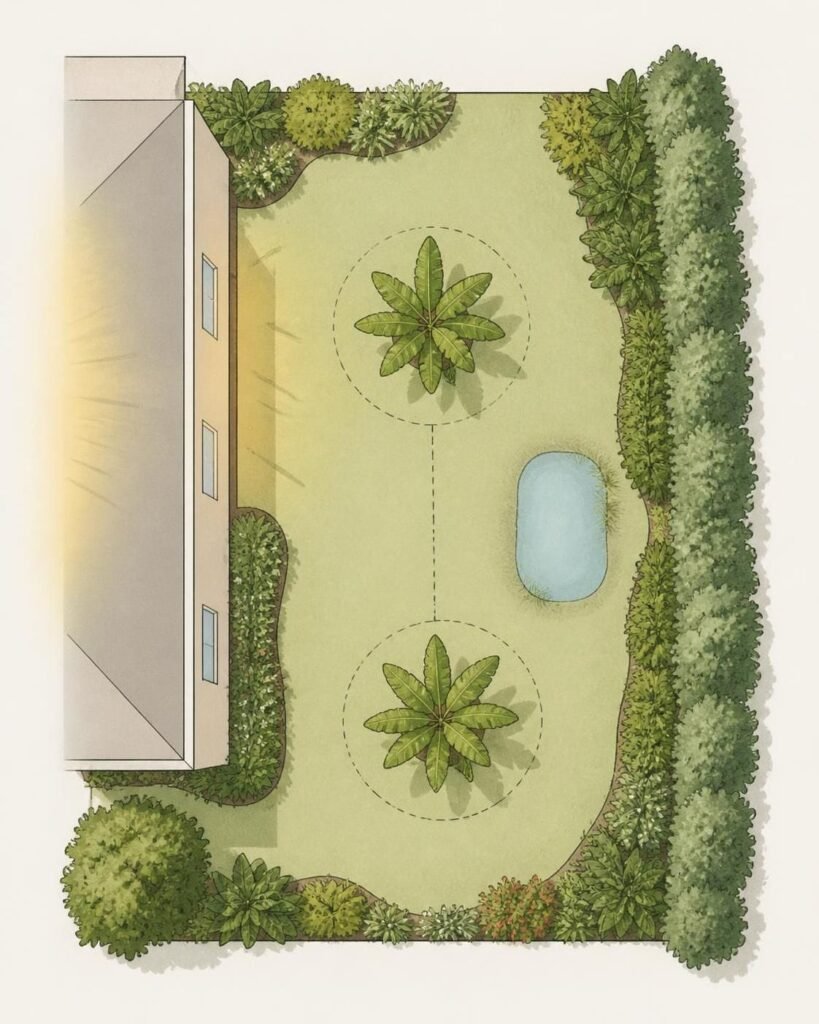
Start with sun. Florida’s extension guidance recommends full or near-full sun for fruiting plants. Bananas tolerate shade of up to about half, but growth and fruit development slow down, and heavily shaded plants end up stunted. Wind comes next, because the leaves act like sails: the same fact sheet puts toppling at winds above 25 mph for tall cultivars and 45 mph for short ones. For spacing, it gives 8 feet between dwarf plants, 12 feet or more between large varieties, and 10 feet or more from outdoor walls. Keep them away from windows too, since a toppled stem needs somewhere to land.
Texas A&M suggests the south or southeast side of a house as the warmest sheltered position. In the Southern Hemisphere, flip that to the north side. It also separates two kinds of planting: ornamentals can sit 2 to 3 feet apart, while plants grown for fruit need roughly 8 to 10 feet.
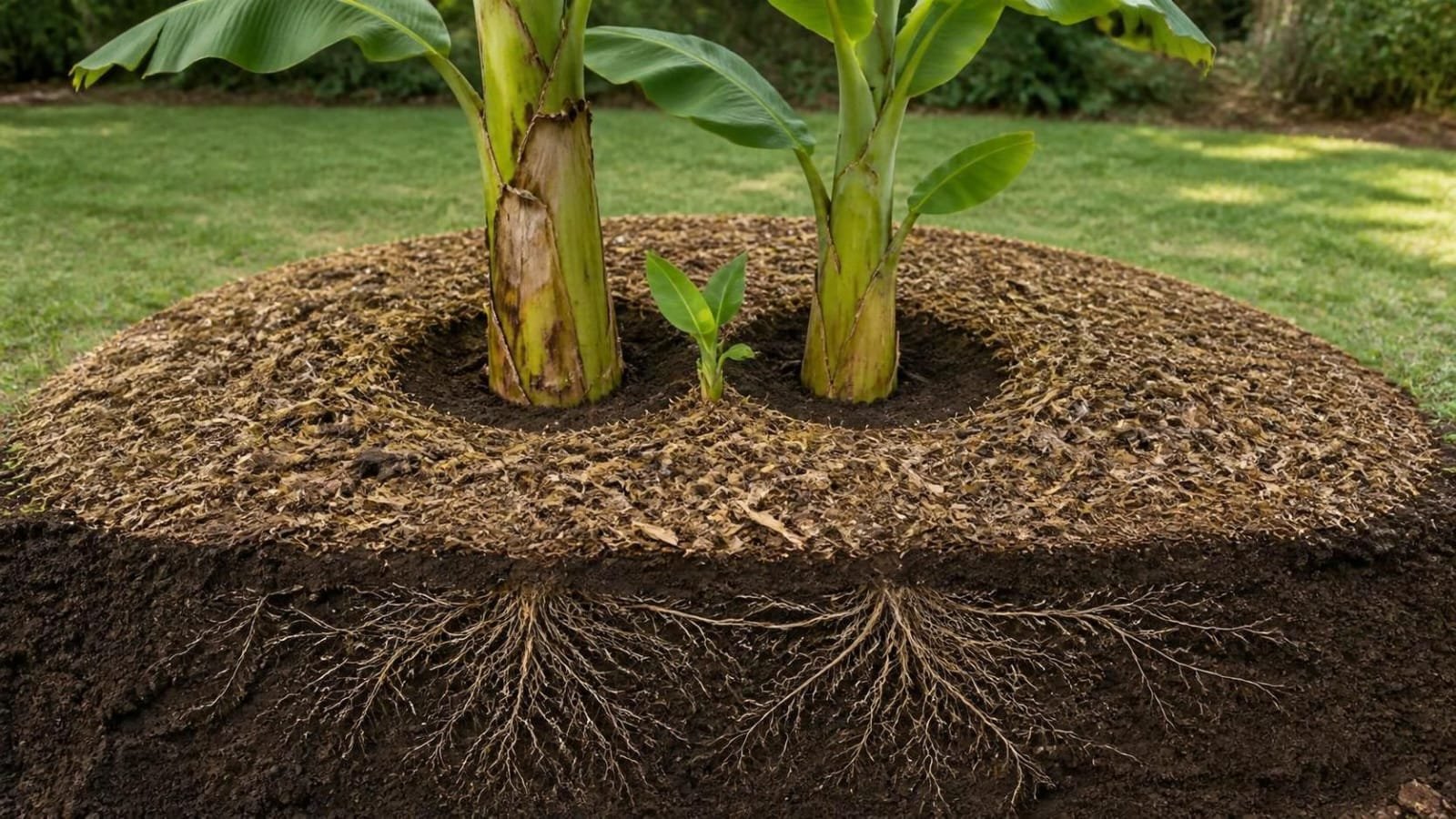
Spacing matters more than it looks, because roots in deep, fertile soil can spread about 16 feet sideways, so a neighbor’s roots are drinking from the same supply. And since new stems replace old ones, a clump creeps outward over the years.
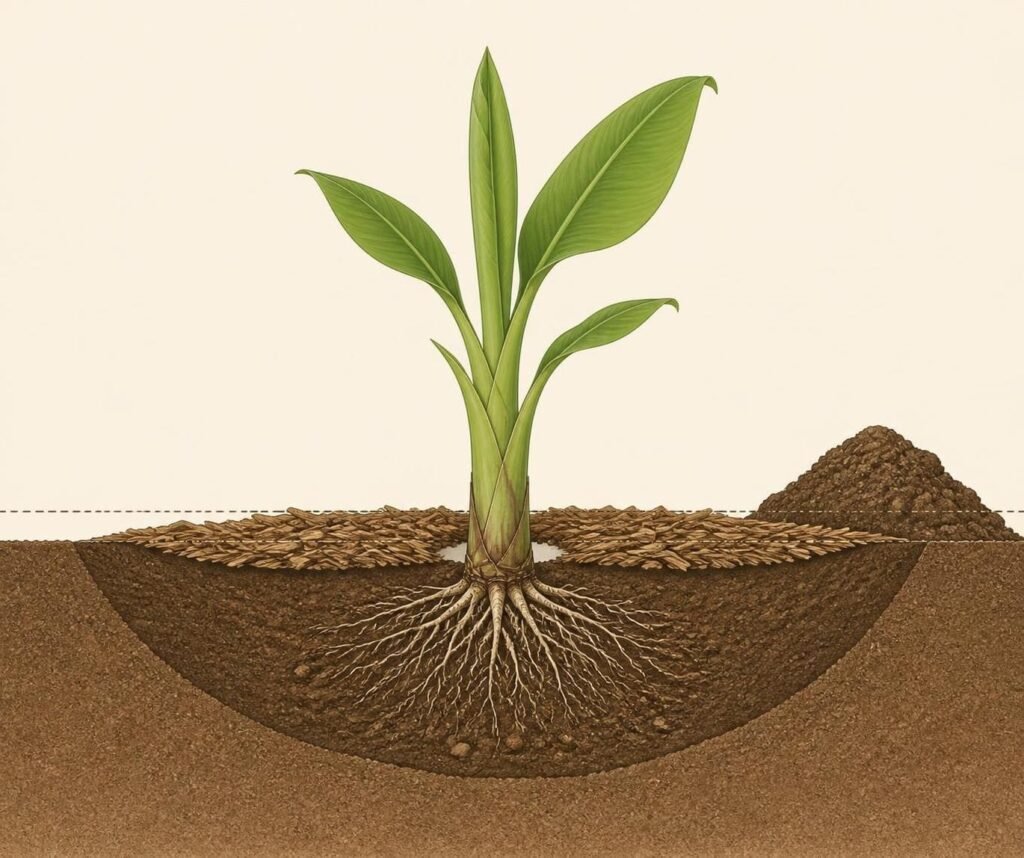
Drainage decides more plantings than sun does. Bananas are not flood tolerant: they may survive a day or two of moving floodwater, but standing water kills them quickly. A spot that looks ideal in a dry summer can turn into a pond after the first heavy rains. Fill the empty hole with water and watch it drain, and if it is still standing there hours later, move over or build up. Where the water table is high or the ground floods briefly, extension guidance suggests planting on a mound of native soil about 2 to 3 feet high and 4 to 10 feet across. Aim for deep, organic soil with a pH between 5.5 and 7.0; our Banana Tree Soil guide goes through how to get there.
How deep to plant a banana tree, and how to set it
Many people fill the bottom of the hole with the richest compost they have and set the plant on top. UF/IFAS calls that layered approach undesirable and says to mix anything you add into the soil you dug out, at no more than half and half, adding that fertilizer is not needed in the hole at all in sandy soil. Some guides do line the bottom with a compost blend, so the advice is not unanimous, and blending is the safer course. The Florida advice leans toward sandy ground, though. In heavy clay, drainage matters before enrichment does, which is the job of the mound described above.
- Strip the grass and weeds from a ring a few feet across, so nothing competes with the new roots.
- Dig a hole three to four times as wide as the pot or root ball. For sandy soil the same guidance gives about three times the container’s depth. The width is there to loosen the soil around the roots; the plant still sits at its original depth.
- Loosen any roots that have circled the pot, using your fingers, as Home for the Harvest recommends, and cut back the biggest leaves.
- Set the plant so the top of the root ball is level with the surrounding soil or slightly above it. A bare sucker goes in at the depth it was already growing. Burying more of the stem invites rot.
- Backfill with the blended soil, press it down lightly to push out air pockets, and water deeply straight away.
- Mulch with bark or wood chips over the root zone and keep it clear of the stem itself. Our mulch for banana trees guide covers depth and materials.
- Stake only if the site is windy. Tie with cotton or natural twine, never wire or nylon, which cut into a growing stem.
Planting a banana tree in a pot
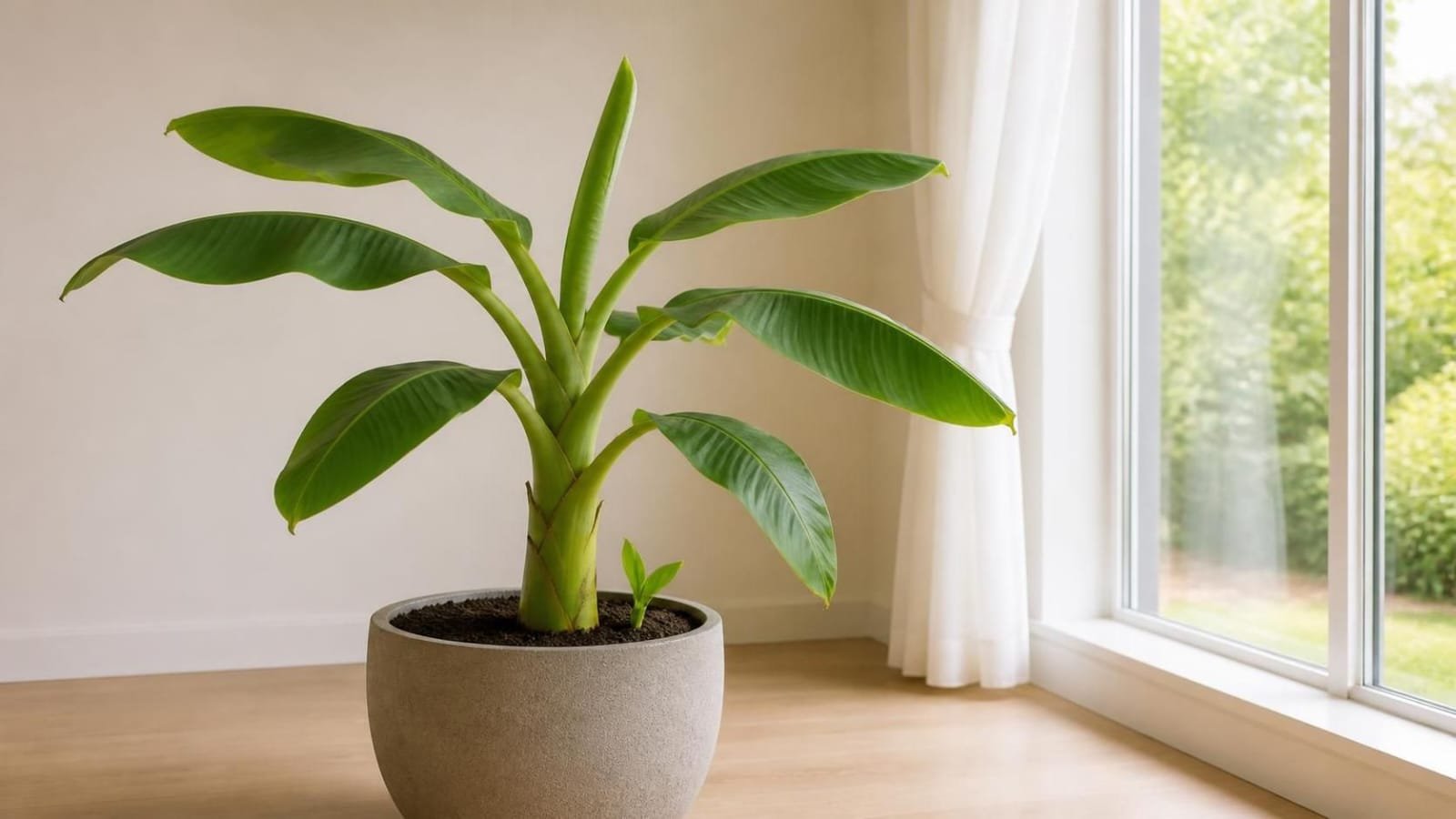
A pot sidesteps freeze risk and flooded beds, since you can move it. Here’s the catch: size. Plant Delights suggests a container of 15 gallons (about 57 liters) or larger, because bananas get big quickly, and the Home Depot guide suggests a planter at least 20 inches (50 cm) wide and deep, with drainage holes and a well-draining mix. Our Banana Trees in Pots guide covers potting mix and repotting.
The first month: what is normal
A new plant that looks unhappy sends most gardeners straight to the watering can or the fertilizer bag. Look closely first.
It is common for a plant to look fine on planting day and then, within a few days, drop its lower leaves and seem like a failed planting. Gardening Know How, drawing on North Dakota State University Extension, says a transplanted pup may wilt and grow slowly at first. It recommends trimming back to the top leaf and keeping the plant in shade for the first few days. After that, read the clues:
- Limp lower leaves, soil dry a few inches down: it needs a drink. Roughly an inch of water a week when it does not rain is a common guide.
- Limp leaves, yellowing, soggy soil: too wet or poorly drained. Continuously wet soil stunts bananas and yellows the leaves, and standing water kills them. Check the drainage before adding any water.
- A new leaf unrolling from the center: the roots are working. This is the sign you were waiting for.
- Ragged, torn leaf edges with no yellowing: wind, not a root problem. Mild shredding is cosmetic, and our Banana Tree Pruning and Brown Leaves guide explains when to cut.
- Plant rocks in the soil: the root ball is loose. Firm the soil and add a stake.
- Growth stalls during a cold week: that is the weather. Growth slows below about 57°F (14°C).
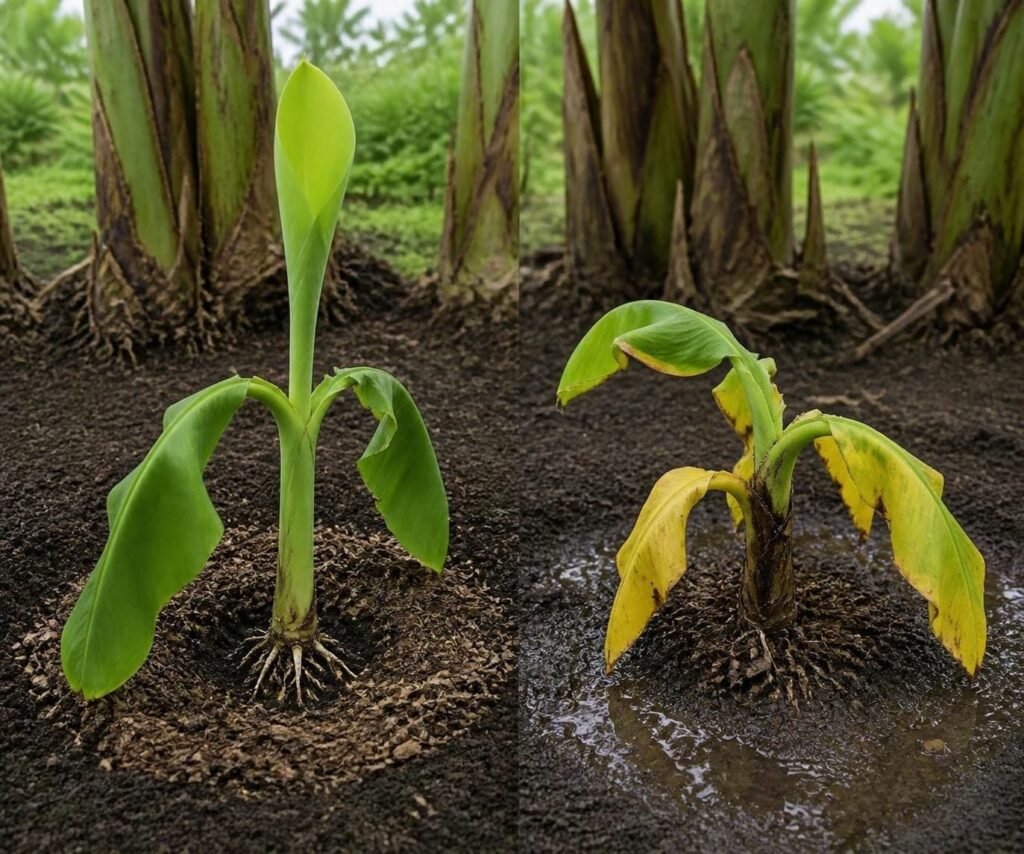
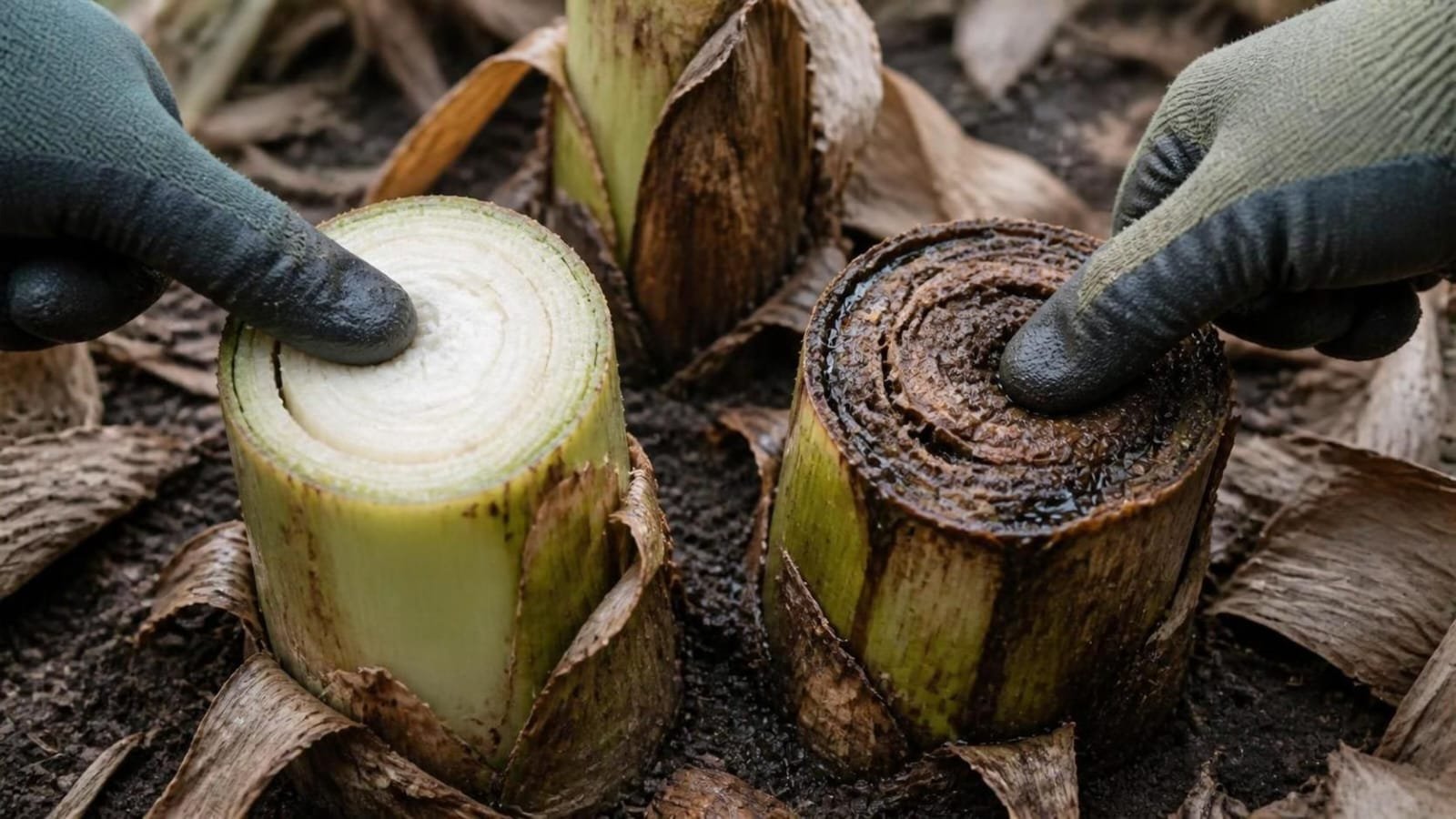
Diagnosing from a description only goes so far. Yellowing and stunting have several overlapping causes, and soggy soil, cold soil and root damage can look alike from above. If the base feels soft, or nothing changes over several weeks of warm weather, your local extension office can look at the plant and give a firm answer.
Feed after that first new leaf rather than before it. The Banana Tree Fertilizer guide covers what and when. Whatever product you use, follow its label and check what is approved where you live.
What not to do
- Bury the stem deeper to make the plant “more stable.” Deep planting rots the base, and a stake does the same job without the risk.
- Plant where water pools after rain, however good the sun is.
- Pile mulch against the stem. Keep a gap.
- Run a mower or string trimmer up to the trunk, or spray systemic herbicide around it. Both can weaken or kill the plant.
- Leave a lawn sprinkler timer running over the root zone. Too much water, too often, leads to root rot.
- Write the plant off in its first week.
Quick answers
How long until a planted banana fruits?
Plan on well over a year from planting to harvest, and longer where summers are cool. Variety and climate change the timing a lot, so ask your local extension office what to expect in your area.
Does the plant die after it fruits?
The stem that fruited is finished and gets cut down, but the rhizome underneath sends up new stems to replace it. That is why you leave a pup or two behind when you divide a clump.
Can you plant a banana tree from seed?
Some wild and ornamental bananas set seed that can be sown, but germination is slow and uneven. Supermarket bananas are a different story, since the dark specks inside are not viable seed.
When a new leaf is unrolling from the center, the plant has taken. Everyday care after that is covered in our Banana Tree Care guide.
4 thoughts on “How to Plant a Banana Tree: Spot, Depth & Spacing”