
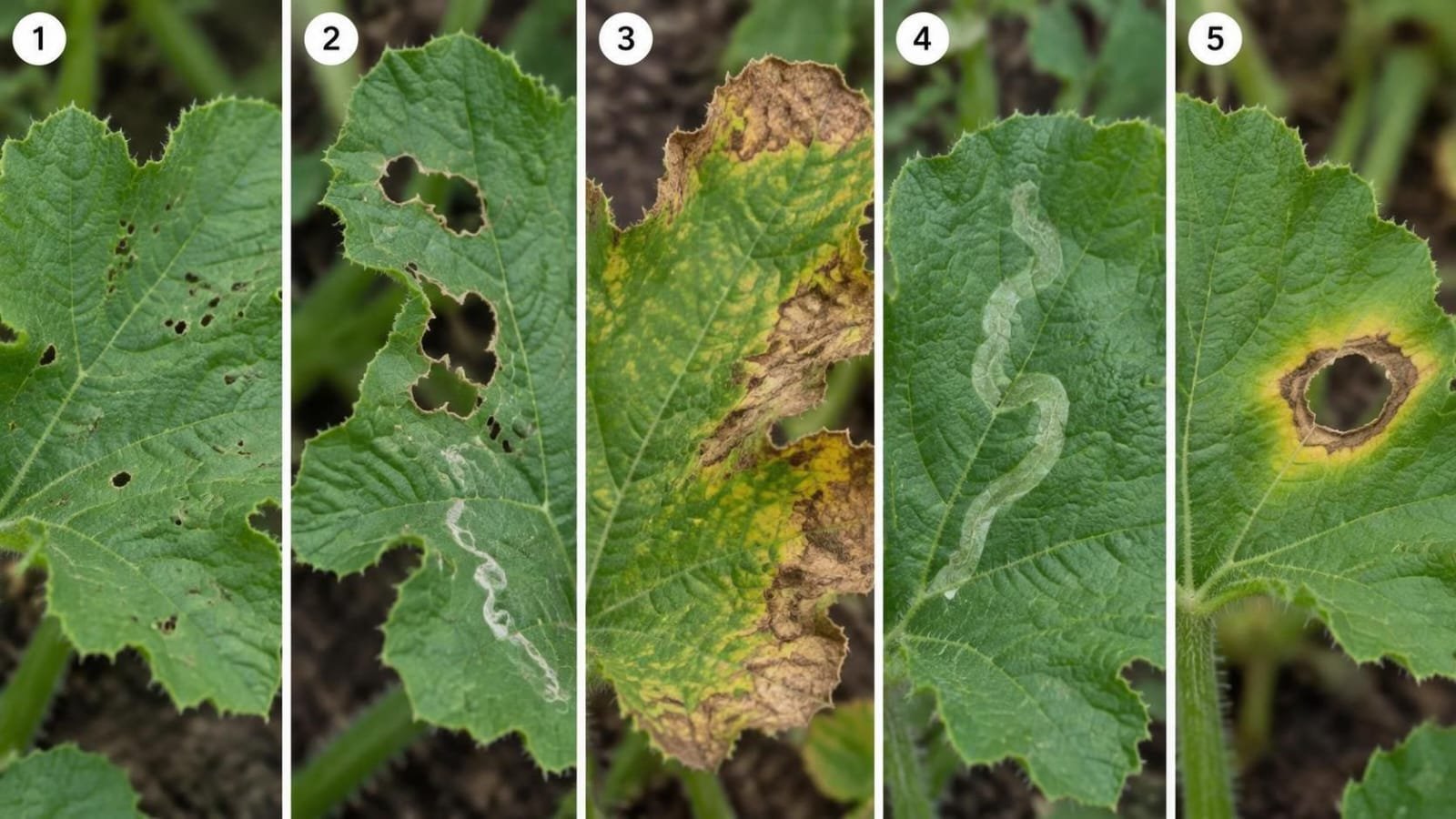
Read the damage before you hunt for the bug. Small holes on young leaves, usually round and neat, most often mean flea beetles, and cucumber beetles can leave similar or more irregular holes. Big ragged holes with a silvery trail point to slugs. Yellow speckles that turn brown, with bronze eggs under the leaf, mean squash bugs. A runner that wilts at midday, with sawdust-like waste at its base, means a borer inside the stem. Whole leaf blades gone overnight suggest a larger animal, or occasionally caterpillars. Most of these can be confirmed in a few minutes, and an established plant often outgrows a fair amount of chewing.
Most of us reach for a spray bottle the moment we see a hole. Hold off for a little while. The same hole can come from several different animals, each needing a different response, and a spray that suits one does nothing for another. A borer, for example, sits inside the stem where a contact spray never reaches it.
One honest limit before the table: damage shapes overlap, and nobody can diagnose a plant perfectly from a description. Use the table to narrow the field, then confirm with the check in the last column. This guide covers chewing and sap-sucking pests. If the problem looks like wilting, mildew, leaf spots or fruit rot instead, start with our zucchini diseases and pests identification guide. If you are still stuck, a clear photo sent to your local extension office often helps.
Match the damage to the likely culprit
| What you see | Most likely cause | Quick way to confirm |
|---|---|---|
| Small round holes, roughly 1/16 to 1/8 inch, mostly on seedlings and young leaves | Flea beetles or cucumber beetles | Tiny beetles that jump when disturbed, or larger yellow-green beetles with stripes or spots |
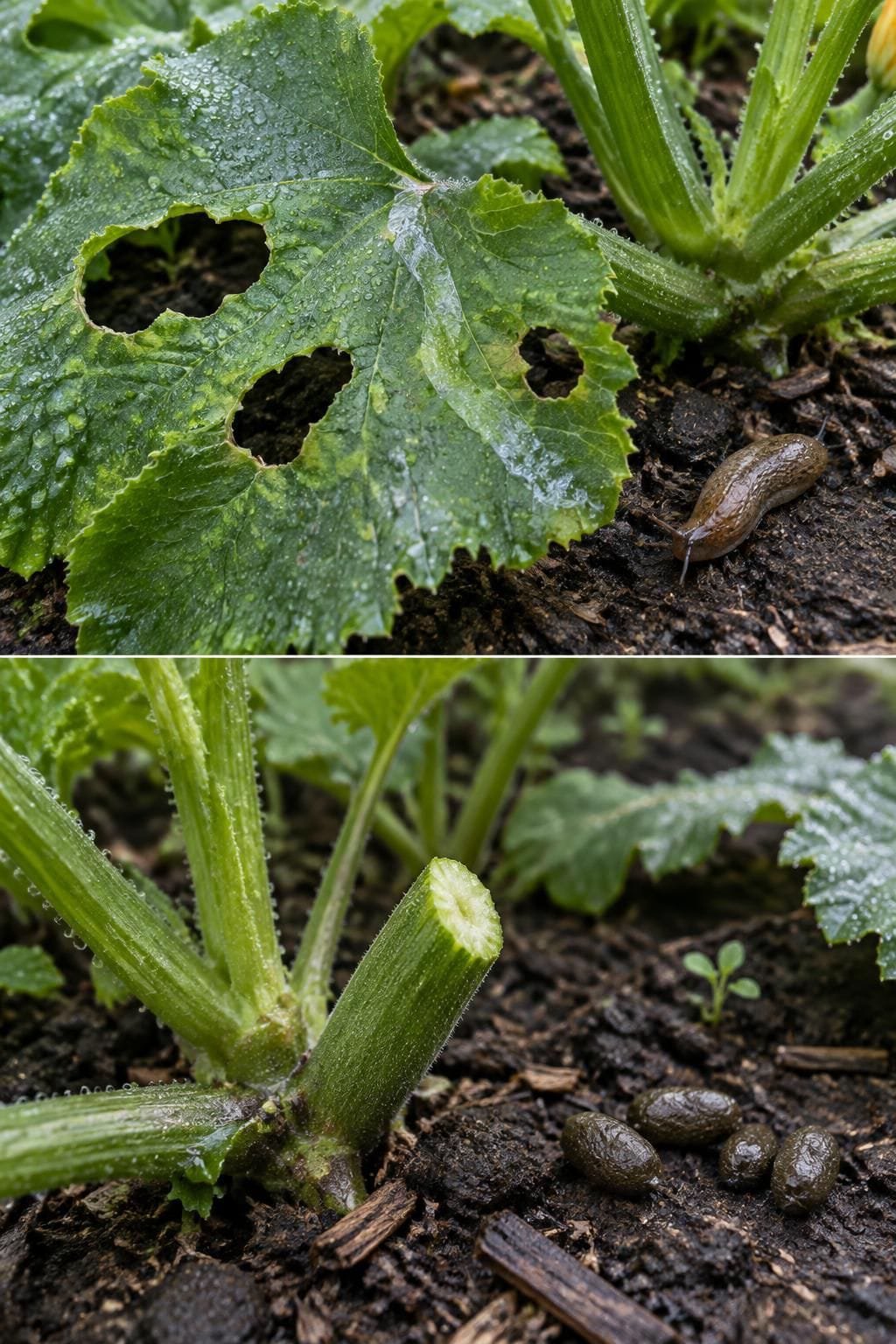
| Large ragged holes that appear overnight, worst near the soil | Slugs and snails | Dried silvery trails on leaves or soil; check with a flashlight after dark |
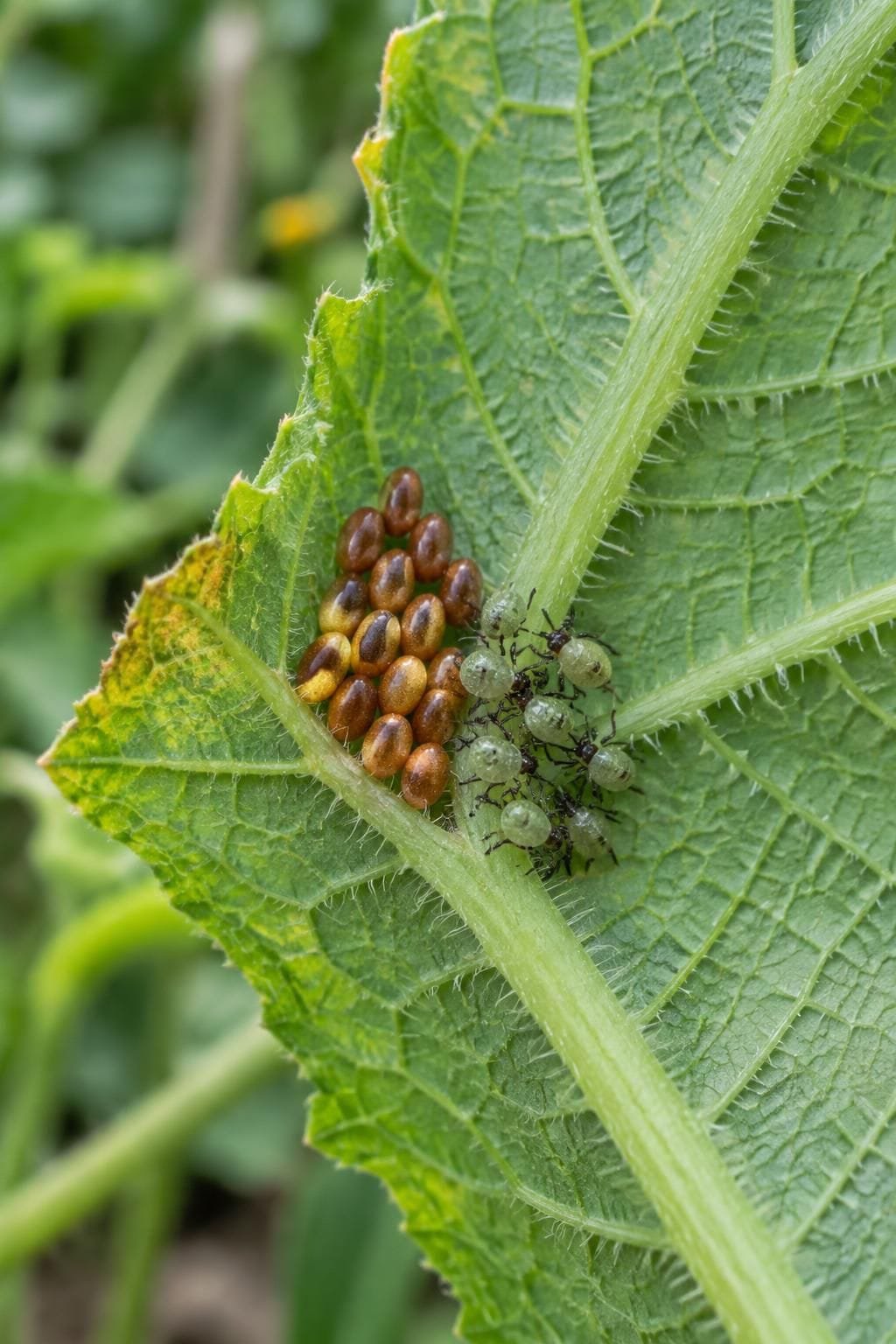
| Yellow speckles that turn brown and crisp | Squash bugs | Bronze egg clusters under the leaf, often in a vein angle; gray-green nymphs in groups |
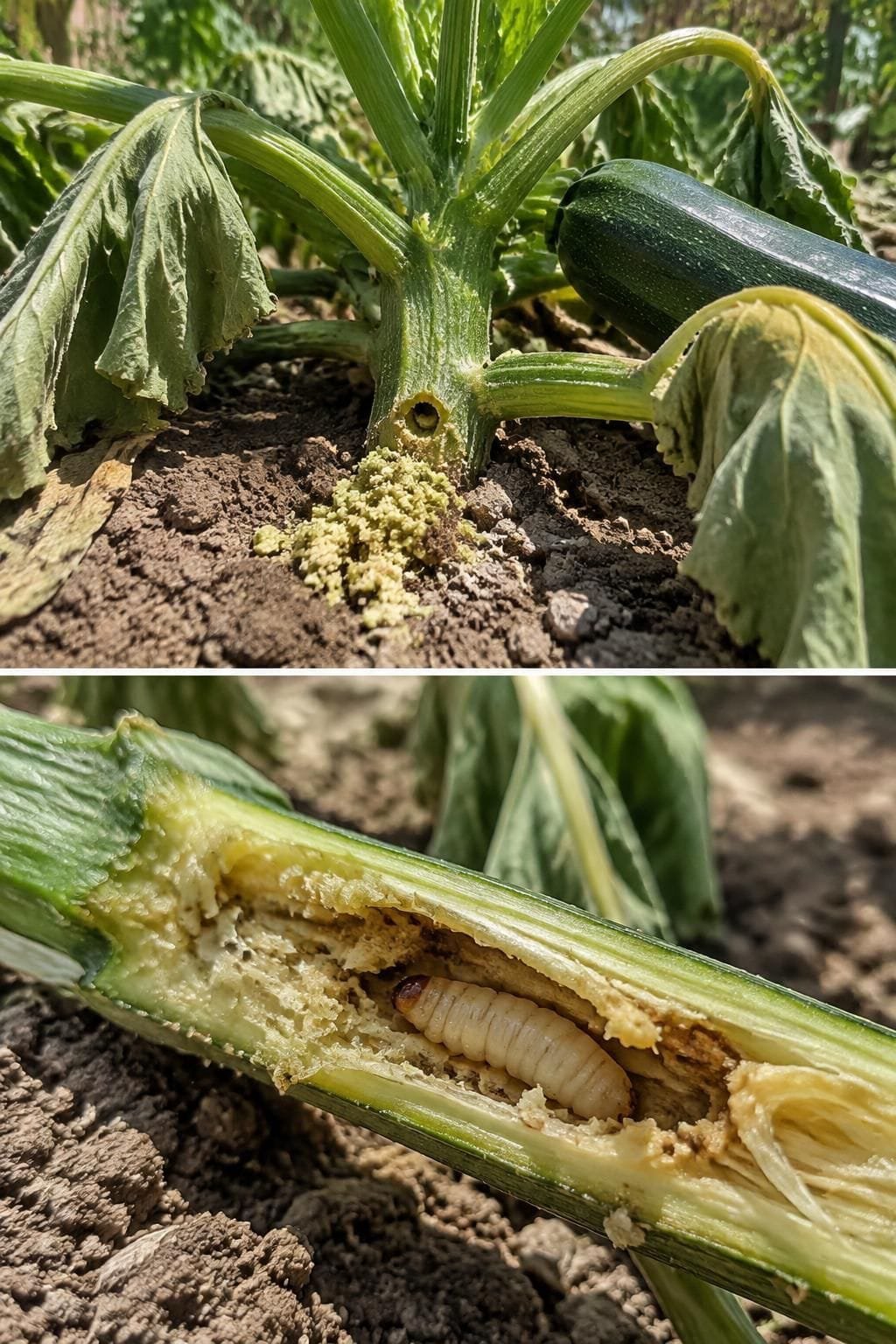
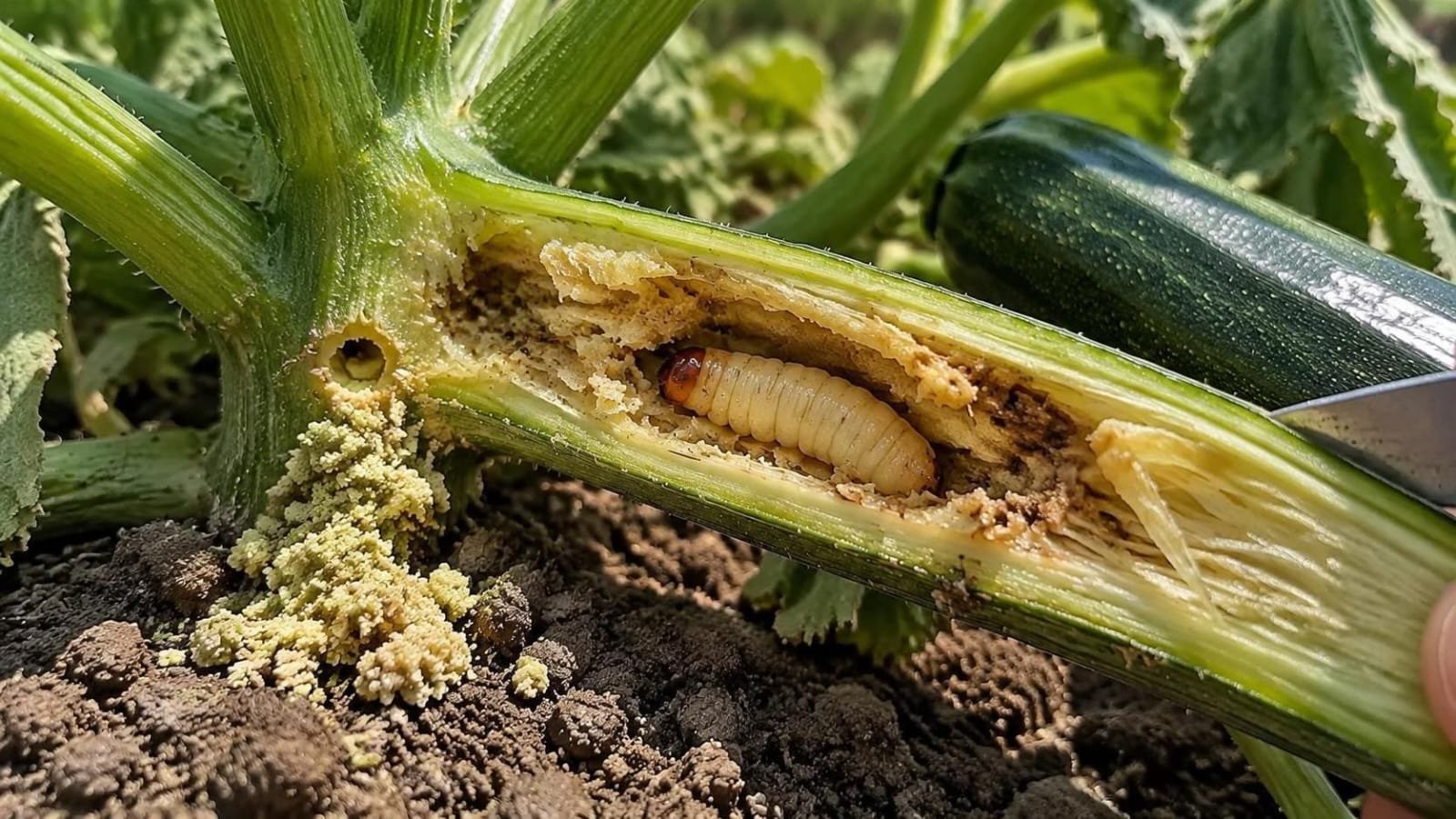
| One runner, or the whole plant, wilts in daytime heat | Squash vine borer (other wilts exist) | A small hole near the stem base with yellow-green, sawdust-like waste |
| Pale winding tunnels inside the leaf | Leafminers | The tunnel sits between the leaf surfaces; the insect is not visible outside |
| Holes with a brown or yellow rim, or dead spots that dropped out | Leaf disease such as angular leaf spot or scab | A spot with a yellow halo appears first, then the center falls out |
| Whole leaf blades gone, stalks left standing | Groundhogs, deer or rabbits | Tracks or droppings nearby; clean angled cuts versus torn edges |
| A young plant toppled at the soil line | Cutworms | Scratch the top inch of soil beside the stump for a curled caterpillar |
Holes but no bugs: what feeds after dark
The usual move is to inspect the plants at noon, find nothing, and decide the holes must be a disease. Fair enough, but the culprits here are shy. Slugs and snails hide in cool, damp places by day and come out at night, which is why the damage seems to appear from nowhere. University of California Cooperative Extension suggests going out at night or in the early morning to catch them at work, and looking for the shiny, slimy trail they leave behind, since other chewers can make similar holes.
Timing and plant size matter. Washington State University notes that slugs do more damage in cool, moist weather, and that seedlings can be eaten completely while larger plants show only holes. So a few ragged holes on a big plant are a nuisance. The same holes on a seedling are a threat.
Skip the salt. University of Maryland Extension specifically advises against salt, vinegar solutions and boiling water, because they can damage the plant. Take away the hiding places instead (boards, rocks, thick mulch against the stems), and water in the morning or switch to drip so the surface is not wet all night. The California extension guidance above makes the same point about moisture.
If entire leaf blades are missing and only the stalks remain, think bigger. Slugs usually leave holes in larger plants rather than bare stalks, and caterpillars such as loopers or armyworms can strip leaves too, but they leave dark droppings where slugs leave slime. An Ohio State University Extension educator explains that rabbits leave clean cuts at a 45-degree angle, usually low on the plant, while deer tear and leave jagged edges. The same source says rabbits rarely bother squash, whereas groundhogs love its tender young foliage. So where groundhogs live, they are a prime suspect on zucchini, and a burrow with a worn path to your bed would support that.
One more night worker deserves a mention. A seedling that is lying on the ground, snipped at the soil line, is the signature of a cutworm; as an Ask Extension reply puts it, cutworms topple the plant close to the soil. Scratch around the stump with your fingers and you may find the caterpillar curled up just below the surface. If there is no caterpillar and the stem looks pinched or water-soaked, damping-off is the other usual cause, covered in our guide to growing zucchini from seed.
Small round holes on young leaves
Holes about the size of a pinhead, scattered across the leaf like buckshot, are what extension entomologists call shothole injury. According to Utah State University Extension, flea beetle holes run roughly 1/16 to 1/8 inch across, and young seedlings are the most sensitive. Colorado State University Extension adds that the beetles jump when disturbed, which gives away the identification: tap the leaf and watch for tiny specks leaping off.
Here’s the kicker: the bug sitting next to a hole is not always the one that made it. In one question sent to the University of Maryland’s extension service, a gardener found a small red-and-black bug on zucchini, wondered if it was behind tiny holes in the leaves, and sprayed diluted neem oil. The expert reply identified the bug as a sap-sucking plant bug, not a chewer, probably dropped from a nearby maple, and pointed out that tiny holes in zucchini are more often caused by flea beetles or cucumber beetles. The spray had been aimed at an innocent visitor.
Cucumber beetles are easier to recognize. The striped one is about a fifth of an inch long, yellow with three black stripes, and the spotted one is a little larger with twelve black spots, according to Rutgers Cooperative Extension. Both chew leaves and flowers and scar fruit, and they can spread bacterial wilt; how to test for it is covered in the bacterial wilt section of our identification guide. Very young plants are the most vulnerable, and UMass Extension stresses keeping beetle numbers low before the five-leaf stage.
That timing points to the most useful action. Protect seedlings from the day they go in the ground, and relax once plants are established. Arizona’s Cooperative Extension in Yavapai County reports that once a plant has five leaves, it tolerates several flea beetles without noticeable damage. Until then, floating row covers keep the beetles off, and they must come off when flowers open so bees can reach them. Hand pollination is a fine backup if you leave covers on a little long; our guide to hand pollinating zucchini shows how. Picking beetles off by hand is most effective early in the morning, and it suits small plantings, as University of Maine Extension notes.
Yellow speckles and crisp brown patches
When leaves show yellow dots that merge into brown, dry patches, stop looking at the hole shape. These insects do not chew. They pierce and suck. The most important culprit is the squash bug. Penn State Extension describes feeding that starts as yellow spots and later turns black, and warns that heavily fed vines can look like bacterial wilt. If a vine collapses and you cannot find a borer hole, check for squash bugs before you condemn the plant to a disease.
Turn the leaf over. Squash bug eggs are oval, about 1/16 inch long and yellowish to bronze, according to University of Minnesota Extension. They are laid in neat clusters, often tucked into the angle where veins meet. Newly hatched nymphs are small and pale green, turning gray as they grow, and they tend to stay in groups, so you can find them without much hunting. Scrape the eggs off or tear out that bit of leaf. Adults are shy and run for cover, so lay a board beside the plants at night and check under it in the early morning; Penn State describes the same trap.
Spraying is a last resort, and timing decides whether it works at all. Minnesota’s extension notes that chemical controls are most effective on nymphs, so a spray is worth considering shortly after hatching, with coverage under the leaves where nymphs hide. Adults shrug off most sprays. Also be careful with soaps and oils on this crop. Epic Gardening, passing along Clemson University guidance, points out that zucchini leaves burn easily with insecticidal soap, so use the weakest strength on the label, sparingly, and never in direct sun.
Smaller sap-feeders look different from squash bug damage. Aphids tend to curl and yellow leaves rather than speckle them, and they leave sticky honeydew; ants marching up the stems are a clue that something is producing it, as Gardener’s Path explains. Spider mites favor hot, dry, dusty conditions and plants under water stress. They cause fine pale stippling, and webbing appears only in heavier infestations, so even watering helps keep them in check. In both cases, a strong stream of water from the hose is a sensible first step before anything stronger.
A runner wilts at midday: check the stem
The instinct here is to water more. It will not help. University of Connecticut Extension notes that vines damaged by squash vine borer do not respond to watering, and that early wilting can vanish overnight, which fools people into thinking the plant is fine. The larva is tunneling inside the stem and blocking water movement from the inside.
Part the leaves and look at the base of the wilting runner, close to the soil. University of Kentucky Extension calls sawdust-like frass near the base the best evidence of a borer. A small hole with yellow-green waste means a larva is inside, and sprays will not reach it there, so catching it early matters. Our zucchini diseases and pests guide shows how to split the stem to confirm it, rescue the vine and plan prevention. No hole and no frass? Then look at squash bugs, dry soil and bacterial wilt before deciding it is a borer.
Tunnels and brown-rimmed holes
Two look-alikes are worth separating, because neither is ordinary chewing from the outside of the leaf. Leafminer larvae live between the leaf surfaces and leave pale, winding tunnels. Utah State University Extension lists floating row covers, removing infested leaves and encouraging natural enemies as the main tools. For a home bed, picking off tunneled leaves is often enough, and natural enemies frequently keep leafminers in check on their own.
Holes with a brown or yellow rim are different again. University of Minnesota’s plant diagnostic guide shows that angular leaf spot and scab both begin as spots with a yellow halo, and the dead center later falls out, leaving a hole that looks shot or ragged. Because no insect made it, no insect treatment will fix it. If the spots came first, read the leaf spot section of our zucchini diseases and pests guide before you buy anything.
Do you actually need to treat?
Often not. Colorado State University Extension says flea beetle injury is usually minor and easily outgrown on established plants, and it is reasonable to expect a few slug or beetle holes on a vigorous, established zucchini to be tolerable too (this is general horticultural judgment, not a measured threshold). Treat when plants are young, when damage is spreading quickly, or when you have confirmed a pest that kills vines, such as borers or heavy squash bug feeding.
A documented result helps keep expectations realistic. In a two-year trial on organic acorn squash, researchers compared mesotunnel row covers with OMRI-listed pesticides. The published paper reports that pesticide treatments did not differ from untreated plots in pest presence in either year, and its title reports that row covers limited pests and disease. Acorn squash is not zucchini, and a research farm is not a backyard bed, so treat this as a hint about where effort pays off, not a guarantee. Cornell Cooperative Extension’s row cover guide adds a useful caution: keep scouting under the covers, since any pest already inside is protected along with the crop.
If you do decide to spray, pick a product whose label lists squash or zucchini and the pest you have actually confirmed. Follow the label on rates, timing and the wait before harvest, and check what is approved where you live, since products and rules differ by country and region. Read the label for guidance on protecting bees too.
- Spraying a plant after a borer has already tunneled in. The larva is protected inside the stem.
- Putting salt or vinegar on slugs near your plants. It can hurt the plant.
- Leaving row covers on after flowers open, which keeps pollinators out.
- Treating whatever bug you happen to see. It may only be passing through.
- Using full-strength soap spray in bright sun on zucchini leaves.
Keeping it from happening again
Prevention here is mostly timing and housekeeping, and the timing of pest seasons varies by region, so your local extension office is the best guide to when each pest arrives. Clear plant debris after the final harvest so squash bugs and others have less shelter, move zucchini to a different bed each year (this helps most against borers, which pupate in the soil, and less against squash bugs, which fly in), and give seedlings a head start before pest season, since strong young plants shrug off what weak ones cannot. If space is tight, train vines up a support as described in growing zucchini vertically. Leaves held off the ground are far easier to inspect underneath, which is where most of the evidence sits.
Tonight, take a flashlight out an hour after dark and look under the leaves and at the soil around the stems. Tomorrow morning, check the stem bases and the vein angles on the underside of the leaves. That is usually enough to tell you which section above applies to your plants.
One thought on “What’s Eating My Zucchini Plant? Identify Pests and Leaf Damage”