
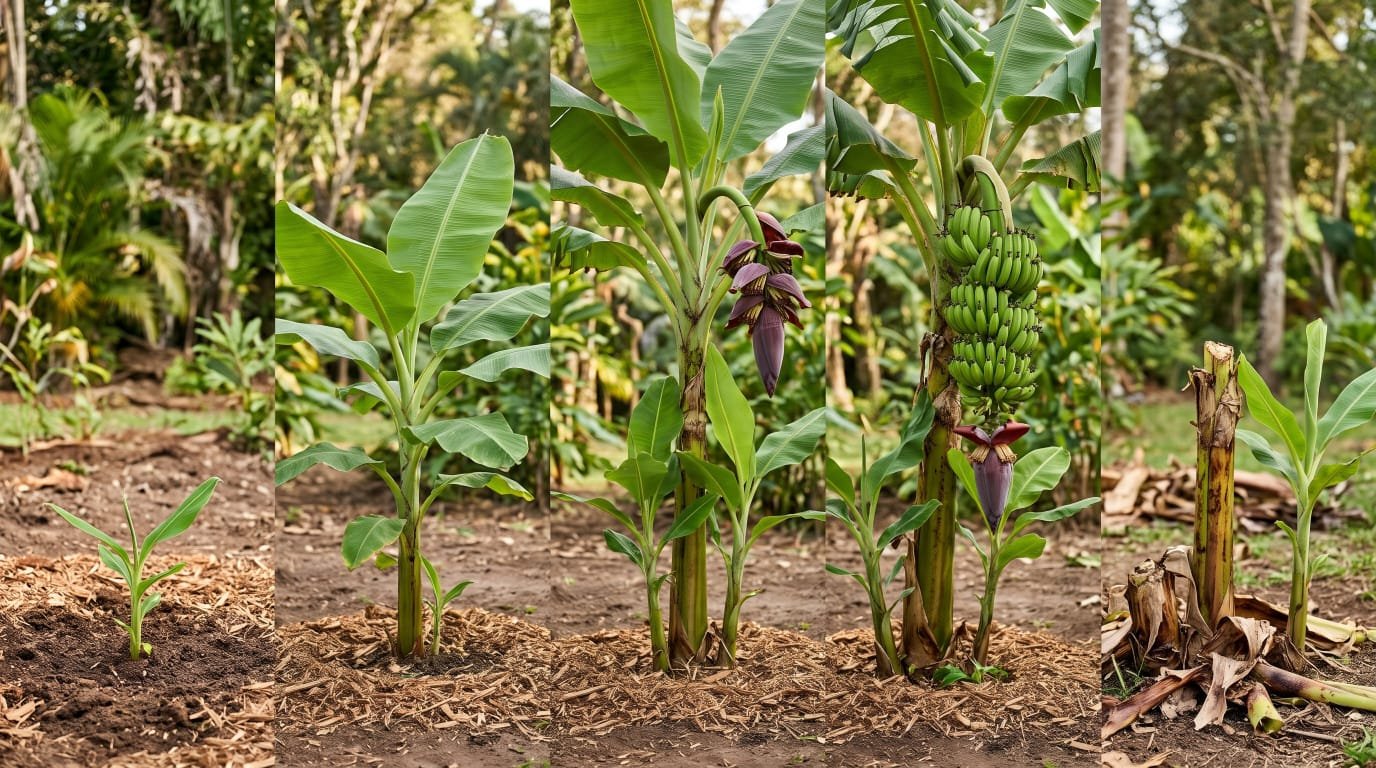
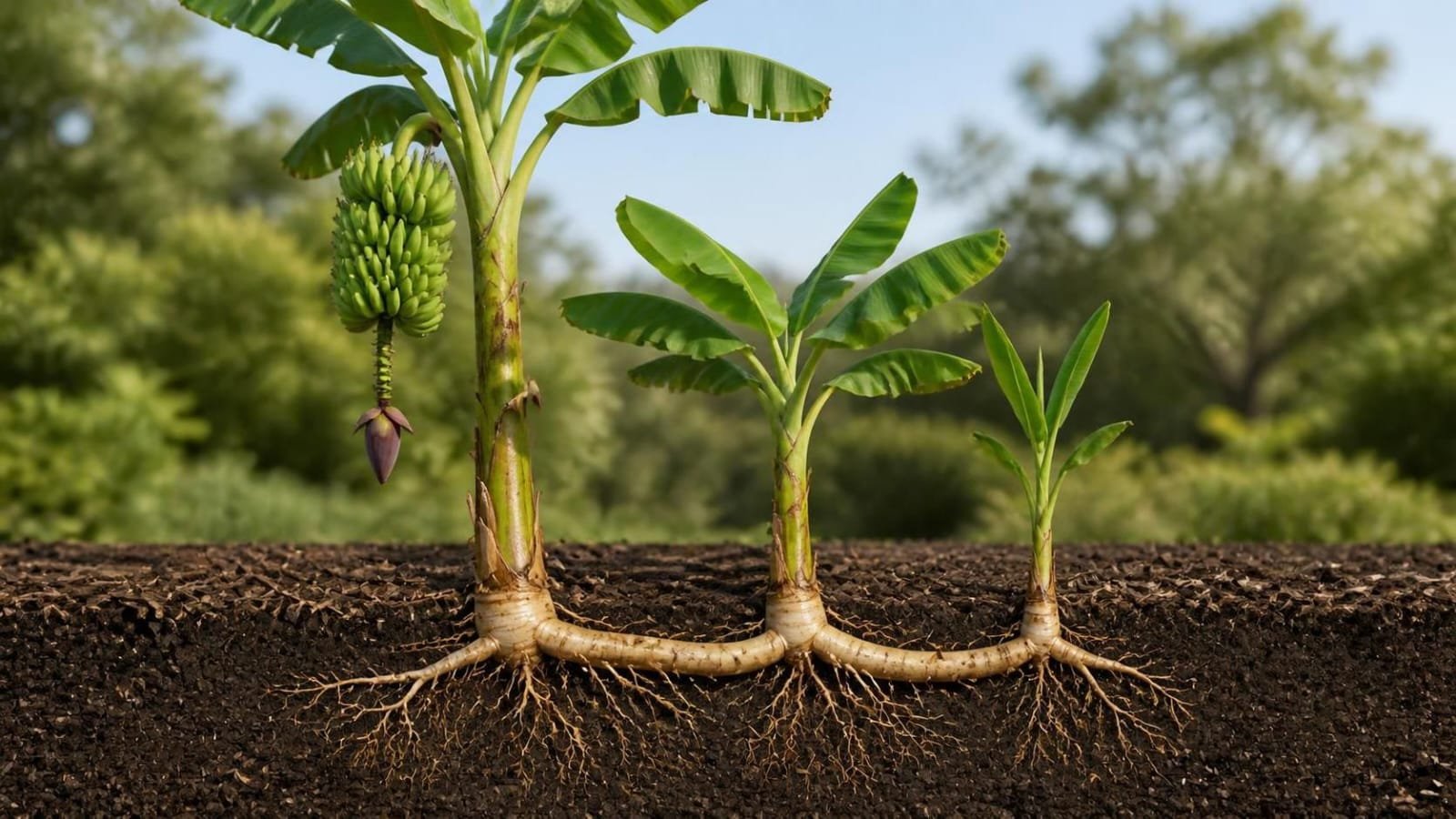
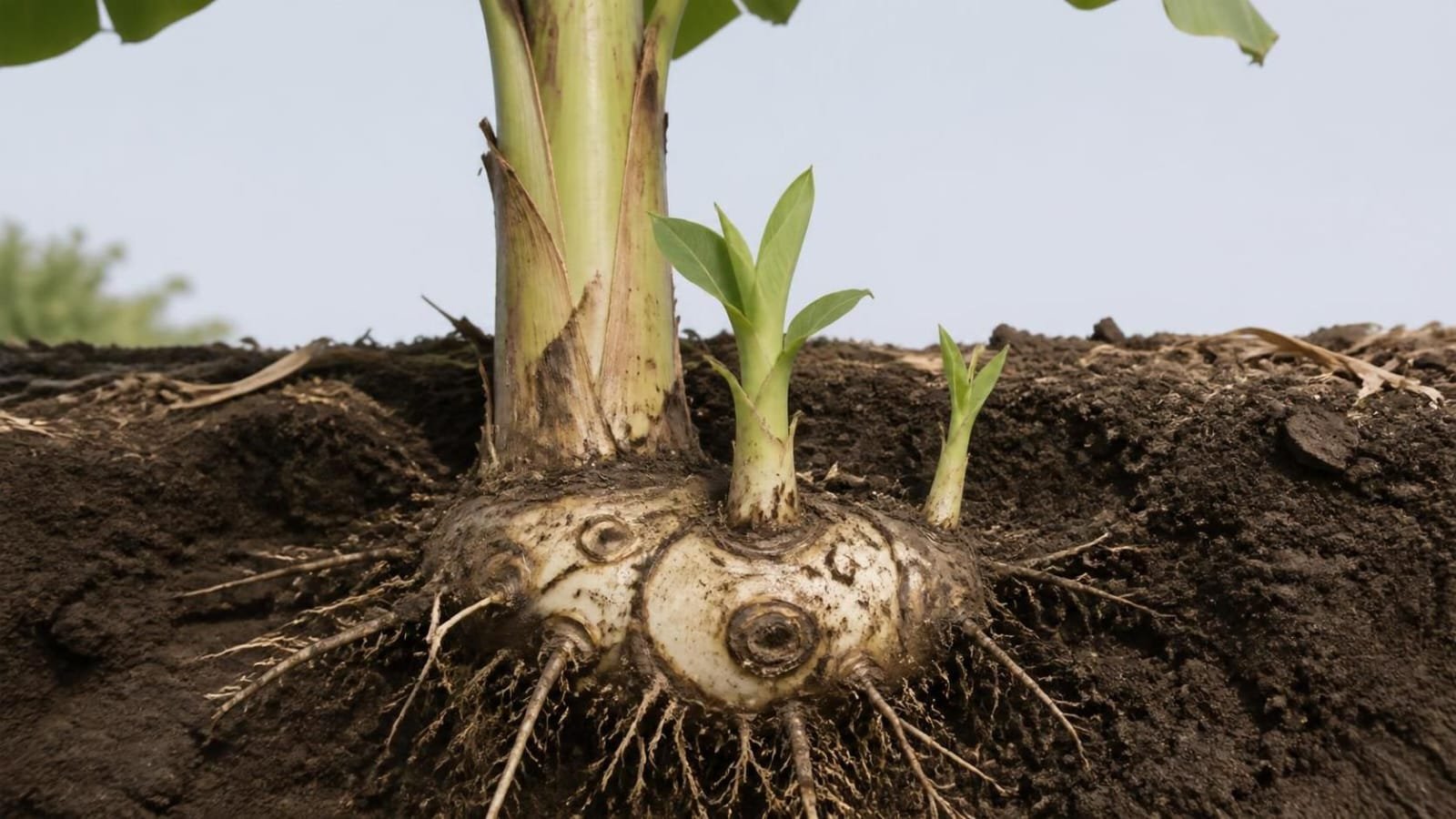
The banana tree life cycle runs on two timelines. Each stem you can see grows for about 9 to 20 months, flowers once, ripens one bunch and is cut down. The underground base, a thick stem called the rhizome or corm, keeps going and sends up new stems before the old one is finished, so the same clump can fruit year after year. For one stem the order never changes: roots, a long run of leaves, a flower stalk pushing out of the top, fruit fill, harvest, and a follower already standing ready to take over.
Ask how long a banana tree lives and you will hear anything from about a year to decades. Both answers can be right, because they count different things. The sections below follow the stem first and the clump second.
Where the cycle starts
Start with what goes in the ground. Nearly all the edible bananas you can buy are grown from a sucker (also called a pup), a piece of the rhizome, or a tissue-culture plantlet. Seed is not a stage in their life cycle. The two wild parent species, Musa acuminata and Musa balbisiana, are the seedy ones, and a few fertile cultivars can set seed, but that is the exception. A rhizome piece will grow, though it is slower and gives a smaller first bunch than a rooted pup. Our guide to propagating banana plants covers how to choose a pup and separate it cleanly.
The banana stages of growth at a glance
Here is the whole run on one page. Timing counts from planting a small sucker and comes from University of Florida extension research in a subtropical climate, so read it as a baseline. Cooler or shadier sites run longer.
| Stage | Typical timing | What you see | What it needs |
|---|---|---|---|
| Getting established | First 3 to 4 months | Roots first, then a steady run of new leaves unrolling from the center | Warmth and steady moisture, without soggy soil. These months set the size of the bunch. |
| Leaf growth | From the first leaves until shooting | A thickening pseudostem and 26 to 32 leaves by the time it flowers | Sun, regular water, and feeding that follows the product label |
| Shooting | 10 to 15 months after planting | The flowering stalk pushes out of the top center and arches over | Protection from cold and drought, two known causes of a stuck stalk |
| Fruit fill | 80 to 180 days after shooting | Bracts drop, hands of fruit swell and straighten | Warmth and water, and removal of the male bud once the last hand has set |
| Harvest and handover | 9 to 20 months after planting, start to finish | Plump green fingers, with a follower stalk already growing nearby | A cut at the base of the fruited stalk, and one sucker kept in its place |
Notice how much of the clock goes to making leaves. Flowering looks like the big event, yet the plant has been settling the size of that bunch for months.
Leaf growth: the long middle
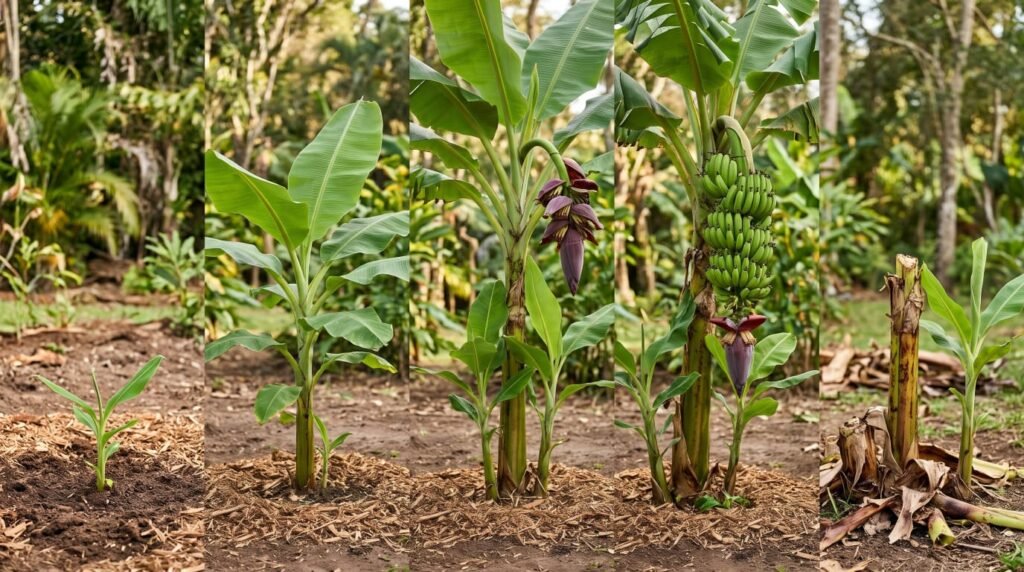
Once the roots take hold, the plant settles into a long stretch of leaf-making. Each new leaf rises from the center as a tight rolled cigar, opens, and pushes the older leaves outward. The sheaths of those leaves wrap around each other to form the pseudostem, the trunk-like column that never turns to wood. By flowering time a stem has typically made 26 to 32 leaves, and it can carry more than 40 over its whole life.
Most of us wait for the flower before paying close attention. Hold off on that. The first three to four months decide the weight of the bunch and the number of hands, so water, warmth and feeding count most while the plant still looks small. How tall a stem gets before it flowers depends heavily on the variety, and banana tree height and size lays out the ranges.
You may be tempted to count leaves and work out the flowering date. Treat the count as a clue and nothing firmer. Researchers who study banana development describe a juvenile phase, a mid-vegetative phase and a reproductive phase, with separate leaf and bunch “clocks” that do not always run in step.
Shooting: when the flower comes out
Somewhere between 10 and 15 months after planting, the flowering stalk emerges from the center of the pseudostem. Growers call this shooting. The flowers come in spiral groups, each group covered by a purplish-to-green bract that sheds as the stalk develops. If you want the month-by-month detail, we go through it in when banana trees flower and produce fruit.
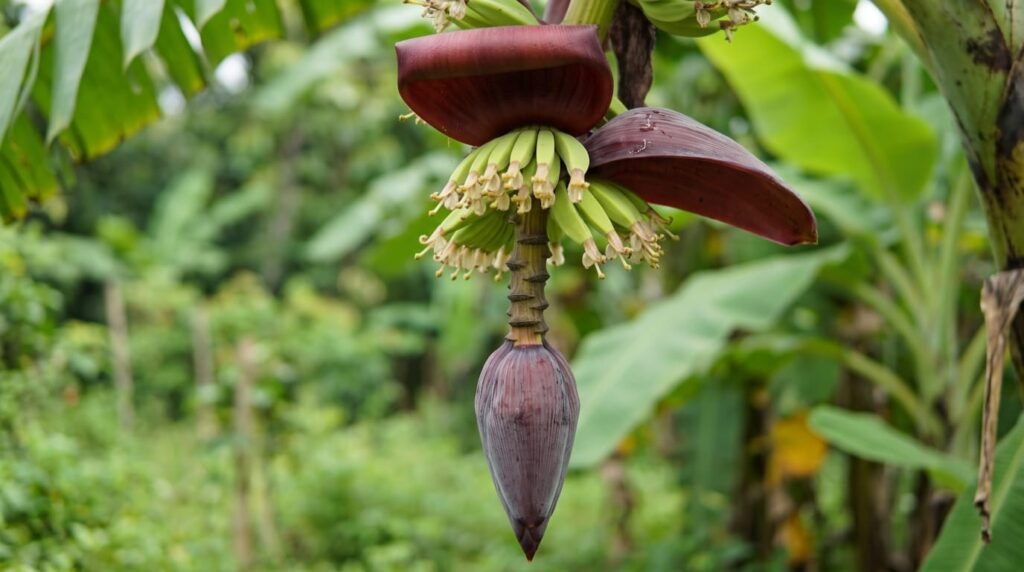
Read the stalk from the base outward. The first flowers are female, and in edible cultivars their ovaries swell into fruit without pollination, which is why the bananas you buy have no real seeds. The flowers further along are male and never make fruit. In most edible bananas the big purple bud hanging at the tip holds the last of them, though some plantains have little or no male bud.
One small job belongs here. Right after the last hand of fruit has set, cutting off the male bud that hangs below it speeds up fruit development. Take the bud and leave the fruit alone.
If the flower seems stuck
Sometimes the stalk swells inside the pseudostem and cannot get out. That is called choking. Cool weather below about 60°F can cause it, and so can severe drought. From the outside the two look alike, so check the past few months of weather first and the soil second. If the stalk stays stuck after conditions improve, your local extension office can take a look.
Fruit fill and harvest
After shooting, the fruit needs 80 to 180 days to reach harvest, depending on temperature, cultivar and soil moisture. Fruit grows best at around 84 to 86°F, a little warmer than the 78 to 82°F that suits shoot growth.
Most of us wait for the fingers to turn yellow before cutting. Fair enough, that is how bananas look in the shop. The better moment comes earlier, when the fingers are plump and rounded but still green, which can be a week or two before they would ripen on the plant. Fruit hung in a cool, shaded place tends to develop better flavor than fruit left to yellow on the stalk. A typical bunch weighs 25 to 40 pounds.
Do banana trees die after fruiting?
The stalk does, and that is meant to happen. A pseudostem fruits once. After harvest it is cut off at the base, chopped into small pieces and left around the clump as mulch, while the plant carries on from the rhizome. Here’s the kicker: in a well-kept clump, the replacement is usually well under way before the bunch is even cut.
A common situation: the bunch is down, the old stalk lies in pieces, and the owner assumes the plant is finished. Meanwhile a half-grown stalk stands right beside it, already well into its own cycle. The reasoning is covered in why banana trees only fruit once, and the short version is that the stem is spent while the rhizome is not.
The mat: three generations at once
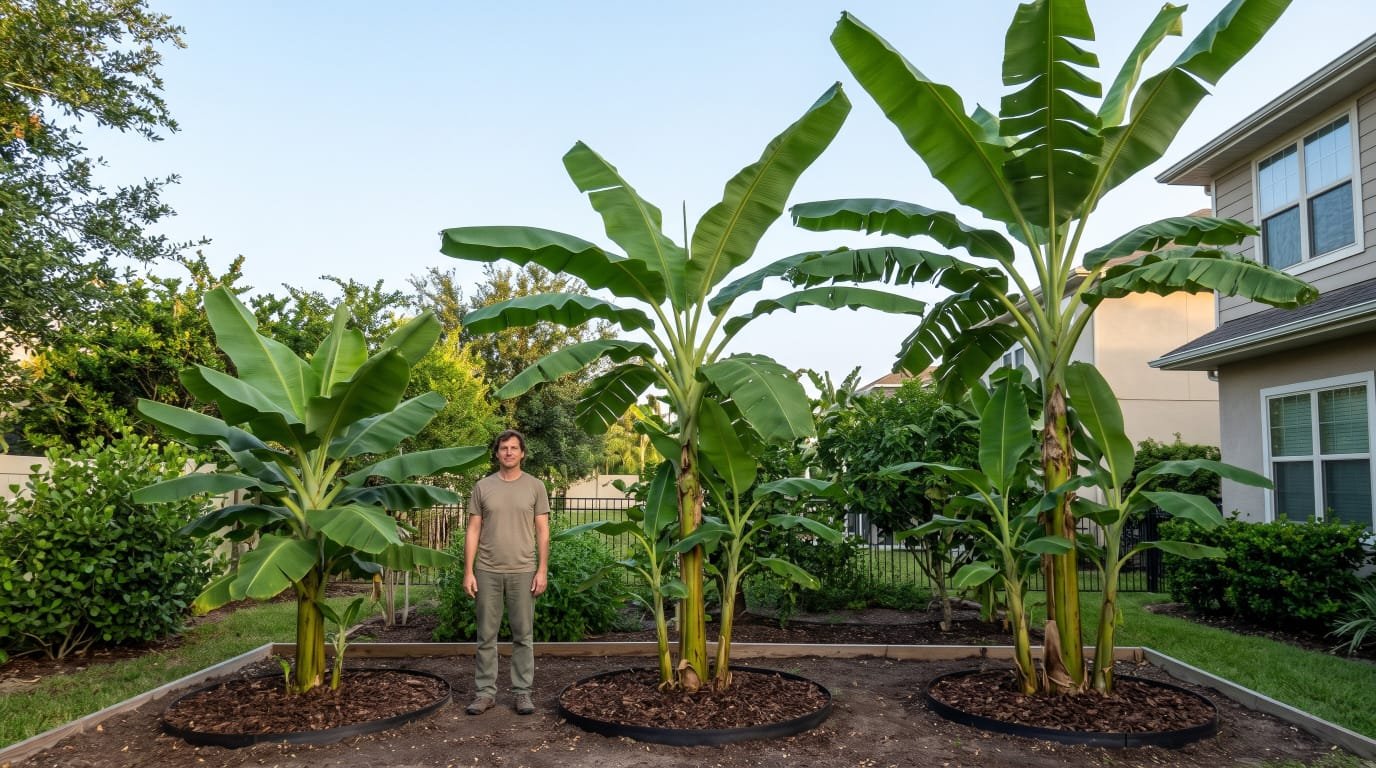
Look at a healthy clump and you are seeing the life cycle laid out in space. The clump, called a mat, holds one stalk that is flowering or fruiting, one about half grown, and one small sucker. That is the arrangement UF/IFAS recommends, and its home-grower calendar stretches it to three or four stalks of different ages.
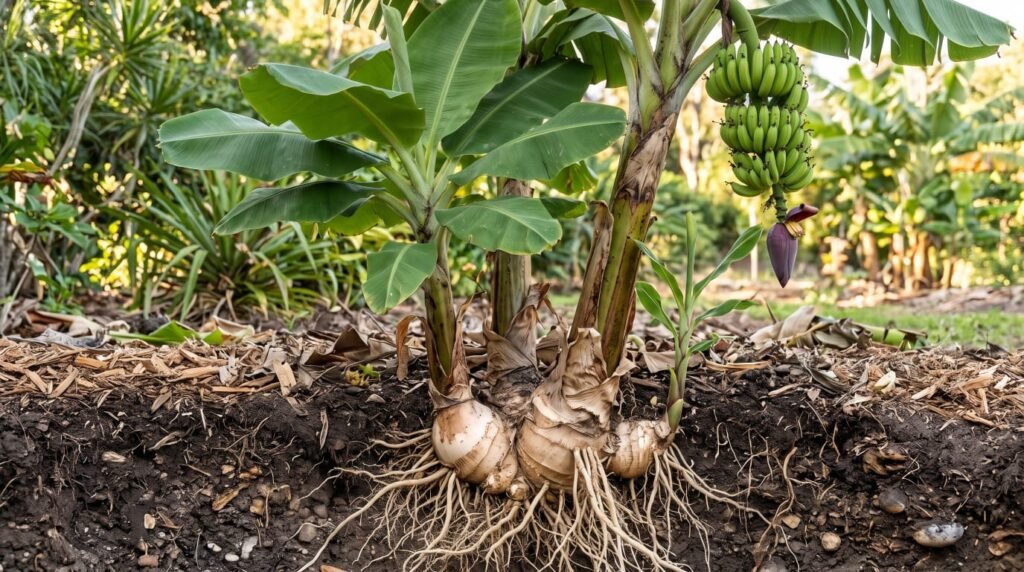
The urge is to let every sucker grow, since more stalks should mean more bananas. It works the other way. Crowded stalks compete for water, light and nutrients, which gives small bunches of poorer fruit and lengthens the time to flowering and harvest. Cut unwanted suckers at ground level and gouge out the bud so it does not regrow quickly. Extra pups can be dug and planted elsewhere.
Later stalks also have a head start, because they grow from an established corm and root system. A field study of two consecutive crop cycles notes that dessert bananas usually have well-developed suckers by the time the first crop matures, so the next cycle runs shorter. Plantains sucker more reluctantly and are less predictable. For a first-year timeline in practical terms, see how long a banana tree takes to grow.
How long does a banana tree live?
One stalk lasts roughly one to two years from planting to cut-down. The mat is another matter. Its life span ranges from a single cycle to nearly permanent cultivation, depending on soil fertility, mulch, pests and care. In poor soils yields tend to slip cycle after cycle, and that is when fields get replanted.
What stretches or shortens the cycle
Every number above moves with the variety, too. In one Nigerian field trial of tissue-culture plants, days to flowering ran from about 255 for a wild diploid called ‘Calcutta 4’ to around 430 for the Cavendish-type ‘Valery’ and three plantain hybrids. Your cultivar sets the pace before the weather gets a say.
Weather then moves it again. Shoot growth is best at roughly 78 to 82°F, slows below 60°F and stops at about 50°F. A pup planted in a cool season can sit for weeks looking unchanged, and please don’t judge it by its first cold month. Drought stretches the time to flowering and shrinks the fruit. Heavy shade delays growth, although bananas tolerate light shade. Temperatures at or above 98°F can scorch leaves and leave new ones narrow.
Frost reshuffles the cycle. Freezing temperatures damage leaves, pseudostems and fruit, and below about 28°F a plant can be killed to the ground. New growth usually sprouts from the rhizome once warm weather returns, so the mat may survive when the stalk does not. A stalk that was heading toward flowering loses its season, and the new shoot starts its stage count over.
The move most of us make to hurry things along is extra fertilizer. Feeding helps when a plant is short of nutrients, and it will not make up for cold, dry or crowded conditions. Follow the product label for rates, since recommendations differ by soil and by region.
Next time you are by the clump, check three things: the center of the tallest stalk, the age spread of the stalks, and the ground around the base. A freshly rolled cigar leaf says the stem is still growing, a flower stalk says harvest is on its way, and a small shoot at ground level says the mat is on schedule.
One thought on “Banana Tree Life Cycle and Growth Stages Explained”