
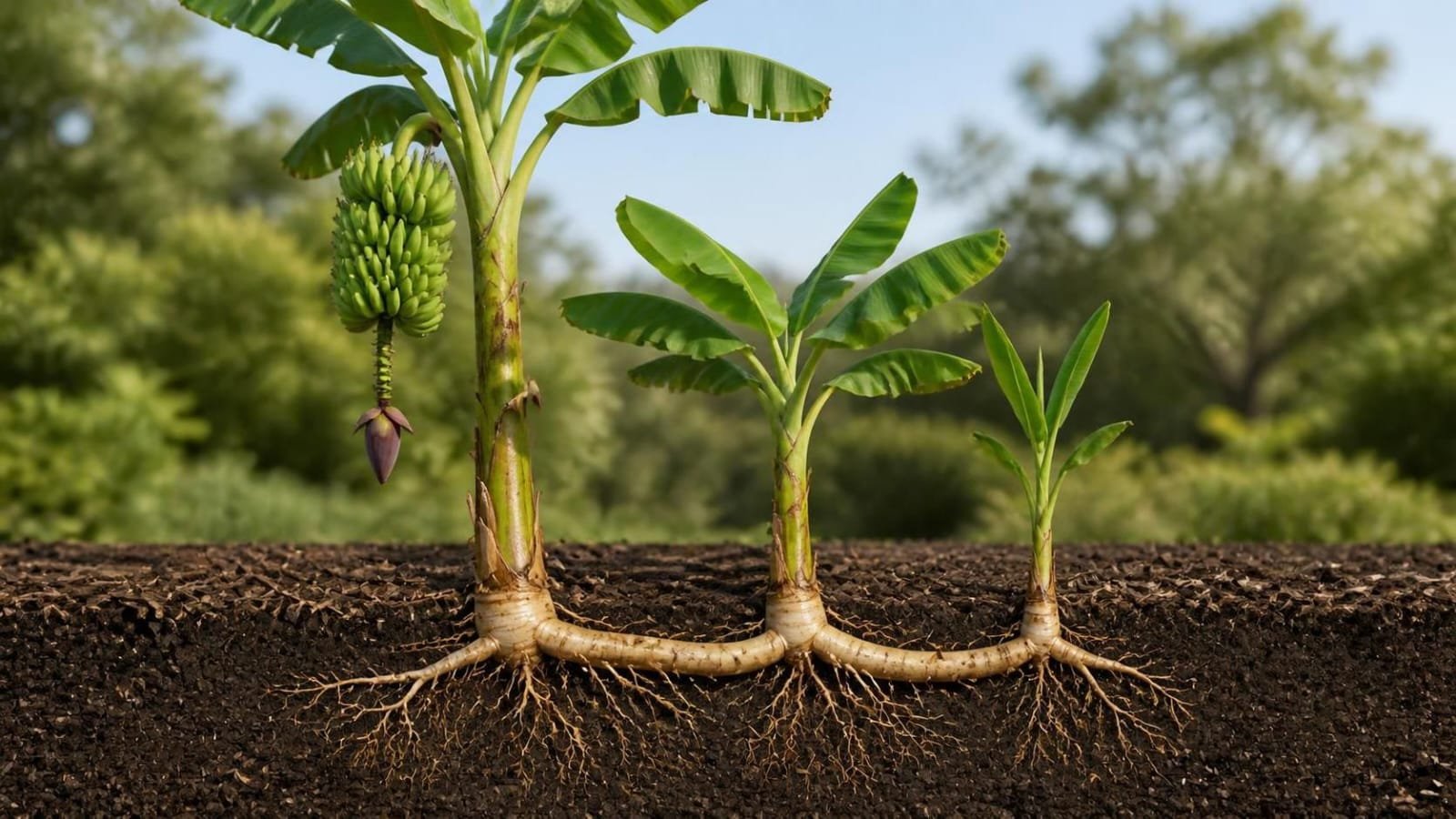
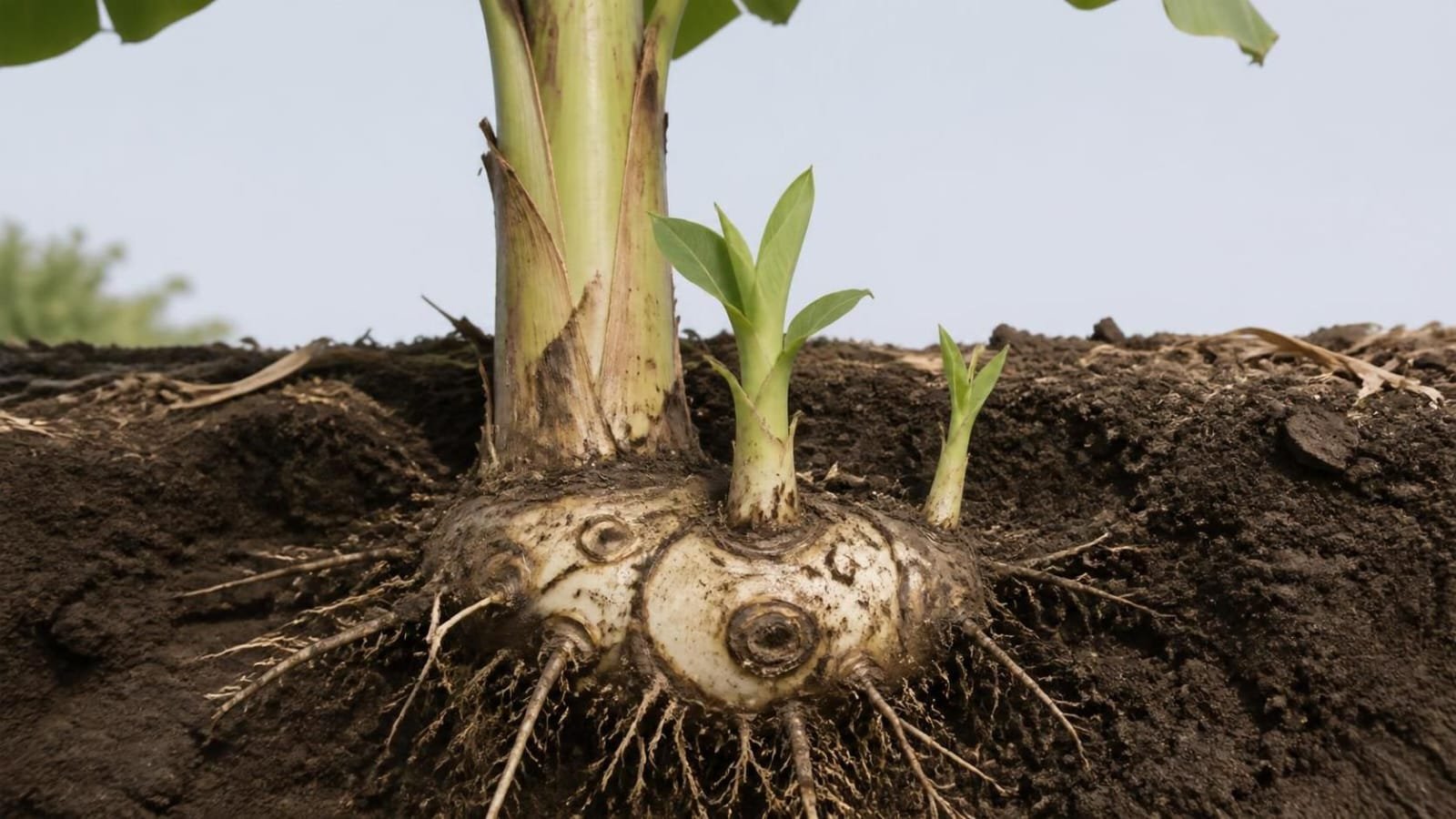
Each banana stem fruits once and then dies back, but the plant itself does not. The underground rhizome keeps sending up new shoots called suckers, and one of them takes over the next crop. A healthy clump can go on bearing bunches for years, one stem at a time.
Start at the base of the trunk. Young shoots coming up around it mean the next crop is already lined up, and the old stem is simply finished. If there are no shoots at all, the clump may be weak or stressed, so head to the last section of this article.
Why one stem fruits once and the plant carries on
Most of us look at a banana plant and see a tree. It isn’t one. The trunk is a pseudostem, a tight stack of leaf bases wrapped around each other. The real flowering stem grows hidden up the middle and pushes out through the top. The ProMusa banana knowledge base calls the plant a tree-like perennial herb, since it has no woody tissue and the fruiting stem dies down after its season.
The permanent part sits underground. That is the rhizome (some growers say corm), a thick stem with growing points that send up new pseudostems and roots. The rhizome plus every stem attached to it is called a mat. When one stem fruits and falls, the mat keeps working. The trunk is just one season’s shoot. How tall it gets depends on the variety, which we cover in banana tree height and size.
How many times does a banana tree bear fruit?
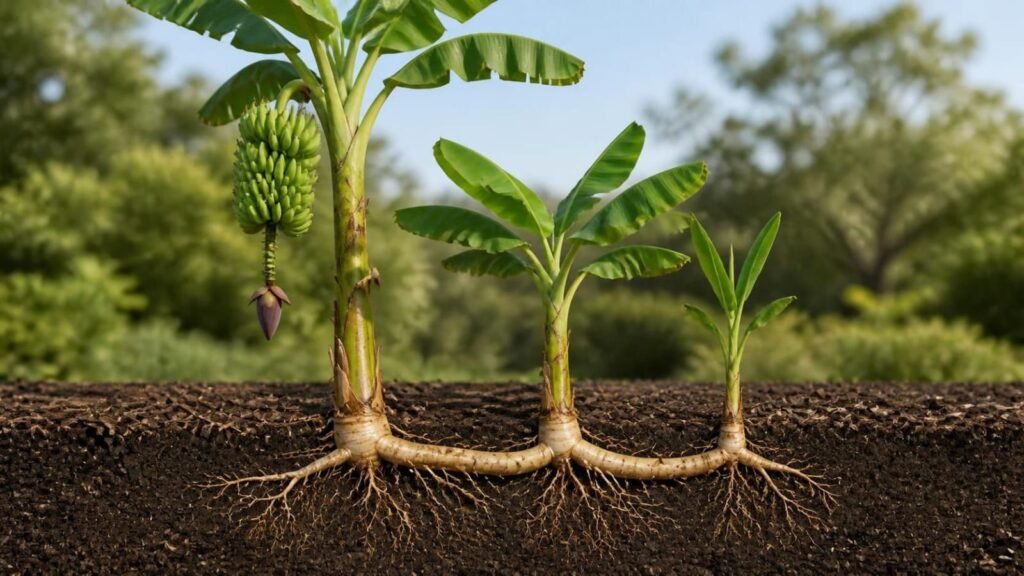
Once per stem, many times per clump. How long a clump keeps going depends on how you manage it. One Extension answer says a rhizome may keep putting up suckers for four or five years. It adds that many growers replace plants after a few years to keep production high. Take that as a rough guide, not a fixed lifespan. Cold, disease and crowding can shorten it, and good care can stretch it.
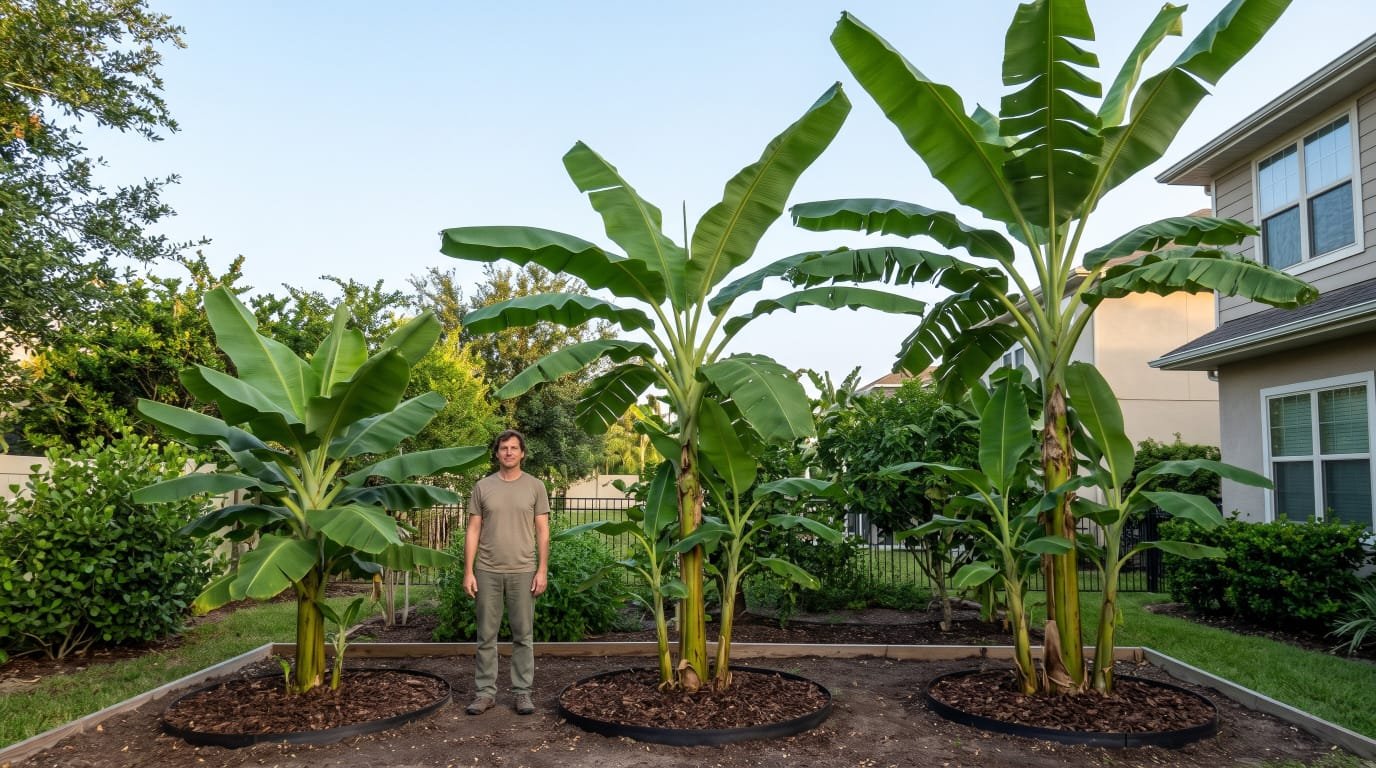
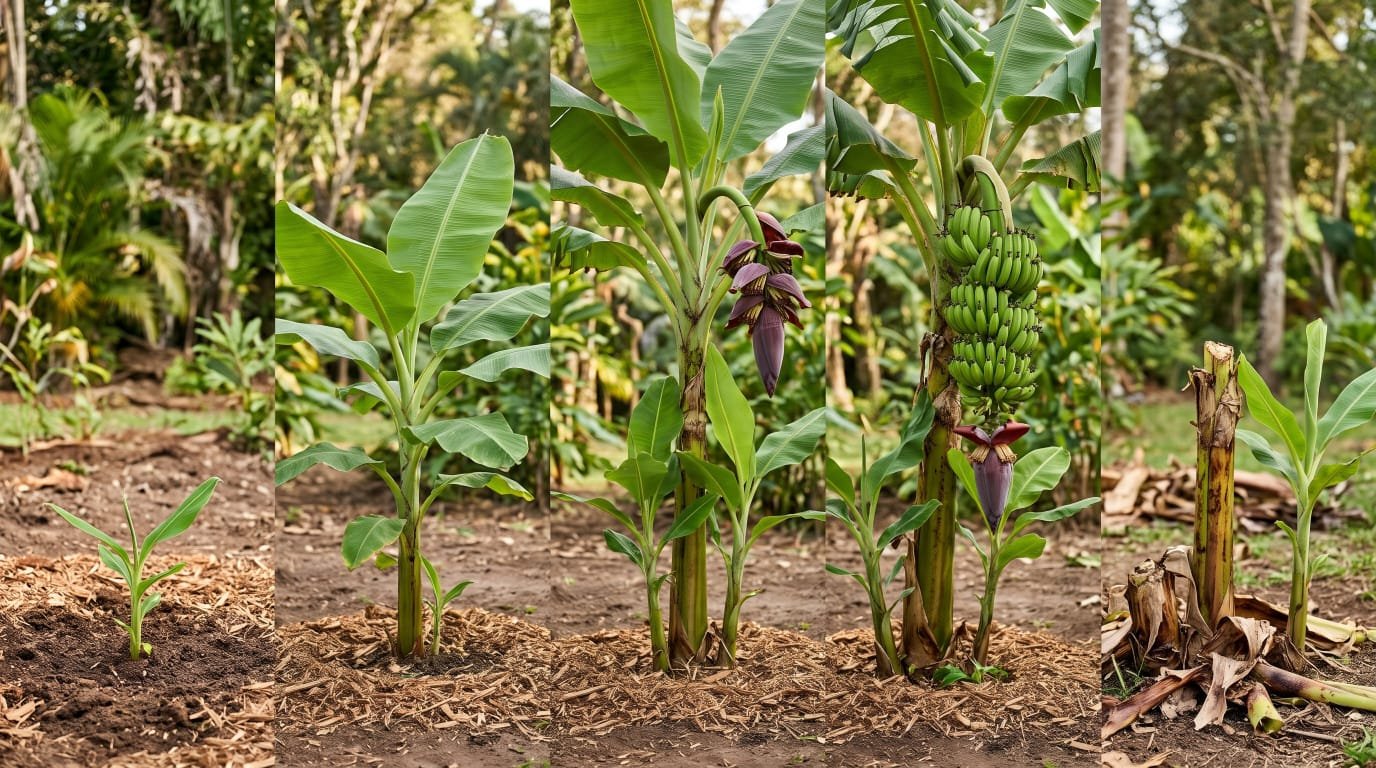
What makes it feel like the tree fruits every year is the staggering. The Florida home-grower guide UF/IFAS HS10 lays out the timing. Flowering comes roughly 10 to 15 months after planting. Harvest follows 80 to 180 days later, depending on temperature, variety and moisture. The first bunch is usually smaller than the ones after it. To keep fruit coming, the guide recommends one stem flowering or fruiting, one about half grown, and one small sucker on its way. Cut the oldest stem, and the half-grown one moves up. Growers call the sucker chosen to replace the parent the follower or ratoon.
Exact timing swings a lot with climate. Our guides on how long a banana tree takes to grow and when banana trees flower and produce fruit go through it stage by stage. For the full sequence from sucker to harvest, see banana tree life cycle and growth stages.
Reading the stems in your clump
A slow walk around the mat tells you what each stem is doing. Use the table to decide what stays and what goes.
| What you see | What it means | What to do |
|---|---|---|
| A purple-red flower bud hanging from the top of a tall stem | This stem’s one and only crop is starting | Leave it standing and keep water supply steady |
| A swelling bunch with a flower tip dangling below the last hand | Fruit is set; the tip is the male bud, which edible types do not need | Remove the tip right after the last hand has set, which can speed fruit development |
| Bunch already cut, trunk still green | The stem is finished even though it looks alive | Cut it at the base and chop it up |
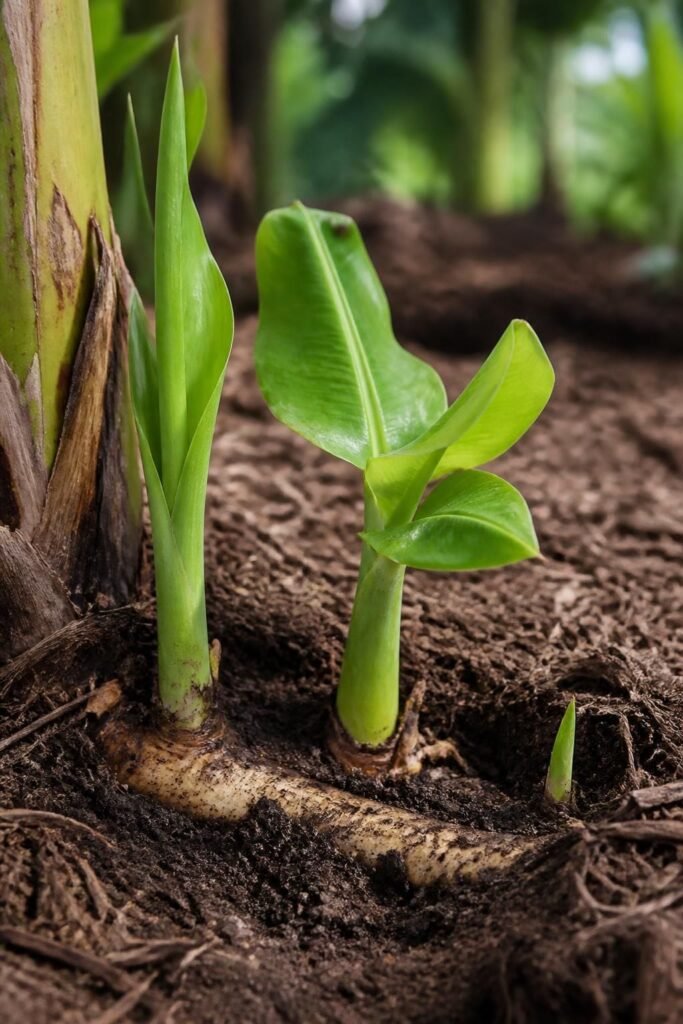
| A shoot 1 to 4 feet tall with narrow, spear-like leaves | Sword sucker, the best candidate for the next fruiting stem | Keep the best-placed one |
| A shoot of similar height with broad leaves, loosely attached | Water sucker, which grows weaker plants and gives less fruit | Remove it |
| A tiny shoot under 1 foot | A peeper, which becomes one of the two types above | Keep one if you have room, otherwise remove it |
Do banana trees die after fruiting? What to do with the old stem
Yes, the stem that carried the bunch dies back after harvest, and that is normal. The tempting move is to leave the old trunk standing and hope for a second bunch. It won’t come. Fair enough, a green trunk looks alive, but it has already done its work. All it can do now is feed the next stem.
Wait until the bunch is harvested. Then cut the stem off at the base, chop it into small pieces, and leave them around the clump as mulch. The same UF/IFAS guide gives this advice and says the sword suckers you allowed to grow will carry the next crop. Our page on mulch for banana trees covers depth and spacing. If the plant looks ragged after a cold snap instead of after fruiting, check before you cut. Banana tree pruning and brown leaves shows how to tell a finished leaf from a frosted stem that is still worth saving.
One caution. The banana borer lays its eggs at the base of the pseudostem, and the larvae tunnel into the stem and rhizome. That makes sanitation matter. If you find tunnels, remove or grind up the old stem. Don’t leave big pieces lying against the clump.
Choosing the next stem and thinning the rest
Most people let every sucker grow, figuring more stems must mean more bananas. Here’s the kicker: it runs the other way. A crowded mat gives small bunches of lower-quality fruit and invites disease. Flowering and harvest slow down too, because the stems compete for water, light and nutrients.
So pick the sword sucker best placed to replace the parent, and keep the staggered pattern from earlier. Cut the others at ground level. Then gouge out as much of what’s left as you can with a digging bar. If the bud inside survives, it grows right back.
Surplus suckers dug up with their roots can become new plants. Propagating banana plants explains how, and how to plant a banana tree covers sucker size, depth and spacing.
What not to do
- Don’t leave the spent stem standing for another season and expect a second bunch.
- Don’t cut the stem down before its bunch has been harvested.
- Don’t keep every sucker. Crowding slows the whole clump.
- Don’t run a mower or weed eater close to the trunk. Damage to the pseudostem weakens it, so keep a grass-free ring around each stem.
- Don’t apply systemic herbicides in the trunk area. They can make a banana plant decline or die.
Do all banana trees produce bananas? When a plant never fruits
A common situation: the plant sits there for two summers, leafy and healthy, throwing up shoots, and never flowers. The one-fruit rule isn’t the issue here. Work down these checks in order, because the first one rules out the most.
Is it a banana grown for fruit?
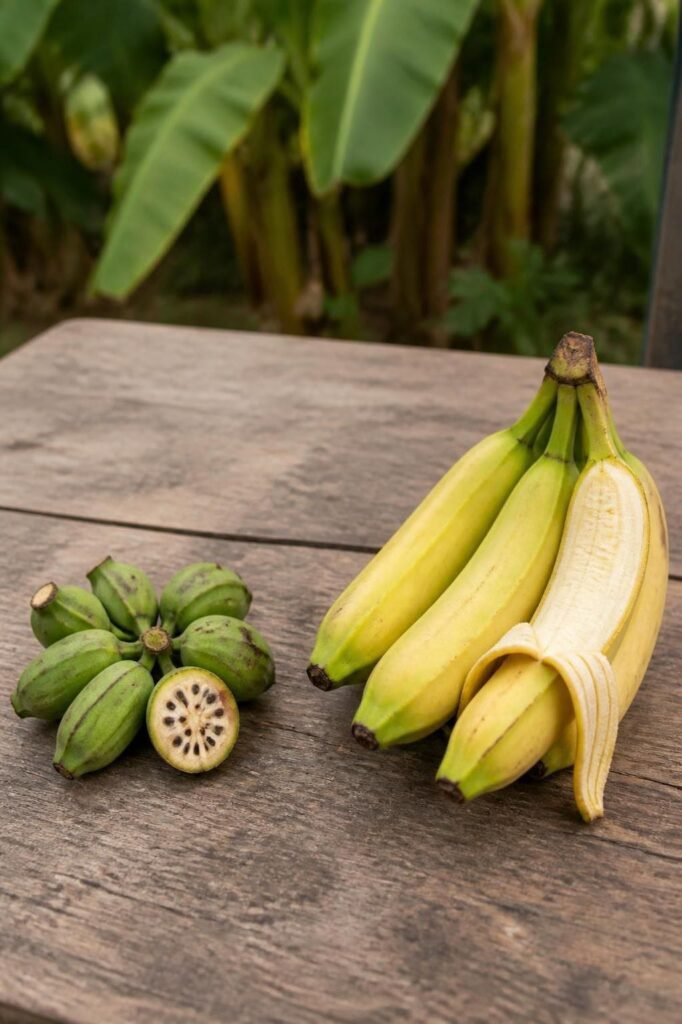
Not every banana plant sold at a garden center is meant to give a crop. Hardy ornamentals such as Musa basjoo are grown mainly for their leaves. In the UK, Horticulture magazine reports that most garden bananas there won’t fruit at all. Where they do, the fruits are usually inedible and often under about 5 cm long. Abyssinian banana (Ensete) looks like a banana but isn’t technically one. A University of Florida guide also points out that many ornamental bananas aren’t good for eating.
Has cold or stress caught the flower stalk?
Even a true fruiting variety can fail at the last step. Western Australia’s agriculture department describes bunch choking, where the bunch can’t emerge normally from the pseudostem. Its list of causes includes waterlogging, cold, high temperature, and a shortage of water or nutrients. Freezing is a separate problem. The same University of Florida guide says Dwarf Cavendish can fruit well if it doesn’t freeze back in winter. In practice, a stem frozen to the ground before it flowers loses its one chance. The next shoot has to grow up and start the clock over.
Is the clump simply too young, too dry or too crowded?
A plant set out this season may just not be old enough. Flowering takes the better part of a year or more. Too little water makes plants slow to fruit and shrinks the bunches. Heavy shade slows things down, and so does a mat with too many stems. A description can’t settle this, and causes overlap, so fix the obvious ones together: water, light, thinning, and a sensible banana tree fertilizer routine. If the leaves look off too, banana tree care sorts out the usual water, potassium and cold signs.
Quick answers
Do banana trees actually grow bananas?
Yes, if it’s a variety bred for fruit. Edible cultivars send a flower stalk up through the middle of the pseudostem, and the bananas form on it. Ornamental banana plants are grown for their leaves, and their fruit is usually small and not worth eating.
Do banana trees produce bananas every year?
The clump can. A single stem can’t. The rhizome keeps putting up new stalks, so a mat with stems of different ages can keep cropping, even though each stem fruits only once. Timing depends on your climate, and the flowering timeline shows what to expect.
Does cutting off the flower stalk keep the plant alive?
No. The same Extension service says cutting off the flowers or flower stem won’t make that stem regrow or give bigger bananas. The only piece worth removing is the dangling male bud, and only for the reason in the table.
Do you need two banana plants to get fruit?
No. Edible banana cultivars set fruit without pollination (parthenocarpy), so a single plant is enough.
Can a banana tree in a pot fruit more than once?
The stem rule is the same: each stem fruits once. A pot leaves less room for suckers, so you’ll thin harder. Banana tree in a pot covers indoor and outdoor setups.
Do banana trees come back after a freeze?
Often, yes. A hard freeze can kill the stems down to the ground, but new growth usually sprouts from the rhizome once warm weather returns. Hold off on digging anything up. Banana tree pruning and brown leaves explains how to judge the damage.
This week, walk around your clump and sort each stem with the table above: leave it, cut it, or keep it as the next fruiting stem.
One thought on “Do Banana Trees Only Fruit Once? What Really Happens”