
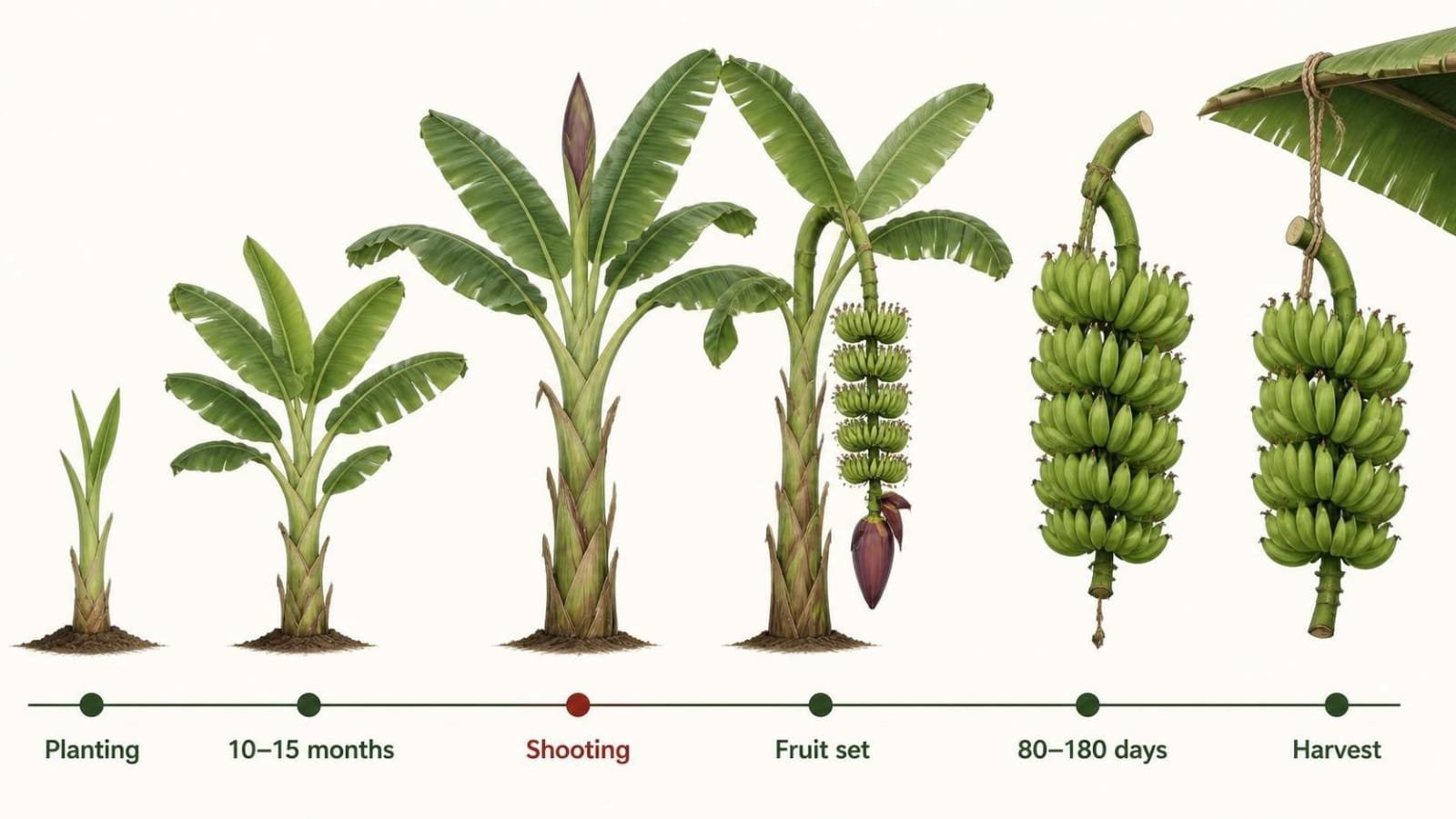
Banana trees usually flower 10 to 15 months after a sucker or nursery plant goes in the ground. The fruit then takes about 80 to 180 days to fill out and be ready to pick. On the Texas Gulf Coast, most flower stalks show up from April to June, and that shifts with climate. If your banana tree is under a year old, or froze to the ground last winter, it’s probably not due yet.
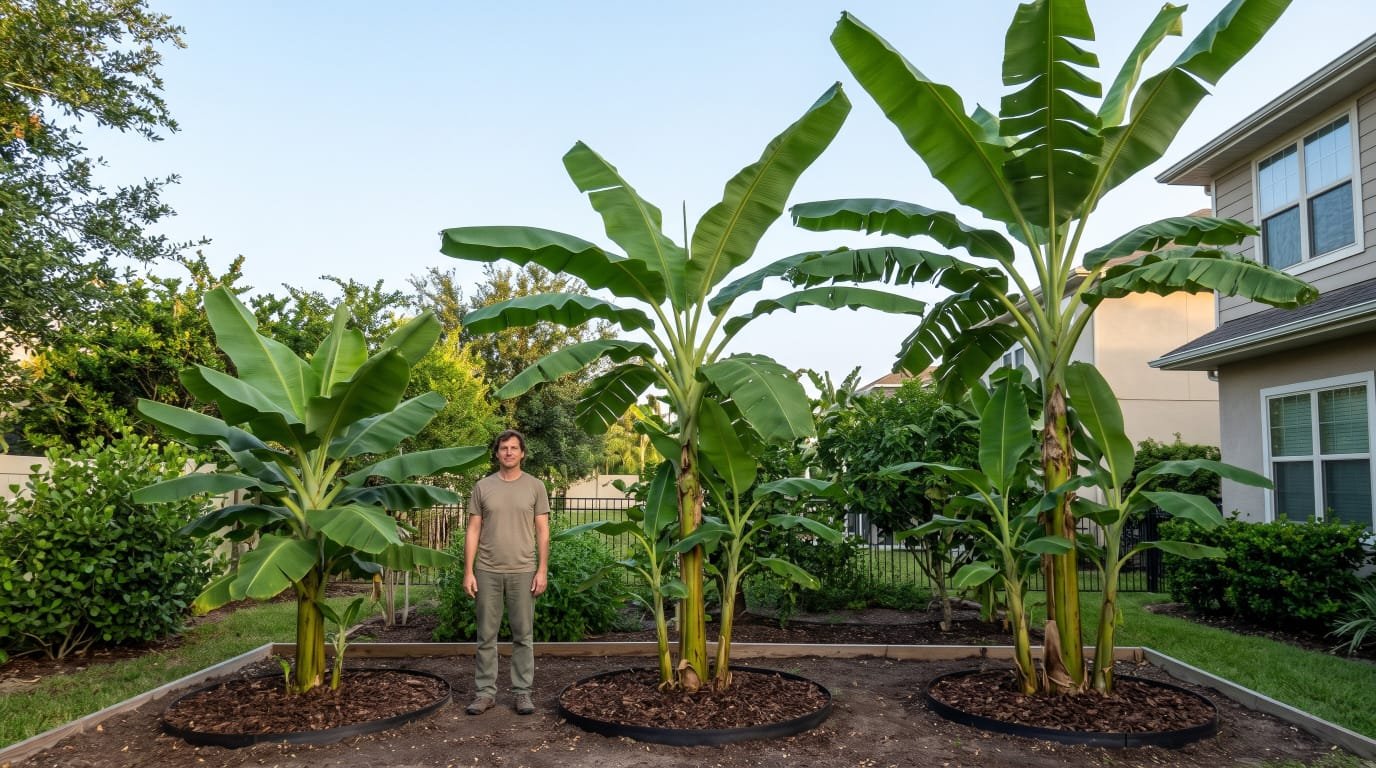
Check the plant, not the calendar. What most of us call a banana tree is really a giant herb, and its trunk is a pseudostem, a stack of tightly packed leaf sheaths. Look at its size, then look at the middle of the pseudostem. By the time the flower stalk pushes up through the center, a banana plant has made 26 to 32 leaves over its life, according to UF/IFAS Extension. Older leaves die and drop off, so you won’t count that many. Judge size instead. A thin young plant isn’t ready. A tall, fat pseudostem with a full crown is getting close. Gardeners call the moment the stalk appears shooting.
In this guide
- The flowering and fruiting timeline
- When banana trees flower
- When banana trees flower by climate and zone
- What a flowering banana plant looks like
- How long after flowering bananas produce fruit
- Why a banana tree is not flowering
- What happens after flowering
- FAQs
The Banana Flowering and Fruiting Timeline
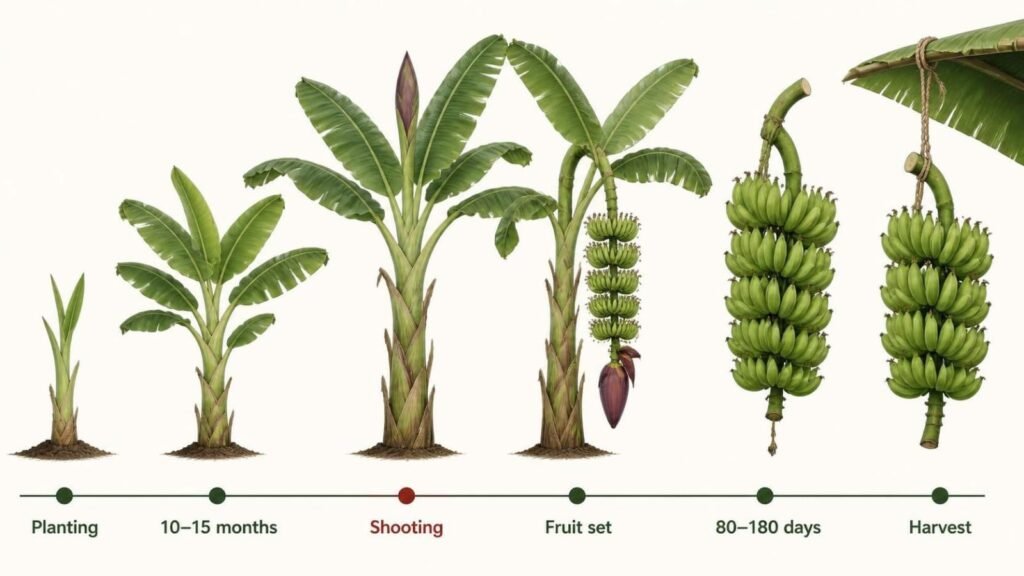
Here’s the whole sequence, from planting to a banana tree growing bananas you can pick. These are typical ranges for a plant grown for fruit. Cool weather stretches every one of them.
| Stage | Typical timing | What you will see |
|---|---|---|
| Leaf growth | About 10 to 15 months after planting a sucker | New leaves keep unrolling, the pseudostem fattens, and the clump sends up new suckers. |
| Shooting | Often April to June on the Texas Gulf Coast; varies by climate | A tapered purple bud pushes out of the center and hangs down on a long stalk. |
| Fruit set | As the bracts lift | The first flowers to open are female. Behind each one, a tiny green banana starts to swell, in rows called hands. |
| Male bud | After the hands are set | The stalk keeps growing and the bud at the tip opens its male flowers. They don’t make fruit. |
| Filling | About 80 to 180 days after shooting | Fingers get longer and plumper. The sharp angles round off. |
| Harvest | When the fingers are full but still green | Cut the whole bunch and let it ripen off the plant. |
Want the growing phase in more detail? Our guide on how long a banana tree takes to grow walks through it. The banana tree life cycle and growth stages article shows how each stage hands off to the next.
When Do Banana Trees Flower?
The short answer: about 10 to 15 months after planting. In Texas and similar climates that’s most often April to June, though a plant can bloom in any month once it’s big enough.
Most of us count months. Plant in spring, expect flowers next spring. Sometimes that works. Sometimes the plant has other plans, because size and warmth matter more than the date. Gardening guides quote anything from 8 to 18 months. Some put nursery plants at 8 to 12, and others say 10 to 18. Don’t read that as sloppiness. Varieties differ, planting dates differ, and every plant sits through a different number of cool weeks.
On the Texas coast, most flower stalks show up in April, May and June. A banana can bloom in any month if the plant is ready. Farther north, or in a cool year, the same plant may flower later in summer or skip the year. So when do banana trees fruit? Two things have to line up. The plant has to be big enough, and the season has to be warm enough to carry the fruit.
Planting date still matters. It decides how much warm weather a young plant gets before its first winter. If you’re still at the planting stage, our guide on how to plant a banana tree covers timing and spacing.
When Banana Trees Flower by Climate and Zone
Banana tree fruiting depends a lot on where you live. Use this table as a starting point, then adjust for your own winters. Most of the numbers come from Florida and Texas, so expect some drift elsewhere.
| Climate | What to expect | What decides it |
|---|---|---|
| Frost-free tropics and south Florida | Flower stalk roughly 10 to 15 months after planting; fruit 80 to 180 days later | Steady warmth, regular water, full sun |
| Texas Gulf Coast and similar mild-winter areas | Most stalks in April to June; at least 14 to 16 months of good weather needed to reach ripe fruit | Whether the pseudostem survives winter |
| Cooler zones (about USDA Zones 7 and 8) | Fruit is realistic mainly with cold-hardy edible types and a protected pseudostem | Winter protection and length of the growing season |
| Containers and indoors | Slower, and reliable fruiting data is hard to find | Light, heat and a big enough pot |
Here’s a documented example of why the Gulf Coast row matters. A Texas A&M horticulturist writing for Galveston County AgriLife Extension says growing a banana plant is easy, but getting a crop is the exception. The trick is to start spring with a plant already 6 to 8 feet tall, which means the trunk has to come through winter alive. Nurseries that trial hardy bananas say much the same. Plant Delights reports that Orinoco, an edible variety, needs a pseudostem that keeps growing at least nine months to fruit. They cage the plants over winter to save next year’s stalk.
What if you live in a cooler climate?
Plan around winter. Most edible bananas have to keep their pseudostem through the cold months. Growers in cooler zones cut the top off after frost, leave a few feet of stem, and wrap it in a wire cage packed with shredded leaves. Shredded works best. Whole leaves hold water, and pine straw or hay insulate poorly. Others dig the plant up and store it dormant somewhere above freezing. Set new plants out a few weeks after the last frost, because growth slows hard below about 57°F (14°C). Even then, a short season can keep some ornamental types from flowering at all.
Does the variety change the timing?
Yes, though solid timing numbers by variety are scarce. Cold tolerance is easier to compare. The ratings below come from the UF/IFAS variety tables, so treat them as Florida-based.
| Variety | Cold tolerance | What to know |
|---|---|---|
| Dwarf Cavendish | Fair | Better suited to the cool edge of the subtropics than most commercial types. |
| Lady Finger (common AAB type) | Good | Tall plant with small, sweet fruit. Needs shelter from wind. |
| Orinoco | Fair to good | Hardy edible type grown for fruit along the Gulf Coast. Needs a pseudostem that grows about nine months and survives winter. |
| Plantains | Poor to fair | Fewer fruit per plant. Male flower parts are small or missing. Cooked, not eaten raw. |
Container growers have to work harder. Our article on banana trees in pots explains the size and care a potted plant needs.
What a Flowering Banana Plant Looks Like
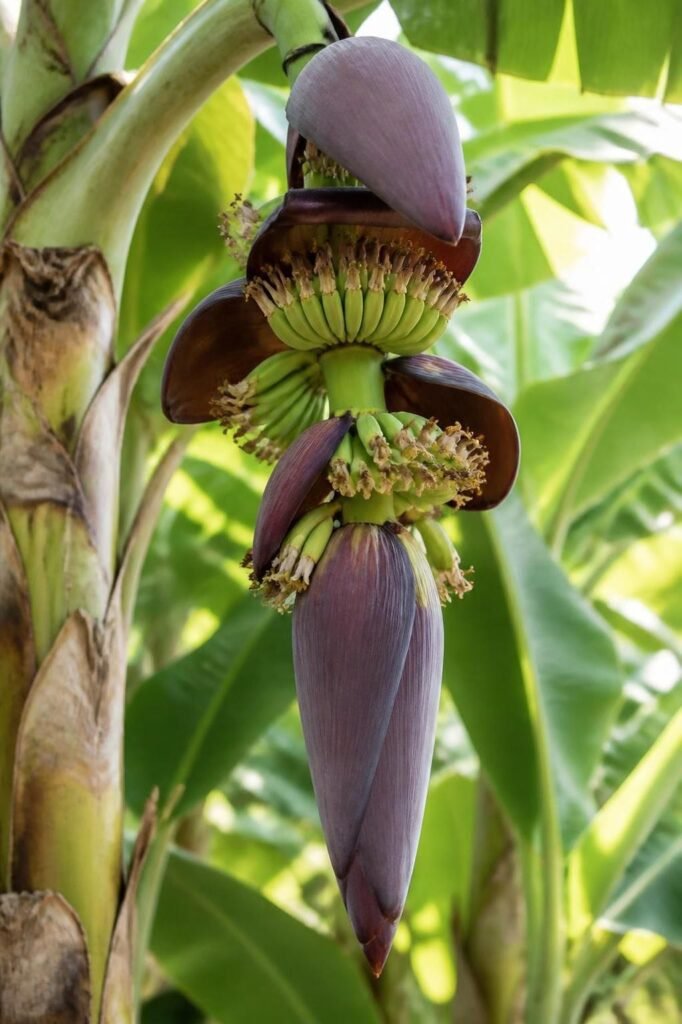
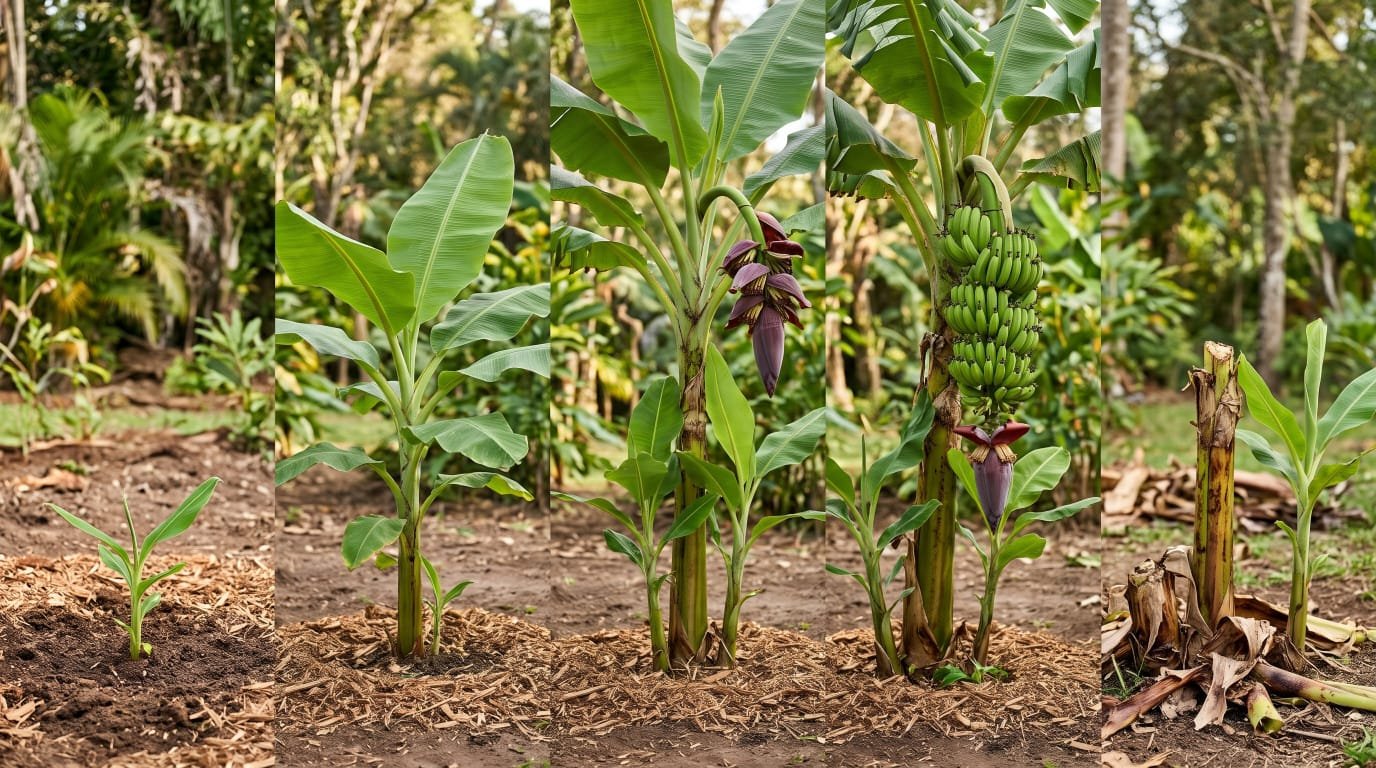
The flower stalk comes out of the very top of the pseudostem and arcs downward. It carries a tapered bud in deep purple. The thick bracts peel back one at a time and show the flowers underneath, arranged in a spiral along the stalk in groups of 10 to 20. The first flowers to open are female. Behind each one sits an ovary that swells into a small green banana. Those groups become hands, and the whole cluster is the bunch.
Farther along the stalk, the flowers turn transitional, then male. The male flowers never make fruit. In plantains they may be small or missing altogether.
Do banana flowers need pollination?
No. Edible varieties make fruit without pollination. The word for it is parthenocarpy, and it’s why edible bananas are seedless. You don’t need a second plant, bees or a paintbrush. Some ornamental and wild types are different and set seedy fruit.
How Long After Flowering Do Bananas Produce Fruit?
Bananas are usually ready to harvest about 80 to 180 days, or roughly three to six months, after the flower stalk appears.
That’s a big range, and it isn’t vague on purpose. Temperature does most of the work. Fruit grows best around 84 to 86°F (29 to 30°C). A cool spell slows everything, so bunches that develop in cooler weather tend to land at the long end. Variety and soil moisture move the number too. Fair enough if that’s a lot of variables. It’s also why one figure from a blog post shouldn’t be treated as a deadline.
In Texas, AgriLife describes about four to six months from flowering to full-size fruit. That fits the low and middle of the range. It also says the color change at maturity can be so slight you barely see it.
When should you cut the banana flower?
Once the female flowers have set fruit, the purple bud keeps growing and hangs below the last hand. Extension guidance says you can cut it off just below the last hand, and some growers do because it may speed up fruit development. It’s optional. Wait until the female flowers have finished setting fruit before you cut.
How do you know when bananas are ready to harvest?
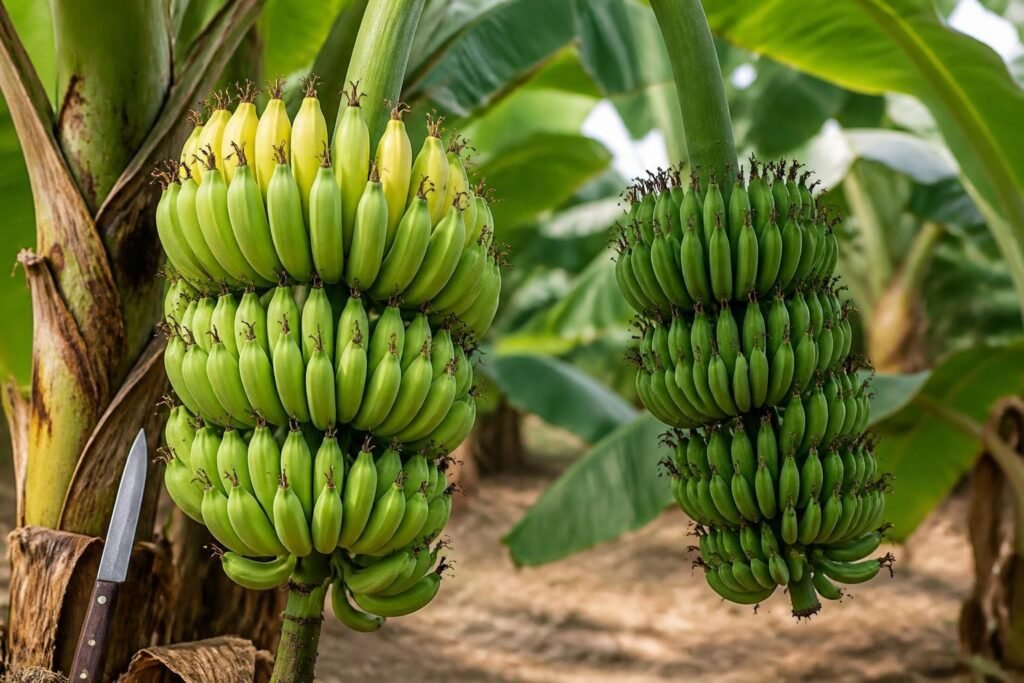
Don’t wait for the whole bunch to turn yellow on the plant. Cut it when the fingers are plump, the sharp ridges have rounded out and the sides have swelled. That’s usually while they’re still green, or when the top hand shows the first faint yellow. Hang the bunch in a cool, shady spot to finish ripening. It tends to taste better than fruit ripened on the plant, and extension guidance suggests picking about one to two weeks before it would ripen on its own. And please keep unripe bananas out of the fridge. Chilling can stop them from ripening properly.
Why Is My Banana Tree Not Flowering?
Most of us reach for the fertilizer first. Bananas are heavy feeders and potassium matters, so our guide to banana tree fertilizer is worth a read. But feeding is rarely what’s holding a plant back. Look at age, winter and weather first. Those are the usual suspects, and our general banana tree care guide covers the routine that keeps the rest in order.
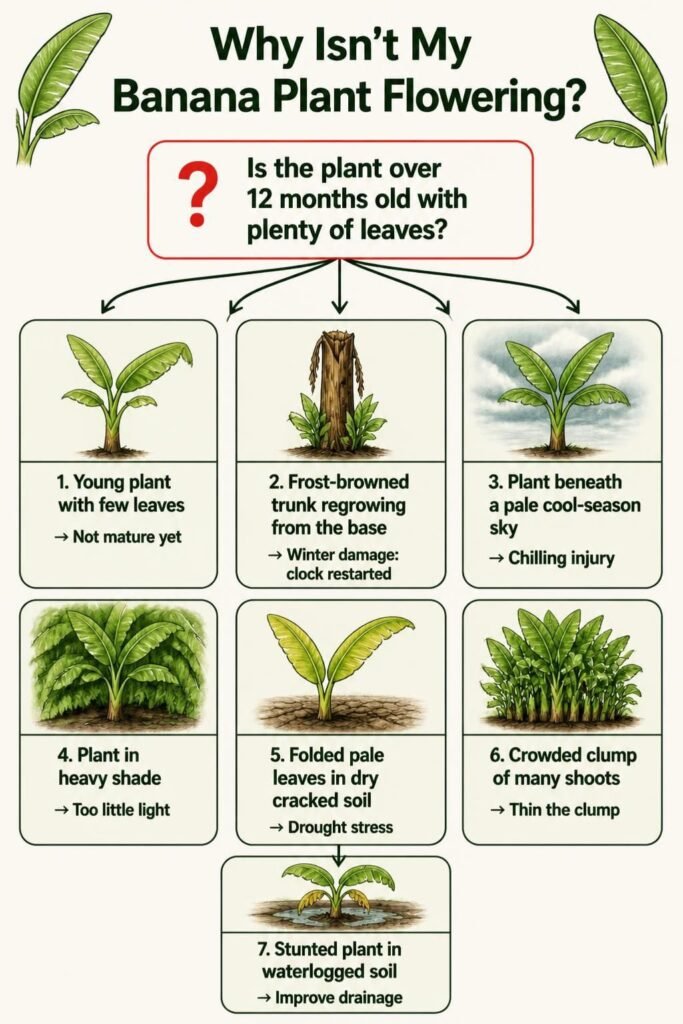
| What you see | Likely cause | What to do |
|---|---|---|
| Plant is under a year old, few leaves | Not mature yet | Keep water and warmth steady and give it the season. |
| Tall plant froze back last winter and regrew from the base | The old pseudostem was lost, so the clock restarted | Protect the trunk next winter so most edible types can flower the following summer. |
| Healthy leaves, no stalk after a cool season | Chilling injury | Wait for steady warmth. The stalk can fail to emerge when temperatures hang between about 32 and 60°F. |
| Leaves fold, turn pale or burn at the edges in dry spells | Drought stress | Water on a steady schedule. Dry spells delay flowering and shrink the bunch. |
| Plant sits in heavy shade | Too little light | Move it or open up the canopy. Full sun is best for fruit. |
| Many shoots crowded in one clump | Competition between pseudostems | Thin to one flowering stem, one half-grown and one small sucker. |
| Soggy, poorly drained soil and stunted growth | Root stress from continuously wet soil | Improve drainage or plant on a raised bed; see our guide to banana tree soil. |
| Trunk snapped after a storm | The stalk for the season was lost | Cut below the break. New leaves come from the cut end. |
The hardest call is a plant that’s just young versus one that lost its trunk to cold. Look at the base. Shoots coming straight out of the ground with no old trunk beside them suggest cold cut it back, though that’s not conclusive. UF/IFAS says temperatures below 28°F (-2°C) can kill a banana to the ground, but new growth usually returns from the rhizome when it warms up. From a description alone, those two cases can look the same. If you’re stuck, your local Extension office can usually sort it out.
Wind matters too. Plant Delights says winds above about 40 mph can snap a pseudostem and wreck the flower for that year. Last, check the variety. Ornamentals such as pink velvet are grown for flowers and foliage, and their fruit is small and seedy. Pink velvet is also a rare exception that can die to the ground in winter and still flower the next season. So the winter-protection rule has exceptions.
What Happens After a Banana Tree Flowers?
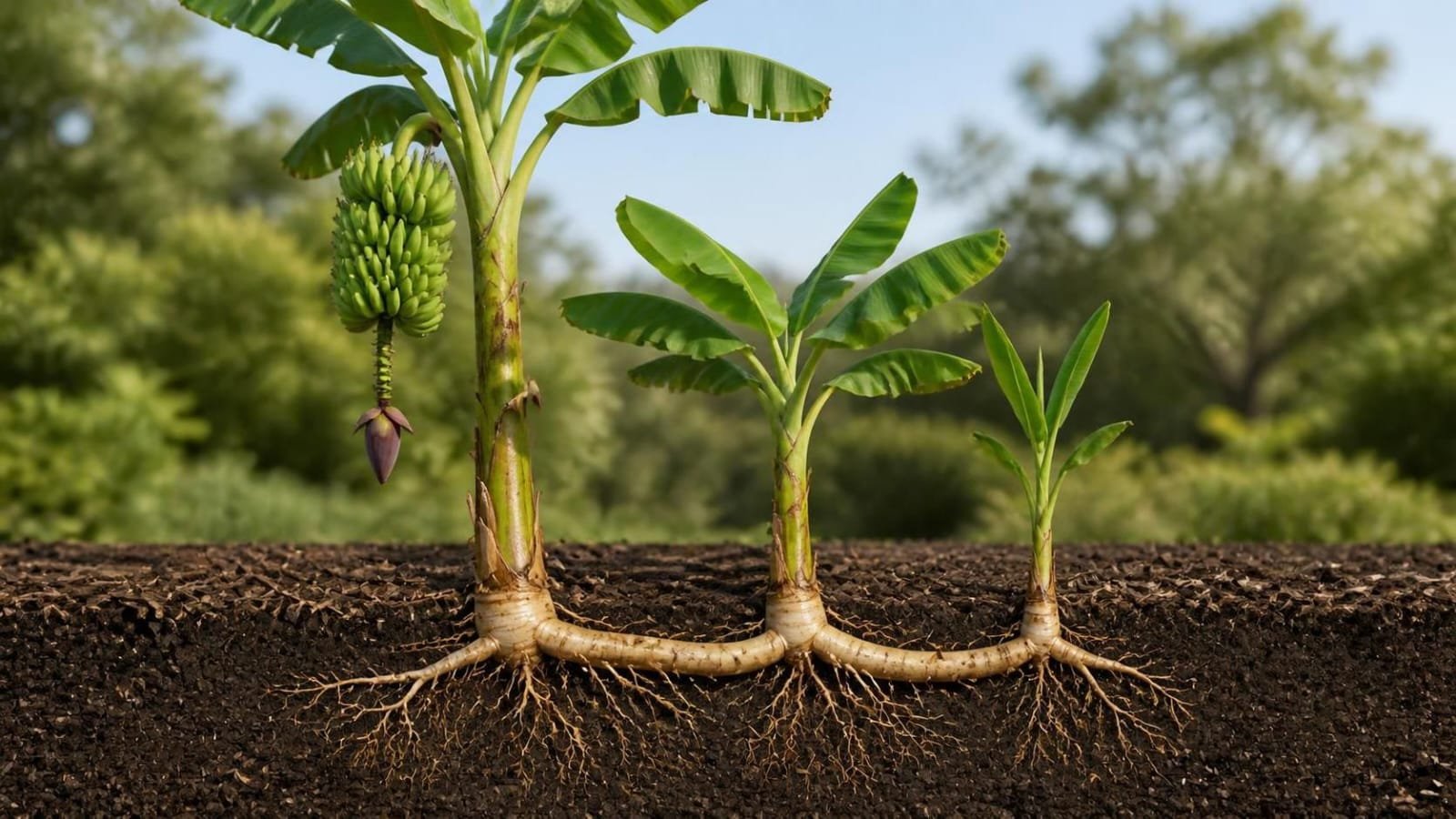
Each pseudostem flowers once, fruits once and then dies. That sounds grim, but the underground rhizome keeps sending up new shoots, so the clump carries on. Our explainer on whether banana trees only fruit once goes deeper. After harvest, cut the old stem down at the base. The follow-up shoot, called a sword sucker, becomes the next fruiting stem. A tidy clump keeps one stem flowering, one about half grown and one small sucker. That spare shoot can also start a new plant, which our guide on propagating banana plants covers.
Pruning helps too. Pull off dead leaves and any that rub the bunch. Our page on banana tree pruning and brown leaves explains which to take and which to leave. A thick layer of mulch for banana trees keeps the soil evenly moist. And if you’re curious how tall a mature stem gets before it shoots, see banana tree height and size.
Banana Flowering and Fruiting FAQs
Do banana trees flower every year?
One pseudostem flowers once. A well-managed clump, with stems at different ages, can bring a new flower stalk each season in a warm climate.
Can banana plants flower in pots or indoors?
It’s possible in principle. Reliable data on indoor fruiting is hard to find, though. Big containers, strong light and warmth are the minimum, and even then it’s a long shot, not something to count on.
Do banana trees die after flowering?
The stem that flowered dies after you harvest the bunch. The plant doesn’t. The rhizome keeps sending up new shoots that take over.
Is the fruit on an ornamental banana edible?
Usually not. Ornamentals such as Musa basjoo can set small yellow bananas in warm climates, but they’re not worth eating. If you want fruit, pick an edible variety suited to your winters.
3 thoughts on “When Do Banana Trees Flower and Produce Fruit? Timeline”