Banana tree types fall into three groups that matter in a garden: sweet dessert bananas such as Cavendish and Lady Finger, starchy cooking bananas and plantains, and ornamental bananas grown for their leaves or their cold hardiness. Almost every edible variety descends from two wild species, Musa acuminata and Musa balbisiana. Choose by asking two things first: do you want fruit you can eat, and how cold does your winter get?
Those two questions sort the options faster than any variety list. Plenty of plants sold as a “banana tree” never make a bunch worth eating, and plenty of the delicious ones will not survive a hard freeze. Names add to the muddle. “Lady Finger” and “Apple” each cover several different cultivars, and “red banana” can mean two unrelated plants. If you have been staring at nursery tags and feeling lost, you’re not alone.
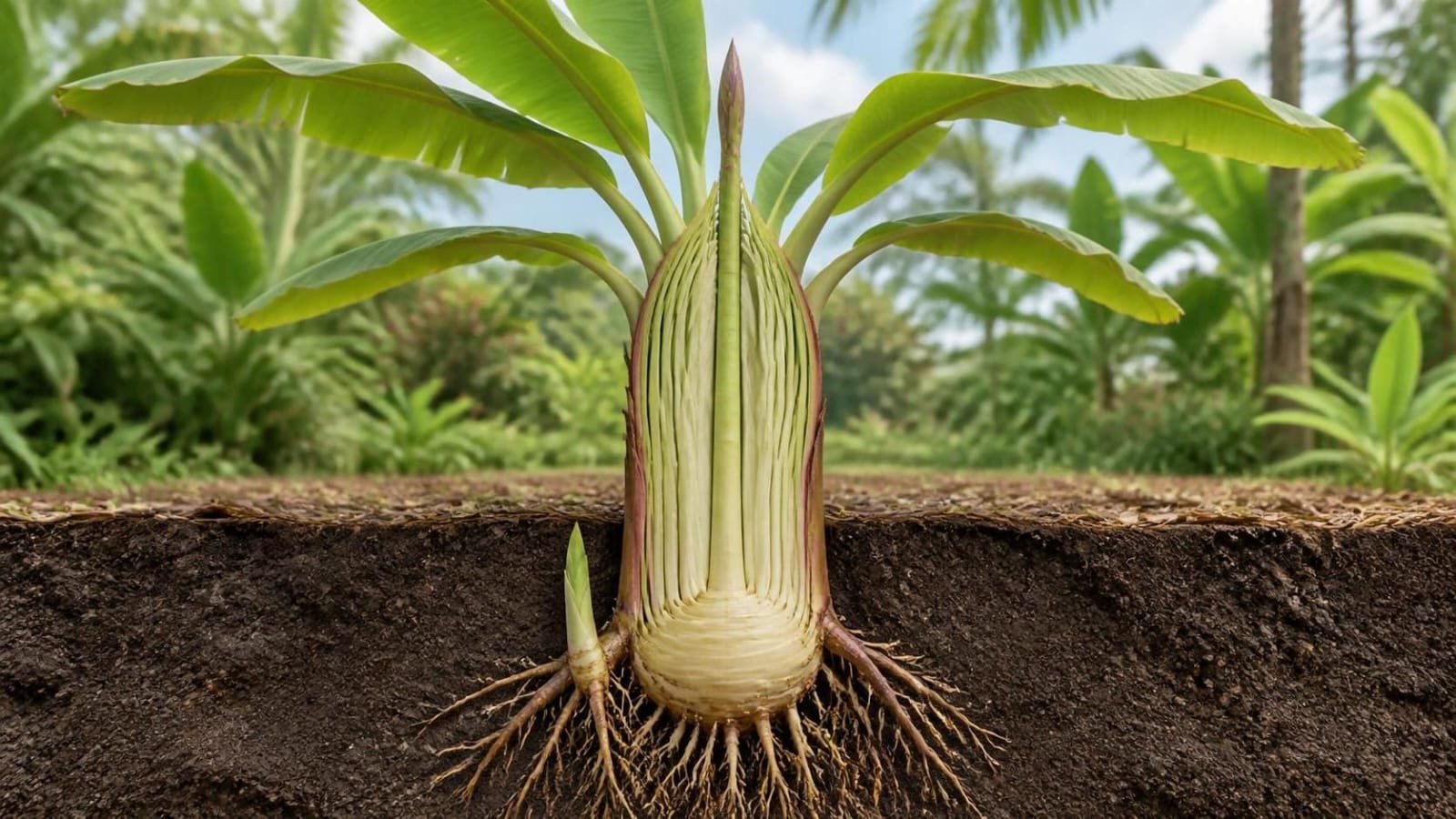
One word on “tree” before we start. Botanically a banana is a giant herb, and the trunk is a pseudostem built from tightly wrapped leaf sheaths. We unpack that in are banana trees actually trees; here, “banana tree” and “banana plant” mean the same thing.
Match the banana plant to what you want from it
Most people start with a favorite name. Start with the goal instead, and the shortlist shrinks to a few candidates.
| Your goal | Best group | Varieties to look at | The catch |
|---|---|---|---|
| Fruit like the supermarket’s | Cavendish group | Dwarf Cavendish, Grand Nain, Williams | Prone to Sigatoka leaf disease; damaged by frost |
| Small, sweet fruit | Lady Finger and Apple types | Lady Finger (Pome, Prata), Apple (Silk, Manzano) | Susceptible to Panama disease; each name covers several plants |
| Disease resistance | FHIA hybrids | Goldfinger (FHIA-01), Mona Lisa (FHIA-02) | Newer cultivars; availability varies by region |
| Cooking | Plantains and cooking bananas | French and Horn plantains, Saba, Bluggoe | Cook before eating; plantains bear fewer fruit per plant |
| Survive cold winters | Musa basjoo | Japanese fiber banana | Fruit is inedible; the stem dies to the ground each winter |
| Dramatic leaves | Blood and pink velvet bananas | Musa acuminata ‘Zebrina’, Musa velutina | Grown for looks; fruit is seedy or ornamental only |
What AAA, AAB and ABB mean on a variety list
Serious banana references label each variety with letter codes such as AAA, AAB or ABB. They look like jargon, yet they tell you two practical things: how the fruit will eat, and how well the plant copes with dry spells. The University of Florida’s extension service explains the system. Nearly all cultivated bananas descend from two wild species, Musa acuminata (A) and Musa balbisiana (B), and each letter stands for one set of chromosomes from a parent. Most cultivars are triploid, which is why most codes have three letters. A cultivar that is mostly A tends to be sweet. One with more B tends to be starchy, and B-heavy types usually handle drought better.
- AAA: sweet dessert bananas, including the Cavendish group and Gros Michel.
- AAB: Apple (Silk), Lady Finger (Pome or Prata), Hua moa, and the plantains.
- ABB: starchier cooking types such as Bluggoe and Saba, plus the Pisang Awak group that includes Ice Cream, also sold as Blue Java.
You don’t need to memorize this. Treat it as a decoder. When two plants share a name, the letters show whether they are the same thing. Local names for one clone vary so widely that matching a plant by photo alone rarely settles it, so a seller who lists the cultivar and its group is worth more than a pretty picture. A few regional types, such as the Fe’i bananas of the Pacific, come from other wild species and fall outside this system.
Sweet dessert bananas
The Cavendish group
Nearly every supermarket banana you have eaten was a Cavendish. For gardens, Dwarf Cavendish is the one most nurseries stock. It makes large bunches of medium-sized fruit and copes with cooler subtropical weather better than most commercial types. Grand Nain and Williams belong to the same group, and the clones differ mainly in how tall the pseudostem grows. If you are wondering whether the fruit on your counter can start a plant, growing a banana tree from a banana has its own answer.
Two weaknesses are worth knowing before you buy. The group is highly susceptible to Sigatoka, a fungal leaf disease that thrives in warm, rainy weather and strips leaves without killing the plant. And while Cavendish types resist the Panama disease races common in Florida, they are susceptible to tropical race 4, a strain of the same soil fungus, Fusarium oxysporum f. sp. cubense. Panama disease has no chemical control.
Lady Finger and Apple: the naming trap
Many cultivars carry the name Lady Finger. The one most often grown in south Florida is an AAB type also called Pome, Brazilian or Prata: tall, tolerant of cool weather, with small sweet fruit, and quick to topple in wind. “Apple” has the same identity problem. The usual one, also called Silk or Manzano, is a medium-sized plant with a pleasant sub-acid flavor when fully ripe.
Both are susceptible to Panama disease, so they belong only in soil where banana plants have never collapsed, and they should be started from disease-free material. That last part matters because symptoms don’t show on young suckers. A healthy-looking pup can still carry the fungus, and by the time a mature plant yellows from the oldest leaves upward, there is no cure to reach for. If you plan to take pups from a neighbor’s clump, read propagating banana plants first.
Blue Java and Goldfinger
Blue Java, sold as Ice Cream banana, has a blue-green peel that ripens pale yellow and creamy fruit with a vanilla note. It sits in the ABB Pisang Awak group, which shows fair to good cold tolerance but is susceptible to Panama disease. Goldfinger (FHIA-01) answers that problem. It is a tetraploid hybrid dessert banana bred with resistance to Panama disease and to both Yellow and Black Sigatoka, and the FHIA hybrids are among the types recommended for home landscapes.
Red bananas
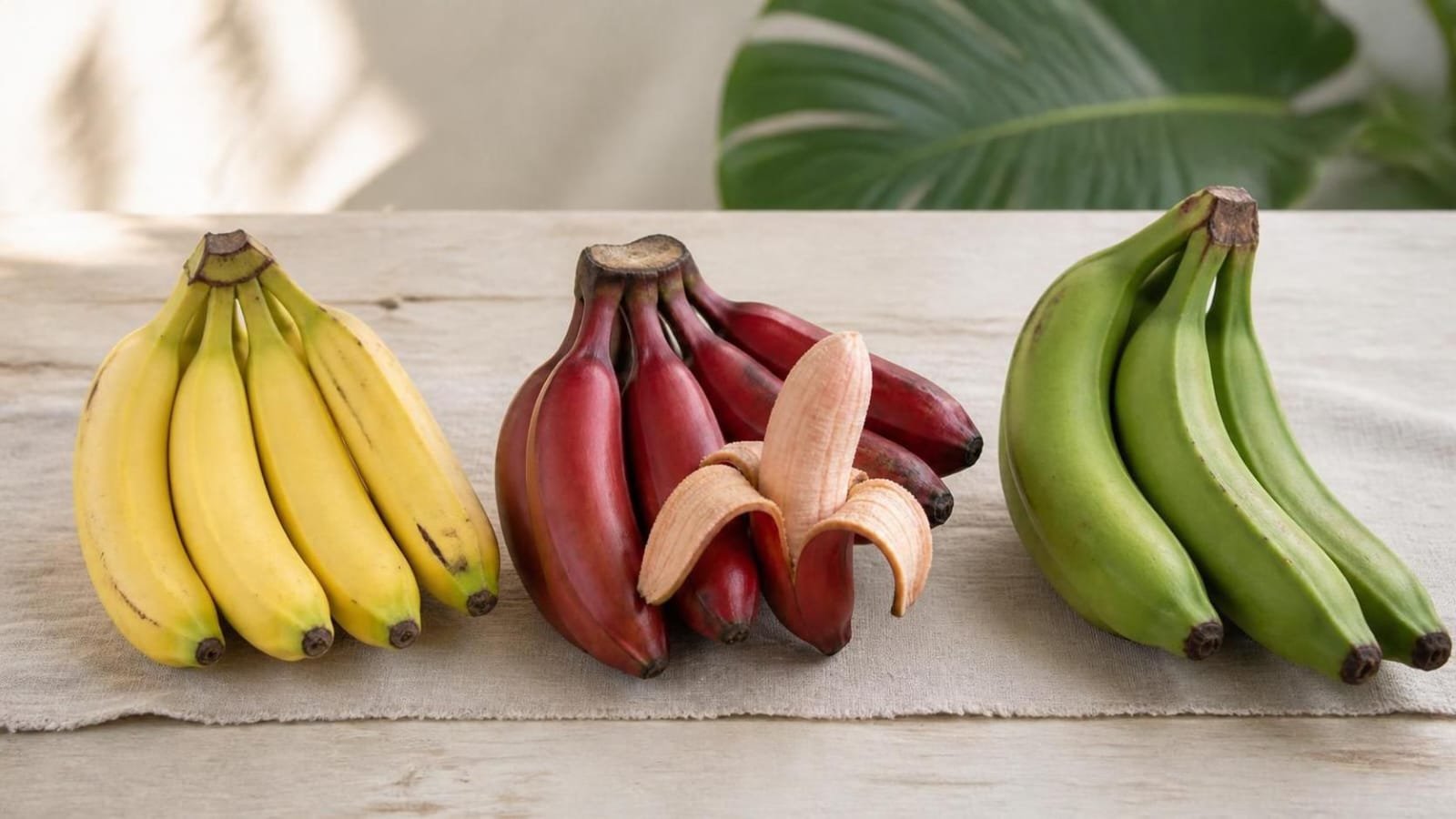
Red-skinned bananas are true bananas. Reference lists include several red Cavendish-type clones, among them ‘Red’, ‘Cuban Red’, ‘Red Jamaican’ and ‘Dwarf Red’. Don’t mix them up with the burgundy-leaved ornamentals sometimes sold under the same label, which we separate below. The fruit-bearing kind has its own page: red banana tree.
Plantains and cooking bananas
Plantains are hybrid bananas in which the male part of the flower stalk is reduced or missing. They are always cooked and carry more starch than sweet bananas, and they come in two groups, French and Horn, that bear fewer fruit per plant than dessert types. They do have one real advantage: plantains resist Panama disease, which makes them a safer bet where that fungus is a worry.
Cooking bananas such as Saba and Bluggoe sit in the ABB group and are meant for the pan rather than the fruit bowl. Any banana can also be cooked while it is still green. A starchy bunch isn’t a failure. It just belongs in a skillet.
Ornamental and cold-hardy bananas
Here’s the catch with the “hardy banana” label. The usual move is to find a banana plant that survives zone 6 winters, order it, and wait for a bunch. The plant will thrive. The bunch is the problem.
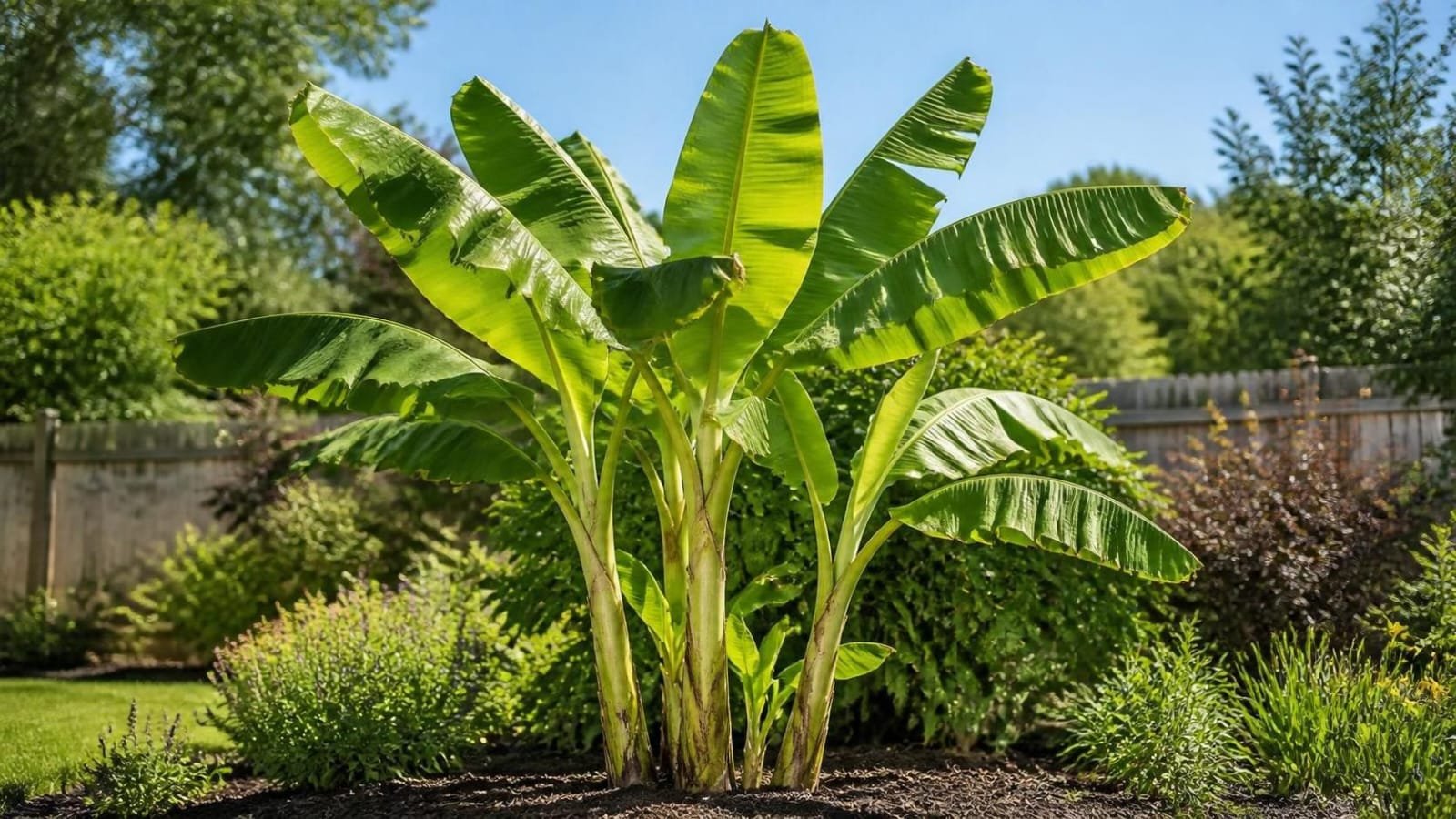
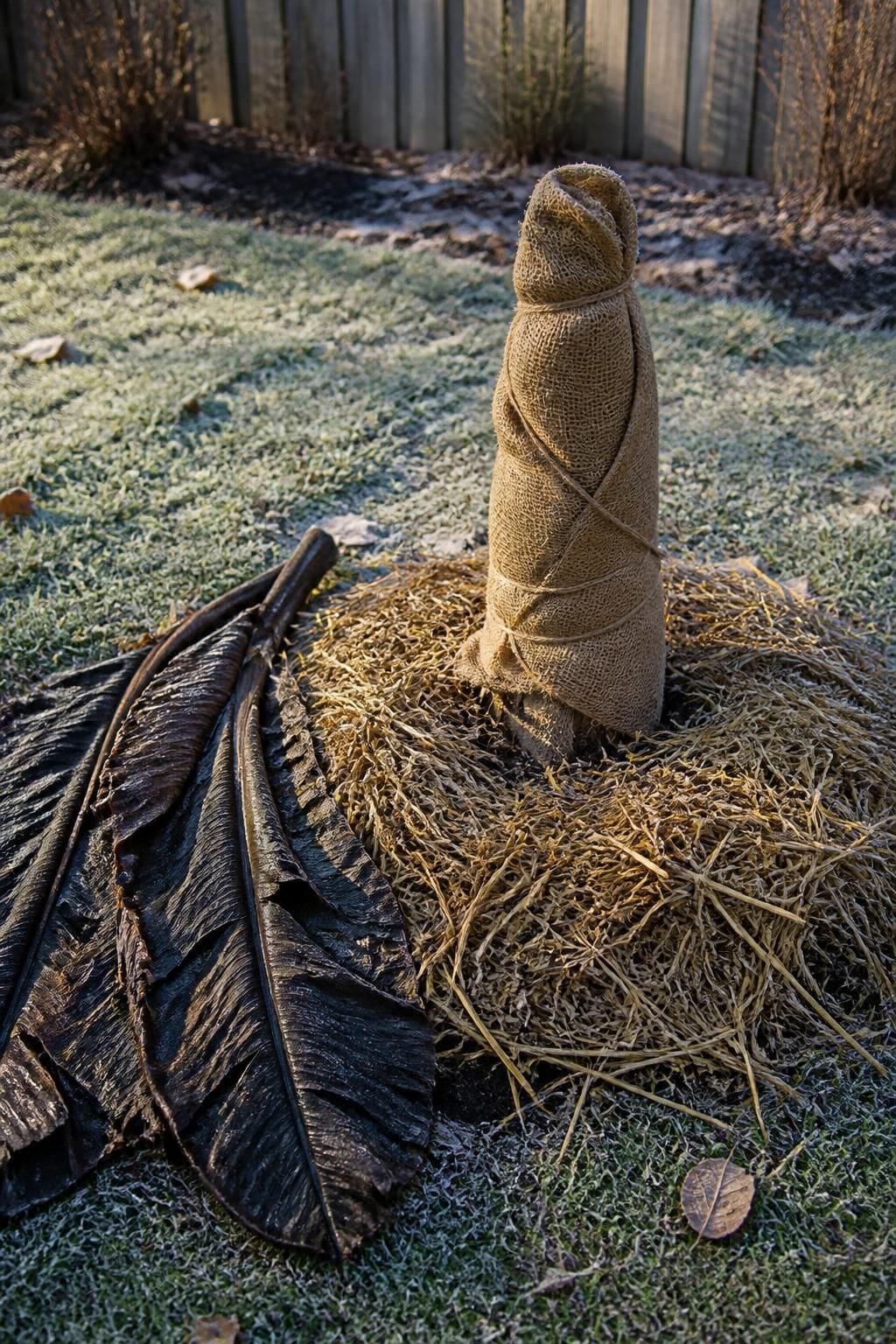
Musa basjoo, the Japanese fiber banana, is the best-known hardy type. NC State Extension describes it as a fast-growing herbaceous perennial native to Sichuan, China, with small, seedy, inedible fruit. The rhizome tolerates temperatures down to about −10°F when it is pruned and mulched. After frost the plant dies back to the ground in zones 5 to 8, so cut the stems to about 2 feet, wrap them, and pile mulch around the base. Writing for UK gardeners, the Royal Horticultural Society calls it borderline hardy and suggests pots that can overwinter under glass wherever the soil stays heavy through winter.
A common situation: a gardener plants a hardy banana in autumn, the first freeze turns every leaf to black mush, and it looks dead. It isn’t. The underground rhizome is the survivor, and it sends up new shoots once the soil warms. What may never appear is fruit, because a banana stem usually flowers 10 to 15 months after planting, and a stem that restarts every spring may not have that long before the next frost.
Zone numbers for this plant differ by source, often zone 5 or 6 with heavy mulch and warmer without. Treat any single number as a starting point. Your own winter lows and how well your soil drains settle the question. More on the cold-tolerant types is in our hardy banana plant guide.
Blood and pink velvet bananas
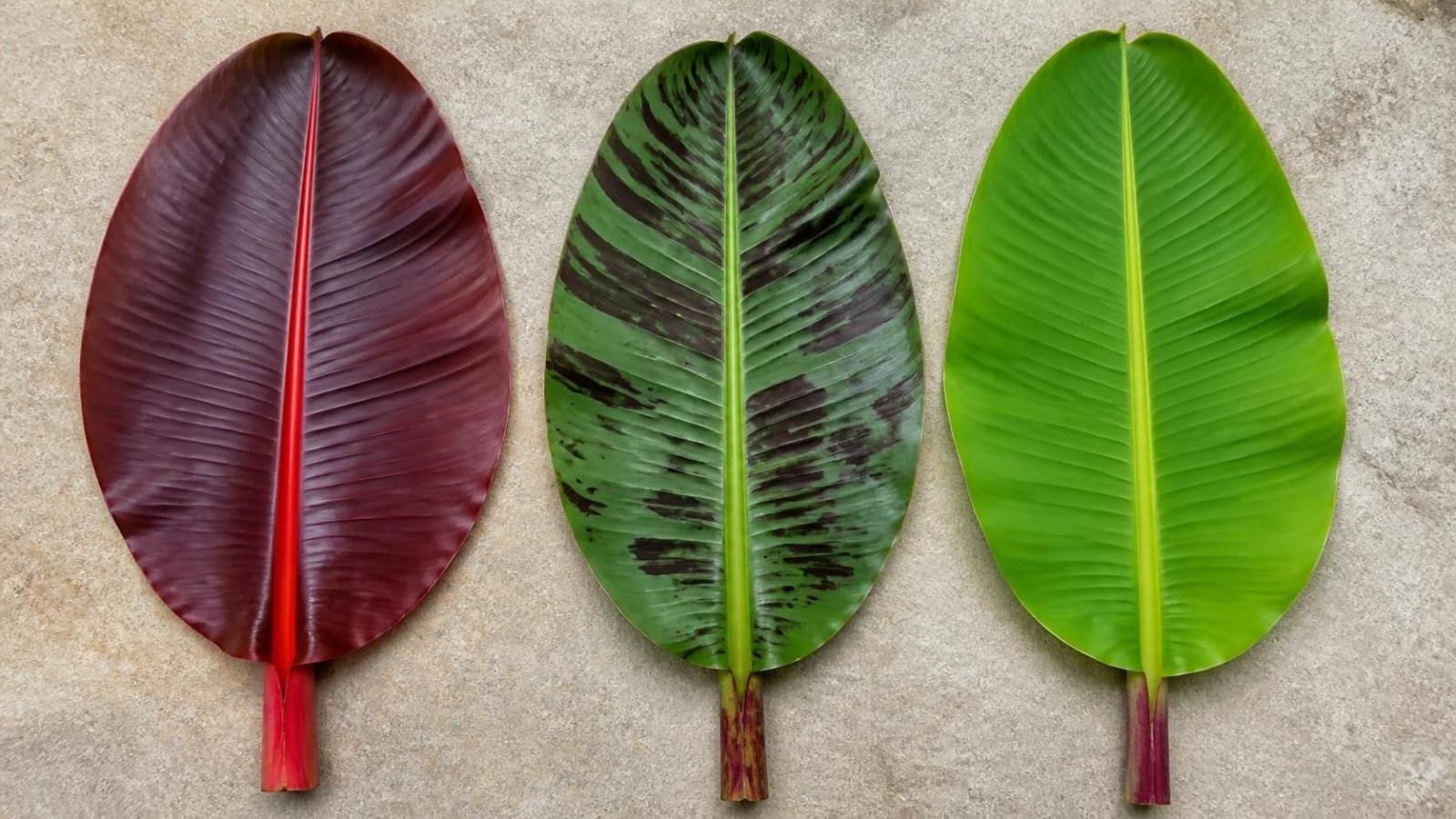
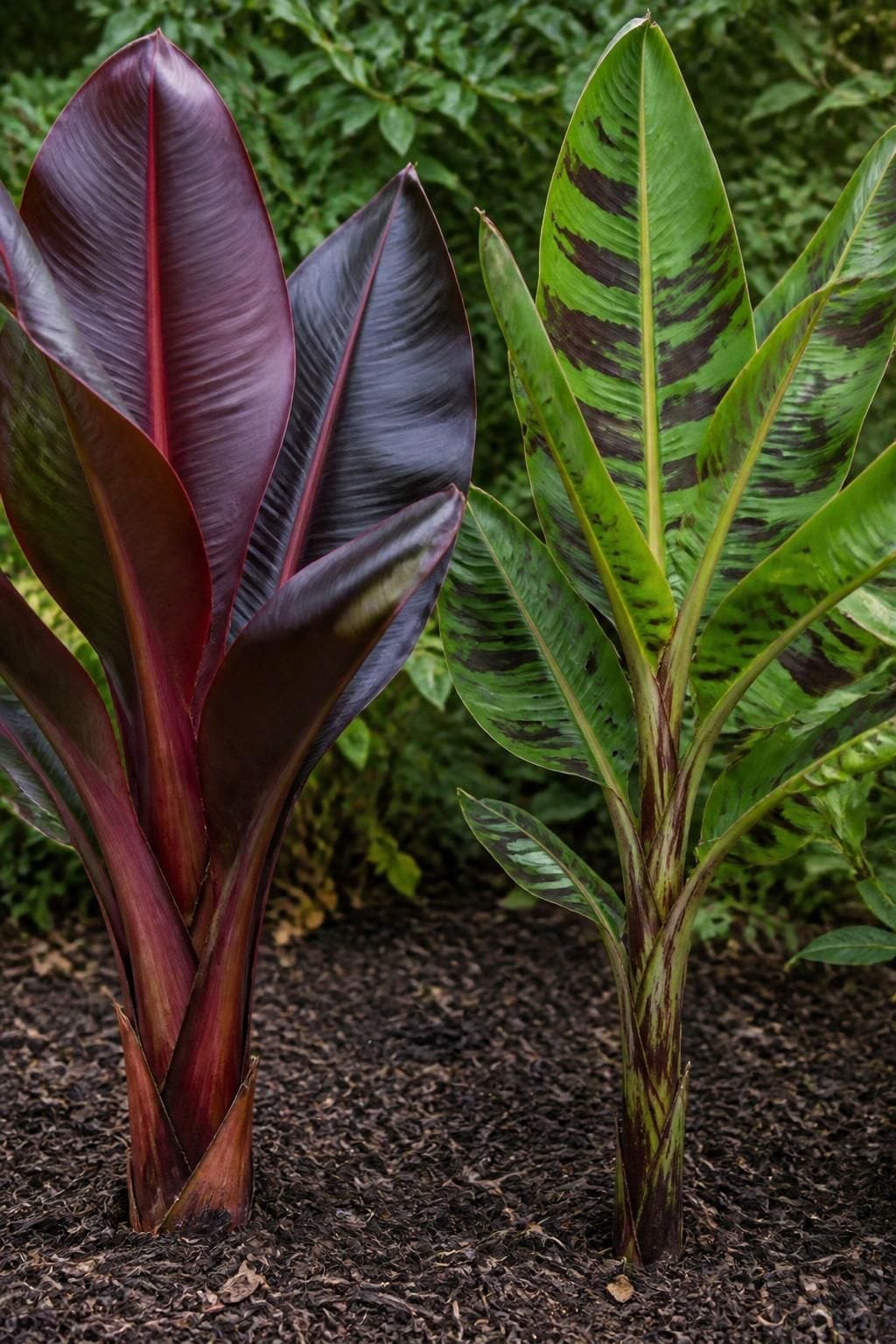
‘Zebrina’, the blood banana, is grown for leaves streaked and blotched in maroon, and its fruit is seedy and not worth eating. Pink velvet banana (Musa velutina) is grown for its bright pink-skinned fruit. Both are ornamental choices, and neither is as cold-tolerant as Musa basjoo, so check the winter low before you plant.
Look-alikes that are not true bananas
Abyssinian banana (Ensete ventricosum) and golden lotus banana (Musella lasiocarpa) look like bananas and tolerate cold, yet they belong to different genera, and UF/IFAS Gardening Solutions points out they are not technically bananas. The red-leaved Ensete ‘Maurelii’ is sometimes sold as a “red banana,” which is why that name causes so much confusion. Its fruit is reported to be dry and is not grown for eating. If the plant you want is grown for burgundy leaves, you may be looking at an Ensete. If it is grown for red-skinned fruit, you are looking at a true banana.
Ask for the botanical name. A common name on a tag is a hint, never proof.
Size, wind and how soon you’ll get fruit
Dwarf cultivars suit small yards and containers, although “dwarf” is relative: planted in the ground, many still grow taller than a person. Published heights for the same cultivar differ because soil, water and climate all change the result, so use any figure as a range. We break heights down by type in banana tree height and size.
Height matters for wind more than for looks. Winds above about 25 mph can topple tall cultivars, while short ones tend to hold up until about 45 mph. Space follows size too: dwarf plants can sit about 8 feet from other dwarfs, while large types need 12 feet or more.
For timing, a small sucker usually takes 9 to 20 months to reach harvest, depending on temperature, cultivar and care, and the first bunch is often smaller than later ones. The stages are covered in how long a banana tree takes to grow.
Choices that waste a season
- Buying a hardy ornamental and expecting a bunch to eat.
- Trusting a common name alone. “Lady Finger,” “Apple” and “red banana” each cover more than one plant.
- Planting Panama-susceptible types such as Apple, Pome-type Lady Finger or Hua moa in soil where bananas have failed before.
- Putting a tall cultivar where the wind hits it head-on.
- Reading one hardiness zone number as a promise.
Common questions about banana tree varieties
How many types of banana trees are there?
Nobody has one agreed count. You will often see “more than 1,000 varieties,” but cultivars carry many local names, so the total depends on how those names are lumped together.
Is a plantain tree a banana tree?
Yes. A plantain plant is a banana plant whose starchy fruit is cooked rather than eaten fresh.
Which banana tree is best for a pot?
A dwarf cultivar, chosen with a realistic eye on mature height. Dwarf Cavendish is the usual pick for fruit, compact types such as ‘Little Prince’ are sold for containers, and a hardy Musa basjoo can be moved to shelter for winter. Whatever you choose, plan on a large pot with good drainage.
What should I check before buying a banana plant?
Ask for the cultivar or botanical name and its group. Confirm whether the fruit is edible or ornamental. Compare your coldest winter night with the hardiness claim, and decide whether you are happy to cut a stem down every year. If you want a Panama-susceptible type, make sure your soil has no history of the disease.