
To grow zucchini in raised beds, you need a bed at least 12 inches deep, six or more hours of direct sun, and rich, well-drained soil. Room is the decision that matters most. Allow about 2 feet between bush plants in a standard bed. In a square foot garden it runs from 1 to 9 squares per plant. A sprawling plant takes the most, a caged or staked one the least. Sow when the soil reaches about 70°F, water at the base, and expect a bed to dry out faster than open ground.
Start with the bed, not the seed packet. Measure the soil depth and the width, then watch how much direct sun reaches it. This page stays with the bed itself: its size, soil, spacing and watering. The wider season-long basics sit in our guide on how to grow zucchini.
Raised bed size, depth and soil for zucchini
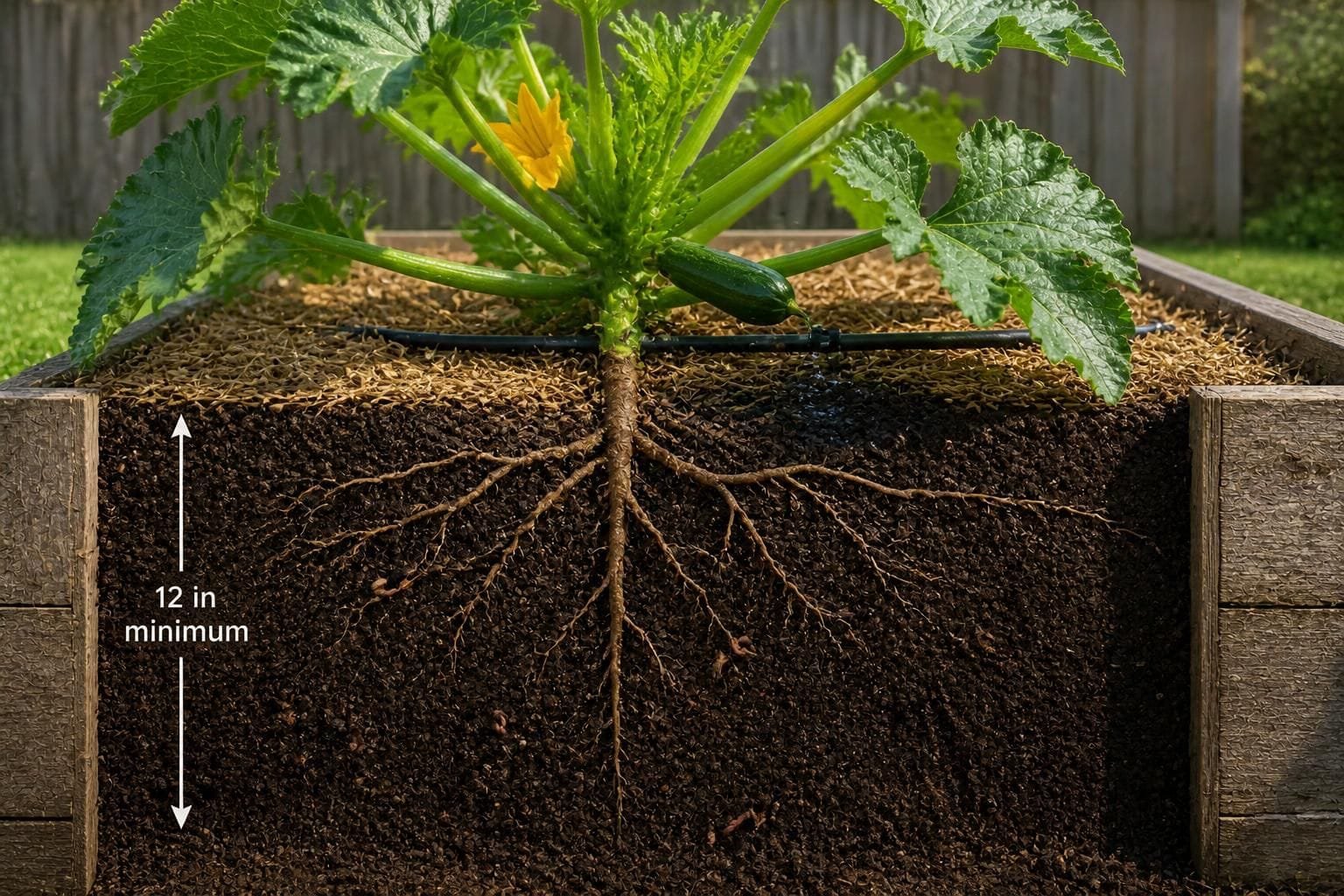
Most of us reach for the seeds first, and a tape measure would serve better. Zucchini roots go deep when they can, so give them at least 12 inches of soil. Keep the bed no wider than about 4 feet so you can reach the middle without stepping in. The Old Farmer’s Almanac gives those two numbers for raised beds, and it asks for eight hours of direct sun. Other guides settle for six, so a bed that sits between the two is workable. If the plants stay small, look at the light first.
If your bed is shallower than 12 inches, or shaded for half the day, a large pot may suit you better. See growing zucchini in containers and pots.
Now the soil. The usual move is to fill the bed with bagged mix and plant straight in. Fair enough, since it looks rich. Zucchini is a heavy feeder, though. Most guides ask for generous compost worked in before planting. It feeds the plant and helps the bed hold moisture without staying soggy. Use well-rotted manure or compost rather than fresh manure, which can carry harmful bacteria and add to weed problems. The preferred pH is slightly acidic to neutral. Published ranges run from about 5.8 to 7.0. University of Minnesota Extension puts the best range for vine crops at 6.0 to 6.5. A cheap soil test tells you more than chasing one number. A raised bed drains freely, so plan on one side-dressing. Use compost or a balanced fertilizer when the vines start to spread or the first flowers open, and follow the label.
How to grow zucchini in a square foot garden: how many squares per plant?
The first move is to squeeze in as many plants as the bed will take. Zucchini punishes that.
Read the habit line on the seed packet before you buy: bush, semi-bush or vining. In a conventional raised bed, Epic Gardening gives bush types roughly 1½ to 2 feet between plants and vining types 2 to 3 feet. Its bed-friendly picks include ‘Emerald Delight’, a bush plant that still spreads three to four feet, and ‘Sungreen’, which needs only 18 to 24 inches. Even among bush types the spread varies by variety, so the spacing printed on the seed packet should outrank any general rule.
In a square foot garden the numbers stop agreeing. The method divides the bed into 12-inch squares, and the planting charts give zucchini anywhere from one square to nine, depending on who wrote them:
| How the plant is grown | Space it takes | Where the number comes from | Best suited to |
|---|---|---|---|
| Sprawling bush, no support | 9 squares (3 × 3 ft) | The Phipps Conservatory square foot planting chart | A bed where zucchini is the main crop |
| Bush plant in a cage or on stakes | 4 squares (2 × 2 ft) | The NYC Parks GreenThumb training sheet | A 4 × 4 bed shared with other crops |
| Spaced 18 to 24 inches apart | 2 squares | The NC State Extension 4-H guide | Compact bush types with an edge to spill over |
| Single stem, staked and pruned | 1 square | Garden Betty’s staking method | Gardeners willing to tie the stem and trim lower leaves as it grows |
The spread exists because these sources describe different plants. A zucchini left to sprawl needs a patch of ground. The same variety tied to a stake needs a hand’s width of it. None of these guides cites a trial comparing the layouts, so treat the figures as working rules rather than tested yields.
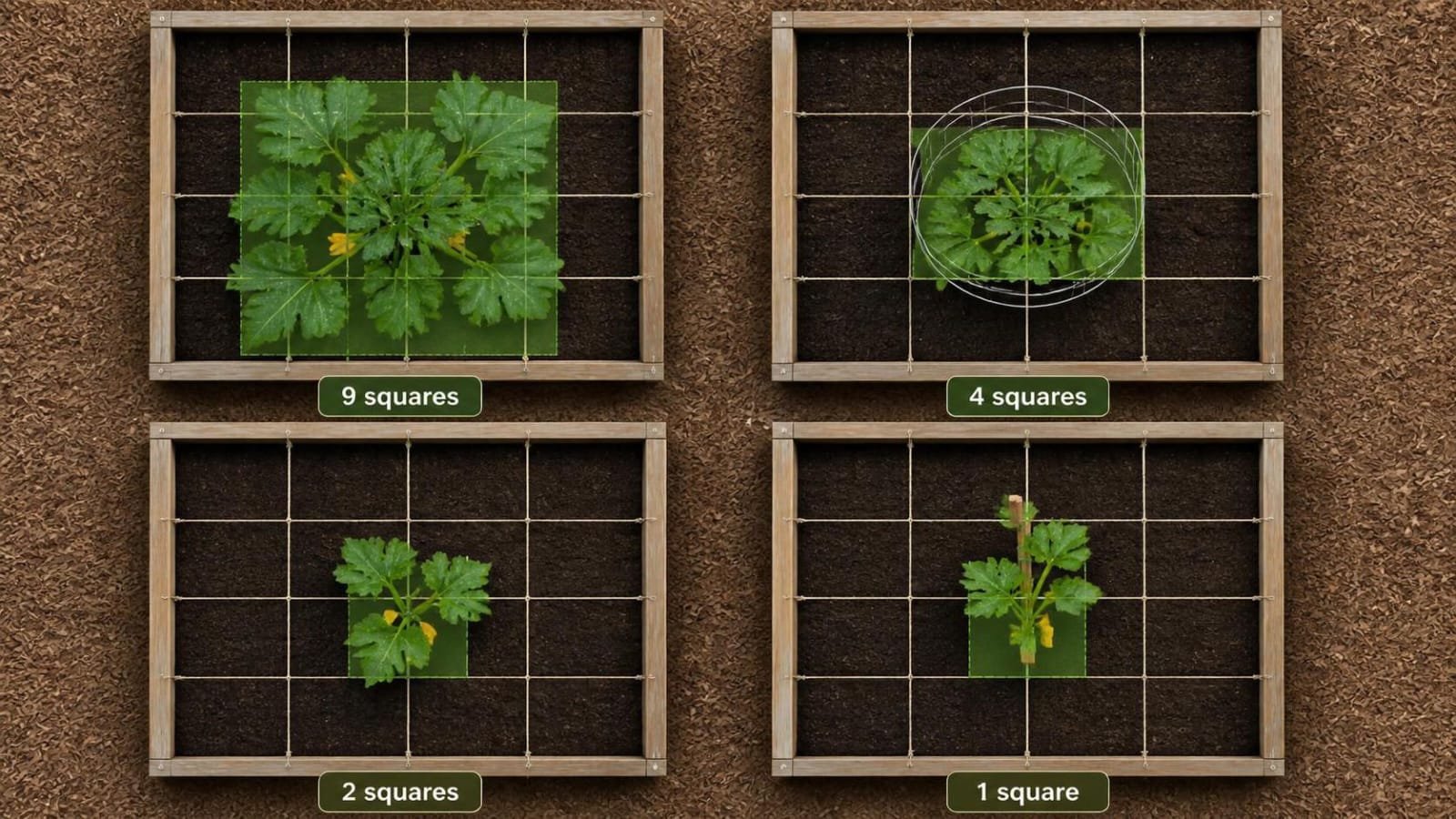
For a shared 4 × 4 bed (16 squares), a good default is one bush plant on four squares, caged. Put it on the north side so it doesn’t shade its neighbors (the south side in the Southern Hemisphere). Drop to two squares if you stake it early. Try the single square only if you don’t mind tying and trimming as it grows. A raised bed guide from Botanical Interests notes that two healthy plants will generally outproduce six crowded ones, so resist the third.
Here’s how it goes wrong. Two plants go into neighboring squares because the packet said “bush.” By midsummer the leaves have met over the middle. The air under them stays still and humid, and white powder shows up on the older leaves. Nothing was wrong with the seed or the soil. The bed held more plant than air.
When to plant zucchini in a raised bed
The usual move is to sow the day the frost risk ends. Zucchini wants warmer soil than that. Guides quote 65 to 70°F, and University of Minnesota Extension asks for at least 70°F at a 2-inch depth. It also says to wait until the soil reaches 75°F before laying straw or compost mulch, which can slow warming. A raised bed usually warms sooner than the ground beside it. That head start is real, and it is the reason to push a soil thermometer in rather than guess.
Sow seed in place when you can, because the roots dislike being moved. If you do transplant, harden the seedlings first and plant on a cloudy day or toward evening. In a hot spell, bed walls (especially dark or metal ones) add heat around young plants. A few days of shade cloth helps transplants settle. For a longer, steadier harvest, sow part of the bed now and the rest about three weeks later. Where squash vine borer is a problem, a later sowing, even into midsummer, is a common way to miss the worst of it. Seed depth, germination and seedling care have their own page: how to grow zucchini from seed.
Watering and mulching zucchini in raised beds
When the big leaves flop at three in the afternoon, most of us grab the hose. Hold off a minute. Push a finger two inches into the soil. If it’s damp, the leaves are losing water faster than the roots can supply it. Epic Gardening notes that it usually perks up once things cool down. If the soil is dry, water. Still limp the next morning with damp soil underneath? That’s a different problem, and the table further down covers it.
Raised beds drain well, which is the whole point of them, and that same drainage dries them out faster. In hot weather a bed may need water every two to three days, according to the Botanical Interests guide. Extension guidance puts the baseline near an inch of water a week, soaked in at the base so the leaves stay dry. In a heat wave, a raised bed will need more. A drip line or soaker hose laid before planting is far easier than trying to reach under those leaves later. Once the soil is warm, a layer of organic mulch slows evaporation and keeps soil from splashing onto the lower leaves.
Trellising zucchini in a raised bed: stakes, cages and grids
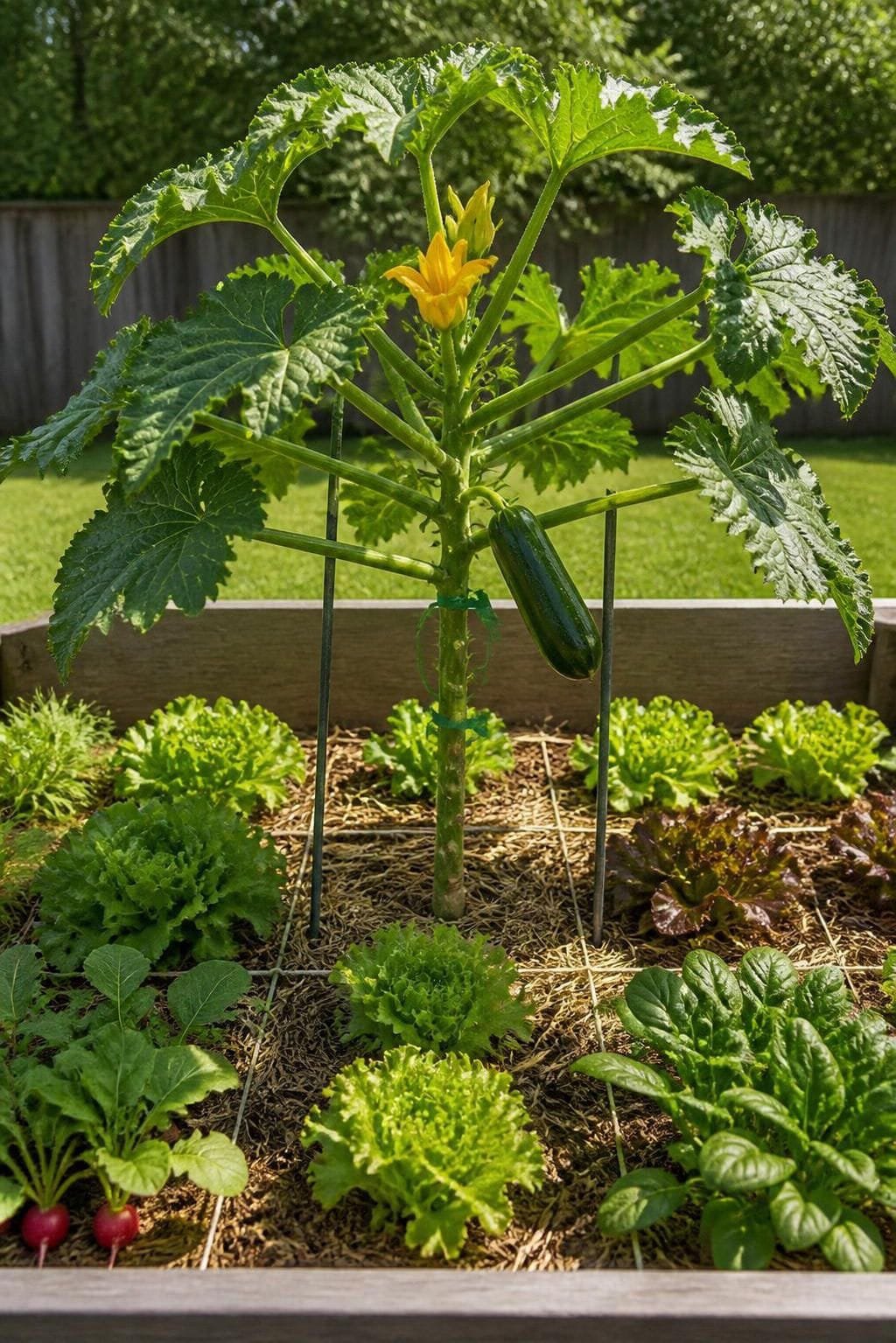
Put the support on the north side of the bed so it doesn’t shade shorter crops (the south side in the Southern Hemisphere). The Phipps Conservatory planning guide gives the same advice for any trellis in a grid bed.
Set the stake or cage at sowing or transplanting. If your bed has a solid bottom, a cage is easier than a driven stake, which needs some depth to hold. Garden Betty points out that a stake set early won’t damage roots later. She also notes you can strip the lowest leaves off a staked plant to keep the stem clean. Pruning is the part people oversell. She cites one HortScience study where two light prunings raised yield. An older HortScience trial from 1996 found that removing half the leaves after the first or second harvest made no difference to third-harvest yield. Both are small studies, so take them as a hint, not a rule. Light pruning seems to do no harm, and the dependable payoffs are airflow and easier picking. She keeps at least ten leaves on each plant and never removes more than a third at once.
For the full stem-training routine, see our guide to growing zucchini vertically.
Under a staked plant, shade-tolerant crops such as lettuce, spinach or radishes can use the ground that a sprawling plant would have claimed. Nasturtiums or herbs along the edges are often suggested for pest control, though that benefit is a maybe. The shade, at least, is real.
Zucchini problems in raised beds: wilting, no fruit and mildew
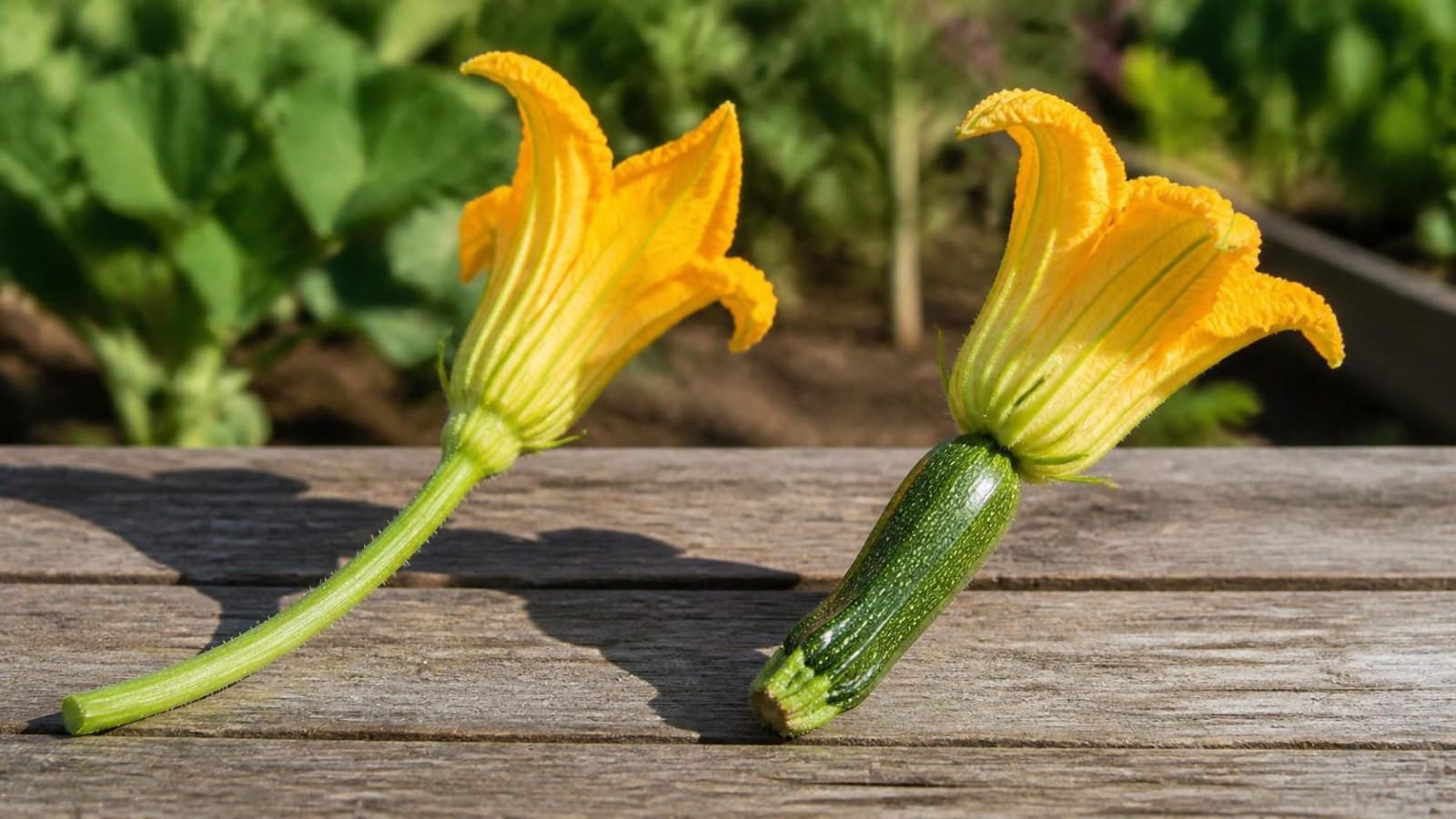
Start at the flowers, because that is where gardeners most often misread a healthy plant. Male flowers sit on thin stalks and open first. Female flowers have a small swelling right behind the petals, which is the future fruit. Everything else in the table below starts at the stem and leaves.

University of Minnesota Extension treats the first dropped flowers as harmless, since they are male. It also notes that cold, rainy or cloudy spells can reduce pollination. If bees stay away, the Almanac suggests hand-pollinating by moving pollen from a male flower to a female one.
| What you see | Most likely cause | How to check |
|---|---|---|
| Leaves droop in the afternoon and recover by evening | Heat, with big leaves losing water | Dig two inches down. Damp soil means wait. Dry soil means water at the base. |
| Whole plant wilts quickly and stays limp, even in damp soil | Squash vine borer feeding inside the stem (or, less often, a wilt disease) | Look at the stem base for a small hole and sawdust-like waste (frass). No hole, and the plant keeps collapsing? Suspect a wilt disease and send a sample to your extension plant clinic. |
| First flowers drop and no fruit forms | Male flowers open first | Check the flower base. No swelling means it is male. |
| Female flowers open but fruit does not form | Poor pollination | Watch for bees. If few visit, move pollen by hand. |
| White powder on older leaves | Powdery mildew, helped by crowding, shade and humid, still air | Look for powdery white spots on the leaf surface, then review spacing, airflow and light. Full guide: powdery mildew on squash and cucumbers. |
| Fruit rots at the blossom end | Uneven watering, tied to calcium supply | Compare against your watering pattern before adding anything to the soil. A fruit that swells, then shrivels and rots from the tip, may simply be poorly pollinated. More detail: zucchini fruit rotting at the blossom end. |
Squash vine borer deserves a closer look because it works fast. Illinois Extension describes a clear-winged moth that lays eggs at the base of the plant. The larvae tunnel into the stem and block the movement of water, so the vine wilts and the whole plant may die. A vine that is still alive can sometimes be kept going by mounding moist soil over the stem so it roots along its length. Some gardeners also slit the stem lengthwise, remove the larva and mound soil over the wound. Prevention works better than rescue. The pupae overwinter in the soil near the old plant, so rotate the crop when you can. You can also cover young plants with floating row cover until the first flowers open, then take it off so bees can get in. Or make a second sowing in midsummer.
If you decide to spray for any pest, choose a product labeled for squash, follow the label and check what is approved where you live. Keep it off open flowers, since bees are doing the pollinating.
A word on limits. From a description alone, heat stress, dry soil, borers and some wilt diseases can look alike, and mildew can be mistaken for other leaf spots. If a plant collapses and the table doesn’t settle it, send a photo or sample to your state extension plant clinic. It’s worth the effort.
Harvesting zucchini in raised beds and quick answers
Pick at about 6 to 8 inches (some guides say as small as 4). In warm weather, check every day or two. Cut with a knife instead of twisting, and leave a short stub of stem on each fruit. Avoid harvesting while the vines are wet, which can spread disease. Oversized fruit slows the plant, and a few male flowers left on the vine keep pollination going.
How deep should a raised bed be for zucchini?
At least 12 inches of soil. A shallower bed dries out fast and limits the roots, so a large pot may suit you better.
How far apart should zucchini be planted in a raised bed?
Allow about 1½ to 2 feet between bush plants and 2 to 3 feet between vining ones. In a 4 × 4 square foot bed, one caged bush plant on four squares is a sensible default.
How often should I water zucchini in a raised bed?
Plan on about an inch a week as a baseline. In hot weather a bed may need water every two to three days. Check two inches down with a finger and water at the base.
How many zucchini plants fit in a 4 × 4 bed?
One or two is plenty. A bush plant on four squares leaves most of the bed free for other crops. A household rarely needs more, and crowding is the likelier problem.
Will zucchini cross with pumpkins or cucumbers in the same bed?
Summer squash can cross with other summer squash, acorn squash and jack-o’-lantern pumpkins, but you will not see it in this year’s fruit. It only matters if you save seed. According to Illinois Extension, it does not cross with melons or cucumbers. Butternut squash and giant pumpkins are different species, so they stay separate from zucchini as well.


One thought on “How to Grow Zucchini in Raised Beds: Bed Size, Spacing and Square-Foot Layouts”