
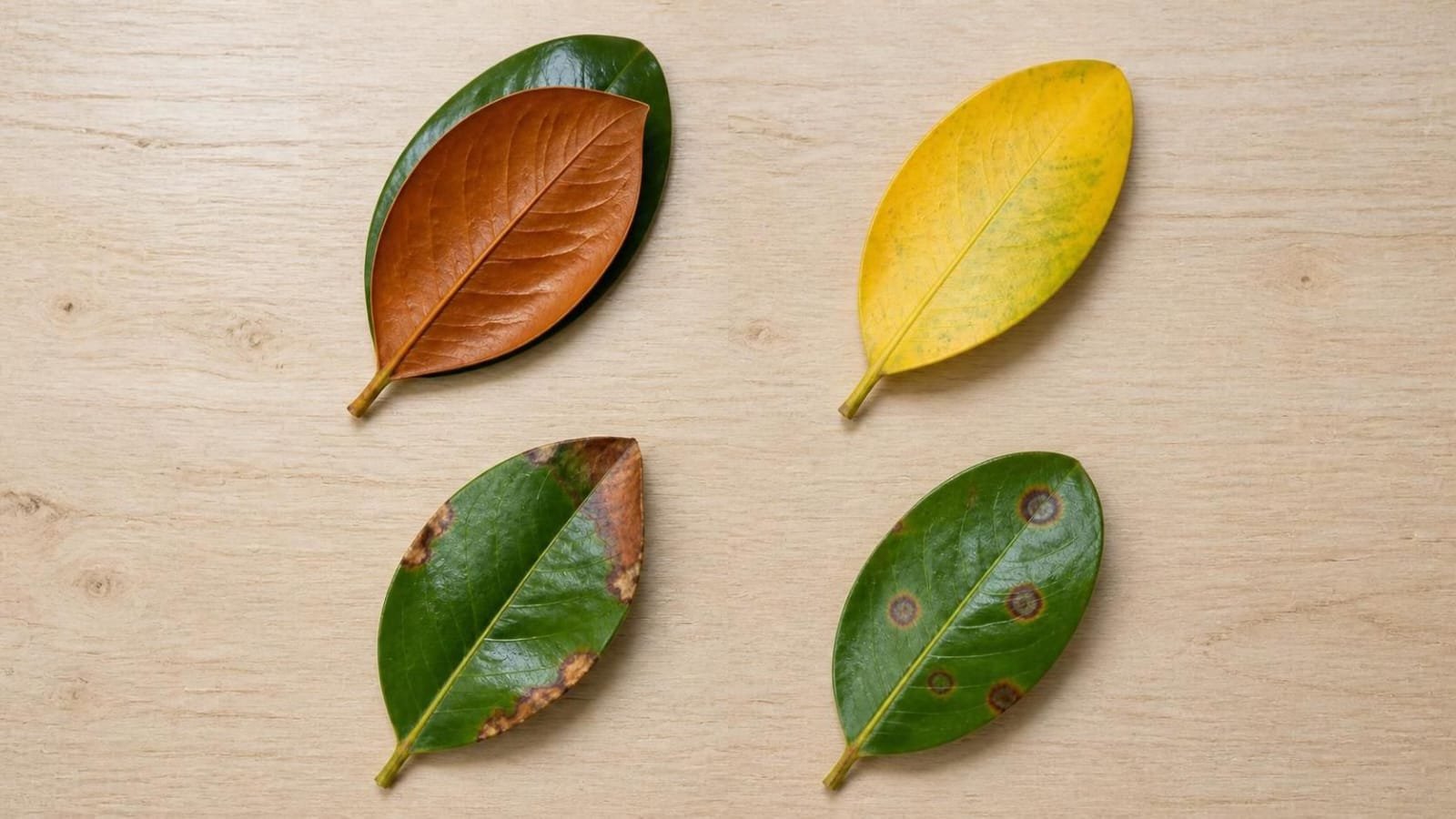
Many Little Gem magnolia problems trace back to the roots, meaning water, planting depth or soil, and a true disease is less often the culprit than people fear. Older yellow leaves dropping in spring can be normal. Yellowing across the whole tree in wet soil points to the roots. Brown edges point to scorch, wind, salt or cold. Distinct spots point to a leaf disease, and a sticky black coating points to scale insects. No flowers usually means a young tree, too much shade, extra nitrogen or buds lost to frost. Work through the clues below before you spray or fertilize anything.
If you’ve already reached for the fertilizer or the watering can, you’re not alone. Most of us do. This guide follows the order in which you would actually check the tree: which leaves are affected, where on the leaf, what the soil feels like, and what time of year it is. Where several causes look alike, the clue that separates them comes first.
First, rule out normal leaf drop
A handful of yellow leaves is not a diagnosis. Little Gem is evergreen, but evergreen only means the tree is never bare all at once. Southern magnolias shed older leaves as part of their normal cycle, and a plant health clinic newsletter from the University of Arkansas gives natural leaf shedding its own heading, alongside freeze injury, leaf spots and the more serious wilt and canker diseases.
Normal looks like this: the yellowing is limited to older leaves, usually toward the inside of the canopy, often around the time new growth pushes out. The branch tips carry healthy new leaves, and the tree still looks full from a few steps back. Not normal looks like yellow on the newest leaves, yellowing across the whole canopy at once, or bare branches. If your tree fits the first description, don’t sweat it.
Flip a leaf over before you worry about brown. According to NC State Extension, the leaves are glossy green above and bronze-brown underneath, so the brown you see on a turned or fallen leaf may simply be the tree’s normal coloring. The same page describes the tree as reliable in zones 7 through 9, warns that it can lose much of its foliage in a harsh winter, and says it handles urban pollutants poorly.
Slow growth is part of the package too. If your tree seems to be taking its time, our guide to Little Gem magnolia size and growth rate shows what to expect, which helps you tell a stalled tree from a patient one.
Quick diagnosis: match what you see to the likely cause
Use this table as a first pass. Each row is only a likely cause, and the sections after it explain how to confirm it.
| What you see | Likely cause | Clue that confirms it | First move |
|---|---|---|---|
| Older inner leaves yellow, new growth looks fine | Normal leaf shedding | Canopy stays full; tips push fresh leaves | Do nothing; keep watching |
| Whole canopy yellowing, tree newly planted or soil soggy | Waterlogged roots or planting too deep | Soil stays wet days after watering; trunk has no visible flare | Stop watering; dig and check |
| Newest leaves pale yellow, veins still green | Iron uptake problem, often high soil pH | Pattern limited to the youngest leaves | Soil test before any treatment |
| Dry brown tips and edges | Scorch from heat, drought, salt or root stress | Worse on the sunny, windy or road side | Check root zone, then water deeply |
| Big brown patches on one side after winter | Cold or wind injury | Appears after a freeze; buds still swell | Wait before pruning |
| Round or sharp-edged spots on leaf surface | Algal, fungal or bacterial leaf spot | Spots have a defined shape and border | Rake leaves; water at the soil |
| Sticky leaves, black coating, ants | Scale insects and sooty mold | Raised shell-like bumps on twigs | Inspect twigs; identify the scale |
| Flower buds brown, or no blooms at all | Young tree, shade, nitrogen or frost | Check age, sun hours and last fertilizer | See the flowering section |
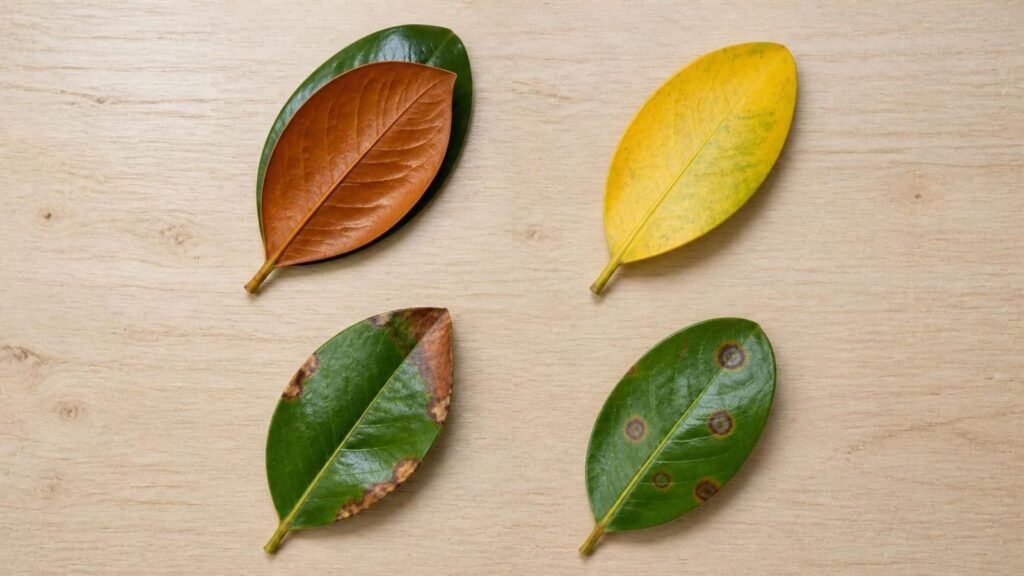
Little Gem magnolia yellow leaves: check the roots before you feed the tree
A lot of folks fertilize first and ask questions later. With a yellowing Little Gem it rarely helps, and on a stressed tree it can add to the trouble. More often the yellow is about water, planting depth or soil chemistry, so start there.
Wet roots and deep planting
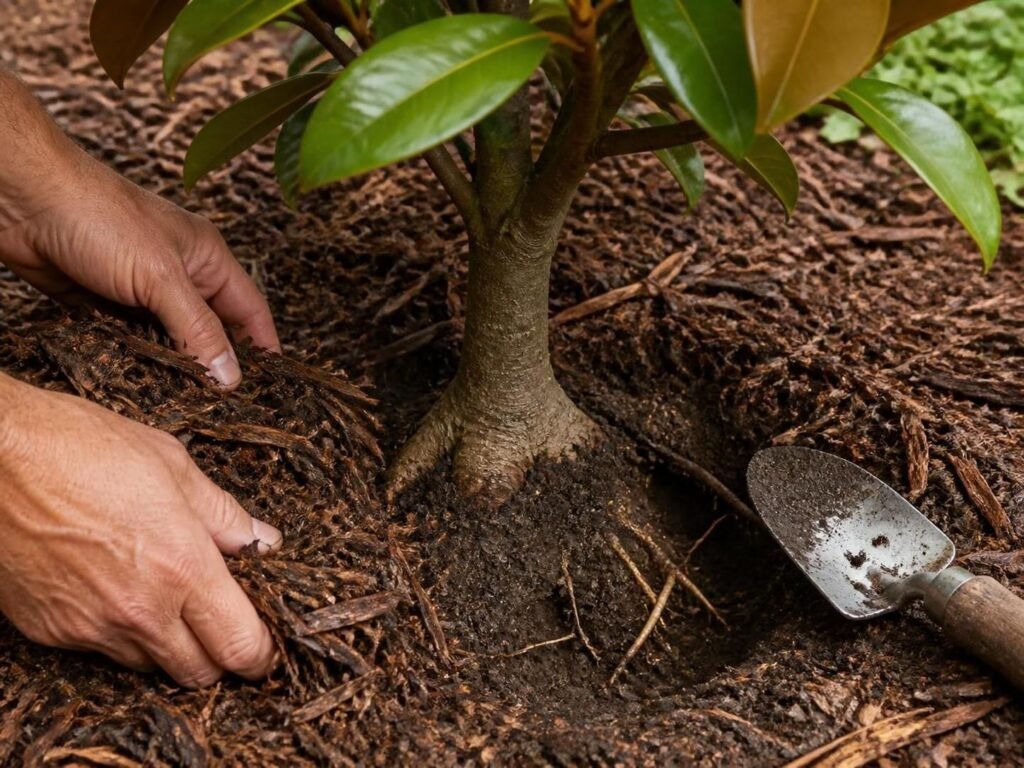
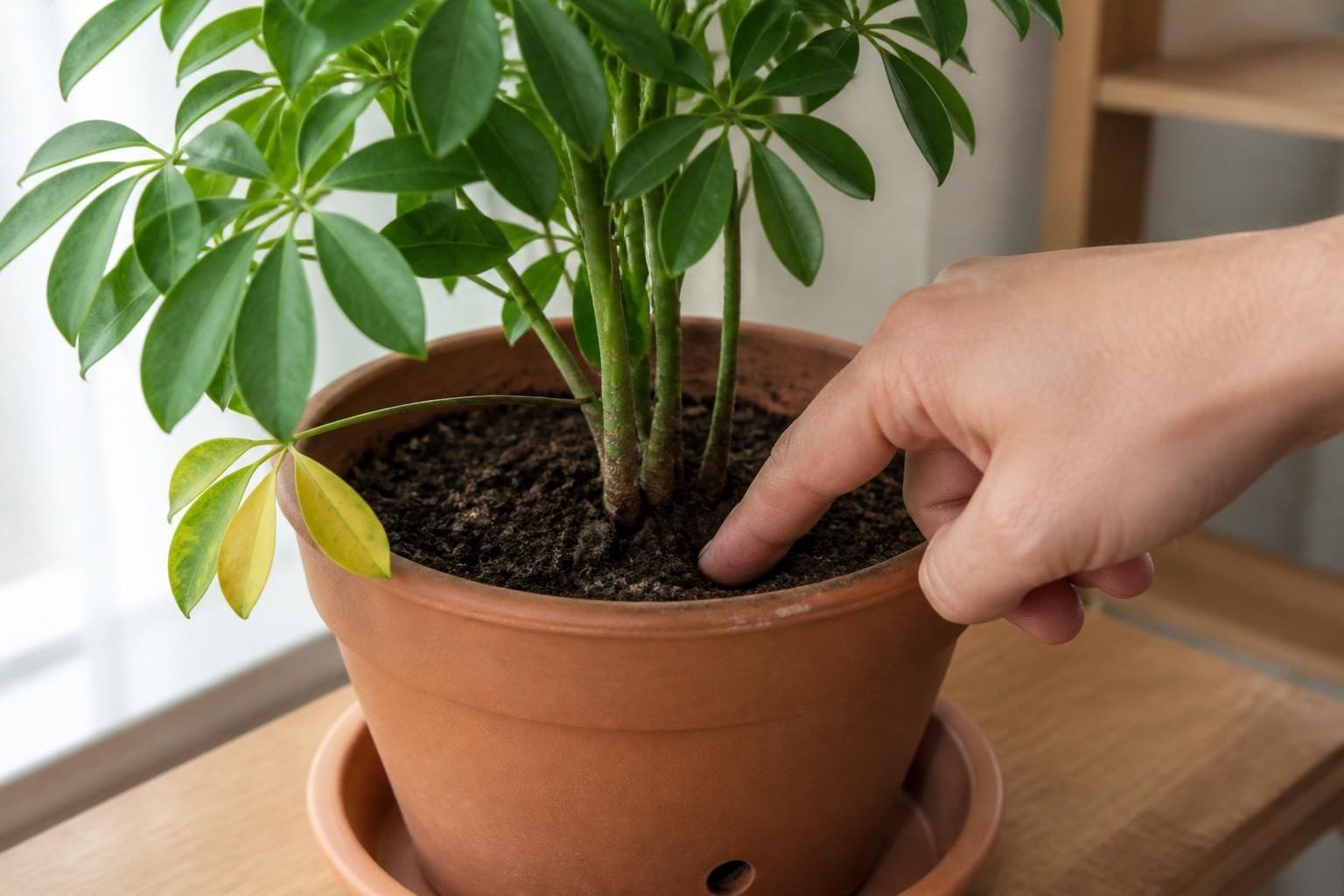
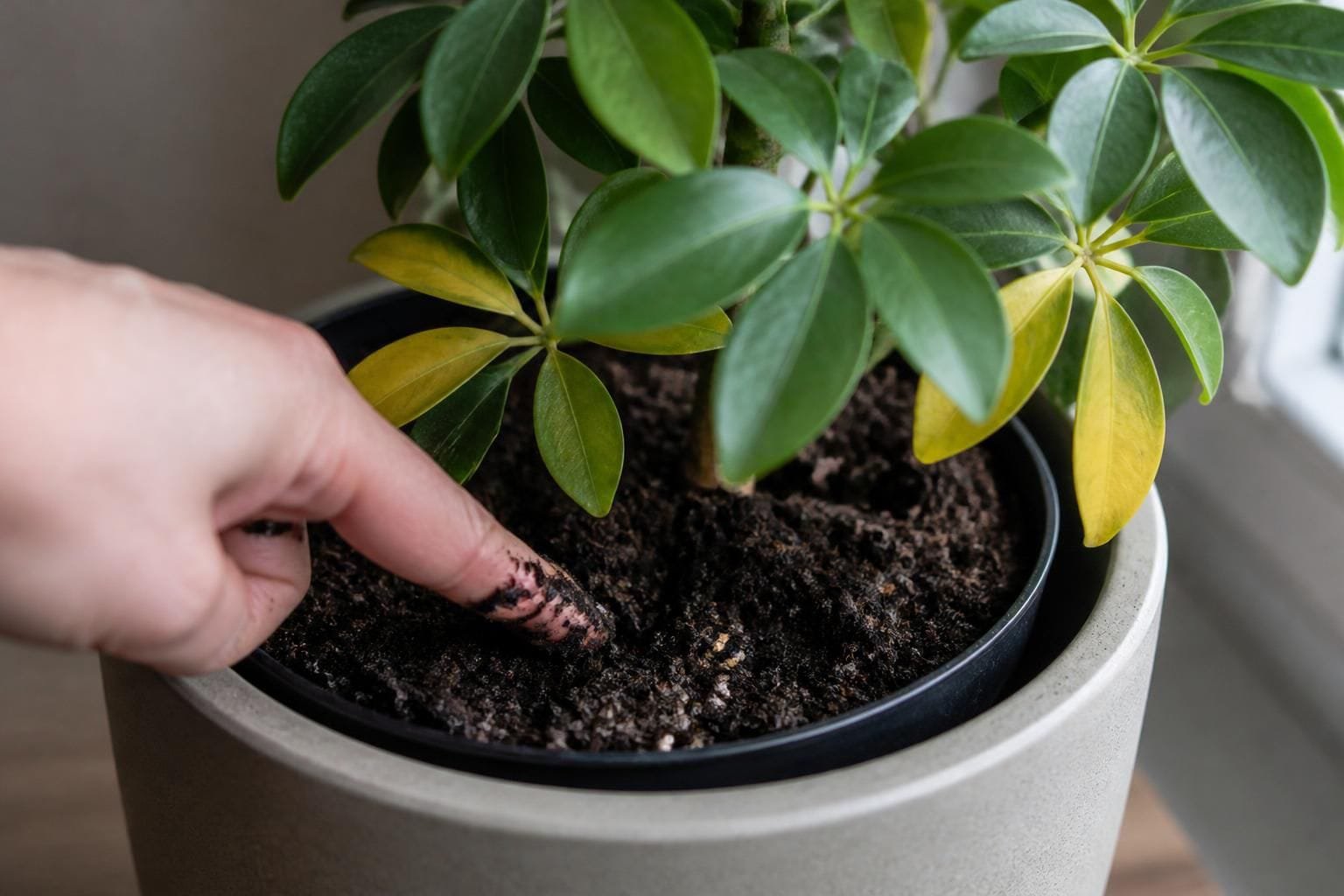
Push a trowel a few inches into the soil near the edge of the canopy a few days after you last watered. Squeeze a handful. If it clumps like wet clay and leaves water on your fingers, the roots are sitting in too much moisture, whatever the calendar says. Newly planted trees are the usual victims, because the owner waters often to help them settle in. The instinct is a kind one. It still backfires.
Next, pull the mulch back from the trunk. You should see the trunk widen into a flare at the soil line. If it disappears straight into the ground like a fence post, the tree is probably planted too deep, and the fix is lifting it, not feeding it. Our Little Gem magnolia planting and care guide covers how to set the root ball at the right height.
Here’s the kicker: a tree that is too dry and a tree that is too wet both wilt and yellow, so the leaves alone can’t settle the question. The soil and the roots can. Healthy roots are firm and pale. Dark, soft or foul-smelling roots point to rot, and Phytophthora root rot is a recognized possibility in saturated soil, but only a lab or your extension office can confirm which organism you have. Hold off on fungicide drenches until someone has.
Newest leaves yellow, veins still green
When the youngest leaves go pale while the veins stay green, the tree is often struggling to take up iron. The usual reason is soil that is too alkaline, which lime or concrete near the roots can make worse. Magnolias generally prefer slightly acidic soil. An Ask Extension reply to a gardener with a stalled Little Gem suggested starting with a soil test for pH and nutrients, and that advice holds here: test first, then decide whether you are correcting pH, adding a nutrient, or doing neither.
Older leaves can also yellow when a nutrient runs short, and that pattern overlaps with normal shedding. This is one of the places where guessing from a description fails. A soil test costs less than a wrong treatment.
Little Gem magnolia leaves turning brown: read the pattern first
Brown makes people reach for a sprayer, and fair enough, it looks alarming. On a Little Gem, though, a lot of browning is physical injury rather than infection, so the shape and location of the damage tell you more than the shade of brown.
- Dry, papery tips and edges, worse on the sunny or windy side. This is scorch: the leaves lose water faster than the roots can replace it. It shows up after hot spells, on young trees, in dry or compacted root zones, and where salt reaches the soil from roads, de-icing or a pool. Check the soil first, then water deeply and slowly.
- Large brown patches across one side after winter. Cold or wind burn. The tree is usually alive. Please don’t judge it in the first week of spring; wait until new growth shows which wood is alive before you prune anything.
- Round spots, or irregular patches with a sharp edge. These are leaf diseases rather than scorch, covered in the next section.
- Brown on the underside of otherwise green leaves. Normal for this tree.
Little Gem magnolia diseases: leaf spots that are mostly cosmetic
Three different problems get called “leaf spot” on southern magnolia, and they call for slightly different handling.
Algal leaf spot
Mississippi State University Extension describes it as a round, fuzzy green colony that turns reddish brown with age, often looking gray once a fungus moves in (the fungus is not parasitic itself). The cause is a parasitic alga, spread by rain splash and wind. It is worst on weak, open-grown trees in full sun with long periods of wet leaves. The advice is to keep the tree vigorous, rake up and dispose of fallen leaves, and use a copper fungicide where treatment is needed. Follow the product label and check local rules, since approved products differ by region.
Anthracnose
University of Florida IFAS Extension describes anthracnose on southern magnolia as large, irregular, brownish-gray dead patches with a clear border that flake and fall away. It tends to follow cool, wet springs, the spores overwinter on branches and leaf litter, and it is rarely a serious threat to the tree’s long-term health. The practical takeaway is simple: keep irrigation off the leaves.
Bacterial leaf spot
The most dramatic version is bacterial. In a 1984 study from Auburn University and the Alabama Agricultural Experiment Station, a bacterium called Pseudomonas cichorii caused dark brown lesions on newly unfolded southern magnolia leaves, in some cases covering as much as two-thirds of the leaf, while older foliage fared better. Disease was milder where plants were watered at ground level instead of overhead, and copper sprays during active shoot growth suppressed it in that trial.
Read that as a pattern, not a prescription. The new spring flush is the vulnerable stage, wet foliage helps the disease along, and watering at the base is a cheap habit worth keeping. The study covered southern magnolia in general, so it tells you what to look for on a Little Gem rather than promising a particular result. Honestly, a lot of what shows up in a wet spring is cosmetic, and the tree shrugs it off.
Telling these three apart by eye is harder than the descriptions suggest, and they can overlap. If spots are spreading fast, or you are about to spray anything, a photo and a leaf sample sent to your local extension office is worth the effort. Meanwhile, rake up fallen leaves and water at the soil line.
Little Gem magnolia pests: sticky leaves, a black coating, bumps on twigs
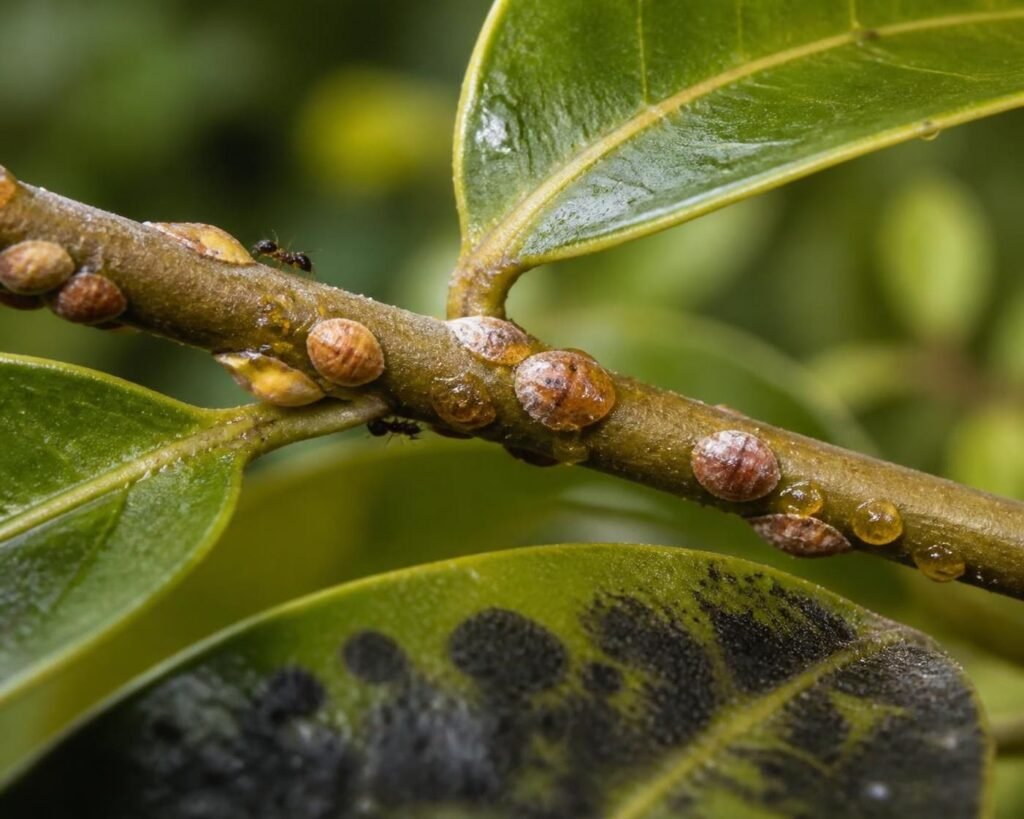
Wiping the black off with soapy water is the first move most people make, and it gives only temporary relief. That coating is sooty mold, which grows on the sugary honeydew that sap-feeding insects excrete. Deal with the insect and the mold gradually weathers away on its own. Long story short, treat the bug, not the black.
University of Georgia Extension notes that honeydew leaves surfaces sticky and that the mold layer reduces photosynthesis by blocking light. A University of Vermont Extension write-up adds that the mold does little other harm, but heavy scale populations can cause yellowing, twig dieback and general decline, and that too much nitrogen can encourage scale to build up. That is one more reason not to fertilize a struggling tree.
To confirm scale, look along one- and two-year-old twigs for raised, shell-like bumps. Penn State Extension describes mature female magnolia scale as about half an inch across, pinkish-orange to brown with a white waxy coating, overwintering as nymphs on twigs, with ants and wasps drawn to the honeydew. Ugly, yes. But look at the twigs before you panic. Magnolia scale tends to favor other magnolias, and NC State calls scale only an occasional pest on Little Gem. A related insect, tuliptree scale, is a different matter: the University of California has documented it heavily infesting southern magnolias, the species Little Gem comes from, in southern California. Which scale you have affects when treatment works, so get it identified before you buy anything.
On a small tree, a Nebraska Extension educator suggests rubbing scale off the twigs by hand with gloves, which also clears honeydew. Oils and insecticides are timed to the insect’s life stage, so follow the label and check local rules. Lady beetles that feed on scale give some natural control, according to Penn State, which is a good reason not to spray without a confirmed need.
Small, irregular holes in new spring leaves are a different story. The yellow poplar weevil, a beetle that also feeds on magnolias, chews them, and on a healthy tree the damage is usually cosmetic.
Why is my Little Gem magnolia dying? Start with a scratch test
The first moves here are usually to water more or to pull the tree out. Do neither yet. A Little Gem that has dropped its leaves is not necessarily dead, and finding out takes about thirty seconds.
The scratch test
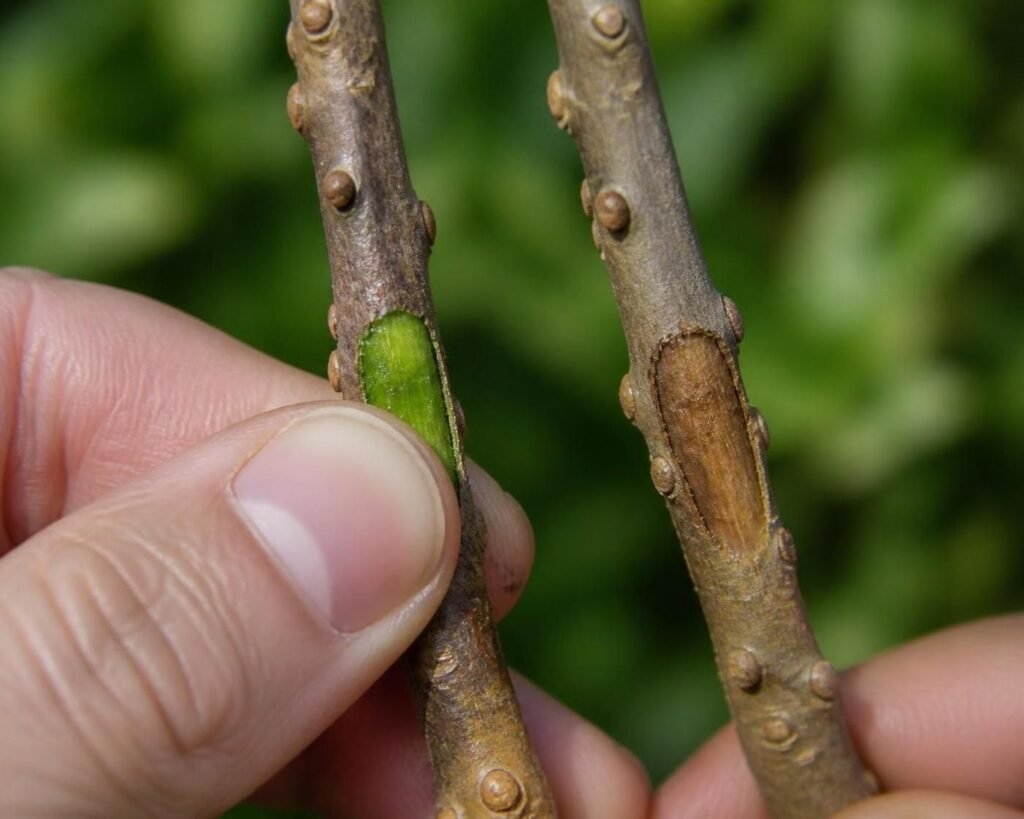
Use a thumbnail or a clean knife to scratch the bark of a small twig. Green, moist tissue underneath means that part is alive. Brown and dry means it is dead at that point. Move back along the branch toward the trunk and scratch again until you hit green. Do this on several branches, then on the trunk near the soil. Live green tissue at the base of the trunk is the best sign you can get. Go and do it now, then come back.
Then work out why
A newly planted tree that drops leaves in its first season is often showing transplant shock while the roots settle in. Judge it after a full growing season, not after a bad week, and keep the soil moist but never soggy.
A tree that was fine for years and then declines points somewhere else. Look for anything that changed around the roots: new paving or fill soil, heavy equipment, a change in irrigation, salt from a road or pool. One Burke’s Backyard expert answer to an Australian gardener who had lost several Little Gems around a pool said these trees are very hardy, doubted disease was the cause, and pointed to soil, water or salt wind instead. The recommendation was a site visit from a horticulturist who would dig holes and poke around. That is good advice for a reason: diagnosing a dying tree from a description is genuinely unreliable.
Branches that die back one at a time, without spots or sticky residue, deserve a sample sent to your extension office. The Arkansas clinic mentioned earlier lists wilt and canker diseases among the problems it sees on southern magnolia, and those are hard to tell from drought or root trouble without a closer look.
What not to do
- Don’t fertilize a stressed tree to feed it back to health. Extra nitrogen pushes soft, leafy growth and can help scale multiply.
- Don’t water on a fixed schedule. Check the soil first, every time.
- Don’t spray a fungicide or insecticide without knowing what you are treating.
- Don’t prune hard to “reset” the tree. Wait for new growth to show where the wood is alive.
- Don’t give up in the first few weeks. Look again after a full growing season.
Little Gem magnolia not flowering
The first thought is to fertilize for blooms, and it tends to backfire. The University of Washington Botanic Gardens plant answer service, drawing on a magnolia care manual, notes that a magnolia mulched once or twice a year may not need extra fertilizer, and that plenty of nitrogen pushes leaves at the expense of flowers. Check these in order:
- Age. A newly planted magnolia can be slow to flower, so give a young tree time.
- Light. Heavy shade gives weak flowering at best. Look at what has grown up around the tree since planting.
- Nitrogen. Lawn fertilizer that reaches the root zone can be a hidden source.
- Buds that brown and die before opening. Cold and wind during bud development are the usual suspects, according to the same Washington source.
- Pruning time. Cuts made at the wrong time remove next year’s flower buds. If you prune, do it right after flowering, as the Ask Extension reply recommends.
- Root competition and compaction. The same reply points out that nearby plants and packed soil over the roots can hold a tree back.
Preventing the next round of problems
Most of what goes wrong with a Little Gem is set up at planting. Set the root flare at or just above the soil line, keep mulch off the trunk, water by checking the soil instead of the calendar, water at the base rather than over the leaves, and rake up fallen leaves in wet seasons. Our planting, care and maintenance guide goes through site choice, soil and watering step by step. In late summer, spend a few minutes looking along the twigs for scale.
If you’ve lost the tree, or you’re still choosing between varieties, compare the two in our Little Gem vs. Teddy Bear magnolia guide before you replant, so the next tree fits the spot.
If the root, twig and leaf checks still leave you unsure, take close photos of both sides of the leaves and a fresh twig sample to your local extension office. Someone who can dig around the tree will see things no description can.
One thought on “Little Gem Magnolia Problems: Causes and Fixes”