
Yellow Lettuce Leaves: Causes and How to Fix Them
Pick the yellowest plant in the bed and squeeze a handful of soil from around its roots. If it drips, or stays cold and slick in your fist a day after you last watered, you may already have your answer, and it isn’t a fertilizer problem. If it crumbles dry and warm, the cause is somewhere else, and a few minutes of looking will find it.
Why are my lettuce leaves turning yellow? Usually because the roots are too wet, because nitrogen is running low as the head fills, or because the oldest leaves are ageing out. Yellow that starts in the center, comes in angular patches, or arrives with wilting or a rotten base points to soil pH or disease instead.
Yellow lettuce leaves are chlorosis, a loss of chlorophyll, and lettuce leaf chlorosis can have more than a dozen causes. The trick is to check them in the order that rules out the most the fastest. Work through the steps below, then jump to the scene that matches what you see. These are starting points. Several of these problems look alike, and when the signs are mixed, a soil test or your local Extension office settles it.
Three minutes in the bed, in this order
- Squeeze the soil, as above. Cold and soggy sends you to the section on soft leaves after rain. Dry soil that pulls away from the roots is plain thirst, so water deeply and steadily, give it a week, and skip the other steps until you’ve ruled that out.
- Note which leaves yellowed first. Oldest outer leaves with a green center point to the section on pale bottom leaves. Young center leaves point to the sections on green veins or a pale, stubby heart.
- Turn a yellow leaf over. Angular patch, white fuzz underneath: go to the downy mildew section.
- If the plant droops, lift it and slice the crown. Brown streaks or a water-soaked, cottony base send you to the section on the plant that droops at noon.
- If water, feed, and pH are all sorted and nothing changed, jump to the last problem section, on yellow that won’t quit.
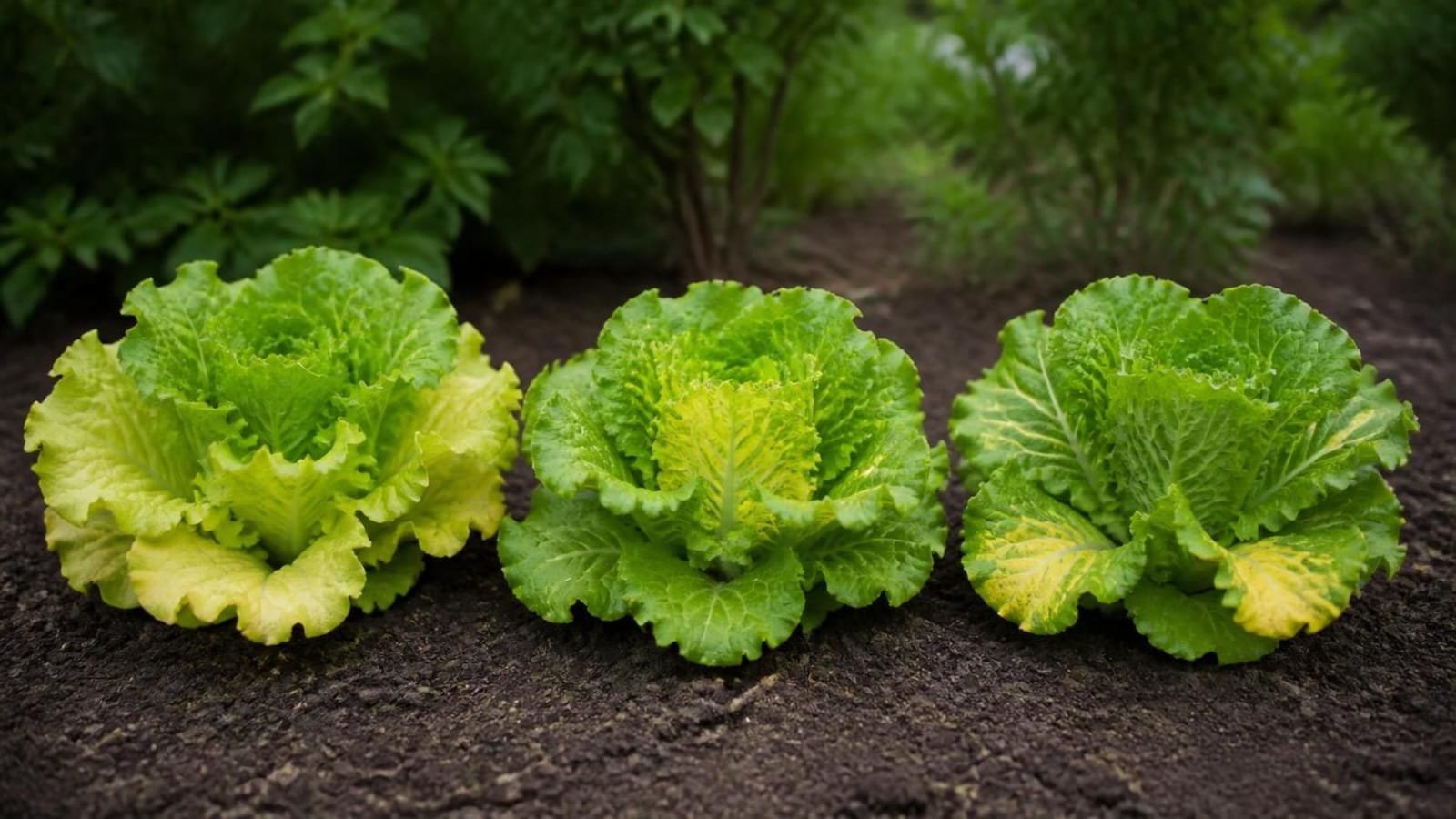
The outer leaves went soft and yellow after a week of rain
A common situation: the bed looks fine through a cool stretch, then a few wet days later the outer leaves turn limp and yellow. The rain filled the soil, not your hose. Lettuce roots are shallow and like steady moisture, which is exactly why saturated soil hurts them, and the same thing happens in containers with poor drainage.
Ease one plant out and look. Healthy roots are pale and firm. Brown, soft roots with a sour smell tell you the plant has been sitting in water. The instinct is to feed a plant that looks hungry, but hold off. Roots that are struggling in wet soil can’t use fertilizer well, and you add stress on top of the problem. Let the top inch or two dry before the next drink, and fix what caused it: drain holes, a lighter potting mix, or a raised bed.
The bottom leaves are pale and the whole plant has slowed down
With clean roots and soil that is only moderately moist, nitrogen is next. Nitrogen moves around inside the plant, so when supply drops, the plant strips it from older leaves to feed new growth. That is why the pale yellow shows up on the oldest leaves while the center stays green. The UC Davis nitrogen guidelines for lettuce describe exactly this pattern. Here’s the catch: they also note that lettuce takes up roughly 70 percent of its total nitrogen between heading and harvest, so a plant that looked fine as a seedling can run short just as the head fills.
A liquid nitrogen feed or a side-dressing of nitrogen fertilizer will work, but follow the label for rates, since products and local rules differ. Give it a week or two. New growth should come in greener. The leaves that have already yellowed will not. Don’t keep adding more when they stay yellow, because overfeeding is its own problem.
If only the bottom one or two leaves have yellowed and the center is green and growing, there may be nothing to fix. Outer leaves are the oldest and drop out first as the head develops. Pull them off cleanly. If the center is stretching upward into a stem, you are looking at lettuce bolting, which has different causes and fixes.
Pale leaves sometimes arrive alongside slow growth, wilting, or a bitter taste, and it is easy to chase the wrong one. The overview of common lettuce growing problems helps you sort which complaint is the real one before you treat anything.
The plant droops at noon and the crown is brown inside
When a yellow plant starts to droop, the reflex is to water it. If the soil is already wet, that makes things worse, so lift one plant first. Sacrifice it to learn what is happening to the rest. Look at the roots, smell the root ball, check where the stem meets the soil, then slice the crown and upper root lengthwise.
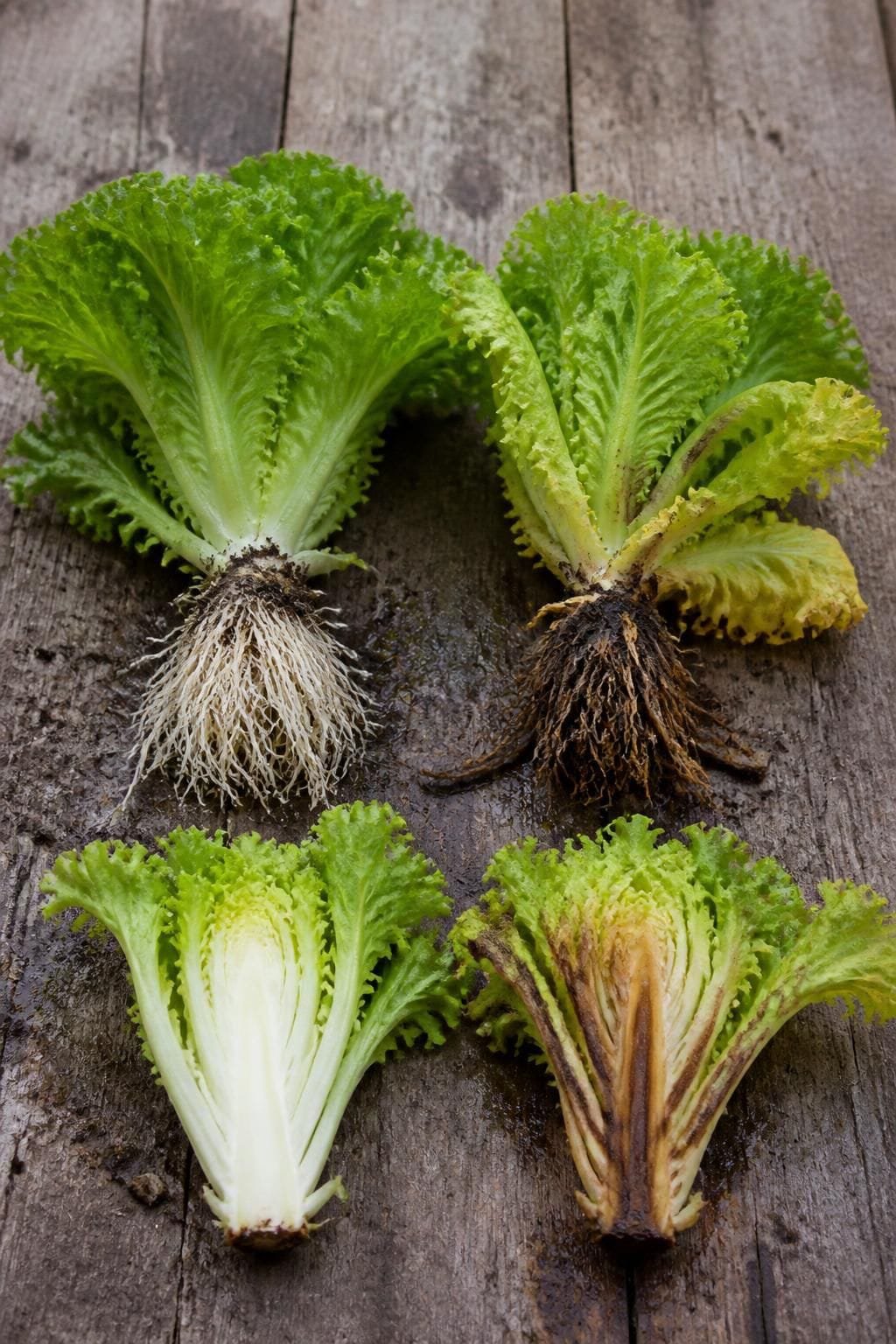
Brown or reddish streaks inside the crown change the diagnosis. Fusarium wilt of lettuce turns leaves yellow, often with tip burn, and stunts plants that may never form a head. According to UC IPM, the vascular tissue in the leaves turns brown to black, and the crown and upper root develop a reddish-brown discoloration. The pathogen causes disease only in lettuce, though it can live on the roots of other plants, and it can persist in the soil for a very long time. Warm soil favors it. If you see this, treat the bed as infested: grow lettuce somewhere else and don’t move soil out of it. The same discoloration can come from ammonium toxicity or Verticillium wilt, so a lab test through your local Extension office is worth the trouble before you rebuild a bed.
A water-soaked tan base with white cottony growth and small, hard black bodies in it is a different disease, white mold, also called lettuce drop. University of Minnesota Extension describes the outer leaves wilting and dropping while the rot advances toward the heart. Pull the whole plant, give the rest more air, and improve drainage, because the fungus thrives where the soil surface stays wet. If the plant is limp but not yet yellow, the guide to why lettuce wilts covers that side of the problem.
Yellow blotches with straight edges and fuzz underneath
Yellow that spreads evenly across a leaf is one thing. Yellow that comes in blotches with straight edges, as if the veins were holding it back, points to downy mildew. The Royal Horticultural Society describes angular patches on the upper surface, limited by the veins, with white fuzzy growth beneath, and patches that turn brown as the tissue dies. Older leaves usually go first, and the disease favors cool, wet weather with long spells of wet leaves.
If the underside looks clean, don’t rule it out yet. A Cornell plant pathology blog describes a simple test: lay the leaf upside down on a wet paper towel inside a sealed bag overnight. That encourages the spores to form, so yellow spots that carry fuzz the next morning are downy mildew.
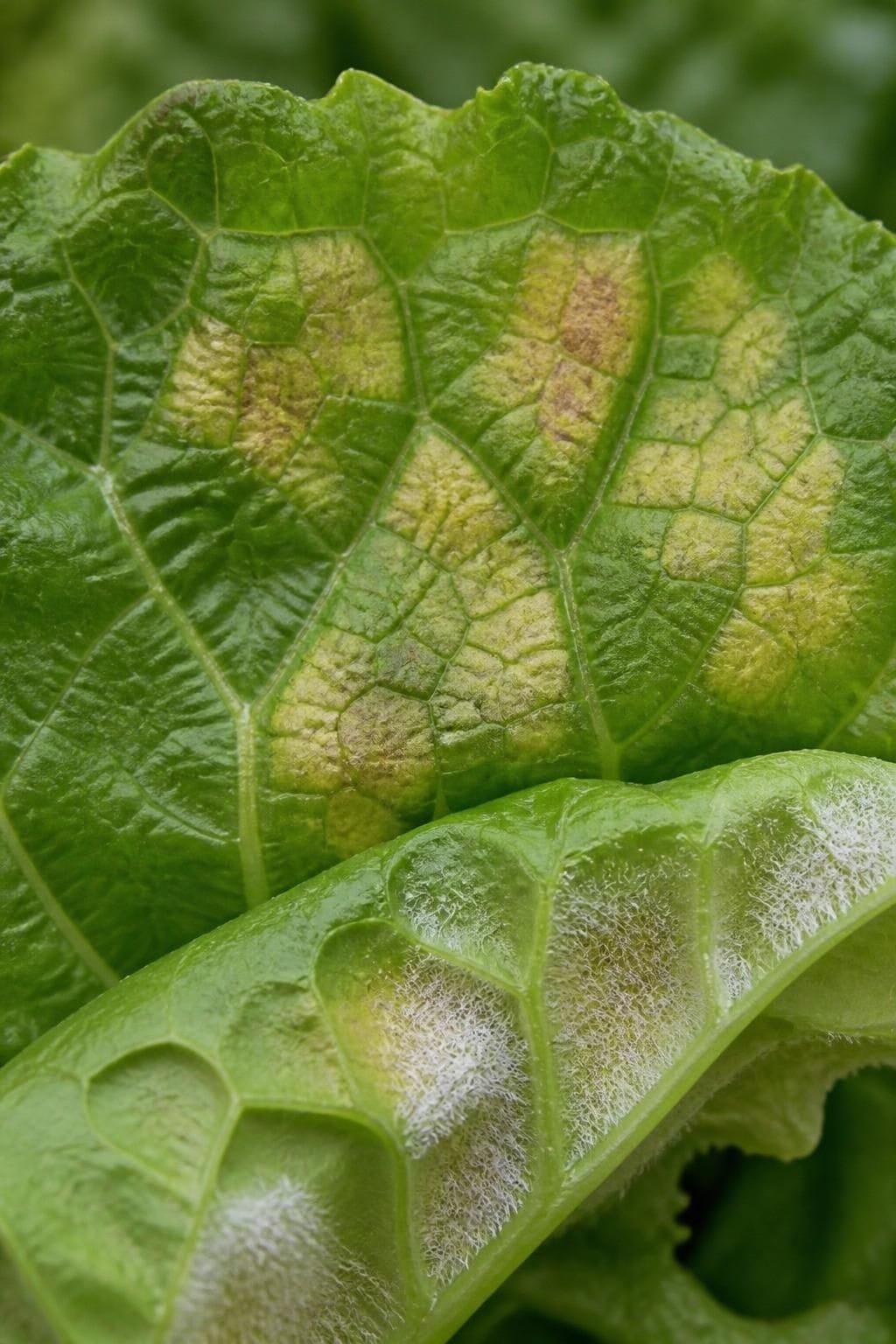
There is no quick fix, and a late-night overhead watering will only make things worse. The RHS notes that no fungicides are available to home gardeners in the UK for downy mildews, and what is approved elsewhere varies by country, so read the label and check local rules before spraying anything. What works everywhere is cutting down leaf wetness: water at the soil in the morning, space plants for airflow, clear old debris, and rotate beds. Choose varieties sold as resistant, but remember that new races keep emerging, so resistance is no guarantee. Take off badly affected leaves and watch the new growth in the center.
The new leaves are yellow but the veins stay green
Adding nitrogen is the usual mistake here, and an understandable one, since yellow seems to mean feed. But a nitrogen shortage shows on the older leaves first, so yellow new growth is telling you something else. Leaves that turn yellow between green veins suggest a micronutrient problem. Ontario’s agriculture ministry, OMAFRA, lists lettuce among the crops that show yellowing from manganese deficiency, notes that manganese is most available in slightly acidic soil, and says foliar applications tend to work better on high-pH soils. Iron behaves in a similar way: high pH is a commonly cited reason it becomes unavailable even when the soil holds plenty.
Lettuce generally does best between pH 6.0 and 7.0, according to Cornell Cooperative Extension. A cheap pH test comes before any purchase. If the reading is well above that range, more fertilizer will not help. A chelated iron or manganese product used as the label directs can green up new growth while you correct the soil more slowly. Which of the two is short is hard to tell by eye, so a lab soil test is the cleaner answer if the yellowing keeps coming back.
The heart of the head is pale, stubby, and slow to open
If the pH is fine and the youngest leaves in the center look like that, pull the plant and check the underside of the midrib. Washington State University Extension describes pinkish or tan latex deposits there as characteristic of aster yellows, a disease spread by leafhoppers. Young plants may also show yellow outer leaves and stunting, while older plants may show only the inner symptoms and the latex.
There is no cure. The University of Wisconsin-Madison advises removing infected plants as the only remedy. Weeds around the bed often shelter the disease, so keep them down. WSU also notes that leafhoppers tend to avoid shaded plants, so a little shade may lower the risk.
Yellow that won’t quit, whatever you change
Some lettuce yellowing ignores every adjustment of water and feed, and aphid-spread viruses are the usual explanation. Beet western yellows virus, described in the Oregon State University plant disease handbook, turns the oldest leaves yellow prematurely, starting at the margins and moving inward while the veins stay green. Its main carrier is the green peach aphid, and it infects many crops and common weeds, which is why the source is so hard to avoid. Because it can pass for a nutrient deficiency, people often chase fertilizer fixes for weeks. Lettuce mosaic virus looks different: mottled yellow and green patches, curled or misshapen leaves, and stunting.
Neither responds to treatment. Remove the plants, keep aphids and weeds in check around later plantings, and send a sample to Extension if you want a firm diagnosis, since viruses are easy to mistake for one another.
The cause is fixed, but the yellow leaves are still there
They won’t turn green again. A leaf that has lost its chlorophyll rarely recovers, so judge the plant by its new growth, and if the center comes in green, the fix worked. Snip fully yellow leaves at the base with clean scissors so they don’t rot against the stem. Leaves yellowed by age or a mild shortage are tougher and blander, so trim them before eating. Anything slimy, moldy, or rotting at the base goes in the bin, and so does any plant you suspect of carrying a virus or aster yellows.
One thought on “Yellow Lettuce Leaves: Causes and How to Fix Them”